
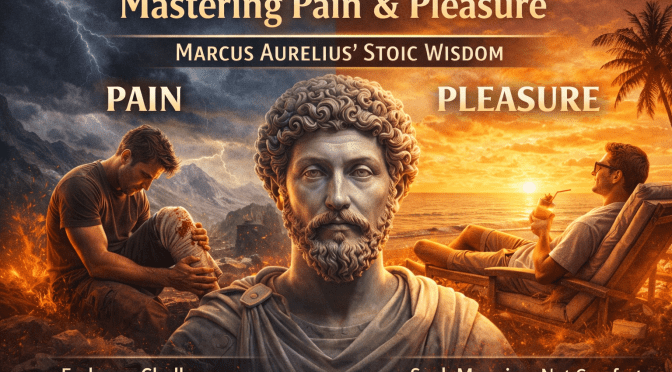
Pain and pleasure — two of the most powerful forces that shape human behavior, motivation, and experience. From the moment we wake up to the moment we fall asleep, these twin sensations play out in subtle and unmistakable ways: we instinctively move toward pleasure and recoil from pain. Yet what if the very things we chase or avoid most are exactly the elements that can either strengthen us or mislead us?
That’s what I’ve been wrestling with — not just intellectually, but in the trenches of daily life. Pain and pleasure aren’t abstract concepts for me. They show up in how I react to criticism, how I pursue goals, and even in how I try to find meaning. In Meditations, Marcus Aurelius doesn’t just recognize these feelings — he challenges us to look beneath them and rethink our instinctive responses. And that challenge, I’ve discovered, is where real personal growth begins.
In Season 5, Episode 8 of my podcast “Meditations: Pain v Pleasure,” we explored not just the philosophical distinctions, but how these emotional poles can be harnessed — or sabotaged — by the way we think and choose to respond. This blog is built on that conversation: a reflection on what pain and pleasure truly are, how they influence our lives, and most importantly, how we can master them for deeper resilience, clarity, and purpose.
What Marcus Taught Me About Pain and Pleasure
One of the most striking lines from Meditations captures the Stoic perspective on this duality:
“The soul does violence to itself when it is overpowered by pleasure or by pain.”
That phrase — overpowered by pleasure or pain — became a turning point for me. What Marcus is warning against isn’t experiencing these sensations; rather, it’s allowing them to take control of our choices, our judgments, and our peace of mind.
To be “overpowered” suggests a loss of agency — as though something external is steering us. But according to Stoic thought, that control is an illusion. Marcus and the Stoics believed that pain and pleasure themselves aren’t inherently destructive — it’s our attachment to them, and the way we let them govern us, that undermines our freedom and wisdom.
This insight was revolutionary for me because, like most people, I’ve spent much of my life reacting impulsively: wanting pleasure when it feels good, avoiding discomfort at all cost, and defining success or happiness through that lens. Yet as I began to explore Stoic philosophy more deeply — and to sit with pain instead of pushing it away — I realized something critical: pain and pleasure are not the ends; they are mirrors — reflections of how we assign meaning to experience and emotion.
The Illusion of Pleasure and the Fear of Pain
Human nature has a funny way of convincing us:
- Pleasure is desirable and should be maximized.
- Pain is evil and must be avoided at all costs.
This instinct isn’t unique to any era — ancient philosophers noted it just as acutely as psychologists today. Pleasure feels good; pain feels bad. Our biology drives us in these directions. But Marcus dissented from the simplistic idea that pleasure is good and pain is bad. In fact, he described the pursuit of pleasure as something that can entangle us in patterns of impulsivity, distraction, and even self‑degradation when taken to extremes.
From Marcus’ viewpoint — and from Stoicism in general — pleasure is not the ultimate good, and pain is not the ultimate evil. They are simply experiences — neutral sensations that are given meaning by our values, judgments, and interpretation.
This reframing shifted something in how I perceive my own desires: I realized that pursuing pleasure for pleasure’s sake often leads to dissatisfaction or attachment — whether that’s comfort, achievement, or validation. And ironically, it’s the fear of pain that most often prevents us from growing into deeper purpose. In essence: pleasure without meaning often disappoints, and pain without reflection often constrains us.
Pain Isn’t the Enemy — Misinterpretation Is
One of the most illuminating reflections from Marcus — and the one I return to again and again — is this idea:
“If you are distressed by anything external, the pain is not due to the thing itself, but to your estimate of it; and this you have the power to revoke at any moment.”
This truth has been transformative for me. It doesn’t mean that physical pain isn’t real — it’s clear when something hurts — but what Marcus emphasizes is the suffering that occurs when we assign extra stories, meanings, or threats to the pain. In many cases, it’s our interpretation of the pain that prolongs and magnifies it.
For example, rejection — whether personal or professional — often feels like a deep wound, not because the event itself is inherently catastrophic, but because we interpret it as a blow to our worth or identity. We add layers of self‑judgment and fear that can make the pain last far longer than the event itself. And often, we do this without even realizing we’re doing it.
What Marcus invites us to do — and what I try to practice daily — is this: acknowledge the sensation, notice the story you’re telling yourself about it, and then detach your interpretation from the raw experience. The pain becomes something to be observed, not something that controls you. That’s Stoic empowerment — not numbness, but proportion.
Pleasure in the Stoic Framework: A Balanced Joy
In contrast to how modern culture often presents pleasure — as an end in itself — Stoicism sees it differently. Pleasure is not rejected, but it is understood to be secondary to virtue and rational choice. Pleasure in moderation and in the context of a life aligned with values can be wholesome. Unchecked or impulsive pleasure, however, can lead us away from purpose and into overindulgence.
Growing up, I pursued pleasures that felt good — recognition, comfort, affection, success. And while these experiences brought temporary satisfaction, I found that they always left a restlessness beneath the surface. What Marcus shows is that true contentment is found in alignment — where our desires harmonize with reason and purpose, not where they dominate our choices. In Stoic thought, when pleasure arises, it should be acknowledged without grasping or obsession; and when pain arises, it should be acknowledged without fear or avoidance.
In this way, the Stoic ideal isn’t to eradicate pleasure, nor to embrace pain gratuitously, but to be unmoved by extremes — to be centered in rational values, not in emotional impulses. That doesn’t lessen joy — it refines it.
The Power of Choice: Redefining Our Relationship with Sensation
At the heart of Stoic practice is the notion that we have control over our judgments and reactions, even if we don’t have control over external events themselves. Marcus said it eloquently: “You have power over your mind — not outside events. Realize this, and you will find strength.”
This realization gave me a sense of ownership over my experience of pain and pleasure. It taught me that the difference between suffering and resilience isn’t the absence of pain; rather, it’s whether or not I allow the pain to dominate my narrative. Pain becomes a teacher, not a tyrant.
And pleasure? Pleasure becomes a companion, not a craving. It becomes a joyful moment to enjoy, without entanglement or fear of loss. In practice, this looks like grounding myself in gratitude rather than indulgence — savoring life’s sweetness without clinging to it as a requirement for happiness.
In essence:
- Pain becomes something to face, not fear.
- Pleasure becomes something to appreciate, not chase.
- Meaning becomes something to choose, not assume.
That’s life lived with emotional mastery — not emotional suppression.
Lessons I’ve Applied (and You Can Too)
Through years of practice — and stumbling — I’ve come to appreciate a few Stoic strategies that help me navigate pain and pleasure more intentionally:
1. Observe Without Reacting Immediately
When a painful sensation arises — whether emotional or physical — I now pause and observe, without immediately interpreting it as “bad.” I notice the sensations, acknowledge them, and then watch whether my mind begins to add judgments like “This shouldn’t be happening” or “This is terrible.” Often, these additional thoughts are the true source of suffering.
2. Detach Pleasure from Identity
Pleasure becomes problematic when it becomes something we need to define our worth. Instead, I practice gratitude for pleasure without attaching it to who I am or what I deserve. This reduces fear of loss and enhances present enjoyment without fixation.
3. Reframe Pain as a Teacher
Pain becomes a prompt for reflection. What is this experience teaching me about my values, resilience, or assumptions? Pain becomes information, not punishment. That shift reframes every hardship not as an obstacle, but as a curriculum for growth.
Final Thoughts: A Balanced Life Built on Wisdom
Pain and pleasure aren’t opposites — they are partners in the human experience. One pulls us, the other repels us. Our natural instinct is to cling to pleasure and flee from pain. Stoicism offers a radically different lens: that neither should be masters of our lives. What matters more is how we interpret them, how we respond, and whether our choices reflect reason and purpose rather than impulse and fear.
Through Marcus Aurelius’s Meditations and the Stoic framework, I learned that a well‑lived life isn’t one devoid of sensation — it’s one in which pain and pleasure deepen our wisdom instead of hijacking our judgment. That realization doesn’t make life easier — pain still hurts, pleasure still delights — but it does make life richer, more authentic, and grounded in what truly matters.
So if you’re struggling with pain that feels overwhelming or chasing pleasures that feel hollow, consider this: neither experience is your enemy. What matters is your response — your interpretation — and your ability to choose what aligns with your deeper values. That’s where peace resides.
 3 Pillars Podcast