All posts by 3 Pillars Podcast - by Chase Tobin

I’m a follower of Christ, a husband, a father, a USMC veteran, a Military Muscle Elite Athlete, and I’m here to motivate, encourage, and inspire YOU! Host of the 3 PILLARS PODCAST! Tune in every Friday morning!

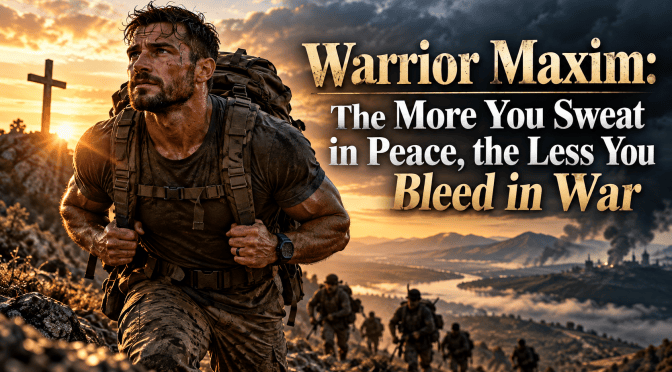
Warrior Maxim: The More You Sweat in Peace, the Less You Bleed in War

“The more you sweat in peace, the less you bleed in war.”

There are certain phrases that immediately resonate with anyone who has spent time in the military.

They are usually short. Direct. Uncomfortable. They rarely promise an easy road. Instead, they communicate hard-earned truths about preparation, discipline, responsibility, and the consequences of neglecting all three.

“The more you sweat in peace, the less you bleed in war” is one of those sayings.

General Norman Schwarzkopf famously used the maxim while speaking to graduating midshipmen at the United States Naval Academy in 1991, where he emphasized that successful leadership rests upon the decidedly unglamorous foundations of hard work and training.

That message should sound familiar to anyone who has worn a uniform.

You train when you are tired so that you can perform when exhaustion is no longer optional.

You rehearse procedures when nothing is wrong so that when everything goes wrong, your actions are not being invented in the moment.

You practice the fundamentals again and again because under pressure, people rarely rise magically to some unknown level of greatness. More often, they fall back on whatever habits they have developed through repetition.

That is what this warrior maxim means to me.

And although it is rooted deeply in military tradition, I believe its wisdom extends far beyond the battlefield.

Whether you are a veteran transitioning into civilian life, a parent raising children, a professional developing a career, a Christian seeking spiritual maturity, or simply someone trying to become stronger physically, mentally, and spiritually, the principle remains the same:

Do the difficult work before the difficult moment arrives.

The Military Tradition of Preparation

Military organizations cannot afford to treat preparation casually.

The consequences are too serious.

Training is designed to create competence before competence is desperately needed. Weapons are maintained before they malfunction. Equipment is inspected before a mission. Communications are rehearsed. Plans are developed. Contingencies are considered. Physical conditioning is performed long before anyone knows exactly when strength or endurance may be required.

This is not paranoia.

It is professionalism.

During military service, a person quickly learns that preparation itself is part of the mission.

There may be days when training seems repetitive. There may be exercises where the scenario feels artificial or inconvenient. There may be early mornings when physical training is the last thing anyone wants to do.

But repetition has a purpose.

The first time I perform an important task should not be when lives depend upon it.

That concept is central to military tradition.

The objective is not merely to know something intellectually. The objective is to have practiced it enough that sound action becomes increasingly natural under stress.

This applies to marksmanship, communications, physical conditioning, emergency procedures, leadership, tactical planning, first aid, logistics, and countless other responsibilities.

Military training also deliberately introduces hardship.

Why?

Because comfort is a poor instructor for adversity.

If every training environment is perfect, every plan unfolds exactly as expected, everyone is rested, and nothing breaks, then we have not prepared ourselves for reality.

Reality is messy.

People become tired.

Equipment fails.

Plans change.

Weather turns.

Communication becomes difficult.

Fear enters the equation.

Stress changes the way people think.

Training provides an opportunity to encounter controlled adversity before encountering uncontrolled adversity.

That is the sweat in peace.

And although training can never eliminate all danger, disciplined preparation can reduce avoidable mistakes when consequences become serious.

Preparation Is an Act of Respect

I have come to see preparation as something deeper than simple efficiency.

Preparation is an act of respect.

When I prepare properly, I demonstrate respect for the mission.

I demonstrate respect for the people depending upon me.

I demonstrate respect for the responsibilities entrusted to me.

And I demonstrate enough humility to acknowledge that good intentions are not the same thing as competence.

That distinction matters.

I can genuinely want to help someone during an emergency, but if I possess no useful skills, my intentions may accomplish very little.

I can genuinely want to lead others, but if I have never developed judgment, communication skills, discipline, or technical competence, wanting to lead does not make me an effective leader.

I can sincerely want to protect my health while spending years neglecting exercise, nutrition, sleep, and medical care.

Wanting the outcome is not the same as preparing for it.

The warrior maxim challenges me to look beyond my intentions and examine my habits.

What am I doing today to prepare myself for responsibilities I may face tomorrow?

That question applies in uniform.

It also applies long after the uniform comes off.

The Veteran’s Transition: Carrying the Training Forward

Leaving military service creates an unusual challenge.

For years, a servicemember operates within an environment built around standards, accountability, schedules, qualifications, physical readiness, and mission accomplishment.

Then civilian life arrives, and much of that external structure disappears.

No one may be standing there telling you when to exercise.

No one may inspect your room, equipment, appearance, or physical readiness.

There may be no formation tomorrow morning.

The chain of command changes.

Sometimes there is no obvious chain of command at all.

For veterans, I believe one of the challenges of transition is learning how to preserve useful military discipline without needing the military environment to enforce it.

The structure has to become internal.

I still have to prepare.

The battlefield simply looks different.

Maybe the battle is building a civilian career.

Maybe it is learning how to communicate more effectively with a spouse and children.

Maybe it is managing stress, grief, anger, or experiences from military service that were never fully processed.

Maybe it is returning to school after years away from academics.

Maybe it is rebuilding physical health after injuries.

Maybe it is developing new professional skills.

The warrior maxim still applies.

The work I do during relatively peaceful periods of life can make me more capable when hardship arrives.

If I invest in my marriage when things are good, my relationship may be stronger when life becomes difficult.

If I maintain physical fitness before illness or injury occurs, I may possess greater capacity for recovery.

If I build meaningful friendships before I enter a difficult season, I will not have to create an entire support system after the crisis begins.

If I develop professional knowledge before economic uncertainty threatens my employment, I become more adaptable.

The veteran does not have to abandon the warrior mentality.

He simply has to mature it.

The objective is no longer preparation for combat.

The objective is preparation for life.

Civilian Life Has Battles Too

I use the word “battle” carefully.

Not every challenge should be compared to combat, and civilian hardships should not be romanticized as warfare.

But life undeniably contains adversity.

A person may face unemployment.

A parent may discover that a child is seriously ill.

A marriage may enter a difficult season.

Someone may lose a loved one.

A business may fail.

A medical diagnosis may arrive unexpectedly.

Financial pressure may build.

Mental-health struggles may emerge.

Faith may be tested.

None of us receives a complete schedule of these events beforehand.

That uncertainty makes preparation important.

A civilian does not need military experience to understand the value of training before a crisis.

Consider finances.

Building an emergency fund during stable times may provide breathing room during unemployment or an unexpected expense.

Consider physical fitness.

Developing strength, cardiovascular capacity, mobility, and healthy habits before they become urgently necessary is generally more effective than waiting until poor health forces immediate action.

Consider education.

Learning skills before a professional opportunity appears prepares me to take advantage of that opportunity when it arrives.

Consider parenting.

Building trust with my children when life is calm creates a stronger relationship from which to navigate difficult conversations later.

Preparation is not pessimism.

It is responsible optimism.

I prepare because I believe the future is worth preparing for.

The Physical Pillar: Train Before Strength Is Required

The most literal application of the warrior maxim is physical.

Training requires voluntary discomfort.

I lift weight that my muscles would rather not lift.

I push my cardiovascular system beyond its current comfort zone.

I choose consistency when sitting on the couch would be easier.

Over time, the body adapts.

That adaptation is one of the reasons physical fitness has always been such an important component of military readiness.

But physical preparation matters in civilian life as well.

I do not exercise merely because I want to look better.

I want to remain capable.

I want to possess enough strength and endurance to meet the responsibilities God has placed before me.

I want to play with my children.

I want to carry groceries, move furniture, work around the house, travel, swim, hike, and respond when someone needs physical assistance.

I want to age with as much strength and independence as circumstances allow.

None of those outcomes is guaranteed.

But I can prepare.

That is the principle.

The workout I complete today may seem unrelated to some future challenge.

So might the healthy meal.

So might getting enough sleep.

So might attending the medical appointment I have been avoiding.

Small acts of stewardship accumulate.

I sweat now so that I may be more capable later.

The Mental Pillar: Rehearsing the Mind

Mental preparation is every bit as important.

Stress does strange things to our thinking.

Problems can suddenly appear larger.

Options seem narrower.

Emotion becomes louder.

Under sufficient pressure, an untrained mind can become its own adversary.

Mental resilience therefore requires practice.

I can learn to recognize unhealthy thought patterns.

I can practice patience rather than immediate reaction.

I can expose myself gradually to difficult tasks rather than avoiding everything uncomfortable.

I can read, study, journal, seek mentorship, and learn from people whose experiences differ from mine.

I can develop problem-solving skills before a crisis forces me to use them.

Perhaps most importantly, I can become comfortable asking for help.

There is nothing admirable about allowing a manageable problem to become catastrophic merely because pride prevented me from speaking.

Veterans understand that teamwork matters.

We should remember that lesson in civilian life.

Sometimes preparation means developing my own skill.

Sometimes it means knowing who has the skill I lack.

Strength does not require isolation.

The Spiritual Pillar: Preparing the Soul

For me, the deepest application of this warrior maxim is spiritual.

Faith should not become emergency equipment that I reach for only after everything else has failed.

I need to know God in times of peace.

I need Scripture before adversity arrives.

I need prayer before I become desperate.

I need fellowship before I feel isolated.

I need repentance before sin hardens my heart.

If I wait until the darkest moment of my life to develop spiritual habits, I am making an already difficult situation harder.

Jesus never promised His followers a life free from hardship.

Christian preparation therefore does not mean believing that sufficient faith will prevent suffering.

It means developing roots deep enough that suffering does not automatically uproot me.

That is why prayer matters when life is going well.

That is why Scripture matters on ordinary Tuesday mornings.

That is why worship matters when I am not in crisis.

Those practices form the spiritual muscle memory that I return to when emotions become unreliable.

Romans 5 teaches that God demonstrated His love toward us through Christ even while we were sinners. That truth is foundational to the Gospel and was also highlighted in the description accompanying this episode of the 3 Pillars Podcast.

My ultimate confidence therefore cannot rest entirely in my preparation.

Preparation is necessary.

God is greater.

I train faithfully while recognizing that I remain dependent upon Him.

Sweat Is Cheaper Than Regret

There is another uncomfortable lesson contained within this maxim.

Preparation requires payment.

The currency may be time.

It may be effort.

It may be money.

It may be discomfort.

It may be humility.

But neglect also has a price.

And frequently, neglect costs more.

The hours required to maintain physical health may seem inconvenient until years of poor habits create larger consequences.

The difficult conversation within a marriage may feel uncomfortable until months of silence become resentment.

Saving money may require sacrifice until an emergency reveals the value of having prepared.

Studying after work may feel exhausting until a professional opportunity appears for which I am suddenly qualified.

Prayer, discipline, training, education, communication, and planning all demand something from me today.

But the maxim reminds me that today’s controlled discomfort may reduce tomorrow’s uncontrolled suffering.

Not eliminate it.

Reduce it.

That distinction is important because preparation does not guarantee outcomes.

The best-trained military in the world can still suffer casualties.

The healthiest person can still become sick.

A responsible employee can still lose a job.

A faithful Christian can still experience tragedy.

The principle is not that preparation gives me control over life.

It gives me greater capacity to respond faithfully when life refuses to be controlled.

Do Hard Things Before You Have To

I believe one of the healthiest habits a person can develop is voluntarily doing difficult things.

Not reckless things.

Not pointless suffering.

Purposeful difficulty.

Wake up and train.

Read the difficult book.

Have the conversation.

Learn the new skill.

Save the money.

Apologize.

Go to counseling.

Attend church.

Complete the course.

Practice the presentation.

Fix the problem before it becomes an emergency.

Develop competence while the stakes are low.

This is how confidence is built.

Real confidence is rarely produced through motivational slogans alone.

Confidence develops when I have evidence that I can do difficult things because I have repeatedly done difficult things.

The warrior maxim embodies that mentality perfectly.

Training converts uncertainty into familiarity.

Discipline converts intention into action.

Repetition converts knowledge into skill.

Preparation converts fear into something more manageable.

Conclusion: Prepare in Peace

“The more you sweat in peace, the less you bleed in war.”

It sounds like a military saying because it is rooted in the realities of military preparation.

But its wisdom belongs to everyone.

As a Marine veteran, I understand the value of training before a mission, preparation before execution, and discipline before adversity.

As a civilian, husband, father, professional, and Christian, I have discovered that those principles did not become irrelevant when I left the military.

They became broader.

My responsibility now is to prepare for the battles that come with ordinary life.

I prepare physically because my body is a tool through which I serve others.

I prepare mentally because adversity demands clear judgment.

I prepare spiritually because ultimately my strength, identity, and hope are rooted in something greater than myself.

I invest in relationships before they become strained.

I develop skills before they become urgently necessary.

I seek wisdom before decisions become crises.

I pray before desperation forces me to my knees.

That is what this warrior maxim means to me.

It is not a celebration of suffering.

It is a recognition that discipline today can reduce unnecessary suffering tomorrow.

It is a call to readiness.

And it raises a question worth asking:

What difficulty in my future could become more manageable because of the preparation I am willing to undertake today?

None of us knows exactly what tomorrow will bring.

But I do know what I can do today.

I can train.

I can learn.

I can pray.

I can prepare.

I can strengthen the Three Pillars—physical, mental, and spiritual—so that when adversity arrives, I do not have to begin building myself in the middle of the storm.

The peaceful season is not wasted time.

It is training time.

Use it well.

Semper Fi. God Bless.

American Ethos: Ask Not What Your Country Can Do for You

Rediscovering the American Spirit Through Faith, Service, and Personal Responsibility

“Ask not what your country can do for you—ask what you can do for your country.”

— President John F. Kennedy, January 20, 1961

A Challenge That Transcends Generations

On January 20, 1961, President John F. Kennedy stood before the American people and delivered an inaugural address that would become one of the most recognizable speeches in American history.

The United States was entering a period of considerable uncertainty. The Cold War presented significant international challenges, the Civil Rights Movement was confronting longstanding inequalities, and technological advancements were rapidly transforming American society.

Kennedy recognized that addressing the challenges of his generation would require more than the efforts of a single administration. His inaugural address called upon Americans to embrace the responsibilities of citizenship and contribute to the preservation of liberty and the advancement of their nation.

His message was simple, yet profound.

Rather than concentrating exclusively on what our country can provide for us, we should consider what we can contribute to our country.

More than six decades later, I believe this question remains relevant.

What does it mean to be an American? What responsibilities accompany the freedoms we enjoy? How can we contribute to the well-being of our communities and the continued development of our nation?

Most importantly, are we willing to take responsibility for the things within our control, or are we constantly waiting for someone else to take the initiative?

As a United States Marine Corps veteran, a father, a Christian, and a working professional, I have developed a deep appreciation for the relationship between individual responsibility and collective success.

I have witnessed how discipline, sacrifice, leadership, and service influence the effectiveness of military units, professional organizations, families, and communities.

These principles are not exclusive to military service. They apply to every aspect of civilian life.

Through the 3 Pillars Podcast, I frequently discuss the importance of developing ourselves spiritually, mentally, and physically. However, personal development should not be an exclusively self-serving pursuit.

The purpose of becoming stronger is not simply to improve our own circumstances, but to become more capable of serving those who depend upon us.

When we apply that principle to our responsibilities as American citizens, Kennedy’s challenge takes on an entirely new meaning.

It becomes a question that each of us must answer through our daily conduct.


Understanding Kennedy’s Message: Citizenship Requires Participation

President Kennedy delivered his inaugural address during a period when Americans faced significant domestic and international challenges.

His speech emphasized freedom, cooperation, public service, and the responsibilities accompanying national leadership.

Kennedy understood that the country’s future would depend, in part, upon the willingness of ordinary citizens to participate in addressing the challenges before them.

In my interpretation, his famous statement challenges us to recognize that citizenship involves more than receiving the benefits associated with living in the United States.

It also involves accepting responsibility for our contributions to society.

We have opportunities to pursue individual goals, establish businesses, obtain an education, practice our religious beliefs, and raise our families according to our convictions.

However, these freedoms also provide opportunities to serve our neighbors, strengthen our communities, and participate in civic life.

Rather than looking exclusively toward government institutions to address every challenge, we can examine what actions are within our own capabilities.

This does not mean that government has no responsibilities to its citizens.

Public institutions have legitimate obligations, and Americans have the right to question their decisions and advocate for improvement.

However, many challenges also benefit from the participation of individuals, families, businesses, churches, charitable organizations, and local communities.

A community’s well-being is influenced by the willingness of its members to recognize problems, accept responsibility, and participate in meaningful solutions.

That is the central principle I take from Kennedy’s message.

Instead of waiting for someone else to act, I can begin by examining what I am capable of contributing.


Community Involvement: Meaningful Change Begins at Home

One of the recurring themes of the 3 Pillars Podcast is that we must recognize the distinction between circumstances we can control and those beyond our immediate influence.

I cannot personally resolve every challenge facing our nation.

I cannot independently eliminate poverty, repair every failing institution, or ensure that every American has access to the opportunities they desire.

However, I can take responsibility for my own conduct.

I can influence the environment within my home.

I can contribute to the well-being of my neighborhood.

I can participate in organizations serving my community.

These actions represent meaningful opportunities to make a difference.

Consider something as simple as volunteering at a local food bank, assisting with a neighborhood cleanup, or mentoring a young person who needs additional guidance.

Individually, these activities may appear insignificant when compared with the challenges facing an entire nation.

However, their significance becomes apparent when we consider the individuals who benefit from them.

A struggling family receives groceries.

A neighborhood becomes cleaner.

A child receives the encouragement necessary to continue pursuing an education.

These outcomes matter.

Imagine what our communities could accomplish if more individuals consistently dedicated a portion of their time and abilities to helping others.

The influence of those actions could extend beyond the immediate recipients.

A child who receives encouragement may eventually become a mentor to someone else.

A family that benefits from community assistance may later find itself in a position to provide assistance to others.

This is how service can create a positive influence extending beyond the original act.

Meaningful change does not always begin with an extraordinary event. Sometimes it begins with an ordinary person deciding to take responsibility for something immediately before them.


Civic Engagement: Citizenship Is Not a Spectator Sport

Another important component of Kennedy’s message involves participation in the civic process.

The American constitutional system provides citizens with opportunities to participate in elections, communicate with elected representatives, attend public meetings, and contribute to discussions concerning their communities.

These opportunities allow individuals to make their perspectives known and participate in decisions affecting their daily lives.

However, meaningful participation requires a willingness to remain informed.

We live in an era when information is readily available through smartphones, computers, newspapers, podcasts, and countless other sources.

Unfortunately, access to information does not automatically produce understanding.

I believe responsible civic engagement requires us to evaluate information carefully, consider multiple perspectives, and distinguish documented facts from speculation or opinion.

It also requires us to engage in respectful discussions.

Two Americans can share a sincere appreciation for their country while holding different opinions concerning public policy, economic priorities, education, or the responsibilities of government.

Disagreement does not have to result in hostility.

I can express my convictions without attacking another person’s character. Likewise, I can listen respectfully without surrendering my own beliefs.

As I discussed in the podcast, we should approach civic discussions with a level head and a willingness to participate in informed conversations.

The ability to communicate respectfully becomes particularly important when discussing complicated issues that do not have universally accepted solutions.

For me, civic responsibility means taking an active interest in the institutions and decisions affecting my community while recognizing that my fellow citizens possess the same right to participate.


Military Service: The Meaning of Duty and Sacrifice

My service in the United States Marine Corps profoundly influenced my understanding of personal responsibility, leadership, and service.

Military service requires individuals to dedicate themselves to a mission extending beyond personal convenience.

It requires sacrifice, discipline, accountability, and a willingness to work alongside people whose backgrounds and personal convictions may differ significantly from their own.

During my time in the Marine Corps, I served alongside individuals who brought different experiences, perspectives, and abilities to our shared responsibilities.

We did not need to agree on every personal matter to accomplish our mission.

We needed to recognize our responsibilities, respect one another’s contributions, and work together toward a common objective.

That experience taught me an important lesson about leadership.

A successful team does not require every individual to possess identical abilities. It requires individuals who are willing to use their strengths to support one another.

One Marine may possess technical knowledge that another lacks.

Another may demonstrate exceptional leadership, physical endurance, or problem-solving ability.

Through training, mentorship, and cooperation, those individuals can strengthen one another.

The same principle applies to civilian life.

Our country benefits when individuals contribute their knowledge, experience, and abilities toward shared objectives.

My military service also required sacrifices from my family. Those sacrifices were real, and they remain part of how I understand the commitment associated with serving something greater than myself.

I am proud to be a Marine, and I am grateful for the lessons that experience has provided.

However, military service is only one of many ways Americans can contribute to their country.

Teachers, first responders, healthcare professionals, parents, volunteers, business owners, and countless others demonstrate service through the responsibilities they fulfill.

What matters is the willingness to recognize those responsibilities and approach them with integrity.


Education: Investing in Ourselves and Future Generations

Education is another important component of individual responsibility and national development.

I have always believed that learning should continue throughout our lives.

Whether we are pursuing higher education, developing professional skills, studying history, reading literature, or learning something entirely new, every opportunity to expand our knowledge can improve our ability to understand and address the challenges before us.

In the podcast, I compared education to adding tools to a toolbox.

Every new skill or piece of knowledge provides another resource that may prove valuable when confronting an unfamiliar problem.

A person equipped with only one approach may struggle when circumstances require a different solution.

However, someone who continually develops new abilities possesses additional opportunities to adapt.

This is particularly relevant to professional development.

The knowledge and skills I acquired during my military service have influenced how I approach leadership, planning, communication, and problem-solving throughout my civilian career.

Continued education allows me to build upon that foundation.

However, education is not exclusively about personal advancement.

It also creates opportunities to assist others.

A retired teacher might volunteer to tutor children struggling academically.

An experienced professional might mentor someone entering the workforce.

A parent might encourage a child’s curiosity by reading together or exploring new subjects.

These activities can provide valuable support to individuals who may otherwise lack access to additional educational opportunities.

I believe one of the most meaningful investments we can make in our communities is sharing knowledge and encouraging others to develop their abilities.

The more capable we become, the more opportunities we may have to contribute.


Supporting Others: Compassion and Personal Responsibility

Personal responsibility is an important principle in my life.

I believe in working hard, developing useful skills, honoring commitments, and accepting accountability for my decisions.

However, I also recognize that people encounter circumstances that extend beyond their immediate control.

Illness, disability, unemployment, family instability, and other challenges can create significant obstacles.

My Christian faith reminds me of the importance of assisting those who are struggling.

Scripture repeatedly emphasizes compassion toward the poor, the vulnerable, widows, orphans, and others experiencing hardship.

For me, there is no contradiction between encouraging personal responsibility and providing meaningful assistance to someone in need.

In fact, the two principles can reinforce one another.

If someone is struggling to obtain employment, helping that individual develop professional skills may provide a pathway toward greater independence.

If a child is having difficulty in school, additional tutoring may provide the encouragement and knowledge necessary to improve.

If a family is experiencing a temporary financial crisis, assistance from a charitable organization may help provide stability while they work toward recovery.

The goal is not simply to offer assistance without considering its purpose.

It is to understand the individual’s circumstances and determine what form of support may be genuinely useful.

Sometimes that means providing resources.

Sometimes it means sharing knowledge.

Sometimes it means offering encouragement, mentorship, or simply being present during a difficult period.

A compassionate community recognizes both the dignity of individuals and the value of helping people develop the abilities necessary to improve their circumstances.


Environmental Stewardship: Taking Responsibility for Our Surroundings

One of the most personal examples of community service I discussed during the podcast involves an initiative my family and I undertake in honor of my late grandmother.

We sponsor a three-mile stretch of road and dedicate time each quarter to cleaning it.

On those mornings, we wake up early, head to our designated section of roadway, and spend approximately two hours collecting litter.

The amount of trash we encounter can be astonishing.

Food containers, discarded packaging, beverage cans, and other waste accumulate along the roadside.

Much of it could have been disposed of properly through ordinary acts of personal responsibility.

This experience has reinforced my belief that environmental stewardship begins with the decisions we make every day.

I do not need to wait for a large-scale environmental initiative to recognize the importance of keeping my community clean.

I can dispose of my own trash responsibly.

I can participate in neighborhood cleanup efforts.

I can help maintain public parks and natural spaces.

I can conserve resources where practical and encourage my children to develop respect for the environment.

As a Christian, I believe we have a responsibility to exercise responsible stewardship over God’s creation.

That responsibility includes caring for the places in which we live.

Our family’s roadside cleanup is also an opportunity to honor my grandmother’s memory through meaningful action.

It allows us to spend time together, contribute to our community, and demonstrate the importance of taking responsibility for our surroundings.

We are not changing the entire world during those two hours.

However, we are making a tangible difference within our immediate sphere of influence.

That is an important application of Kennedy’s challenge.


National Unity: A Tapestry of Shared Responsibility

America is home to people representing many different cultural backgrounds, religious traditions, personal experiences, and philosophical perspectives.

These differences can influence how individuals understand their responsibilities and approach the challenges facing their communities.

However, cooperation does not require everyone to possess identical beliefs or experiences.

During the podcast, I described the American nation as a tapestry.

A tapestry is composed of individual threads that retain their distinct characteristics while contributing to a larger design.

I believe this provides a useful metaphor for understanding our shared civic life.

Americans can maintain their individual identities, cultural traditions, and religious convictions while recognizing their shared responsibilities toward one another.

We can disagree about public policy while working together to assist families experiencing hardship.

We can approach religious questions differently while respecting one another’s freedom of belief.

We can hold different professional interests while contributing our abilities to the well-being of our communities.

Unity does not require uniformity.

It requires recognizing opportunities for cooperation despite our differences.

My experiences in the Marine Corps reinforced this principle.

People from different backgrounds can develop mutual respect through shared responsibilities, honest communication, and a willingness to support one another.

That lesson remains relevant to how I approach my responsibilities as an American citizen.


The Three Pillars: Preparing Ourselves to Serve

The foundation of the 3 Pillars Podcast is the development of spiritual, mental, and physical strength.

I believe these areas of personal development influence our ability to fulfill our responsibilities toward others.

Spiritual strength provides a foundation for the values guiding my decisions.

Through prayer, Scripture, worship, and fellowship, I seek to develop humility, compassion, integrity, and a greater commitment to serving others.

My Christian faith reminds me that my responsibilities extend beyond personal achievement.

In Mark 10:45, Jesus explains that He came not to be served, but to serve.

That example challenges me to consider how my actions influence the people around me.

Mental strength allows me to approach difficulties with discipline, patience, and sound judgment.

The ability to evaluate information, develop useful skills, communicate effectively, and manage emotional responses is valuable in professional and civic life.

Mental resilience also helps me remain engaged when meaningful progress requires sustained effort.

Physical strength supports my ability to fulfill responsibilities that require energy, mobility, and endurance.

I pursue physical fitness because I value my health and want to remain capable of supporting my family, meeting my professional obligations, and assisting others when circumstances require it.

Not everyone possesses the same physical abilities, and meaningful service takes many forms.

The principle is to develop and responsibly use the abilities available to us.

When considered together, these three pillars represent more than a personal development philosophy.

They provide a framework for becoming more dependable, disciplined, and capable of contributing to the lives of others.


Conclusion: What Can I Do for My Country?

President Kennedy’s inaugural address challenged Americans to consider the responsibilities accompanying citizenship and the importance of contributing to the well-being of their nation.

His question remains relevant to the way I approach my everyday life.

What can I do for my country?

I can begin by taking responsibility for the things within my control.

I can strive to be a dependable husband and father.

I can conduct myself with integrity in my professional life.

I can continue developing my knowledge and abilities while sharing what I have learned with others.

I can participate in civic discussions, volunteer within my community, and treat my fellow Americans with dignity.

I can assist people experiencing hardship, support charitable initiatives, and take responsibility for caring for the environment.

Most importantly, I can recognize that my contributions do not need to receive widespread recognition to possess meaningful value.

The opportunities before me may appear ordinary.

However, ordinary responsibilities performed consistently can have a lasting influence on the people around us.

As a Christian, I want my life to demonstrate the principles I profess.

As a father, I want my children to understand the importance of integrity, service, and personal responsibility.

As a Marine Corps veteran, I remain grateful for the opportunity to have served my country and for the lessons that experience continues to provide.

And as an American citizen, I recognize that meaningful contributions can take many forms.

I cannot personally resolve every challenge facing our nation.

However, I can take responsibility for the decisions I make today.

I can become more knowledgeable.

I can become more disciplined.

I can become more compassionate.

I can become more capable of serving others.

The American ethos is not merely something we inherit. It is something we have an opportunity to demonstrate through our daily conduct.

When I consider Kennedy’s famous challenge, I am reminded that meaningful service does not necessarily begin in Washington, D.C., or within the halls of a government institution.

Sometimes it begins in our homes, our workplaces, our churches, and our neighborhoods.

Sometimes it begins with a father teaching his children about responsibility.

Sometimes it begins with a volunteer helping a struggling family.

Sometimes it begins with a group of neighbors deciding to clean up a neglected street.

And sometimes it begins with a simple question:

What can I do today to make a positive difference in someone else’s life?

I believe that question deserves a place in our daily reflections.

Each of us possesses different abilities, resources, and opportunities.

We also encounter different responsibilities and challenges throughout our lives.

Nevertheless, we can examine how our individual actions influence the people around us and consider where we might make a meaningful contribution.

That is what President Kennedy’s challenge means to me.

Not merely asking what my country can provide, but taking responsibility for what I can contribute to the people who share it with me.

Semper Fi. God Bless.


Listen to the 3 Pillars Podcast

This article accompanies American Ethos, Episode 28, Season 5 of the 3 Pillars Podcast.

In this episode, I examine President John F. Kennedy’s inaugural address and discuss how Americans can apply its central message through community involvement, civic participation, military service, education, personal responsibility, environmental stewardship, and national unity.

The discussion also explores how developing ourselves spiritually, mentally, and physically can better prepare us to fulfill our responsibilities and serve others.

Blessed Be the Lord My Strength: Prepared for the Battles Ahead

“Blessed be the LORD my strength, which teacheth my hands to war, and my fingers to fight.” — Psalm 144:1, KJV

Adversity rarely announces itself before it arrives. A difficult diagnosis, the loss of a loved one, financial pressure, betrayal, professional uncertainty, temptation, or conflict can suddenly change the terrain beneath my feet. One moment, life appears stable; the next, I am standing in the middle of a battle I did not choose and cannot avoid.

In those moments, one question rises above all others: Who do I rely on?

Psalm 144:1 gives me a clear answer. I rely on the Lord—not merely as a distant observer of my struggle, but as my strength and my instructor. David did not simply praise God for removing every conflict from his path. He praised God for preparing him to face what was in front of him. The Lord taught his hands to war and his fingers to fight.

That image speaks powerfully to me. God is present in the training, the preparation, the uncertainty, and the confrontation itself. He strengthens me before I feel ready, teaches me while I am still learning, and remains with me when the outcome is beyond my control.

In reflecting on the 3 Pillars Podcast episode “Blessed Be the LORD My Strength,” I return to a foundational truth: strength must be developed before it is demanded. Psalm 144:1 does not encourage aggression, recklessness, or the pursuit of conflict. It reveals disciplined dependence upon God. When the battles of life arrive, I should not rely solely on emotion, instinct, physical ability, intelligence, money, influence, or status. Those things may have value, but they are limited. My ultimate reliance must be upon the One who sees the entire battlefield.

The Reality of the Battle

When Scripture uses the language of war, I believe it is important to understand that not every battle involves a physical enemy. Some of the most difficult battles are fought in private.

There are battles against fear, pride, lust, resentment, despair, addiction, complacency, and self-doubt. There are battles to remain faithful when compromise would be easier, to forgive when anger feels justified, and to maintain integrity when no one appears to be watching.

Adversity also comes through circumstances rather than personal sin. Grief, illness, failure, family responsibility, and prolonged disappointment can test every part of a person.

The question is not whether I will face adversity. The question is whether I will be prepared when it comes.

Pressure does not automatically create character. Pressure reveals what has already been cultivated. When life becomes difficult, I usually fall back on my habits, convictions, training, and relationships. If I have trained myself to panic, avoid responsibility, neglect prayer, and surrender to every negative thought, adversity will expose those weaknesses. If I have practiced discipline, truth, prayer, courage, and wise action, those habits become tools in my hands.

Psalm 144:1 is therefore not merely a verse for the battlefield. It is a verse for preparation.

When I Face Adversity, I Rely on God

I have learned that self-reliance has limits. Personal responsibility is essential, and I believe strongly in doing the work, developing competence, and refusing to make excuses. However, personal responsibility is not the same as believing I am self-sufficient.

I can prepare carefully and still encounter circumstances I cannot control. I can make a sound plan and still face unexpected resistance. I can possess experience, strength, and confidence and still reach the boundary of my own ability.

That boundary is not always a place of defeat. It can become a place of surrender.

When I rely on God, I am not abandoning action. I am placing my action under His authority. I pray, prepare, seek counsel, evaluate the risks, and then move forward with faith. I do what I am responsible to do while trusting God with what only He can control.

The next verse calls the Lord David’s fortress, high tower, deliverer, shield, and refuge. God is both the One who trains him and the One who protects him.

I am not relying on God only to make me stronger. I am relying on God because He is my strength. The goal of Christian preparation is not to become so capable that I no longer need Him. The goal is to become more obedient, disciplined, and useful while remaining completely dependent upon Him.

Physical Preparation: Stewarding the Body

The first pillar of preparation is physical readiness.

My body is not the whole of who I am, but it is the instrument through which I carry out many of my responsibilities. I work, lead, serve, protect, worship, and care for others through a physical body. Neglecting that body can reduce my ability to respond when life requires endurance.

Physical preparation does not mean everyone must become an elite athlete. It means practicing responsible stewardship according to my age, health, limitations, and duties. Strength training, cardiovascular conditioning, mobility, adequate rest, proper nutrition, hydration, and medical care are not expressions of vanity when pursued with the right motives. They can be expressions of discipline and gratitude.

Regular physical activity can support sleep, emotional balance, thinking, and the ability to manage stress. Exercise is not a substitute for prayer, medical care, counseling, or spiritual formation. It simply acknowledges that physical health and mental readiness influence one another.

The purpose of physical discipline is not to worship the body. It is to make the body a more dependable servant of a higher mission.

Physical training also teaches me to experience discomfort without panic and to keep moving when a task becomes unpleasant. The battle is not won in the gym, but the gym can help me practice discipline for the battles ahead.

There is a tremendous difference between seeking suffering and becoming capable of enduring it. I do not train because I hope life will become more difficult. I train because difficulty is an unavoidable part of life, and I want to meet my responsibilities when it comes.

Physical preparation is therefore connected to service. I want the energy to care for my family, the strength to assist someone in need, and the endurance to continue working when others depend upon me. Physical fitness is not merely about appearance. Properly understood, it is about readiness.

Spiritual Preparation: Knowing the Source of Strength

Physical readiness is valuable, but it cannot carry the full weight of adversity. A strong body without a grounded spirit can still collapse beneath fear, meaninglessness, guilt, or despair.

Spiritual preparation begins with a living relationship with God through Jesus Christ. It is developed through prayer, Scripture, worship, repentance, obedience, and fellowship with other believers. These practices are not emergency equipment to be opened only when life becomes difficult. They are daily disciplines that shape my understanding of God.

If I wait until the battle begins to decide what I believe, fear may make that decision for me.

I must settle certain truths beforehand. God is sovereign even when I do not understand His plan. God is good even when circumstances are painful. My identity is rooted in Christ rather than success, approval, wealth, strength, or public recognition. Suffering is not proof that God has abandoned me. Obedience remains right even when it is costly.

These convictions become positions of spiritual defense. When adversity attacks my emotions, I return to what God has already revealed.

Prayer is part of the training. It does not always change the situation immediately, but it changes how I enter the situation. It forces me to slow down, confess my limitations, seek wisdom, and align my desires with God’s will.

Scripture places truth in my hands. It answers fear with God’s sovereignty, shame with grace, and pride with humility and community.

Spiritual preparation is not pretending that I never feel afraid. It is learning where to take fear when it arrives.

I believe there is an important difference between fear and cowardice. Fear is a natural response to danger, uncertainty, or potential loss. Cowardice occurs when fear is allowed to overrule conviction and responsibility. Courage does not require the absence of fear. Courage requires obedience in the presence of fear.

That courage comes from knowing who stands with me. When my confidence is rooted only in my own ability, every weakness becomes a threat. When my confidence is rooted in God, I can acknowledge my limitations without being destroyed by them.

Mental Preparation: Governing the Inner Conversation

The mental battle is often the bridge between spiritual conviction and physical action.

I may know what is right and possess the physical ability to do it, yet still be defeated by an undisciplined mind. Catastrophic thinking, uncontrolled anger, resentment, indecision, and hopelessness can distort my judgment.

Mental readiness requires me to examine the thoughts I repeatedly entertain. Not every thought deserves agreement. Fear may present a possibility as though it were a certainty. Anger may convince me that immediate reaction is strength. Pride may prevent me from asking for help. Discouragement may interpret a temporary setback as a permanent verdict.

I must challenge these narratives with truth.

This does not mean denying reality or forcing artificial positivity. Mental strength is not repeating that everything is fine when it clearly is not. It is seeing the situation honestly without surrendering my judgment to panic.

A mentally prepared person can acknowledge danger while still thinking, experience emotion without being ruled by it, and adapt when the original plan no longer works.

This resilience is developed through practice. I can journal, study, rehearse possible responses, seek mentorship, limit unhelpful influences, and build relationships with people who speak truth. During periods of significant anxiety, depression, trauma, or emotional distress, seeking qualified professional help can be an act of wisdom rather than weakness.

Mental preparation also requires control of my attention. If I continually consume outrage, fear, comparison, and distraction, clear thinking becomes harder. I need silence, reflection, prayer, reading, and purposeful conversation.

The battle for the mind is won through repeated decisions about what I will believe, rehearse, and obey.

There will be moments when I cannot control the circumstance, but I can still govern my response. I can choose patience rather than panic. I can choose prayer rather than despair. I can choose wise counsel rather than isolation. I can choose disciplined action rather than emotional reaction.

Those decisions may appear small, but they determine whether adversity strengthens my character or exposes me to further destruction.

Who Is My Instructor?

Psalm 144:1 does not merely identify God as strength. It identifies Him as teacher.

My ultimate instructor is the Lord.

He instructs me through His Word. Scripture reveals the character I must develop, the dangers I must avoid, and the mission I must pursue. He instructs me through the Holy Spirit, who convicts, guides, comforts, and brings truth to remembrance. He instructs me through the example of Jesus Christ, who demonstrated courage without cruelty, authority without pride, strength under control, and obedience even unto death.

God also uses parents, pastors, coaches, leaders, counselors, mentors, hardship, and even failure. Not every painful experience is good, but God can bring instruction from experiences I would never have chosen.

As a Marine veteran, I understand the importance of respecting the instructor and trusting the training. Training often feels repetitive before the crisis. Fundamentals can appear ordinary until conditions become chaotic. Then the value of repetition becomes obvious.

The same principle applies spiritually. Prayer, Scripture study, physical discipline, honest self-examination, and service may feel routine on an ordinary day. In adversity, those routines become anchors.

A teachable person asks, “Lord, what are You developing in me?” He does not assume every hardship is punishment, nor does he pretend every loss is easy to explain. He remains open to correction, growth, and deeper dependence.

God’s instruction will not always take the form I expect. Sometimes He teaches through success, but often He teaches through resistance. Sometimes He confirms my plan, but sometimes He redirects it. Sometimes His lesson is how to advance, and sometimes His lesson is how to wait.

The important question is whether I remain teachable.

Prepared, but Still Dependent

There is a dangerous form of preparation that produces arrogance. I can become so impressed with my discipline that I begin trusting the training more than the Trainer.

Psalm 144:1 protects me from that mistake. David possessed skill, but he blessed the Lord. He recognized that ability itself was a gift and that preparation did not eliminate dependence.

I should train hard, think clearly, pray faithfully, and plan responsibly. Then I should hold those preparations with humility. My strength can fail. My information can be incomplete. My plan can require adjustment. God alone sees the end from the beginning.

Christian readiness contains both confidence and surrender. I can enter the battle confidently because I have prepared, yet humbly because I know preparation does not control the outcome.

My responsibility is faithfulness. The results belong to God.

This understanding also protects me from despair. When an outcome does not unfold as I hoped, I do not have to conclude that all preparation was wasted or that God was absent. Faithfulness is not measured solely by visible victory. Sometimes victory is remaining obedient, maintaining integrity, refusing bitterness, and trusting God while walking through an outcome I would never have chosen.

Conclusion: Blessed Be the Lord

When adversity comes, I want my first response to reveal where my trust has been placed.

I do not want to wait until the crisis to begin building physical discipline, spiritual conviction, and mental resilience. I want to prepare now. I want to care for my body, guard my mind, deepen my prayer life, study Scripture, cultivate trustworthy relationships, and practice obedience in the small decisions that no one applauds.

Most importantly, I want to remember who my instructor is.

The Lord trains me for the work He places before me. He is my fortress, deliverer, shield, and strength when my own strength is gone.

The battle may be greater than I expected, but it is not greater than God.

I may feel unprepared, but I am not abandoned.

I may not know how the conflict will end, but I know who stands with me in the middle of it.

When I face great adversity, I rely on the Lord.

I prepare physically, spiritually, and mentally by training faithfully, living with discipline, seeking wisdom, and remaining rooted in truth.

My instructor is the God who created me, called me, redeemed me, and continues to shape me for His purpose.

“Blessed be the LORD my strength.”

That is not merely a verse to admire. It is a declaration to live.

Confession: The Courage to Bring Sin Into the Light

There is something within human nature that wants to hide.

When I fail, my first instinct is not always to step into the light. Sometimes I want to minimize what happened, justify it, blame someone else, or pretend it will disappear if I refuse to name it. That instinct is as old as the Garden of Eden. After Adam and Eve sinned, they covered themselves and hid from God. Sin entered the world, and concealment followed closely behind it.

The same pattern still appears in my life. Sin promises pleasure, control, relief, or self-protection, but it often leaves me carrying shame and looking for somewhere to hide. I may hide behind busyness, anger, success, religious activity, or silence. None of those hiding places can heal me.

This is why confession is such an important Christian practice. Confession is not spiritual humiliation for its own sake. It is an invitation to stop running, abandon deception, and return to the God who already knows the truth and still calls me toward mercy.

In Episode 26 of Season 5 of the 3 Pillars Podcast, titled “Confess,” I explored this essential act of Christian discipleship. A strong life cannot be built on hidden compromise. If I want to become stronger spiritually, mentally, and physically, I must live honestly before God.

What Confession Really Means

Biblical confession is more than admitting that I made a mistake. At its core, confession means agreeing with God about my sin.

I stop calling pride “confidence.” I stop calling greed “ambition.” I stop calling lust “harmless entertainment.” I stop calling bitterness “discernment.” I stop calling uncontrolled anger “just being honest.” Confession strips away the false labels.

When I confess, I am saying, “God, You are right about this, and I have been wrong.” That statement requires humility because it removes my excuses and exposes the difference between what I wanted and what God commanded.

However, confession is not the same as self-hatred. God does not call me to despise myself. He calls me to tell the truth about myself so that I can receive grace and be transformed. Christian confession is not hopeless condemnation; it is movement toward reconciliation.

First John 1:9 gives one of the clearest promises in Scripture: if we confess our sins, God is faithful and just to forgive us and cleanse us from unrighteousness. Confession does not create God’s mercy. It places me in the posture to receive and walk in the mercy He offers through Jesus Christ.

Why Confession Is Necessary

Confession matters because sin grows in secrecy.

A hidden sin can begin to form a private world within me. I maintain one outward identity while protecting another inward reality. The longer that division continues, the easier it becomes to rationalize what I once resisted. My conscience can become quieter—not because the sin has become harmless, but because I have practiced ignoring conviction.

Confession interrupts that process. It brings the hidden thing into God’s presence, names it for what it is, and breaks my agreement with deception. My identity is not found in defending my worst decisions, but in belonging to Christ.

Confession is also necessary because love requires truth. I cannot claim to desire intimacy with God while intentionally protecting what separates my heart from obedience. God already knows everything about me, but relationship requires that I willingly come before Him without pretense.

When I confess, I am not giving God information. I am giving Him my surrender.

I Cannot Hide From God

One of the most irrational things about unconfessed sin is that I often behave as though silence makes me hidden.

It does not.

Psalm 139 teaches that God understands my thoughts and is acquainted with all my ways. Hebrews 4:13 declares that nothing in creation is concealed from His sight. God does not discover my sin when I mention it in prayer. He knew the action, motive, rationalization, and damage before I found the courage to speak.

This truth can sound frightening, but it is also comforting. The God who sees everything still calls me to repentance and extends grace.

Hiding from God is spiritually exhausting because it requires me to resist the One who is already present. I may avoid prayer because prayer makes me uncomfortable. I may neglect Scripture because it exposes what I am protecting. I may withdraw from Christian community because honest fellowship threatens the image I am maintaining.

Eventually, the hiding place becomes a prison.

What Happens Spiritually When I Hide Sin

The first consequence of concealed sin is spiritual disruption.

Not every dry season means a person is hiding a terrible secret, and emotional struggle should not automatically be treated as divine punishment. Faithful Christians can experience grief, depression, trauma, fatigue, and spiritual dryness without personal sin being the cause.

However, when I knowingly cling to sin and refuse confession, it affects my fellowship with God. My prayers become guarded. Worship becomes difficult because part of me is resisting surrender. Scripture feels threatening rather than life-giving. Conviction becomes something I avoid instead of a mercy I welcome.

David describes this burden in Psalm 32. While he kept silent, he felt inwardly worn down; when he acknowledged his sin, he experienced forgiveness. Concealment drains, but confession opens the heart to restoration.

Unconfessed sin can also harden me. The first compromise may disturb me deeply; the tenth may feel easier. Repeated disobedience can reshape what I tolerate. I stop asking whether something honors God and begin asking how close I can get to the boundary without consequences.

Confession keeps my heart teachable. Conviction is not evidence that God has abandoned me. It is often evidence that He is calling me back.

What Happens Emotionally When I Hide Sin

Emotionally, concealed sin creates tension between who I appear to be and what I know to be true.

That tension can produce shame, anxiety, irritability, defensiveness, and isolation. I may become unusually sensitive to correction because even a small criticism touches the larger truth I am avoiding. I may judge others harshly because exposing their failures helps me look away from my own.

Secrecy also feeds rumination. My mind replays what happened, imagines discovery, rehearses excuses, and calculates how to keep the truth contained. Even when no one else knows, I know.

Guilt and shame must be distinguished. Healthy guilt says, “I have done something wrong.” Shame says, “I am beyond redemption.” Conviction points me toward repentance; condemnation tells me to hide because change is impossible.

Romans 8:1 teaches that there is no condemnation for those who are in Christ Jesus. That does not make sin unimportant; it means sin does not write the final sentence over my life. Confession allows me to stop spending emotional energy defending what God wants to heal.

What Happens Physically When I Carry Hidden Sin

The spiritual, mental, and physical pillars are interconnected. What burdens the conscience can affect the emotions and eventually be felt in the body.

I do not mean that every headache, illness, sleepless night, or physical symptom is caused by unconfessed sin. That would be irresponsible and spiritually harmful. Medical conditions require appropriate evaluation, and Christians should not feel ashamed for seeking professional care.

However, concealment can create ongoing stress. A person who is constantly afraid of exposure, replaying guilt, maintaining deception, or living in internal conflict may remain psychologically and physically tense. Chronic stress can contribute to sleep disturbance, headaches, muscle tension, digestive problems, fatigue, and difficulty concentrating.

Hidden sin can also influence behavior. I may cope through overeating, alcohol, compulsive entertainment, pornography, overwork, or other habits that temporarily numb discomfort while creating additional harm. One concealed issue can spread into several areas of life.

Confession does not guarantee instant physical relief or replace medical or psychological treatment. Yet honest repentance can remove one source of internal conflict and restore integrity between my beliefs, actions, and relationships.

Confession Must Lead Toward Repentance

A confession that never produces a desire to change can become another form of avoidance.

I can repeatedly say, “God, forgive me,” while making no effort to remove the opportunity, habit, or pattern that keeps pulling me back. I can feel temporary relief after prayer without taking responsibility for what sustains my sin.

True confession points toward repentance.

Repentance means turning. I do not merely regret the consequences; I become grieved by the offense against God and the damage done to others. This may require practical action. I may need to establish accountability, apologize, repay what I took, correct a lie, seek counseling, change my environment, or surrender a relationship that repeatedly leads me away from God.

Grace does not remove responsibility. Grace gives me the courage to accept responsibility without believing I am permanently defined by failure.

Confessing to God and to Others

All sin must be confessed to God, but some sin must also be confessed to people.

If I have harmed someone, private prayer does not eliminate my responsibility to seek reconciliation. I cannot lie to a person, confess only to God, and pretend the relationship requires nothing further from me. As far as it is wise and possible, repentance includes making things right.

James 5:16 instructs believers to confess their faults to one another and pray for one another. This does not mean I must broadcast every private struggle. Wisdom matters.

Instead, I need trustworthy Christian relationships where honesty is possible. A mature pastor, mentor, counselor, or faithful friend can pray with me, ask difficult questions, and help me build a plan for change.

Pride says, “Handle it alone.”

Fear says, “No one can know.”

Grace says, “Step into the light.”

A Practical Pattern of Confession

When I recognize sin, I try to respond simply.

First, I stop defending it and ask God to search my heart. Second, I name the sin specifically. Vague prayers can protect vague excuses. Third, I accept responsibility without centering my confession on what someone else did. Fourth, I turn toward obedience by identifying what must change. Fifth, I receive forgiveness rather than repeatedly resurrecting what God has cleansed. Finally, I remain accountable so that confession becomes part of a life that values truth.

Confession Is an Act of Strength

The world often treats confession as weakness because confession admits failure. I see it differently.

It takes no courage to protect an image. It takes courage to tell the truth.

It takes no humility to blame. It takes humility to accept responsibility.

It takes no faith to hide. It takes faith to believe that God’s mercy is greater than the sin I am bringing before Him.

Confession is not the collapse of Christian strength. It is one of its clearest expressions. Spiritual maturity is not pretending to be beyond temptation. It is becoming increasingly honest, repentant, and dependent on grace.

The goal is not to become comfortable with sin. The goal is to become quick to confess, quick to repent, and quick to return to obedience.

Conclusion: The Beginning of Freedom

When I think about confession, I no longer want to see only discomfort. I want to see invitation.

God calls me out of hiding because hiding is destroying me. He calls me into the light because truth is where healing begins. He asks me to confess not because He delights in my shame, but because He desires my restoration.

The question is not whether God already knows.

He does.

The question is whether I will continue exhausting myself by protecting what He is asking me to surrender.

I will still fail and need correction. Pride will tell me to hide, and fear will tell me to remain silent. But through Christ, I do not have to live divided. I can approach God honestly. I can repent sincerely. I can make amends where necessary. I can seek help without shame. I can receive forgiveness and continue growing.

Confession reminds me that my worst moment does not have to become my permanent identity. Sin may explain why I need grace, but it does not cancel God’s willingness to give it.

The door is still open.

The light is still on.

The Father is still calling.

And when I finally stop hiding, I discover that confession was never the end of hope.

It was the beginning of freedom.

Moving Through Grief: Practical Strategies for Healing After Loss

Grief can make time feel painfully slow and impossibly fast. The world continues moving, yet part of us may remain suspended at the moment life changed. Ordinary tasks become exhausting. Familiar places feel unfamiliar. A song, scent, photograph, or passing remark can reopen an emotion we thought we had learned to manage.

In Episode 25, Season 5 of my podcast, “Grief and Loss,” I opened a conversation that deserves more honesty than it often receives. We tend to describe grief as a temporary obstacle—something to overcome, complete, or leave behind. I see it differently. Grief is not proof that we are broken. It is a natural response to losing someone or something that carried meaning in our lives.

Healing does not require me to erase the past or return to the person I was before. It asks me to understand grief, respond to myself with compassion, and gradually build a life capable of holding both sorrow and hope.

What Is Grief Psychologically?

Psychologically, grief is the mind’s response to significant loss. It can follow a death, but it may also arise after divorce, illness, infertility, job loss, financial instability, relocation, reduced physical ability, or the loss of an expected future.

Grief is not one emotion. It is an evolving combination of thoughts, feelings, physical sensations, behaviors, and changes in identity. Sadness may be present, but so may anger, guilt, fear, disbelief, numbness, yearning, or relief. Conflicting emotions can coexist without making anyone cold, ungrateful, or disloyal.

The mind forms attachments and expectations. When someone is woven into my daily life, I expect that person’s voice, message, routine, or familiar response. After a loss, reality has changed, but those internal expectations do not immediately disappear. Part of grieving is updating the world inside me to match the world around me.

This is why grief can affect concentration, memory, sleep, appetite, energy, and decision-making. I may intellectually understand what happened while emotionally continuing to reach for what is gone. That mental fog is not weakness. It reflects the difficult psychological work of adaptation.

Grief Does Not Move in a Straight Line

Many people know the five stages of grief: denial, anger, bargaining, depression, and acceptance. These labels can help us name experiences, but they should not become a rigid schedule or a test of whether someone is grieving correctly.

I may feel accepting in the morning and angry that evening. I may feel steady for weeks and then become overwhelmed by an anniversary, holiday, dream, or unexpected reminder. I may laugh with friends and cry on the drive home. None of this means I have failed.

Grief is more like a tide than a staircase. It advances, retreats, and changes intensity. A powerful wave years later does not erase the healing that came before it.

Acceptance also deserves clarification. It does not mean approving of what happened or no longer feeling pain. It means gradually recognizing the reality of the loss and learning to live within it.

Acceptance is not forgetting. It is integration.

The Most Efficient Way to Manage Grief Is Not to Rush It

When people ask how to manage grief efficiently, I understand the desire for relief. Grief can be painful, disruptive, and exhausting. It is natural to want an end to that discomfort.

However, efficiency cannot mean speed. There is no healthy shortcut around attachment, memory, and love.

Managing grief efficiently means reducing unnecessary suffering. It means supporting the mind and body instead of fighting every emotion, isolating ourselves, or demanding an unrealistic performance of strength.

The goal is not to feel good as quickly as possible. The goal is to respond wisely, preserve our health, remain connected, and rebuild meaning one manageable step at a time.

Seven Practical Strategies for Healing After Loss

1. Name the Full Loss

A major loss often creates secondary losses that are less visible. I may be grieving companionship, financial security, daily routines, physical affection, shared dreams, social identity, or the version of myself that existed within a relationship.

Sometimes the hardest part of grief is not only missing a person. It is missing how I felt when that person was present.

Naming these layers turns an undefined weight into something I can understand. I can say, “Today I am not only missing this person; I am missing the safety I felt with them.”

Specific language creates emotional clarity. Once I understand what hurts, I can respond to that pain more intentionally.

2. Allow Feelings Without Giving Them Every Decision

Emotions need acknowledgment, but they do not need complete authority.

I can respect sadness without making a permanent decision during my most painful hour. I can notice anger without directing it toward someone who does not deserve it. I can experience guilt without treating every guilty thought as fact.

One helpful practice is to name the emotion and identify the need beneath it:

“I feel overwhelmed, and I need rest.”

“I feel lonely, and I need contact.”

“I feel angry, and I need a safe way to express what feels unfair.”

This approach moves me from reaction to response. The feeling remains real, but it becomes information rather than a command.

3. Create a Small, Reliable Daily Structure

Grief can make ordinary responsibilities feel unmanageable. During intense periods, I do not need an ambitious reinvention plan. I need a few dependable anchors.

I can focus on regular meals, hydration, medication as prescribed, basic hygiene, gentle movement, and a reasonable sleep routine. I can choose one necessary task and one restorative activity each day.

A short walk, a shower, a nourishing meal, or ten minutes outside may seem insignificant when compared with the size of the loss. Yet stability is often rebuilt through small acts repeated consistently.

Structure does not remove grief. It gives the mind and body a sense of order while so much else feels uncertain.

4. Stay Connected to Safe People

Grief may create the urge to withdraw. Solitude can be restorative, but prolonged isolation can deepen hopelessness and make basic coping more difficult.

Support becomes more useful when I make specific requests.

“Could you call me tonight?”

“Can you bring dinner on Thursday?”

“Would you sit with me without trying to fix anything?”

“Can you come with me to this appointment?”

Safe people do not pressure me to perform recovery. They listen without comparisons, forced positivity, or deadlines.

Support may come from family, friends, a faith community, a grief group, a therapist, or peers with similar experiences. What matters is being met with honesty, patience, and compassion.

5. Give Grief a Place to Go

Unexpressed grief does not necessarily disappear. It may surface as irritability, exhaustion, anxiety, distraction, or emotional numbness.

I do not have to think about my loss throughout the entire day, but I may benefit from creating intentional space for it.

I might journal, pray, speak aloud, record a private voice note, write an unsent letter, make art, or talk with someone I trust. I can set aside fifteen or twenty minutes to acknowledge what I am feeling.

The purpose is not to force tears or manufacture an emotional breakthrough. It is to remind myself that my feelings are allowed to exist.

When grief has a safe place to go, it may become less likely to demand attention at every moment.

6. Remember in Ways That Support Life

Healing does not require me to sever every emotional connection to what I have lost.

I can create a memory book, prepare a meaningful meal, continue a tradition, visit a special place, display a photograph, support a cause, or tell stories that preserve someone’s influence.

If I am grieving another kind of loss, I can still honor what that chapter taught me without pretending it ended the way I wanted.

Moving forward and remembering are not opposites. Love and meaning can change form while remaining part of my identity.

The relationship may no longer exist in the same way, but its influence can continue through the values I practice, the stories I tell, and the way I choose to live.

7. Seek Professional Support When Grief Becomes Unmanageable

Grief is natural, but that does not mean it is always manageable alone.

Professional support may be important when intense symptoms continue to disrupt daily life, when I cannot reconnect with relationships or responsibilities, or when avoidance, substance use, panic, traumatic memories, or severe guilt are increasing.

I should seek immediate help if I am thinking about harming myself, believe others would be better off without me, or feel unable to stay safe. Contacting emergency services, a crisis line, or a trusted person is an act of protection, not failure.

Therapy does not erase love or diminish the importance of the loss. It can help me process what happened, address traumatic experiences, challenge harmful beliefs, rebuild routines, and create a life that feels inhabitable again.

Asking for help is not an admission that I am grieving incorrectly. It is recognition that some burdens become safer when carried with trained support.

What Grieving People Need From Others

When someone I care about is grieving, I may feel pressure to find the perfect words. Usually, presence matters more than explanation.

Statements such as “Everything happens for a reason,” “You need to stay strong,” or “At least they are no longer suffering” may be well-intended, but they can leave a grieving person feeling unseen.

Better words are often simpler:

“I am sorry.”

“I am here.”

“You do not have to pretend with me.”

“Tell me what today has been like.”

Specific practical offers can also help. A meal, transportation, childcare, assistance with paperwork, or a scheduled weekly call transforms concern into care.

Support should continue after the funeral and the first wave of attention fade. Everyone else may return to a familiar routine, but the grieving person is still learning how to live in a changed world.

Remembering important dates and checking in months later can be profoundly meaningful.

Can Grief Lead to Personal Growth?

I am careful when discussing growth after loss because suffering should never be romanticized. No one is required to turn pain into an inspirational lesson. Sometimes a loss is simply devastating, unfair, and unwanted.

Yet growth can occur—not because the loss was necessary, but because human beings can create meaning while responding to circumstances they did not choose.

Grief may clarify my priorities, deepen my compassion, strengthen my boundaries, or make me more intentional about time and relationships. It may teach me to say what matters while people can still hear it. It may encourage me to stop postponing the life I am capable of living today.

Growth and sorrow can coexist.

I can appreciate who I am becoming while still wishing the loss had never happened. I can discover strength without being grateful for the circumstances that demanded it.

Perhaps the better question is not, “What good came from this?”

Perhaps the better question is, “Given that this happened, how do I want to live now?”

Moving Forward Does Not Mean Leaving Anyone Behind

The phrase “moving on” can sound like an instruction to abandon the past. I prefer “moving forward.”

Moving forward allows me to carry memory, love, wisdom, and even sadness into a new season.

Joy after loss is not betrayal. Laughter does not cancel love. New relationships do not replace old ones. New memories do not erase the memories that came before them.

I can honor what I lost by continuing to participate in life. I can let grief soften me without allowing it to erase me. I can remain open to beauty, purpose, connection, and peace—even when they return slowly.

Frequently Asked Questions About Grief and Loss

What Is Grief in Simple Terms?

Grief is the emotional, psychological, physical, and social response to losing someone or something meaningful. It can affect mood, sleep, concentration, appetite, identity, relationships, and daily functioning.

How Long Does Grief Last?

There is no universal timeline. Grief varies according to the individual, the relationship, the nature of the loss, cultural expectations, previous experiences, and available support.

Healing is often better measured by an increasing ability to participate in life than by the complete absence of sadness.

What Is the Healthiest Way to Cope With Grief?

Healthy coping often includes acknowledging emotions, maintaining basic routines, staying connected to safe people, caring for the body, remembering meaningfully, and seeking professional support when necessary.

Is It Normal for Grief to Return Unexpectedly?

Yes. Anniversaries, milestones, places, music, scents, dreams, and ordinary moments can reactivate grief. A difficult day does not mean that all previous progress has been lost.

Learning to Carry Grief With Hope

Grief asks us to live with a truth we would often rather change. It reminds us that love creates vulnerability and that meaningful attachments leave lasting impressions.

But grief also reveals the human capacity to adapt without forgetting.

I may never return to the exact person I was before a significant loss. That does not mean healing has failed. It may mean I am becoming someone who understands life differently—more aware of time, more compassionate toward hidden pain, and more willing to value the people and moments that remain.

I cannot always choose what life takes from me. I can choose how I care for myself afterward.

I can name the loss, accept support, protect my health, honor what mattered, and take the next manageable step.

Healing is not the disappearance of grief. It is the gradual discovery that grief can exist without occupying every room in my life.

Hope does not demand that I deny the darkness. It invites me to believe that darkness is not the only thing left.

Living with PTSD: Coping, Healing, and Finding Hope Again

There are some conversations that do not end when the episode ends. They stay with me. They follow me into quiet moments. They challenge me to think deeper, speak more honestly, and make room for the kind of healing that cannot be rushed.

My podcast episode, “Dealing with PTSD,” was one of those conversations.

PTSD is not a simple topic, and it should never be treated like one. It is not just a diagnosis. It is not just a set of symptoms. It is not just something people “get over” because time has passed. PTSD is often the invisible weight someone carries after surviving something that overwhelmed their sense of safety, trust, control, or identity.

When I think about PTSD, I think about the person who looks strong on the outside but is fighting a war no one else can see. I think about the person who has learned how to function, smile, work, parent, serve, lead, and show up, while still feeling trapped by memories, triggers, or emotions that seem to come out of nowhere.

I also think about hope.

Because as serious as PTSD is, it is not the end of the story. Healing is possible. Support is available. Peace can be rebuilt. A person can move from surviving to living again.

Understanding PTSD Without Shame

One of the most important things I believe we can do when discussing PTSD is remove shame from the conversation.

Too many people judge themselves for how trauma affected them. They wonder why they are still struggling. They ask why they cannot “just move on.” They compare their healing to someone else’s timeline. They may even minimize what they went through because someone else “had it worse.”

But trauma is not a competition, and pain does not need permission to be real.

PTSD can affect the mind, body, emotions, relationships, sleep, concentration, and sense of safety. It can make the past feel present. It can cause someone to feel on edge even in a safe place. It can make everyday situations feel overwhelming because the nervous system is still trying to protect the person from danger that has already passed.

That does not mean the person is weak. It means the body and mind adapted to survive.

When I look at PTSD through that lens, compassion becomes easier. Instead of asking, “What is wrong with me?” the better question becomes, “What happened, and what do I need now to heal?”

That shift matters.

Learning to Recognize Triggers

Triggers can be one of the most difficult parts of living with PTSD. A trigger may be obvious, like a loud noise, a specific location, or a certain anniversary date. But triggers can also be subtle. A smell. A tone of voice. A crowded room. A sudden silence. A facial expression. A song. A conflict. A feeling in the body.

Sometimes the reaction seems bigger than the current situation, but that does not mean it is irrational. It may mean the current situation has touched an old wound.

Learning my triggers does not mean I am giving them control. It means I am gathering information. It means I am learning the language of my own nervous system.

When I notice myself becoming tense, defensive, numb, anxious, angry, or disconnected, I can pause and ask:

What just happened?

What did I feel in my body?

What memory, fear, or belief came up?

What do I need in this moment?

That kind of self-awareness is powerful. It allows me to respond instead of simply react. It gives me a chance to care for myself in real time.

Building a Grounding Toolkit

Grounding is one of the most practical coping strategies for PTSD because it brings attention back to the present moment.

When trauma is activated, the mind may feel pulled into the past. Grounding helps create a bridge back to now.

One grounding technique I appreciate is the 5-4-3-2-1 method. I name five things I can see, four things I can feel, three things I can hear, two things I can smell, and one thing I can taste. It may sound simple, but simplicity is part of its strength. When emotions are intense, the brain does not always need something complicated. It needs something steady.

I can also ground myself by placing both feet on the floor, noticing the support beneath me, taking slow breaths, and reminding myself, “I am here. I am in this moment. I am safe enough right now.”

Grounding does not erase the past. It helps the body remember that the past is not happening in the present.

I also believe grounding works best when practiced consistently. We cannot always wait until crisis hits to build the skill. The more I practice when I am calm, the more accessible the tool becomes when I am overwhelmed.

Breathing Through the Moment

Breathing is often talked about so casually that it can almost sound too basic to matter. But when PTSD activates the body’s alarm system, breathing can become a way to communicate safety to the nervous system.

Slow breathing helps create a pause. It gives me a moment to come back to myself. I do not have to force myself to feel calm immediately. I can simply breathe long enough to interrupt the spiral.

One practice that helps is extending the exhale. I may inhale for a few counts and exhale a little longer. The goal is not perfection. The goal is presence.

Sometimes I place a hand on my chest or stomach as I breathe. That small gesture reminds me that I am still here. I am still living. I am still capable of caring for myself, even in a hard moment.

Therapy Is Support, Not Weakness

I believe one of the strongest things a person can do is ask for help.

Therapy can be a life-changing resource for people coping with PTSD. A trauma-informed therapist can help create a safe space to process what happened, understand symptoms, reduce self-blame, and build healthier coping tools.

There are several evidence-supported approaches used for PTSD, including Cognitive Processing Therapy, Prolonged Exposure, and EMDR. Some people may also benefit from medication, especially when symptoms such as anxiety, depression, or sleep disruption are affecting daily life.

The most important thing is finding care that feels safe, respectful, and appropriate. Healing should not feel like being forced or shamed. It should feel like being supported while doing difficult work.

Therapy does not mean someone is broken. It means they are worthy of help.

Creating a Safe Support System

PTSD can make isolation tempting. Sometimes being alone feels easier than explaining what is happening. Sometimes a person withdraws because they do not want to be misunderstood. Sometimes they are tired of hearing advice from people who do not really listen.

But healing often needs connection.

Not everyone deserves access to our most vulnerable stories. But having even one or two safe people can make a difference. A safe person does not rush the healing process. They do not minimize the pain. They do not make everything about themselves. They listen. They respect boundaries. They stay consistent.

Support can look like a trusted friend checking in. It can look like a family member learning about PTSD instead of judging it. It can look like a support group where people understand without needing every detail explained. It can look like a faith community, mentor, counselor, or peer network.

We are not meant to heal in environments that keep reopening the wound. We heal best in spaces where safety, honesty, patience, and compassion are present.

The Role of Routine in Recovery

When life feels unpredictable internally, routine can become an anchor externally.

A simple routine can help create structure when PTSD makes the world feel chaotic. This does not mean every day has to be perfectly scheduled. It means giving the body and mind repeated signals of stability.

Waking up around the same time, eating nourishing meals, drinking water, moving the body, journaling, praying, meditating, limiting stressful media, and creating a calming nighttime routine can all support recovery.

These things may sound ordinary, but ordinary can be healing.

Trauma can make life feel out of control. Routine helps me reclaim small areas of control. It reminds me that I can participate in my own healing one decision at a time.

Caring for the Body That Carried the Trauma

PTSD is not only mental or emotional. It can be physical too. The body may hold tension, fatigue, pain, restlessness, or a constant sense of being on alert.

That is why body-based care matters.

Movement can help. Not as punishment. Not as pressure. Not as a way to prove anything. Movement can be a way to reconnect with the body gently.

Walking, stretching, yoga, swimming, dancing, strength training, or simply stepping outside for fresh air can help release stress and restore a sense of presence. The goal is not performance. The goal is reconnection.

I want to treat my body as something that protected me, not something that betrayed me. Even when my reactions feel frustrating, I can remember that my body has been trying to keep me alive.

That perspective changes how I care for myself.

Sleep, Rest, and PTSD

Sleep can be complicated for people dealing with PTSD. Nightmares, intrusive thoughts, anxiety, or hypervigilance can make rest feel unsafe.

A calming bedtime routine can help prepare the body for sleep. This might include turning off intense content before bed, lowering the lights, listening to calming music, journaling, stretching, praying, or practicing breathing exercises.

Rest is not laziness. Rest is repair.

If sleep struggles are ongoing, it may be important to speak with a healthcare professional. We cannot underestimate the connection between rest and emotional resilience. When the body is exhausted, coping becomes harder. When the body is supported, healing has more room.

Journaling as a Healing Practice

Writing can be a powerful tool for processing PTSD. Journaling gives thoughts somewhere to go. It allows feelings to be expressed without needing to explain them perfectly to another person.

Sometimes I may write about what triggered me. Other times I may write about what I need, what I am grateful for, what I am grieving, or what I am learning. I may write a letter I never send. I may write a prayer. I may write one honest sentence: “Today was hard, but I made it through.”

Journaling does not have to be polished. It does not have to be profound. It only has to be honest.

There is something meaningful about seeing survival on paper. It reminds me that my thoughts are not bigger than me. They are something I can witness, reflect on, and work through.

Boundaries Are Part of Healing

PTSD recovery often requires boundaries.

Boundaries may mean limiting conversations that feel harmful. They may mean stepping away from environments that constantly activate stress. They may mean saying no without overexplaining. They may mean protecting quiet time, rest, therapy appointments, or emotional space.

Some people misunderstand boundaries as rejection. But healthy boundaries are not about punishing others. They are about protecting healing.

I cannot recover while constantly abandoning myself to keep everyone else comfortable.

Learning to set boundaries can feel uncomfortable at first, especially for people who were taught to ignore their own needs. But every healthy boundary is a message to the self: my peace matters, my safety matters, my healing matters.

Faith, Meaning, and Hope After Trauma

PTSD can raise deep questions. Why did this happen? Who am I now? Can I trust people again? Can I trust myself again? Where was God in the pain? What does healing look like when the past cannot be changed?

I do not believe healing requires pretending those questions are easy. Some answers take time. Some grief has to be honored. Some anger has to be acknowledged before peace can be received.

But I also believe meaning can be rebuilt.

Hope does not mean denying the pain. Hope means believing pain is not the only thing left. Hope means accepting that the story includes trauma but does not have to end there.

There can be wisdom after wounds. There can be strength after survival. There can be compassion after suffering. There can be joy after seasons when joy felt impossible.

I do not have to become who I was before trauma. I can become someone whole in a new way.

Resources That Can Help

Coping with PTSD may involve several layers of support. Professional counseling, trauma-focused therapy, medical care, support groups, crisis lines, trusted community, and educational resources can all play a role.

For immediate emotional crisis support in the United States, 988 is available by call, text, or chat. For mental health and substance use treatment referrals, SAMHSA’s National Helpline can also be a helpful starting point. Veterans may benefit from veteran-specific PTSD resources and crisis support.

I believe everyone should have a support plan before they feel desperate. Save the numbers. Write down the names of safe people. Know which coping tools help. Keep reminders nearby. Healing is easier when support is not something we have to search for in the middle of a crisis.

What PTSD Has Taught Me About Healing

PTSD has taught me that healing is not always loud. Sometimes it is quiet. Sometimes it is private. Sometimes it looks like getting out of bed. Sometimes it looks like making the phone call. Sometimes it looks like choosing not to isolate. Sometimes it looks like breathing through a moment I used to run from.

Healing is not linear. There may be progress, setbacks, breakthroughs, and difficult days. But a hard day does not erase growth. A trigger does not erase healing. A tearful moment does not mean failure.

Every time I choose a healthy coping tool, I am healing.

Every time I tell the truth instead of hiding in shame, I am healing.

Every time I accept support instead of carrying everything alone, I am healing.

Every time I remind myself that I am safe now, I am healing.

Final Thoughts: Finding Hope Again

Living with PTSD can be painful, but it can also become a journey of courage, awareness, and restoration. It asks us to be honest about what hurt us while also staying open to what can heal us.

I want anyone dealing with PTSD to know this: you are not weak, you are not broken, and you are not alone. Your reactions make sense in the context of what you survived. Your healing matters. Your future still holds possibility.

The goal is not to erase the past. The goal is to stop letting the past control every part of the present.

There is help. There are tools. There are people who understand. There are resources that can support the next step. And there is hope, even if hope feels small right now.

Sometimes hope begins as a whisper. Sometimes it is just enough strength to say, “I will try again tomorrow.”

And sometimes, that is enough.

FAQs About Living With PTSD

What is one of the best ways to cope with PTSD in the moment?

Grounding can be very helpful during a PTSD trigger. Focusing on what you can see, feel, hear, smell, and taste can help bring your mind and body back to the present moment.

Can PTSD improve over time?

Yes. With support, treatment, coping tools, and safe connection, many people experience meaningful improvement. Healing may take time, but PTSD does not have to define a person’s entire life.

Is therapy necessary for PTSD?

Not everyone’s path looks the same, but professional support can be extremely helpful. Trauma-informed therapy gives people tools to process trauma safely and reduce symptoms over time.

How can loved ones support someone with PTSD?

Loved ones can listen without judgment, respect boundaries, learn about PTSD, avoid minimizing the person’s experience, and encourage professional support when needed.

What should someone do during a mental health crisis?

In the United States, anyone in emotional distress or crisis can call or text 988 for immediate support. If there is immediate danger, emergency services may be necessary.

Breaking the Silence: A Positive Conversation About Men’s Mental Health

There are conversations men need to have that too many of us have avoided for too long. Men’s mental health is one of them.

For generations, men have been taught to carry weight quietly. We have been told to provide, protect, lead, endure, and keep moving no matter what is happening inside of us. There is honor in responsibility. There is dignity in discipline. There is strength in perseverance. But there is also danger when a man believes he must suffer silently in order to be considered strong.

I believe it is time to have a better conversation.

Men’s mental health is not a sign of weakness. It is not an excuse. It is not a trend. It is not something we should only talk about after crisis strikes. Men’s mental health is a foundation. It affects how we think, how we lead, how we love, how we serve, how we parent, how we work, how we worship, and how we show up for the people who depend on us.

When I talk about men becoming healthier, I am not talking about men becoming softer, less responsible, or less disciplined. I am talking about men becoming more whole. I am talking about men developing the spiritual, mental, and physical fitness needed to function at optimal levels for their families, their communities, and their purpose.

A man who is healthy internally is better equipped to lead externally.

Why Men’s Mental Health Matters

Men’s mental health matters because men matter.

That statement may sound simple, but it needs to be said clearly. Men are fathers, husbands, sons, brothers, mentors, coaches, pastors, business owners, employees, protectors, leaders, and servants. The condition of a man’s mind and spirit does not remain isolated inside him. It affects everyone connected to him.

If a man is angry, disconnected, exhausted, anxious, bitter, or quietly defeated, that emotional weight often spills into his home, his workplace, and his community. He may not intend to hurt anyone. He may even believe he is doing the right thing by pushing through. But unaddressed pressure has a way of coming out.

Sometimes it comes out as irritability. Sometimes it comes out as isolation. Sometimes it comes out as control. Sometimes it comes out as addiction, overworking, emotional distance, or destructive decision-making.

This is why men’s mental health cannot be treated like a private issue that has no public consequence. Healthy men help build healthy homes. Healthy homes help build healthy communities. Healthy communities help build a stronger society.

When men are mentally clear, spiritually grounded, and physically disciplined, they become more present, patient, and purposeful. They make better decisions. They listen more carefully. They lead with greater humility. They respond instead of react. They become the kind of men their families can trust and their communities can count on.

The Weight Men Carry in Silence

One of the biggest challenges men face is the pressure to appear fine even when they are not.

Many men wake up every day carrying financial pressure, family pressure, spiritual pressure, career pressure, physical pressure, and emotional pressure. They may feel responsible for everyone else while feeling unsure of where to take their own pain.

A man can be surrounded by people and still feel alone. He can have a family, a job, a platform, a ministry, or a mission and still feel like no one truly sees what he is carrying. He may be the one everyone calls when something goes wrong, yet he may not know who to call when he is the one struggling.

That kind of silence can become heavy.

I believe one of the most dangerous lies a man can believe is that he must handle everything by himself. Independence has value, but isolation is dangerous. Self-control is necessary, but emotional suppression is not the same as strength. There is a difference between being steady and pretending nothing affects you.

Real strength requires honesty.

A man must be able to look himself in the mirror and ask, “How am I really doing?” Not how do I appear to be doing. Not how do people assume I am doing. Not how do I want people to think I am doing. But how am I really doing?

That question can change a man’s life.

Mental Health Is Maintenance, Not Weakness

I look at mental health the same way I look at physical fitness. You do not work out once and expect to stay strong forever. You do not eat one healthy meal and expect your body to operate at its best for the rest of your life. You do not pray once, reflect once, or rest once and assume your spirit and mind never need attention again.

Health requires maintenance.

Mental health is mental maintenance. It is the daily work of paying attention to thoughts, emotions, stress, habits, relationships, and purpose. It is learning how to process life instead of simply reacting to it.

As men, we often respect physical strength because we can see it. We can measure it. We can track progress in the gym, on the scale, or through performance. But mental strength is often quieter. It looks like patience. It looks like clarity. It looks like self-control. It looks like forgiveness. It looks like asking for help before things fall apart. It looks like having the discipline to rest instead of running yourself into the ground.

A man who takes care of his mental health is not weak. He is responsible.

He understands that his family needs more than his income. They need his presence. They need his peace. They need his wisdom. They need his emotional maturity. They need his ability to lead without allowing stress, fear, or frustration to control the atmosphere of the home.

The Three Pillars of a Healthier Man

I believe a man functions best when he pays attention to three essential areas: spiritual fitness, mental fitness, and physical fitness.

These three areas are connected. When one is neglected, the others often suffer. When a man is spiritually dry, his mind can become unstable. When his mind is overwhelmed, his body can begin to break down. When his body is undisciplined, his thoughts and emotions can become harder to manage.

A healthier man does not separate these areas. He strengthens them together.

Spiritual Fitness

Spiritual fitness gives a man foundation.

For me, spiritual health means staying connected to God, purpose, truth, humility, and conviction. It means understanding that I am not just here to survive. I am here to serve. I am here to grow. I am here to become the man I was created to be.

A spiritually grounded man does not have to be perfect. He simply has to be willing to surrender pride, seek wisdom, and walk with purpose. Prayer, scripture, reflection, worship, gratitude, and repentance all help a man stay aligned.

When a man loses spiritual alignment, he can begin chasing things that never satisfy him. He may chase status, money, attention, control, pleasure, or approval, only to realize that none of those things can give him peace.

Spiritual fitness reminds a man who he is, whose he is, and why his life matters.

Mental Fitness

Mental fitness is the discipline of managing the inner life.

This includes thoughts, emotions, stress, perspective, decision-making, and self-awareness. A mentally fit man does not ignore his emotions. He learns how to understand them. He does not allow every feeling to dictate his actions. He learns how to respond with wisdom.

Mental fitness requires honesty. It requires a man to recognize when he is becoming overwhelmed, bitter, anxious, distracted, or disconnected. It requires him to stop pretending that being busy means being healthy.

A man can be productive and still be unhealthy. He can be successful and still be empty. He can be respected publicly and still be struggling privately.

Mental fitness helps a man become whole from the inside out.

Physical Fitness

Physical fitness matters because the body affects the mind.

When I take care of my body, I think more clearly. I manage stress better. I sleep better. I have more energy. I become more disciplined. Physical fitness does not mean every man has to look the same or train the same. It means every man should respect the body he has been given.

Movement, strength training, walking, stretching, proper sleep, hydration, and better nutrition are not just physical habits. They support mental and emotional health as well.

A man who is physically disciplined often develops confidence that carries into other areas of life. He learns consistency. He learns patience. He learns that growth takes time. He learns how to keep showing up even when motivation is low.

That lesson matters far beyond the gym.

How Men’s Mental Health Impacts the Family

A man’s mental health affects the atmosphere of his home.

When I am healthy, I am more patient. I listen better. I am slower to anger. I am quicker to apologize. I am more present. I am more consistent. I can lead without dominating. I can correct without crushing. I can love without making people feel like they have to earn my peace.

But when I neglect my mental health, my family can feel it. Stress can become sharp words. Exhaustion can become emotional distance. Pressure can become irritability. Fear can become control. Unprocessed pain can become silence.

That is a sobering truth, but it is also empowering.

It means that when a man chooses healing, his family benefits. When he chooses discipline, his family benefits. When he chooses counseling, accountability, prayer, rest, and growth, his family benefits. His children see a healthier example of manhood. His spouse or partner experiences greater emotional safety. The home becomes more peaceful because the man is no longer allowing unresolved internal battles to set the tone.

Men must understand that leadership begins with self-leadership. Before I can lead my family well, I must be willing to lead myself well.

How Men’s Mental Health Impacts the Community

Communities need healthy men.

We need men who mentor young men. We need men who show boys what discipline, respect, faith, courage, and emotional maturity look like. We need men who serve without needing applause. We need men who protect without controlling. We need men who speak truth without cruelty. We need men who lead with strength and compassion.

A mentally healthy man becomes an asset to his community. He is more likely to build, serve, teach, guide, and encourage. He is less likely to be ruled by pride, insecurity, bitterness, or anger. He becomes the type of man who can step into difficult situations and bring stability instead of chaos.

This is why men’s mental health is bigger than the individual. When men heal, communities heal. When men grow, younger generations gain better examples. When men become emotionally and spiritually grounded, they help break cycles that may have existed for years.

A healthy man does not just change his own life. He changes the environment around him.

Practical Ways Men Can Strengthen Their Mental Health

Improving mental health does not always require a dramatic life change. Sometimes it starts with small, consistent decisions made every day.

The first step is honesty. A man has to be willing to admit when something is off. He has to stop minimizing everything. He has to stop saying “I’m good” when he knows he is not. He has to stop treating exhaustion, anger, isolation, and emotional numbness like normal parts of manhood.

The second step is structure. Men need healthy rhythms. We need time to pray, think, move, rest, work, connect, and recover. Without structure, life can become reactive. We move from one demand to the next without ever checking the condition of our soul.

The third step is connection. Every man needs people he can talk to honestly. Not just people who laugh with him, work with him, or watch sports with him. He needs people who can ask deeper questions and hold him accountable.

The fourth step is action. Awareness matters, but action creates change. Make the appointment. Take the walk. Join the group. Call the brother. Start the routine. Open the Bible. Write down the thoughts. Apologize. Set the boundary. Get help.

Healing does not happen by accident. Growth requires participation.

A Better Definition of Strength

We need to redefine strength for men in a healthier way.

Strength is not pretending you never hurt. Strength is facing what hurts and refusing to let it rule you.

Strength is not silence. Strength is knowing when to speak.

Strength is not isolation. Strength is having the humility to receive support.

Strength is not anger. Strength is self-control.

Strength is not dominance. Strength is responsibility.

Strength is not perfection. Strength is growth.

The world does not need men who pretend to have no weaknesses. The world needs men who are willing to mature. Families do not need emotionally absent providers. They need present, grounded, loving, disciplined men. Communities do not need men who are driven by ego. They need men who are anchored in purpose.

A better standard of manhood is possible, but it requires men to do the inner work.

Final Thoughts: Breaking the Silence for the Next Generation

I believe we are living in a time when men must become more intentional about their health than ever before. Not just physical health. Not just financial health. Mental, spiritual, and emotional health as well.

We cannot afford to keep ignoring what is happening inside men. We cannot keep telling men to tough it out while families, communities, and future generations deal with the consequences of unaddressed pain. We need to create space for honest conversations without removing responsibility. We need to encourage men to seek help without shame. We need to remind men that healing is not weakness. Healing is wisdom.

My challenge to men is simple: take your mental health seriously before life forces you to.

Do not wait until you are burned out. Do not wait until your relationships are damaged. Do not wait until your anger has cost you trust. Do not wait until your body starts warning you. Do not wait until your family feels the weight of what you refused to face.

Start now.

Pray. Reflect. Exercise. Rest. Talk. Listen. Build discipline. Seek counsel. Strengthen your body. Renew your mind. Guard your spirit. Serve your family. Invest in your community.

A healthier man becomes a stronger man. A stronger man becomes a better husband, father, friend, leader, and servant. And when men become healthier, everyone connected to them benefits.

Breaking the silence around men’s mental health is not about creating excuses. It is about creating stronger men.

And stronger men help build a stronger world.

Exhausted but Not Empty: How God Sustains the Faithful Servant

There is a kind of tired that sleep does not fix.

I have known physical exhaustion. I have known the heaviness that comes after long days, full schedules, constant responsibilities, and the normal demands of life. That kind of tiredness is real, and sometimes the most spiritual thing a person can do is get some rest. But there is another kind of exhaustion that reaches deeper than the body. It settles into the soul. It touches motivation, faith, perspective, and endurance. It can make a person wonder, “Lord, why do I feel so worn out when I am trying to do what You called me to do?”

That is the kind of exhaustion I want to talk about.

Isaiah 40:28 says, “Do you not know? Have you not heard? The Lord is the everlasting God, the Creator of the ends of the earth. He does not faint or grow weary; His understanding is unsearchable.”

That verse has been sitting with me in a deeper way. It does not simply tell me that God is strong. It reminds me that God is eternal, unlimited, steady, and never depleted. He does not have to recover. He does not run out. He does not reach the end of His wisdom, patience, mercy, or power.

And that truth matters most when I feel like I have reached the end of mine.

What It Really Means to Be Spiritually Exhausted

Spiritual exhaustion is not always the result of doing something wrong. Sometimes it comes from doing what is right for a long time.

That can be hard to accept because many of us assume that if we are in God’s will, we should always feel strong, energized, and encouraged. We imagine that obedience should make us feel constantly refreshed. But Scripture and experience both tell a more honest story. Faithfulness can be costly. Ministry can be draining. Prayer can involve wrestling. Loving people can require deep sacrifice. Carrying spiritual responsibility can weigh on the heart.

There are times when serving God means being poured out.

Oswald Chambers captures this idea powerfully in My Utmost for His Highest. He points us to the reality that spiritual exhaustion can come through service. That thought challenges me because it helps me stop pretending. It gives language to something many faithful people experience but rarely admit.

Sometimes I am not tired because I have been running from God. Sometimes I am tired because I have been walking with Him through difficult places.

Sometimes I am not weary because I lack faith. Sometimes I am weary because faith has required endurance.

Sometimes I am not empty because I do not care. Sometimes I feel empty because I have cared deeply, prayed earnestly, served sincerely, and carried burdens that were never meant to be carried apart from God.

That distinction matters.

Tired of God or Tired for God?

There is a difference between being tired of God and being tired for God.

Being tired of God is a dangerous place. That is when my heart begins to withdraw from Him. I lose desire for His presence. I resist His correction. I treat obedience like an interruption. I allow disappointment, pride, or distraction to pull me away from intimacy with Him.

But being tired for God is different. That kind of tiredness can come while still loving Him. It can come while still wanting to serve Him. It can come while still believing His Word, praying through the struggle, and trying to remain faithful.

The problem is that both conditions can feel similar at first. Both can involve heaviness. Both can involve discouragement. Both can make prayer feel harder and worship feel less natural. That is why honest self-examination is necessary.

I have to ask myself: Am I weary because I have drifted from God, or am I weary because I have been trying to serve God from a source He never asked me to rely on?

That question has a way of exposing the truth.

Because often, the issue is not that God has failed to sustain me. The issue is that I have been trying to sustain myself.

When I Draw Strength from the Wrong Source

One of the most convicting realities about spiritual exhaustion is that it often reveals where I have been getting my supply.

I can serve from love, or I can serve from pressure.

I can give from overflow, or I can give from insecurity.

I can obey God because I trust Him, or I can perform because I want others to approve of me.

I can do ministry from communion with God, or I can do it from adrenaline, routine, ambition, guilt, or fear.

The work may look the same on the outside, but the source is completely different.

This is where I have to slow down and pay attention. Am I energized only when people notice? Am I discouraged when no one thanks me? Am I measuring my faithfulness by visible results? Am I serving because God called me, or because I do not know how to say no? Am I mistaking busyness for spiritual fruit?

These are uncomfortable questions, but they are necessary ones.

Because spiritual exhaustion becomes dangerous when I confuse activity for abiding. I can be busy with spiritual things and still be disconnected from spiritual strength. I can talk about God while failing to sit with God. I can encourage others while neglecting my own soul. I can pour out truth while forgetting to drink deeply from the Source of truth.

That is when exhaustion becomes more than tiredness. It becomes a warning light.

God Does Not Grow Weary

Isaiah 40:28 does not begin with my weakness. It begins with God’s nature.

“The Lord is the everlasting God.”

That means before I analyze my exhaustion, I need to remember who God is.

He is not temporary. He is not fragile. He is not limited by time, emotion, circumstance, or opposition. He is the Creator of the ends of the earth. Everything that overwhelms me remains under His authority. Every burden that feels too complex for me is fully understood by Him. Every situation that leaves me confused is already clear to Him.

He does not faint.

He does not grow weary.

His understanding is unsearchable.

That phrase comforts me because there are many moments when I do not understand what God is doing. I do not always understand why the road is long, why answers seem delayed, why obedience feels costly, or why the burdens of life and faith can feel so heavy. But Isaiah reminds me that God’s wisdom is not limited by my ability to interpret the moment.

I may not understand, but He does.

I may grow tired, but He does not.

I may feel uncertain, but He is never confused.

I may feel stretched thin, but He is never depleted.

This is not just theology for a sermon. This is truth for survival. When I am spiritually exhausted, I do not need a smaller view of my problems. I need a greater view of my God.

The Eternal God Sustains Temporary People

One of the most humbling things about being human is that I have limits.

I need sleep. I need food. I need silence. I need correction. I need encouragement. I need grace. I need time to recover. I need God every moment, whether I admit it or not.

God has no such limits.

He is eternal, and I am not. He is self-sufficient, and I am dependent. He is unchanging, and I am often inconsistent. He is never overwhelmed, and I can become overwhelmed quickly.

At first, that contrast may seem discouraging. But it is actually freeing.

I was never created to be unlimited.

I was never called to be the source.

I was never asked to carry the weight of being God.

When I forget that, I start living as though everything depends on me. I carry burdens God invited me to surrender. I try to fix people God called me to love. I try to control outcomes God called me to trust Him with. I try to be strong in ways He never required.

But spiritual renewal begins when I stop pretending I am unlimited.

There is humility in saying, “Lord, I am tired.” There is wisdom in saying, “Father, I need You.” There is maturity in recognizing that dependence is not weakness. Dependence is the design.

The eternal God sustains temporary people not by making them self-sufficient, but by drawing them into deeper reliance on Him.

Being Poured Out Without Running Dry

There is something beautiful and sobering about being used by God.

To be used by God means my life can become a blessing to someone else. My words can encourage. My prayers can strengthen. My testimony can point someone toward hope. My obedience can serve a purpose beyond what I see. My sacrifice can become part of another person’s healing, growth, or endurance.

But being used by God also means there will be times when I feel poured out.

That is not always a sign that something is wrong. Sometimes it is evidence that God is working through my life.

The danger is not being poured out. The danger is being poured out while refusing to be refilled.

This is where I have to remember that I am not the bread of life. Jesus is. I am not the living water. Jesus is. I am not the source of anyone’s salvation, healing, peace, or strength. Jesus is.

When I forget that, I begin to serve as though I am necessary in a way only God is necessary. That kind of thinking will crush the soul. It will make every need feel like an assignment, every burden feel personal, and every outcome feel like a verdict on my faithfulness.

But when I remember that God is the source, I can serve with open hands. I can give without pretending to be enough. I can love people deeply without trying to become their savior. I can pour out what God gives me while returning to Him for more.

That is the rhythm of faithful service.

Receive. Pour out. Return. Be renewed.

Renewal Is Not Escaping the Assignment

Sometimes when I hear the word renewal, I imagine relief. I think of stepping away, catching my breath, and being restored in quiet places. And sometimes that is exactly what renewal requires.

But spiritual renewal is not always God removing the assignment. Sometimes it is God restoring me in the middle of it.

That is important because I may be tempted to believe that if I feel exhausted, the only answer is to quit. But weariness does not always mean I am in the wrong place. Sometimes it means I need to return to the right source.

There are seasons when God calls us to rest. There are also seasons when God calls us to keep going, but not in our own strength.

Renewal may look like prayer before action. It may look like Scripture before strategy. It may look like worship before work. It may look like silence before speaking. It may look like repentance for self-reliance. It may look like receiving rest without guilt. It may look like admitting that my soul has been running on fumes while my schedule kept moving.

Renewal is not passive. It is not laziness. It is not quitting on responsibility.

Renewal is returning to God so I can continue faithfully with the strength He supplies.

The Positive Side of Spiritual Exhaustion

I do not want to glorify burnout. Burnout can be destructive, and ignoring warning signs is not wisdom. God does not call me to destroy my health, neglect my family, or confuse overcommitment with obedience.

But I also do not want to miss the positive side of spiritual exhaustion.

Spiritual exhaustion can reveal that my life is being used for something beyond myself. It can remind me that love costs something. It can deepen my compassion for others who are weary. It can expose false sources of strength. It can teach me to pray with more honesty. It can strip away pride and bring me back to dependence.

Sometimes exhaustion becomes the place where God reorders my motives.

I may begin a work wanting to serve Him, but over time, other desires can attach themselves to the assignment. I may start wanting recognition. I may want control. I may want visible success. I may want people to understand my sacrifice. I may want the work to feel easier than it actually is.

Then weariness comes, and suddenly I have to ask: Would I still serve if no one noticed? Would I still obey if the outcome took longer than I hoped? Would I still trust God if I did not understand the process? Would I still believe He is good when I feel weak?

Those questions are not meant to condemn me. They are meant to refine me.

Spiritual exhaustion can become a holy invitation to return to pure dependence.

How I Learn to Be Sustained by God

I am learning that God’s sustaining power is not just something I admire from a distance. It is something I must actively depend on.

That means I have to stop performing strength.

I do not need to pretend with God. I do not need to polish my prayers. I do not need to act more confident than I am. I can come honestly and say, “Lord, I am tired. I want to be faithful, but I need You to renew me.”

I also have to return to Scripture not merely for content, but for communion. The Word of God does more than inform me. It re-centers me. It corrects the lies I have believed. It reminds me that I am not alone, not abandoned, and not responsible for being the source of my own strength.

I have to practice prayer as surrender, not just request. Prayer is where I hand back the burdens I accidentally picked up as my identity. It is where I confess that I have tried to carry what belongs to God. It is where I remember that my Father is not exhausted by my need.

I have to receive rest as obedience. That may be one of the hardest lessons for driven people. Rest can feel unproductive, but in the kingdom of God, rest is often an act of trust. It says, “God is still working even when I am not.”

And I have to remain connected to the body of Christ. Spiritual exhaustion grows heavier in isolation. Sometimes renewal comes through honest conversation, shared prayer, wise counsel, and the humility to let others help carry what I was never meant to carry alone.

A Question Worth Sitting With

The question I keep coming back to is this: Who is really sustaining me?

Not who do I say is sustaining me.

Not what would I answer in a Bible study.

But in the actual rhythm of my life, where am I drawing strength?

Am I drawing from God’s presence, or from people’s approval?

Am I drawing from prayer, or from productivity?

Am I drawing from Scripture, or from my own opinions?

Am I drawing from obedience, or from obligation?

Am I drawing from the eternal God, or from my temporary emotions?

That question is thought-provoking because it reaches beneath the surface. It moves past appearances and asks what is really happening in the soul.

And when I answer honestly, I often find that my exhaustion is not just about how much I have been doing. It is about how I have been doing it.

God never called me to serve Him apart from Him.

Exhausted but Not Empty

The hope of Isaiah 40:28 is not that I will never feel tired. The hope is that my tiredness does not have the final word.

I may grow weary, but God does not.

I may feel spent, but God is not depleted.

I may lack understanding, but God’s wisdom is unsearchable.

I may come to the end of myself, but I will never come to the end of Him.

That is what sustains the faithful servant. Not personal grit. Not public recognition. Not endless energy. Not emotional excitement. The faithful servant is sustained by the everlasting God.

So yes, there may be seasons when I am spiritually exhausted for God. There may be times when obedience stretches me, service drains me, and love costs me deeply. But I do not have to confuse exhaustion with emptiness.

If God is my source, I can be poured out without being abandoned. I can be tired without being hopeless. I can be weak without being useless. I can rest without guilt. I can continue without pretending. I can admit my limits while trusting His limitless nature.

The everlasting God does not faint. He does not grow weary. His understanding is beyond my ability to measure. And because He is eternal, steady, and faithful, I can bring my exhausted soul back to Him again and again.

I may be exhausted, but in Him, I am not empty.

I am sustained.

I am renewed.

And by His grace, I can keep walking.


Frequently Asked Questions

What does Isaiah 40:28 teach us about spiritual exhaustion?

Isaiah 40:28 teaches that human beings grow weary, but God does not. When I feel spiritually exhausted, this verse reminds me to stop depending on my own limited strength and return to the everlasting God who sustains His people.

What does it mean to be spiritually exhausted for God?

To be spiritually exhausted for God means to feel deeply worn from faithful service, prayer, love, leadership, sacrifice, or spiritual responsibility. It is not always a sign of failure. Sometimes it is a sign that I have been poured out and need to be refilled by God.

Is spiritual exhaustion the same as burnout?

Spiritual exhaustion and burnout can overlap, but they are not always the same. Burnout often involves emotional, physical, and mental depletion from prolonged stress. Spiritual exhaustion specifically touches the soul and often reveals whether I am serving from God’s strength or my own.

How does God’s eternal nature help sustain me?

God’s eternal nature reminds me that He is not limited like I am. He does not panic, weaken, age, or run out of wisdom. Because He never grows weary, I can depend on Him when my own strength fails.

How can I find renewal when I feel spiritually exhausted?

I can find renewal by returning to God through honest prayer, Scripture, worship, rest, surrender, and dependence. Renewal begins when I stop pretending I am unlimited and allow God to restore my soul from His unlimited supply.

Seek First the Kingdom: Choosing God’s Order Over My Own

Introduction: The Verse I Cannot Afford to Treat Casually

There are some Scriptures I can quote easily but live only with great difficulty. Matthew 6:33 is one of them.

Jesus says, “But seek first the kingdom of God and His righteousness, and all these things shall be added to you.”

That verse is beautiful. It is comforting. It is memorable. But it is also deeply confrontational. It does not simply ask me to include God in my life. It does not suggest that I make room for Him somewhere in my schedule, my plans, or my priorities. It calls me to put Him first.

And not just first in theory.

First in desire.
First in trust.
First in decision-making.
First in obedience.
First in my response to pressure.
First in how I handle worry.
First in how I define success.
First in how I live when life does not go according to my plan.

That is where this verse becomes more than a framed saying or a familiar memory verse. It becomes a mirror. It forces me to ask a question I cannot avoid: Am I truly seeking first the Kingdom of God, or am I seeking my own kingdom and asking God to bless it?

That question has stayed with me. It is the heart behind the message of “Seek the Kingdom.” It is also a question Oswald Chambers presses into with great clarity in My Utmost for His Highest. Chambers had a way of cutting through religious language and getting straight to the issue of surrender. He reminds me that Jesus does not call me to a life of spiritual decoration, where God is an accessory added to my ambitions. Jesus calls me to a life of spiritual reordering, where everything begins with God and everything returns to Him.

To seek first the Kingdom of God means I must choose God’s order over my own.

And that choice changes everything.

Matthew 6:33 Is a Call to Reorder My Life

Matthew 6:33 does not stand alone as an isolated promise. Jesus speaks these words in the middle of a larger teaching about worry, provision, and trust. He talks about food, drink, clothing, and the concerns of daily life. These are not imaginary concerns. They are real needs. Jesus is not dismissing the practical parts of life, and He is not telling us to pretend that bills, responsibilities, work, family, and the future do not matter.

He knows they matter.

But He also knows how easily the things that matter can become the things that rule us.

That is where I have to be honest. Much of my anxiety comes from disordered seeking. I seek certainty. I seek control. I seek comfort. I seek answers. I seek outcomes. I seek the assurance that everything will work out the way I think it should. And while none of those desires may appear wrong on the surface, they become dangerous when they take first place.

Jesus is not saying, “Do not work.”
He is not saying, “Do not plan.”
He is not saying, “Do not care.”
He is not saying, “Do not be responsible.”

He is saying, “Do not make these things your first pursuit.”

That distinction matters.

The Kingdom-first life is not careless. It is not passive. It is not lazy. It is not irresponsible. It is a life where every responsibility is submitted to the rule of God. It is a life where my needs are real, but they are not ultimate. It is a life where I do what I am called to do, but I refuse to let worry become my master.

Jesus knows that whatever I seek first will shape everything else.

If I seek security first, fear will govern me.
If I seek success first, achievement will define me.
If I seek approval first, people will control me.
If I seek comfort first, obedience will feel threatening.
If I seek control first, trust will always feel unsafe.

But if I seek the Kingdom first, then God becomes the center that holds everything together.

That is the reordering Jesus is calling me into.

What Oswald Chambers Helps Me See About “First”

One of the reasons Oswald Chambers continues to speak so powerfully is because he does not allow me to soften the words of Jesus. In My Utmost for His Highest, Chambers repeatedly points back to the absolute claim of Christ over the whole life. He challenges the tendency to make faith something sentimental rather than surrendered.

When I think about Matthew 6:33 through that lens, I realize that the most challenging word in the verse may be the word “first.”

Not second.
Not later.
Not after I figure everything out.
Not after I secure the future.
Not after I have enough.
Not after life feels manageable.

First.

My natural instinct is often to reverse the order. I want to seek first the things I believe will make me feel safe, and then seek God once I have enough margin. I want to solve my problems first and then pray with a calmer heart. I want to build my plans first and then ask God to bless them. I want to make sure my needs are covered first and then give God whatever attention, energy, or obedience I have left.

But Jesus does not bless that order. He overturns it.

Chambers understood this deeply. He saw that the Christian life is not about fitting God into human priorities. It is about letting God establish an entirely different priority system. The Kingdom of God is not one item on the list. It is the reality that redefines the whole list.

That is where I feel the weight of the verse.

Seeking the Kingdom first means I do not come to God merely for help building my own kingdom. I come to Him because His Kingdom is greater, wiser, purer, and eternal. I come to Him because His righteousness is better than my ambition. His will is better than my preference. His timing is better than my urgency. His provision is better than my striving. His rule is better than my control.

The word “first” confronts the illusion that I can serve God while still reserving the highest place for myself.

I cannot.

Something always sits on the throne of the heart.

Jesus is calling me to make sure it is Him.

What It Truly Means to Seek the Kingdom of God

To seek first the Kingdom of God is to actively desire and pursue God’s reign in every part of life. It means I want His will to be done in me, not just around me. It means I am not merely asking God to change my circumstances; I am asking Him to rule my heart.

That is important because I can easily reduce “seeking the Kingdom” to religious activity. I can think it only means attending church, reading Scripture, praying, or doing spiritual things. Those things matter deeply. They are necessary and life-giving. But seeking the Kingdom is larger than a devotional routine. It is a whole-life surrender.

It reaches into how I speak.
It reaches into how I forgive.
It reaches into how I spend money.
It reaches into how I handle disappointment.
It reaches into how I treat people when I am tired.
It reaches into how I respond when I do not get my way.
It reaches into how I make decisions when compromise would be easier.
It reaches into what I do when no one else is watching.

To seek the Kingdom means I begin asking different questions.

Not simply, “What do I want?”
But, “What does God want?”

Not simply, “What will benefit me?”
But, “What honors Christ?”

Not simply, “What is easiest?”
But, “What is righteous?”

Not simply, “How can I get ahead?”
But, “How can I be faithful?”

Not simply, “How do I protect my comfort?”
But, “How do I obey God with courage?”

That is where the Kingdom becomes practical. It is not vague. It is not abstract. It is not reserved for Sunday mornings or spiritual conversations. The Kingdom of God presses into ordinary life and asks whether God’s authority is welcome there too.

In my home.
In my work.
In my private thoughts.
In my relationships.
In my ambitions.
In my habits.
In my fears.
In my plans for the future.

Seeking first the Kingdom means I stop treating any area of my life as off-limits to God.

The Kingdom-First Life Is Built One Surrender at a Time

I wish seeking God first were something I could settle once and never revisit. I wish I could make one strong declaration and then live permanently aligned from that moment forward. But that is not how the heart works.

The heart drifts.

It drifts toward worry.
It drifts toward self-protection.
It drifts toward pride.
It drifts toward comfort.
It drifts toward control.
It drifts toward the visible and away from the eternal.

That means seeking first the Kingdom is not just a one-time decision. It is a daily return.

Every day, I have to bring my priorities back before God. Every day, I have to let Him search what I am chasing. Every day, I have to ask whether I am living for His Kingdom or quietly rebuilding my own.

Some days, that surrender looks dramatic. Other days, it looks very ordinary.

It looks like praying before reacting.
It looks like choosing patience when irritation rises.
It looks like telling the truth when dishonesty would be convenient.
It looks like forgiving when resentment feels justified.
It looks like giving when fear tells me to hold back.
It looks like serving when I would rather be served.
It looks like obeying when I do not fully understand.
It looks like trusting God with an outcome I cannot control.

That is the beauty and difficulty of Matthew 6:33. It is not merely a verse for crisis moments. It is a verse for Tuesday morning. It is a verse for the commute, the meeting, the family conversation, the financial decision, the disappointment, the delay, the temptation, the unanswered question.

It meets me in real life and asks, “What are you seeking first right now?”

Not what did I say I believe?
Not what do I want others to think I prioritize?
Not what sounds spiritual?

What am I actually seeking first?

That question is not meant to condemn me. It is meant to awaken me. It is an invitation to return to the only order that leads to peace.

The Battle Between Worry and Worship

It is no accident that Jesus speaks about seeking the Kingdom in the same passage where He speaks about worry. Worry is not just an emotional struggle. It is often a spiritual signal. It reveals where I am trying to carry what only God can carry.

That does not mean every concern is sinful. It does not mean faith requires emotional numbness. There are real burdens in life. There are real uncertainties. There are real responsibilities that weigh heavily on the heart. Jesus knows this. He is compassionate toward human weakness.

But worry becomes dangerous when it becomes the lens through which I see everything. Worry magnifies the problem and minimizes the Father. It rehearses fear more than truth. It keeps asking, “What if?” but rarely pauses to remember, “God is.”

When I worry, I often feel like I am doing something productive. I feel like I am preparing, calculating, protecting, or staying alert. But most of the time, worry does not strengthen me. It drains me. It does not solve tomorrow. It steals from today. It does not deepen faith. It distracts from the Father’s care.

Seeking first the Kingdom calls me out of anxious striving and into worshipful trust.

Worship reminds me who God is.
Worship restores proportion.
Worship places the burden back where it belongs.
Worship re-centers my heart on the King instead of the crisis.

That is not always easy. Sometimes I have to worship while I still feel uncertain. Sometimes I have to obey while I still have questions. Sometimes I have to trust while my emotions are still catching up.

But this is where faith becomes real. Faith is not proven only when I feel calm. Faith is often proven when I choose to seek God first while the pressure is still present.

That kind of seeking is powerful because it declares that worry will not be my lord.

God will be.

“All These Things” and the Trustworthiness of the Father

The promise attached to Matthew 6:33 is deeply reassuring: “and all these things shall be added to you.”

But I have to handle that promise carefully. Jesus is not giving me a blank check for selfish desire. He is not saying that if I put religious language around my ambitions, God will give me everything I want. He is not promoting a shallow version of faith where seeking God becomes a strategy for getting more earthly comfort.

The promise is better than that.

Jesus is pointing me to the faithful care of the Father.

“All these things” refers to the needs He has already been discussing. Food. Drink. Clothing. The necessities of life. The daily concerns that often occupy the mind and trouble the heart. Jesus is saying that when I seek the Father’s Kingdom first, I do not have to live as though I am abandoned to provide for myself by myself.

God knows what I need.

That sentence is simple, but it is life-changing when I believe it.

God knows what I need before I can explain it well.
God knows what I need when I am afraid I will not have enough.
God knows what I need when the future looks uncertain.
God knows what I need when I feel unseen.
God knows what I need when my plans change.
God knows what I need when obedience costs me something.

The Kingdom-first life rests on the character of the Father. It trusts that God is not careless with His children. It trusts that His provision may not always come in the form I expected, but it will always be consistent with His wisdom, His timing, and His will.

Sometimes He provides resources.
Sometimes He provides strength.
Sometimes He provides wisdom.
Sometimes He provides endurance.
Sometimes He provides correction.
Sometimes He provides peace.
Sometimes He provides a closed door that protects me from what I could not see.

Seeking first the Kingdom does not mean I always understand what God is doing. It means I trust who He is while He is doing it.

Seeking the Kingdom Changes My Definition of Success

One of the most thought-provoking parts of Matthew 6:33 is how it challenges the way I measure a successful life.

The world often measures success by visibility, wealth, influence, comfort, achievement, and personal freedom. It asks how far I have advanced, how much I have accumulated, how many people recognize me, and how much control I have over my life.

But the Kingdom asks different questions.

Was I faithful?
Did I obey God?
Did I seek righteousness?
Did I love well?
Did I serve with humility?
Did I forgive as I have been forgiven?
Did I tell the truth?
Did I honor Christ when no one applauded?
Did I trust God when I could not see the outcome?

That shift is both freeing and challenging.

It is challenging because it exposes how often I want God’s approval and the world’s applause at the same time. It is freeing because it releases me from chasing a version of success that can never fully satisfy.

If I seek success first, I will always need more.
If I seek approval first, I will always be vulnerable to people’s opinions.
If I seek comfort first, I will always avoid the very obedience that forms Christlike character.
If I seek control first, I will always be threatened by uncertainty.

But if I seek the Kingdom first, success becomes faithfulness to God.

That does not mean excellence does not matter. It does. It does not mean goals are wrong. They are not. It does not mean ambition is always sinful. Ambition submitted to God can become fruitful and meaningful. But ambition must be governed by righteousness. Goals must bow to obedience. Excellence must serve God’s glory, not my ego.

The Kingdom-first life does not make me aimless. It gives me the right aim.

The Hidden Idols Behind Misplaced Seeking

One of the hardest but most necessary questions I can ask is this: What am I seeking first without realizing it?

The answer is not always obvious. Sometimes what competes with God is not something openly sinful. Sometimes it is something good that has become ultimate.

Security is good, but it cannot be my god.
Family is good, but it cannot be my god.
Work is good, but it cannot be my god.
Financial wisdom is good, but it cannot be my god.
Being understood is good, but it cannot be my god.
Planning is good, but it cannot be my god.
Rest is good, but it cannot be my god.

A good thing becomes spiritually dangerous when it takes first place.

That is why Matthew 6:33 is so merciful. Jesus is not trying to take something good away from me. He is trying to restore everything to its proper place. When God is first, everything else can be rightly ordered. But when something else is first, even good things begin to carry a weight they were never meant to bear.

A career cannot save me.
Money cannot secure my soul.
Approval cannot give me identity.
Comfort cannot produce holiness.
Control cannot give me peace.
Success cannot make me whole.

Only God can occupy the first place without destroying me.

That is why seeking the Kingdom first is not a loss. It is liberation. It frees me from asking created things to do what only the Creator can do.

Practicing a Kingdom-First Life

So what does this look like in practice?

For me, it begins with surrender before strategy. Before I ask God to bless my plans, I need to ask whether my plans are submitted to Him. Before I ask Him to open doors, I need to ask whether I am willing to walk through the doors He chooses. Before I ask for provision, I need to ask whether I trust the Provider.

A Kingdom-first life can be practiced in simple but powerful ways.

I can begin the day by giving God the first word instead of handing my mind immediately to worry, noise, or distraction.

I can pray before making decisions instead of praying only after I have already decided.

I can let Scripture correct me instead of only looking for verses that comfort me.

I can choose righteousness when compromise promises an easier path.

I can serve quietly without needing recognition.

I can give generously because my security is not ultimately in what I keep.

I can repent quickly when God shows me that my priorities have drifted.

I can pause in moments of anxiety and ask, “Father, what would it mean to seek Your Kingdom first right here?”

That last question has become especially important to me because seeking the Kingdom must become specific. It is not enough to admire the concept. I have to apply it in the moment.

When I am frustrated, what does the Kingdom require?
When I am afraid, what does trust look like?
When I am tempted to compromise, what does righteousness demand?
When I feel overlooked, what does humility choose?
When I am uncertain, what does obedience look like today?

The Kingdom-first life is not about perfection. It is about direction. It is a continual turning of the heart toward God’s rule, God’s righteousness, and God’s will.

Why This Message Matters Right Now

We live in a world that constantly trains us to seek everything else first.

Seek money first.
Seek comfort first.
Seek influence first.
Seek pleasure first.
Seek self-expression first.
Seek certainty first.
Seek your own truth first.
Seek what makes you feel safe first.

But Jesus cuts through the noise with a better command: Seek first the Kingdom of God and His righteousness.

This message matters because distraction is normal now. Anxiety is normal. Hurry is normal. Outrage is normal. Self-promotion is normal. Building a personal kingdom is normal.

But Jesus does not call me to normal. He calls me to faithfulness.

The Kingdom of God gives me a different center. It reminds me that my life is not ultimately about self-preservation or self-promotion. It is about God’s reign being made visible in me. It is about becoming the kind of person whose life points beyond itself. It is about letting the righteousness of Christ shape how I live in a confused and anxious world.

When I seek the Kingdom first, I become less controlled by the spirit of the age. I become less reactive, less fearful, less desperate for approval, and less obsessed with outcomes. I become more rooted, more peaceful, more obedient, and more available to God.

That does not happen overnight. But it does happen as I keep choosing God’s order over my own.

Conclusion: The Peace of Putting God Back in First Place

Matthew 6:33 is not just a verse to quote when I am worried. It is a way of life. It is both a command and an invitation.

The command is clear: Seek first the Kingdom of God and His righteousness.

The invitation is beautiful: Trust your Father with everything else.

I do not want to merely admire that truth. I want to live it. I do not want to build my own kingdom and sprinkle spiritual language over it. I want God’s Kingdom to shape my priorities, my decisions, my relationships, my work, my desires, and my trust.

I want to seek Him first when life feels steady.
I want to seek Him first when life feels uncertain.
I want to seek Him first when obedience is costly.
I want to seek Him first when worry is loud.
I want to seek Him first when my plans are interrupted.
I want to seek Him first when I am tempted to take control.

Because the truth is, whatever I seek first will shape the direction of my life.

And I want my life shaped by the Kingdom of God.

So today, I come back to the question Matthew 6:33 keeps placing before me:

What would change if I truly sought the Kingdom first?

Not someday.
Not when life gets easier.
Not after every problem is solved.
Not after I feel fully ready.

Today.

Because the Kingdom-first life begins right here, in the present moment, with a surrendered heart that says:

Father, Your Kingdom first. Your righteousness first. Your will first. Your order over mine.

Posture Is More Powerful Than Most People Realize

When most people think about health and wellness, they think about the usual categories first. They think about nutrition, fitness, sleep, hydration, stress management, and maybe even supplementation. Those things matter, and they deserve attention. But I have come to believe there is another part of the conversation that is too often ignored, even though it affects nearly every part of daily life.

That part is posture.

Posture is not usually the headline topic in health discussions. It does not feel exciting. It is not often marketed as the secret to transformation. Most people do not wake up and say, “Today I’m going to focus on improving my posture,” even though posture influences how they sit, stand, walk, work, breathe, and move through the world.

That is exactly why I think it deserves more attention.

To me, posture is one of the most overlooked and underrated parts of overall wellness. It sits in the background of daily life so quietly that many people barely think about it at all. But the more I reflect on it, the more convinced I become that posture is not a small side issue. It is part of the foundation. It affects comfort, energy, confidence, presence, and the way the body handles the demands of everyday life.

In a culture that often chases quick fixes and dramatic solutions, posture reminds me of something simple but important: sometimes the most powerful health habits are the ones hiding in plain sight.

Why Posture Gets Overlooked

I think posture gets overlooked for a few reasons.

First, it is easy to ignore what becomes familiar. We live in a world where slouching has become normal. People spend hours bent over phones, hunched over laptops, sitting in cars, leaning into couches, and moving through the day in positions that slowly teach the body poor habits. When something becomes common, people start assuming it is harmless. They stop seeing it as a problem because it looks like everyday life.

But common does not always mean healthy.

Second, posture is often associated with appearance instead of function. Many people hear the word posture and immediately think about looking more polished, more confident, or more disciplined. They think about being told to “sit up straight” as a child. Because of that, posture can get reduced to something cosmetic, when in reality it has much deeper implications.

Third, most people focus on symptoms rather than patterns. If someone feels neck tension, tight shoulders, fatigue, back discomfort, or stiffness, they usually try to relieve the symptom. That is understandable. But what often gets missed is the fact that symptoms can grow out of daily patterns, and posture is one of the biggest patterns we repeat.

That is what makes this so important to me. Posture is not just one moment. It is a repeated position. It is a repeated habit. It is a repeated relationship between the body and gravity. And repeated habits always shape long-term outcomes.

Posture Is About More Than Standing Up Straight

One of the biggest mistakes people make is thinking posture is simply about forcing the body into a rigid shape. I do not see it that way at all.

Proper posture is not stiffness. It is not trying to hold yourself like a statue. It is not about putting on a performance. It is about alignment, support, and efficiency. It is about the way the body is organized so it can do what it was designed to do with less strain and more balance.

When posture is working well, the body tends to move with greater ease. The head is not constantly drifting too far forward. The shoulders are not living in a collapsed position. The spine is not under unnecessary tension all day long. The body is not fighting itself as much.

When posture is poor, the opposite often happens. Compensation becomes the norm. Some muscles work too hard. Others become weak from disuse. Certain joints take on more pressure than they were meant to handle. Energy gets wasted. The body adapts, but not always in healthy ways.

That is why I think posture matters so much. It is not only about how a person looks when they walk into a room. It is about how their body is carrying the load of life.

The Quiet Link Between Posture and Daily Discomfort

I do not believe every ache or pain can be traced back to posture alone. The body is more complex than that. But I do believe posture plays a bigger role in daily discomfort than many people realize.

What happens when the head lives too far forward for hours at a time? The neck and upper back have to work harder to support it. What happens when the shoulders stay rounded and the chest stays collapsed? Tightness and restriction often build. What happens when the body sits in poor alignment day after day, week after week, month after month? The strain has a way of accumulating.

This is one reason posture can be so deceptive. Its effects are often gradual. Poor posture does not always announce itself in one dramatic moment. It often builds quietly. The body starts adapting to poor positions, and because the process is slow, people barely notice it happening.

Then one day they wonder why they feel tight, tired, stiff, or uncomfortable so often.

To me, posture is one of those things that whispers before it shouts. That is why it deserves attention early, not only after the discomfort becomes impossible to ignore.

How Posture Affects Breathing and Energy

One of the most interesting parts of this conversation is how posture influences breathing.

When the body is collapsed, breathing often becomes more shallow. When the chest closes in and the body folds forward, it can become harder to breathe with ease and fullness. Even without realizing it, people can move through large parts of the day taking smaller, less effective breaths simply because their posture has become cramped and compressed.

That matters.

Breathing is not just about survival. It affects calm, focus, rhythm, and energy. It influences how we feel in our bodies. It affects whether we move through the day feeling open and steady or tense and restricted.

I think this is one of the reasons posture is more powerful than it first appears. It reaches into areas people do not always connect to it. It is not just about back and shoulders. It is also about the quality of our breathing, the ease of our movement, and the amount of tension we carry without realizing it.

Poor posture can be draining. It creates unnecessary friction. The body spends more effort compensating, bracing, and enduring positions that do not support it well. Over time, that constant low-level strain can affect how a person feels physically and mentally.

Better posture, on the other hand, can create a greater sense of ease. Not perfection. Not magic. But ease. And sometimes ease is one of the most meaningful things we can create in the body.

Posture and Presence

This part matters to me deeply because posture is not just physical. It is also expressive.

The way we carry ourselves says something, not only to others but also to ourselves. When someone is discouraged, anxious, exhausted, defeated, or overwhelmed, it often shows up in posture before a single word is spoken. Shoulders sink. Head lowers. Chest closes. The body reflects the inward weight a person is carrying.

But the reverse can also be true.

The way we position ourselves can influence how we feel. Again, I am not saying posture solves emotional struggles or removes all stress. But I do believe there is something powerful about choosing to stand tall, open the chest, relax the shoulders, and carry the body with intention.

There is dignity in that.

There is strength in that.

There is a quiet message in that.

To me, good posture is not about pride or image. It is about presence. It is about refusing to live collapsed inward when you were made to move through life with awareness and strength. It is about learning to inhabit your body more intentionally instead of simply reacting to whatever habits modern life has given you.

Modern Life Works Against Good Posture

If I am being honest, I think one reason posture matters so much today is because modern life constantly works against it.

Many daily routines encourage collapse. Screens pull our gaze downward. Desk work keeps people seated for long stretches. Long commutes reduce movement. Stress tightens the body. Fatigue makes people fold inward. Convenience often replaces mobility. Even rest is sometimes spent in positions that continue reinforcing poor habits.

The body learns from whatever we repeat. That means our daily environment is always training us, whether we realize it or not.

This is why I think posture should be part of a proactive wellness conversation. It is not enough to think about health only when we are exercising or trying to improve one specific symptom. We also have to think about what our ordinary routines are shaping.

The ordinary matters.

How we sit matters.
How we stand matters.
How we work matters.
How we recover matters.
How we carry ourselves when nobody is thinking about posture matters.

That is where real change begins.

Wellness Is Often Built in the Small Things

I believe one of the biggest mistakes people make in the wellness world is underestimating the basics. There is often a desire for advanced strategies, dramatic interventions, and fast transformation. But real health is usually built in the repeated things, not just the exciting things.

Posture is one of those repeated things.

It is there in every season of life. It matters for the person who works at a desk. It matters for the person who trains hard. It matters for the parent picking up children, the professional sitting in meetings, the student studying for hours, and the person simply trying to move through the day with less pain and more energy.

Because posture is always with us, it has a cumulative effect. That is what makes it powerful. Small moments of alignment repeated over time can change the way the body feels. Small moments of awareness repeated over time can shift a person’s relationship with movement, tension, and even self-care.

To me, this is one of the most hopeful parts of the conversation. Posture is not reserved for experts or athletes. It is not a luxury topic. It is a human topic. It is available to anyone willing to pay attention.

Improving Posture Starts With Awareness

The encouraging thing about posture is that improvement often begins with something simple: awareness.

Pay attention to how you sit when you are tired.
Pay attention to where your head goes when you look at your phone.
Pay attention to your shoulders when you are stressed.
Pay attention to how you stand when you have been on your feet for a long time.
Pay attention to whether you are breathing freely or holding tension in your body all day.

Awareness is powerful because you cannot change what you refuse to notice.

Once you begin noticing, the next step is not perfection. It is pattern change. It is taking small actions that support better alignment over time. It may mean moving more often. It may mean adjusting your workspace. It may mean strengthening the muscles that support healthy posture. It may mean stretching areas that have become tight and overworked. It may mean pausing throughout the day to reset instead of pushing through tension without thinking.

The goal is not to become rigid or overly self-conscious. The goal is to become more intentional. There is a difference.

Good posture should feel supported, natural, and alive. It should allow breathing, movement, and flexibility. It is not about locking the body down. It is about helping the body work with greater harmony.

Posture as a Form of Stewardship

The more I reflect on posture, the more I see it as a form of stewardship.

It is one of the everyday ways we care for what we have been given. It is one of the quiet choices that reflects whether we are paying attention to the foundations or neglecting them. It is not glamorous, but it is meaningful.

We often think care has to be dramatic to count. But some of the most meaningful forms of care are simple and repeated. Drinking water. Getting rest. Going for a walk. Taking a breath. Standing well. Sitting with intention. Releasing tension from the shoulders. Resetting before strain becomes pain.

These things may look small, but small things shape life.

That is why I find posture so thought provoking. It reminds me that the body is always responding to what I repeatedly do. It teaches me that health is not just built through major decisions. It is also built through quiet discipline. It is shaped by the things I practice when nobody is watching and when nothing feels urgent.

That truth goes far beyond posture. It touches almost every part of life.

Final Thoughts

Posture is easy to overlook because it lives in the background. It does not demand attention the way more obvious health topics do. But I believe it deserves a much bigger place in the wellness conversation.

Posture affects how we move, how we breathe, how we carry stress, how we conserve energy, and how we show up in the world. It can influence comfort, confidence, function, and presence. It may not seem dramatic in the moment, but over time its impact is real.

That is why I believe posture is more powerful than most people realize.

It is not just about standing up straight.
It is not just about appearance.
It is not just about avoiding discomfort.

It is about living with greater awareness.
It is about supporting the body instead of constantly working against it.
It is about honoring the small habits that quietly shape long-term health.

In a world that constantly invites us to slump, scroll, rush, and disconnect, there is something deeply grounding about learning to carry ourselves with intention again. There is something positive and powerful about standing taller, breathing deeper, and recognizing that even the simplest habits can shape the quality of our lives.

Sometimes the most important shifts are not the loudest ones.

Sometimes they begin in the quiet decision to stop overlooking what matters.

FAQ Section

Why is posture so important for wellness?

Posture matters because it influences how the body moves, breathes, balances tension, and handles the demands of daily life. It may seem small, but it affects comfort, energy, presence, and long-term function.

Can posture really affect energy levels?

I believe it can. When the body is constantly compensating for poor alignment, it creates unnecessary strain. Better posture can support easier breathing and more efficient movement, which can help reduce that low-level drain.

Is good posture the same as sitting rigidly straight all day?

No. Good posture is not about stiffness. It is about balanced, supported alignment that allows the body to move and breathe naturally.

Why do so many people struggle with posture today?

Modern life encourages habits that work against it. Long hours at desks, phone use, driving, stress, and sedentary routines all make it easier for poor posture to become normal.

What is the first step to improving posture?

The first step is awareness. Start noticing how you sit, stand, breathe, and carry tension throughout the day. Small corrections repeated consistently can make a meaningful difference.