Tag Archives: Jesus

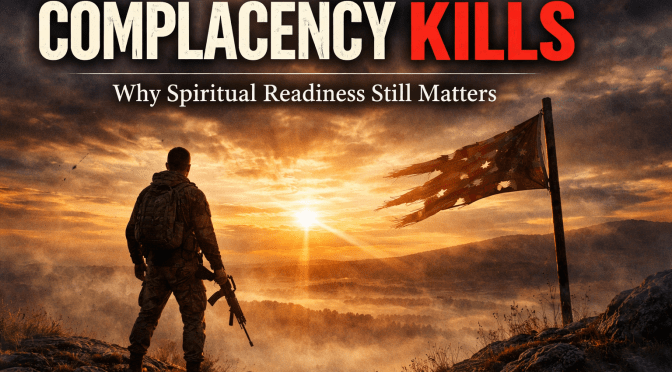
Complacency Kills: Why Spiritual Readiness Still Matters

There are some phrases that hit harder than others because they carry the weight of lived reality. “Complacency kills” is one of them.

It is simple. Direct. Uncomfortable. And absolutely necessary.

As I continue this discussion on Warrior Culture, I keep coming back to the fact that this phrase is not just something that belongs in military language, tactical spaces, or high-risk environments. It belongs in everyday life. It belongs in the home, in the church, in leadership, in fatherhood, in marriage, in discipleship, and in the hidden places of the heart. It belongs anywhere there is something worth protecting and anywhere there is a battle worth fighting.

That is one of the reasons Jamie Walden’s Omega Dynamics resonates so deeply with me. It forces the reader to confront a truth that many people would rather avoid: we are not living in neutral territory. We are living in contested ground. There is a real conflict between good and evil, truth and deception, courage and cowardice, conviction and compromise. And in that kind of environment, complacency is never harmless.

It is deadly.

When I say “complacency kills,” I am not only talking about physical danger, although that absolutely matters. I am also talking about spiritual drift, moral laziness, emotional passivity, and the slow erosion of conviction. I am talking about what happens when a man, a woman, a family, or a community stops watching, stops praying, stops training, stops discerning, and starts assuming that because nothing has gone wrong yet, nothing ever will.

That assumption is where many defeats begin.

What Complacency Really Is

Complacency is not rest. It is not peace. It is not confidence.

Complacency is a false sense of security that convinces us vigilance is no longer necessary.

It whispers that the standards can relax. It says the threat is exaggerated. It tells us that one more compromise is no big deal, one more distraction is harmless, one more neglected responsibility can wait until tomorrow. It persuades us to lower our guard without realizing that our guard was the very thing preserving us.

That is why complacency is so dangerous. It rarely announces itself as collapse. It usually presents itself as comfort.

That is what makes it lethal.

In a physical battle, complacency gets people hurt because they stop paying attention to the terrain, the patterns, the weaknesses, the indicators, and the possibility of contact. In the spiritual and moral battle, it works the same way. People stop paying attention to what is forming them. They stop paying attention to what they are tolerating. They stop paying attention to the condition of their own soul. They stop paying attention to the forces trying to shape their mind, their family, their values, and their priorities.

And because the decline is gradual, it feels manageable right up until the consequences become undeniable.

Warrior Culture Is Not About Aggression

This matters to say clearly: Warrior Culture is not about becoming harsh, loud, reactive, or obsessed with conflict.

True warrior culture is not reckless. It is disciplined.

It is not insecure bravado. It is governed strength.

It is not domination. It is responsibility.

A warrior, in the highest sense, is someone who understands that strength exists for service, not vanity. It exists to protect, to endure, to stand firm, to bear weight, to confront evil when necessary, and to remain faithful under pressure. Warrior culture, at its best, forms people who are hard to deceive, hard to intimidate, hard to corrupt, and hard to move off truth.

That is why this conversation matters so much in our time. We live in an age that often confuses softness with virtue and passivity with peace. But peace is not the absence of conflict. Peace is the presence of order under righteous authority. And order does not sustain itself automatically. It must be guarded. It must be cultivated. It must be defended.

That takes people who are awake.

That takes people who are willing to carry responsibility rather than avoid it.

That takes people who understand that good does not advance merely because it is good. Good must be chosen, practiced, embodied, defended, and handed down.

The Modern Battlefield Between Good and Evil

When I talk about the modern battlefield, I am not reducing everything to politics or headlines. The battlefield is bigger than that.

The battlefield is the human heart.

It is the mind that is being discipled either by truth or by lies.

It is the family that is either being strengthened or slowly fractured.

It is the church that is either becoming bold and clear or vague and compromised.

It is the culture that is either honoring what is good, true, and beautiful or celebrating confusion in the name of progress.

It is the individual who must decide every day whether he will drift with the current or stand against it.

Good and evil are not abstract categories. They become visible in what we normalize, what we reward, what we excuse, what we ignore, and what we are willing to fight for.

That is why complacency is so dangerous on this battlefield. Evil rarely needs our active cooperation at first. It often only needs our silence. Our distraction. Our hesitation. Our desire to stay comfortable. Our willingness to say, “It’s probably fine,” when deep down we know it is not fine.

The modern battlefield is full of subtle invasions. Deception rarely begins as open rebellion. It begins as a slight shift. A little compromise. A little exhaustion. A little indifference. A little moral fog. A little less prayer. A little less conviction. A little less courage.

And then one day we look around and realize we have tolerated what we once would have confronted.

That is what complacency does.

How Complacency Shows Up in Real Life

Complacency is not always dramatic. In fact, it is usually mundane.

It shows up when I know I need to strengthen an area of my life but keep postponing it because today feels easier than discipline.

It shows up when I consume far more than I create, react more than I think, and drift more than I lead.

It shows up when comfort becomes my highest value and conviction becomes negotiable.

It shows up when I stop training my mind, stop guarding my habits, stop evaluating my influences, and stop taking responsibility for my role.

It shows up when I assume somebody else will carry the burden.

Somebody else will speak the truth.
Somebody else will protect the children.
Somebody else will preserve the standard.
Somebody else will confront the lie.
Somebody else will lead with courage.

That mindset is dangerous because the battlefield does not pause while we outsource responsibility.

I believe one of the clearest signs of complacency in our time is the normalization of passivity. We have gotten used to being spectators. We watch. We scroll. We comment. We analyze. But many people never step into responsibility. They never take ownership of their fitness, their home, their habits, their discipleship, their relationships, or their calling.

But Warrior Culture does not allow me to live like a spectator.

It reminds me that I have a post to keep.

How I Apply “Complacency Kills” on the Modern Battlefield

For me, applying this concept begins with remembering that vigilance is a lifestyle.

It means I do not wait for crisis to start becoming serious.

I want to be the kind of person who is already building strength before the pressure hits. That applies spiritually, mentally, emotionally, and physically.

Spiritually, it means staying rooted. Prayer cannot be an emergency-only discipline. Scripture cannot be an occasional reference point. Discernment cannot be outsourced. If I want to stand in a corrupt and confused age, then I have to remain anchored in truth before I am tested by error.

Mentally, it means guarding what shapes my thinking. Not every voice deserves influence. Not every trend deserves attention. Not every popular idea deserves a place in my worldview. Complacency in the mind leads to confusion in judgment. And confusion in judgment eventually produces compromise in action.

Physically, it means respecting the connection between stewardship and readiness. The body matters. Endurance matters. capacity matters. Discipline matters. I do not want to build a life where my spirit is willing but my habits are weak. Readiness requires training.

Relationally, it means leading and loving on purpose. Homes do not become strong accidentally. Marriages do not stay healthy on autopilot. Children are not formed by vague intentions. If complacency is allowed into the home, it will eventually affect everything. So I want to be deliberate with my words, my presence, my protection, and my example.

Morally, it means refusing to make peace with what I know is corrosive. The modern battlefield is full of seductive compromises disguised as normal life. But not everything common is harmless. Not everything convenient is wise. Not everything culturally approved is good.

“Complacency kills” reminds me to stay alert where it would be easiest to go numb.

Vigilance Is Not Fear

This is where I want to keep the discussion positive and grounded.

Vigilance is not paranoia.

Readiness is not anxiety.

Warrior culture, rightly understood, does not produce frantic people. It produces sober people. Clear people. Steady people. Faithful people.

There is a big difference between living in fear and living awake.

Fear reacts from panic.
Vigilance responds from clarity.

Fear imagines threats everywhere.
Vigilance recognizes that danger is real but refuses to be ruled by it.

Fear collapses inward.
Vigilance stands outward.

In my own life, I have found that disciplined readiness actually produces more peace, not less. When I know I am paying attention, strengthening weak areas, staying grounded in truth, and taking responsibility for what has been entrusted to me, there is a deep steadiness that comes with that. Not because I control everything, but because I am no longer pretending the battle is not there.

Denial is fragile.
Preparedness is stabilizing.

That is one of the greatest gifts of this mindset. “Complacency kills” does not have to leave us discouraged. It can wake us up. It can call us higher. It can move us out of passivity and into purposeful living.

What This Means for Good and Evil

If the battlefield between good and evil is real, then every day matters.

Small choices matter.
Private disciplines matter.
Quiet obedience matters.
Integrity matters.
Courage matters.
Attention matters.

Good is strengthened when ordinary people choose faithfulness over drift.

Evil gains ground when people decide that alertness is exhausting, conviction is inconvenient, and courage can be delayed until later.

But later is often where regret lives.

So I want to live now with intention. I want to confront the subtle things before they become strongholds. I want to identify the vulnerabilities before they become failures. I want to build the habits now that will sustain faithfulness later.

That is the challenge in front of all of us.

Stay awake.
Stay grounded.
Stay disciplined.
Stay watchful.
Stay humble enough to examine yourself.
Stay strong enough to act when action is needed.
Stay close enough to truth that lies become easier to recognize.

Final Thoughts

When I think about Warrior Culture through the lens of Omega Dynamics and the phrase “complacency kills,” I do not walk away feeling hopeless. I walk away feeling summoned.

Summoned to greater clarity.
Summoned to greater discipline.
Summoned to greater courage.
Summoned to greater responsibility.

This is not a call to live angry. It is a call to live awake.

It is a call to reject the slow death of passivity and to embrace the kind of life that is spiritually alert, morally anchored, and ready to stand. The modern battlefield between good and evil is not won by people who are casually drifting through life. It is faced by men and women who understand that vigilance is love in action, discipline is stewardship, and courage is still required.

Complacency kills.

So I do not want to coast.
I do not want to sleep through the hour.
I do not want to hand off my responsibility to someone else.
I do not want comfort to become my commander.

I want to be found faithful at my post.

And I believe that is the heart of Warrior Culture: not obsession with battle for its own sake, but readiness to stand for what is good, true, and worth defending when the battle comes.

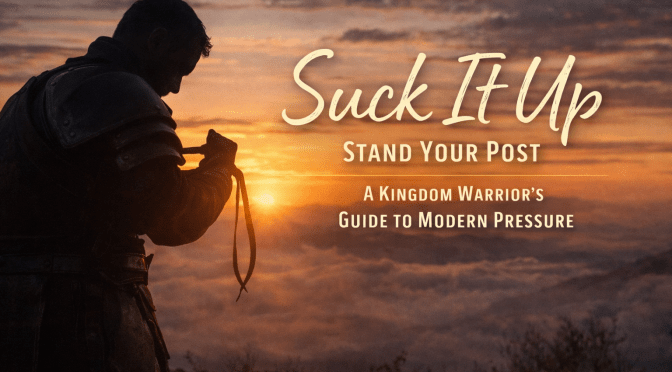
Suck It Up, Stand Your Post: A Kingdom Warrior’s Guide to Modern Pressure

There’s a phrase I’ve heard my whole life that can land two very different ways depending on who says it, when they say it, and what they mean by it.

“Suck it up.”

For some people, it’s the language of grit—the push that keeps you moving when you’d rather quit. For others, it’s the language of neglect—a way to silence pain, dismiss weakness, and pretend the heart doesn’t matter.

As I continue this conversation on warrior culture—especially through the lens of Jamie Walden’s Omega Dynamics—I want to redeem that phrase and put it in its proper place. Because I believe there is a Kingdom way to “suck it up” that doesn’t make me numb, harsh, or spiritually brittle. And I believe that kind of endurance is urgently needed on the modern battlefield between good and evil.

Not because we’re trying to become cold. But because we’re trying to become faithful.

Not because we’re trying to ignore pain. But because we refuse to let pain become our master.

Not because we’re trying to “man up” in some shallow, performative way. But because there is a real war for the mind, for the home, for the conscience, for the next generation—and warriors who fold under pressure don’t hold the line very long.

So when I say “suck it up,” I’m not talking about stuffing emotions until they explode sideways. I’m talking about choosing faithful endurance in the face of real pressure. I’m talking about standing my post when my feelings are loud and my strength is low. I’m talking about doing the next right thing—again and again—until obedience becomes instinct.

Why I’m Talking About This at All

I’m continuing this warrior culture discussion because I’ve watched something happen in the modern world: discomfort has been treated like an emergency, and discipline has been treated like oppression.

We’ve been trained to believe that if something is hard, it must be wrong.

If it costs something, it must be unhealthy.

If it requires endurance, it must be toxic.

But the truth is, a life without endurance isn’t a life of freedom—it’s a life of fragility.

And fragility is expensive. It costs your relationships. It costs your calling. It costs your clarity. It costs your witness. It costs your peace.

I’ve also seen the opposite extreme: a counterfeit toughness that pretends pain doesn’t exist, that mocks weakness, that refuses help, and that uses “suck it up” as a weapon to shut down the human soul.

That’s not Kingdom warrior culture either.

So I’m aiming for something better: strength with humility, endurance with honesty, discipline with love, grit with a clean heart.

That kind of warrior doesn’t just survive the battle. That kind of warrior becomes an anchor for others in the storm.

Defining “Suck It Up” the Kingdom Way

Let me put this plainly.

“Suck it up,” in a redeemed, Kingdom sense, means I refuse to let discomfort, fear, temptation, or fatigue drive the decisions of my life.

It means I don’t obey my mood. I obey my mission.

It means I don’t ask, “What do I feel like doing?” first. I ask, “What does faithfulness require?” first.

It means when I’m pressured, I don’t reach for the fastest relief. I reach for the truest response.

It means I accept that sometimes the right path feels heavy—and I walk it anyway.

But I need to say what it does not mean:

It does not mean I pretend I’m okay when I’m not.

It does not mean I suppress pain until it becomes anger or addiction.

It does not mean I isolate and call it strength.

It does not mean I refuse counsel and call it independence.

It does not mean I stay wounded forever and call it “just how I am.”

The Kingdom way doesn’t produce robots. It produces resilient disciples.

So I’m not trying to become less human. I’m trying to become more whole.

Omega Dynamics and the Warrior-Class Mindset

One of the reasons Omega Dynamics resonates with people is because it refuses to treat life as neutral. It frames the believer’s life as something more than passive church attendance. It calls for readiness, discipline, sobriety, and spiritual clarity—what Walden describes in terms of a “warrior class” of Christians.

When I read that concept, I don’t hear elitism. I hear responsibility.

Because the world doesn’t need more spectators who can comment on the battle. The world needs more believers who can stand steady inside it.

In a war, you can’t always choose the conditions. But you can choose whether you’re prepared. You can choose whether you’re disciplined. You can choose whether you’ll become the kind of person who holds the line when others panic.

And that’s where “suck it up” becomes more than a phrase. It becomes a mindset of readiness:

I won’t be ruled by comfort.

I won’t be manipulated by fear.

I won’t be seduced by distraction.

I won’t be owned by my appetites.

I won’t abandon my post because it got hard.

That’s not bravado. That’s maturity.

The Modern Battlefield Between Good and Evil Isn’t Always Loud

When people think of “good versus evil,” they often imagine dramatic scenes—headline-level evil, obvious villains, obvious crises. But the battle we face most days is quieter than that.

The modern battlefield is often fought in:

My thought life—what I believe, what I rehearse, what I allow to live rent-free in my mind.

My attention—what gets my time, my focus, my imagination.

My appetite—what I reach for when I’m stressed or lonely.

My integrity—what I do when nobody’s watching.

My speech—whether I bless or curse with my words.

My home—whether peace or chaos is being cultivated.

My relationships—whether I’m present, honest, faithful.

In that sense, the battle is not only external. It’s internal. And one of the enemy’s most effective strategies is not to make me commit some dramatic sin—it’s to make me drift.

A little compromise here.

A little distraction there.

A little bitterness tucked away.

A little fatigue that becomes permission.

A little resentment that becomes identity.

And suddenly I’m not fighting. I’m coping.

Pressure Is Real—But Pressure Doesn’t Have to Win

Here’s something I’ve had to learn the hard way: pressure itself is not the problem. What I do with pressure is the problem.

Pressure can form me or fracture me.

Pressure can refine me or reveal what’s already weak.

Pressure can push me toward God—or pressure can become the excuse I use to abandon Him.

This is why the phrase “suck it up” matters on a spiritual battlefield.

Because there will be pressure:

You will get tired.

You will feel misunderstood.

You will want to quit.

You will feel tempted.

You will feel discouraged.

You will be disappointed by people.

You may even be disappointed with yourself.

And in those moments, the enemy whispers the same kinds of lies:

“You’re tired. Just check out.”

“You’re stressed. You deserve this.”

“You’re hurt. Become cynical.”

“You’re alone. Compromise.”

“You’ve failed before. Why try again?”

The war is often fought at the level of narrative—the story I tell myself about why I’m allowed to drift.

So when I say “suck it up,” I mean I refuse to let those lies become my permission slip.

I refuse to let pressure rewrite my convictions.

What “Suck It Up” Looks Like When I Apply It Correctly

Let me make this practical. Here’s what it looks like when I try to live this out as a Kingdom-minded warrior.

1) I Choose the Next Right Step, Not the Perfect Feeling

There are days I don’t feel spiritual. There are days I don’t feel strong. There are days my emotions are loud and my mind is foggy.

On those days, I don’t need a dramatic spiritual breakthrough as much as I need the next right step.

Pray anyway.

Open the Word anyway.

Tell the truth anyway.

Apologize anyway.

Show up anyway.

Get to work anyway.

Love my family anyway.

Do the responsible thing anyway.

The enemy loves to make me think I need to “feel it” before I live it. But discipline teaches me that obedience often comes before emotion catches up.

2) I Refuse to Negotiate With Temptation

Temptation always wants a conversation.

It wants me to sit down with it, analyze it, justify it, rationalize it, delay resistance until my willpower is exhausted.

Warrior culture trains decisiveness.

So my goal is not to “manage temptation.” My goal is to shut it down early.

When the thought comes, I don’t feed it.

When the opportunity appears, I don’t flirt with it.

When the old habit calls, I don’t take the call.

“Suck it up” means I accept the discomfort of saying no now so I don’t suffer the consequences of saying yes later.

3) I Endure Without Becoming Harsh

This is huge for me.

Endurance can accidentally harden a person. You can become so “tough” that you lose tenderness. You can become so “disciplined” that you become impatient with weakness—your own and everyone else’s.

But Kingdom warrior culture doesn’t make me cruel. It makes me steady.

So I’m learning to endure without losing compassion.

To stand firm without becoming arrogant.

To hold the line without needing to demean anyone to do it.

To correct without humiliating.

To speak truth without enjoying the fight.

If my endurance makes me less loving, then I’m not becoming strong—I’m becoming damaged.

4) I Stay Faithful in Private

Private faithfulness is the real battlefield.

It’s easy to talk about discipline publicly.

It’s harder to practice it quietly:

The integrity choice when nobody will know.

The faithful habit when nobody will clap.

The consistent prayer life when nobody sees it.

The decision to turn off what I shouldn’t watch.

The decision to stop scrolling and start listening.

The choice to guard my eyes and mind.

The choice to keep my word.

“Suck it up” means I don’t need an audience to obey.

5) I Let Responsibility Be a Form of Love

Warrior culture respects responsibility. It doesn’t treat it like a curse; it treats it like an honor.

I’ve started viewing responsibility as love in action.

Providing is love.

Protecting is love.

Staying emotionally present is love.

Leading my household toward peace is love.

Refusing to lash out when I’m stressed is love.

Enduring hardship without making everyone else pay for my mood is love.

Sucking it up, in that sense, is not about ego. It’s about servanthood.

The Line I Refuse to Cross: “Suck It Up” Cannot Mean “Shut Down”

Now let me speak to the danger.

Some people “suck it up” by shutting down emotionally. They stop feeling. They stop talking. They stop processing. They stop letting anyone in. They confuse silence with strength.

But what happens when you don’t process pain?

It doesn’t disappear. It relocates.

It leaks out as anger.

It leaks out as addiction.

It leaks out as workaholism.

It leaks out as cynicism.

It leaks out as control.

It leaks out as numbness.

That’s not warrior culture—that’s a slow internal collapse with a tough exterior.

The Kingdom way includes honesty.

I can be strong and still grieve.

I can be disciplined and still ask for help.

I can endure and still confess, “Lord, this is heavy.”

Even Christ, in His humanity, expressed sorrow and anguish. Strength is not the absence of emotion. Strength is choosing obedience while emotions are present.

So if “suck it up” becomes a way to avoid healing, it turns toxic.

My goal is not denial. My goal is endurance with God.

The Warrior Tools That Help Me Live This Out

If I’m going to apply this on the modern battlefield, I need practices—not just ideas.

Here are tools I return to again and again.

Prayer as a Briefing

I don’t always pray long prayers. But I try to pray honest ones.

“Lord, keep me faithful today.”

“Guard my mind.”

“Help me endure without becoming bitter.”

“Give me courage to do what I already know is right.”

Simple. Direct. Daily.

Scripture as a Map

Truth counters lies. And most spiritual battles begin with lies.

Lies about God.

Lies about me.

Lies about what sin will cost.

Lies about what obedience will require.

The Word anchors me when narratives start swirling.

Physical Stewardship

I’ve learned that the body and soul are connected. When I’m exhausted, I’m more tempted. When I’m undisciplined physically, I’m often undisciplined mentally.

Rest matters.

Training matters.

Routine matters.

Not as vanity—stewardship.

A warrior doesn’t despise the body. A warrior maintains it for the mission.

Accountability and Brotherhood

Every warrior needs a unit.

Isolation is where excuses thrive.

So I need people I can be real with—people who will call me higher, pray with me, and keep me honest when I start rationalizing compromise.

Guarding the Gates

What I watch shapes what I tolerate.

What I scroll shapes what I desire.

What I repeat shapes what I believe.

Warrior culture means I protect the gates of my mind and home with intentionality.

The Positive Side of “Suck It Up”: I Become Someone Others Can Rely On

Here’s the fruit of doing this the right way: faithfulness starts blessing people around me.

When I “suck it up” in a redeemed sense—meaning I endure with humility and discipline—I become more reliable.

I become steadier in crisis.

I become less reactive.

I become safer to be around.

I become more present.

I become the kind of person who can carry weight without making everyone else carry my emotional spillover.

And that is deeply needed right now.

Because many people don’t need another opinion. They need an example.

They need someone who can stand firm without becoming cruel.

Someone who can endure without becoming numb.

Someone who can suffer without becoming selfish.

Someone who can fight evil without adopting evil’s methods.

That’s Kingdom warrior culture.

A Thought-Provoking Self-Check I’m Using

This phrase forces me to ask questions I can’t dodge:

Am I calling comfort “wisdom” when it’s actually compromise?

Am I avoiding responsibility and naming it “boundaries”?

Am I enduring with God—or merely surviving without Him?

Am I becoming stronger—or just becoming harder?

What would change if I treated today like I’m on watch?

Those questions don’t condemn me. They correct me. They pull me back to center.

Conclusion: Suck It Up and Stand Your Post—With God

The modern battlefield between good and evil is not a movie scene. It’s daily life.

It’s the pressure to drift.

It’s the temptation to cope instead of conquer.

It’s the subtle invitation to compromise and call it maturity.

So my goal is not to become a harsh person with a hard face. My goal is to become a faithful person with a steady soul.

“Suck it up,” the Kingdom way, means I accept that faithfulness costs something—and I pay the cost with humility.

It means I endure the discomfort of obedience because I believe the fruit of obedience is worth it.

It means I stand my post when nobody cheers.

It means I keep my word.

I guard my gates.

I refuse the lies.

I take the next right step.

And when I’m tired, I don’t quit—I pray, I recalibrate, I lean into my brothers, and I stand again.

Because warrior culture in the Kingdom is not about being the loudest voice in the room.

It’s about being the most faithful presence in the room.

And on this battlefield, faithfulness is not weakness.

Faithfulness is warfare.

The Warrior Culture of the Kingdom: What “Always Faithful” Demands of Me

There are phrases that sound inspiring on a shirt, but carry weight when you try to live them on an ordinary Tuesday.

“Always Faithful” is one of those phrases for me.

It’s simple. It’s direct. It doesn’t leave much room for loopholes. And that’s exactly why it confronts me in the best way. Because if I’m honest, my default setting is not “always.” My default is “mostly.” Or “when I’m in the mood.” Or “when it’s convenient.” Or “when I feel strong.”

But “Always Faithful” calls me higher than convenience. It calls me into a kind of warrior culture that isn’t built on aggression or swagger, but on steadfast loyalty—especially when nobody is watching, when the pressure is real, and when the cost is personal.

When I talk about warrior culture, I’m not talking about a personality type. I’m talking about a posture. A way of standing in the world. A way of carrying responsibility without collapsing under it. A way of living as if good and evil are not just abstract concepts, but forces that press against the heart every day.

And in that sense, the battlefield is not only “out there.” The battlefield is also within.

This is where Jamie Walden’s “Omega Dynamics” has been useful for me as a frame—because it doesn’t treat life like a neutral stroll through history. It calls believers to wake up, to recognize the reality of spiritual conflict, and to become what he describes as a “warrior class” of Christians: grounded, disciplined, and ready for the days ahead. Not paranoid. Not theatrical. Not violent. Ready.

Ready to stay faithful.

What Warrior Culture Is—and What It Isn’t

Before I go further, I need to define what I mean, because “warrior culture” can get twisted fast.

True warrior culture is not a love affair with violence. It’s not a fetish for conflict. It’s not posturing, bullying, or trying to dominate people. That’s not strength. That’s insecurity dressed up as toughness.

Real warrior culture is ordered courage.

It is strength under authority.

It is the willingness to carry responsibility when it would be easier to walk away.

It is discipline that shows up even when the feelings don’t.

It is loyalty to mission and to people—especially when there’s no applause.

And in the Kingdom of God, warrior culture must be shaped by the character of Christ. That means humility has to sit inside strength. Love has to guide power. Truth has to outrank ego.

If my “warrior culture” makes me cruel, I’m not becoming a warrior—I’m becoming a threat.

If it makes me proud, I’m not being forged—I’m being inflated.

But if it makes me faithful—steady, sober, courageous, resilient, loving—then I’m moving in the right direction.

“Always Faithful” Is a Standard, Not a Mood

The reason “Always Faithful” hits me is because it doesn’t ask how I feel. It asks who I am.

And that’s the core of it: faithfulness is identity, not emotion.

A faithful person doesn’t wake up every day with perfect enthusiasm. A faithful person wakes up and does what is right anyway. Faithfulness is what you do when motivation is low, temptation is high, and the path is narrow.

In a spiritual sense, I think “Always Faithful” means this:

Faithful to God’s truth even when the culture calls it foolish.

Faithful to God’s ways even when shortcuts look easier.

Faithful in private before I try to be faithful in public.

Faithful when my prayers feel powerful, and faithful when my prayers feel like they bounce off the ceiling.

Faithful when my circumstances are calm, and faithful when my life is shaking.

That’s not perfection. That’s posture.

And I believe God honors posture.

Omega Dynamics and the Call to Stop Living Like a Spectator

One idea I’ve taken from “Omega Dynamics” is the insistence that believers should stop living like spectators.

There’s a difference between believing in God and being enlisted under His leadership.

There’s a difference between knowing Scripture and being formed by it.

There’s a difference between admiring courage and practicing it.

The “warrior class” concept, as I understand it, isn’t about elitism. It’s about maturity. It’s a call to become the kind of believer who doesn’t fold at the first sign of pressure. The kind of believer who can discern what’s happening in the world without becoming hysterical. The kind of believer who can stand firm, love well, and think clearly while other people panic.

That matters, because we live in an age where confusion is celebrated, distraction is constant, and compromise is marketed as compassion.

If I’m not intentional, I drift.

And drift is one of the enemy’s favorite strategies—not a dramatic fall, but a slow fade.

The Modern Battlefield Between Good and Evil

When I say “battlefield,” I’m not trying to sound dramatic. I’m describing what it feels like to live in a world where the pressure to compromise is constant.

The modern battlefield between good and evil is fought in places that don’t always look “spiritual” at first glance:

In the mind—what I allow to shape my beliefs.

In my attention—what gets my focus, my time, my imagination.

In my desires—what I chase when I’m stressed, lonely, or bored.

In my identity—who I believe I am and what I believe I’m for.

In my speech—whether my words heal or poison.

In my relationships—whether I love people with truth or use people for comfort.

In my home—whether I lead with presence or surrender the atmosphere to chaos.

Evil rarely announces itself as evil. It often shows up as a “reasonable” trade:

Trade conviction for comfort.

Trade prayer for distraction.

Trade truth for approval.

Trade courage for safety.

Trade holiness for “just this once.”

And the problem with trades is this: you rarely notice the cost until you’ve been doing it for a while.

Drift Is Not Neutral—It’s a Direction

One of the most thought-provoking realities for me is this: nobody accidentally becomes faithful. But a lot of people accidentally become compromised.

Drift doesn’t require effort. Drift requires neglect.

If I neglect prayer, I don’t become neutral—I become vulnerable.

If I neglect Scripture, I don’t become “free”—I become shaped by whatever is loudest.

If I neglect community, I don’t become independent—I become isolated, and isolation is where temptation speaks the clearest.

If I neglect repentance, I don’t become “confident”—I become hardened.

This is why “Always Faithful” feels like a battle cry. Not because I’m trying to win arguments, but because I’m trying to keep my soul alive.

Faithfulness is how I resist drift.

Applying Warrior Culture to the Real War: Staying Sane, Staying Soft, Staying Strong

If the modern battlefield is spiritual, then the weapons aren’t primarily physical. The weapons are disciplines, virtues, and decisions—repeated until they become instinct.

Here’s what applying these concepts looks like in my life.

1) I Start the Day Like I’m On Watch

Warrior culture includes an understanding of watchfulness. Someone is always on post. Someone is always guarding the gate. That mindset translates spiritually.

I cannot afford to start my day with chaos and call it “normal.”

So I treat prayer like a briefing. Not a performance—alignment.

Sometimes it’s simple: “Lord, keep me faithful today. Guard my mouth. Guard my eyes. Guard my mind. Make me courageous. Make me clean. Make me useful.”

That’s not fancy, but it’s real.

And reality is where battles are won.

2) I Treat Scripture Like a Map, Not a Decoration

If I’m not anchored in truth, I will be tossed by trends. That’s not a theory—it’s predictable.

The point of Scripture is not to make me sound smart. The point is to make me steady.

On the modern battlefield, deception is common. Half-truths are everywhere. Emotional manipulation is normal. Outrage is profitable. If I don’t know what God says, I’ll start repeating what the crowd says—and I’ll call it wisdom because it has likes.

A warrior can’t afford that.

So I return to the Word, not as a ritual, but as reinforcement. Truth has to be installed in me, not just visited.

3) I Build Rules of Engagement for My Life

Warriors don’t walk into conflict without rules of engagement. In the spiritual realm, I need boundaries, because my heart is not indestructible.

Rules of engagement sound like this:

I don’t entertain what I would hate to become.

I don’t flirt with what I pray against.

I don’t call weakness “self-care” if it’s actually self-indulgence.

I don’t excuse sin because the culture renamed it.

I don’t keep secrets that thrive in darkness.

I don’t feed anger and call it righteousness.

I don’t weaponize truth to hurt people.

I tell the truth, but I tell it with a clean heart.

If my methods contradict Christ, my mission is already compromised.

4) I Refuse the Counterfeit Warrior Spirit

There is a counterfeit warrior spirit that is loud, reactive, and addicted to conflict. It always needs an enemy. It always needs a fight. It confuses aggression for authority and sarcasm for discernment.

I’ve had to check myself here.

Because there’s a kind of “strength” that is really just unresolved anger.

There’s a kind of “boldness” that is really just pride.

There’s a kind of “discernment” that is really just suspicion.

But the warrior culture of the Kingdom is different.

It is steady.

It is patient.

It is courageous without being cruel.

It is strong enough to stay gentle.

It is bold enough to stay humble.

It can confront evil without becoming evil.

That’s not weakness. That’s mastery.

5) I Fight for Faithfulness in the Small Things

One of the most practical shifts for me has been realizing that the biggest battles are often won or lost in small decisions:

Will I tell the truth when a lie would be easier?

Will I apologize without defending myself?

Will I shut down temptation at the first knock, or invite it in for conversation?

Will I be present with my family, or disappear into screens?

Will I serve when I feel unnoticed?

Will I keep my word when it costs me?

Will I choose integrity when I could get away with compromise?

Warrior culture is forged in repetition. Faithfulness is built the same way.

Small obediences become spiritual strength.

The “Always” Part: Faithful When It’s Hard, Not Just When It’s Holy

“Always Faithful” sounds inspiring until you realize it includes days you didn’t plan for:

Days when you’re tired and irritable.

Days when temptation is loud.

Days when your prayers feel dry.

Days when people misunderstand you.

Days when doing the right thing costs you socially, financially, or emotionally.

This is where the phrase becomes more than a motto. It becomes a decision.

I cannot control everything that happens to me. But I can control whether I stay faithful in it.

Faithful doesn’t mean I never struggle. It means I don’t surrender.

Faithful doesn’t mean I never doubt. It means I bring my doubts to God instead of running from Him.

Faithful doesn’t mean I never get wounded. It means I refuse to let wounds become excuses for sin.

And this is where the modern battlefield reveals itself: the enemy loves to use fatigue as leverage. Burnout can become a doorway to compromise. Discouragement can become permission to quit.

So I have to fight for resilience—not the kind that pretends everything is fine, but the kind that keeps walking with God when life is not fine.

Every Warrior Needs a Unit

A lone-wolf mentality is not warrior culture. It’s vulnerability.

Even the strongest person becomes unstable without support.

So part of applying these concepts is building brotherhood and sisterhood—people who can speak truth, pray, challenge, encourage, and remind you who you are when your emotions get loud.

Accountability is not control. It’s protection.

And protection is love.

If I want to be “Always Faithful,” I need relationships where faithfulness is normal, not strange.

The Goal Is Not to Be Dangerous—It’s to Be Holy

This is a key point I want to keep clear.

Some people confuse “warrior” with “dangerous.” They want to feel intimidating. They want to feel feared. They want to feel like they can crush opposition.

But the goal in the Kingdom is not intimidation. The goal is transformation.

Holiness is not fragility. Holiness is power with purity.

A holy person is not controlled by impulse.

A holy person is not enslaved to addiction.

A holy person is not owned by pride.

A holy person is not manipulated by fear.

Holiness is the strength to obey God consistently.

That is warrior culture at its highest level.

A Thought-Provoking Question I Keep Asking Myself

If “Always Faithful” is the standard, I have to ask:

Where am I not faithful yet?

Not where someone else is failing. Where I am.

Where do I compromise quietly?

Where do I entertain what I should resist?

Where do I call convenience “wisdom” when it’s really avoidance?

Where do I let my emotions drive the wheel instead of letting truth drive the wheel?

Where am I more loyal to comfort than to calling?

These questions don’t exist to condemn me. They exist to calibrate me.

A warrior who refuses evaluation becomes a liability.

A believer who refuses repentance becomes brittle.

But a person who stays teachable stays dangerous in the right way: dangerous to darkness, because they won’t be owned by it.

Conclusion: “Always Faithful” Is How I Hold the Line With Hope

In the end, “Always Faithful” is not a call to become harsh. It’s a call to become steady.

It’s not a demand to become perfect. It’s a demand to stay committed.

It’s not about winning every moment. It’s about not abandoning the mission.

Warrior culture—rightly understood—forms people who can be trusted under pressure. People who don’t collapse when life gets heavy. People who don’t betray their convictions for temporary relief. People who love well, tell the truth, serve quietly, and stand firm when the wind shifts.

And that is exactly what I want to be in the modern battlefield between good and evil:

Not loud. Not performative. Not fueled by rage.

Faithful.

Always faithful.

“Without Excuse”: The Chapter That Won’t Let Me Stay Comfortable

There are chapters in Scripture that feel like a warm blanket—comforting, steady, familiar. And then there are chapters that feel like a mirror held up under bright light. Romans 1 is that kind of chapter for me.

It doesn’t let me hide behind vague spirituality. It doesn’t let me settle for “I’m doing my best.” It doesn’t let me pretend that my choices are neutral or harmless. Romans 1 presses me with a question I can’t politely sidestep: What am I doing with what I already know about God?

When I sit with the first chapter of Romans, I hear Saint Paul laying a foundation that is both sobering and strangely hopeful. Sobering, because he dismantles the many excuses human beings use to turn away from the Lord. Hopeful, because the only reason God exposes what’s broken is because He intends to heal it. Paul isn’t writing to entertain us. He’s writing to wake us up.

Romans 1 does not read like a casual devotional thought. It reads like a spiritual diagnosis. And the uncomfortable truth is this: I can recognize myself in the patterns Paul describes if I’m willing to be honest.

The Gospel Isn’t Decoration—It’s Power

Paul opens Romans with clarity about who he is and what he’s been called to do. He is not presenting a self-help strategy or a philosophical theory. He is announcing good news—news that carries power.

That’s one of the first places my excuses get challenged.

Because I can treat faith like decoration. A nice addition. A background song. Something I nod at but don’t build my life on. I can hold Christian vocabulary and still live as though I’m the final authority over my own heart.

Paul doesn’t allow that kind of split life. He speaks about the gospel as the power of God for salvation. Not just information—power. Not just inspiration—transformation. If the gospel is true, then it has claims on me. It means God is not merely a concept; He is Lord.

And if He is Lord, then I don’t get to make excuses as if my choices are private and consequence-free.

The Excuse of Ignorance: “I Didn’t Know”

One of the most common excuses people make for turning their backs on God is the claim of ignorance: “I didn’t know any better.” “No one taught me.” “How could I be expected to understand?”

Paul speaks directly to that instinct. He says that what can be known about God is plain because God has shown it. He points to creation—God’s invisible attributes made visible through what has been made. In other words, the world itself bears witness. The design, the order, the beauty, the moral awareness that tugs at the human conscience—these are not accidents.

Paul’s point is not that every person has perfect theological knowledge. His point is that we’re not starting from zero.

And that’s where the excuse starts to crumble.

Because if I’m honest, my problem is rarely a lack of information. My problem is often a lack of surrender. I can know enough to seek God and still choose not to. I can sense God’s presence and still resist Him. I can recognize that life has meaning and still live as though it doesn’t.

Ignorance can be real. But it can also be a mask I wear when I don’t want responsibility. Paul’s words push me to ask a more direct question: Am I truly unaware—or am I unwilling?

The Excuse of Disappointment: “God Didn’t Show Up for Me”

Another excuse people make is rooted in pain. “If God were real, He wouldn’t have let that happen.” “I prayed and nothing changed.” “I tried faith and it didn’t work.”

I don’t say those words lightly. Disappointment is not imaginary. Grief is not theoretical. Trauma leaves marks. And I never want to speak about suffering as if it’s simple.

But Romans 1 confronts something else: the way suffering can become permission.

There is a difference between wrestling with God in pain and using pain as an alibi to reject Him entirely. I can be wounded and still turn toward the Lord—or I can be wounded and decide that my hurt gives me the right to live however I want.

This is one of the hardest spiritual crossroads: when pain tempts me to enthrone myself. When the logic becomes, “Because I suffered, I get to decide what’s right.” That kind of reasoning feels protective. It feels like control. But it can also become a door into deeper darkness.

Paul is not dismissing pain. He’s exposing the danger of turning pain into a permanent excuse for unbelief, bitterness, or rebellion.

The Excuse of Self-Approval: “I’m a Good Person”

This is a popular one, and it can sound so reasonable: “I’m a good person. I’m kind. I’m not hurting anyone. Surely that counts for something.”

There’s a subtle trap here. When I say “good,” I often mean “better than someone else.” I compare myself downward to find comfort upward.

Paul doesn’t let me do that. Romans is not primarily about grading on a curve. It’s about God’s holiness and humanity’s need.

Being “nice” is not the same as being righteous. Being socially acceptable is not the same as being spiritually aligned. And the heart can be full of pride while the hands look polite.

The excuse of self-approval keeps me from repentance because it convinces me I don’t need it. It tells me that the standard is my own best intentions rather than God’s truth.

But Romans 1 pushes me to realize: the issue is not whether I can point to a few respectable traits. The issue is whether I honor God as God.

The Excuse of Identity: “This Is Just Who I Am”

One of the most powerful excuses of our time is the claim that desire equals destiny. “This is just who I am.” “God made me this way.” “If I deny myself, I’m denying my true self.”

Paul’s logic cuts deeper than modern slogans. He shows how human beings exchange truth for lies, how desires can become disordered, and how the heart can worship the created instead of the Creator.

I have to be careful here, because this conversation can quickly become combative in the wrong hands. But Paul is not writing to pick fights. He is writing to show what happens when we detach identity from God.

Every one of us has desires. Every one of us has impulses. Every one of us has a will that wants control. The question isn’t whether I feel something. The question is whether my feelings are my final authority.

“This is just who I am” can be a confession of helplessness masquerading as empowerment. It can be a way of saying, “Don’t ask me to change. Don’t challenge my choices. Don’t call me higher.”

But the gospel calls every person—me included—into transformation. Grace does not flatter my bondage. Grace breaks it.

The Excuse of Culture: “Everyone’s Doing It”

Another excuse slips in quietly: normalcy. “It’s just the way things are now.” “You’re being outdated.” “Times have changed.”

Romans 1 reminds me that culture can train the conscience. What used to shock can become entertainment. What used to grieve can become a joke. What used to be resisted can become celebrated.

This is one of the most dangerous drifts because it rarely feels like rebellion. It feels like adaptation. It feels like being reasonable. But Paul describes a downward spiral that begins with a refusal to honor God and ends with confusion so deep that people not only practice what’s destructive but approve of it in others.

That last part is haunting: approval. Not just doing wrong, but clapping for it. Not just stumbling, but recruiting.

I’ve learned to watch for the moment my heart starts calling darkness “freedom” simply because it’s popular. That’s not progress. That’s a trade.

The Great Exchange: Worship Traded for Substitutes

One theme in Romans 1 hits me like a drumbeat: exchange.

Paul describes people exchanging the glory of God for images. Exchanging truth for a lie. Exchanging gratitude for entitlement. Exchanging worship for substitutes.

When I hear “idols,” I don’t only think of statues. I think of the modern things that promise me what only God can give:

Comfort that replaces obedience.
Approval that replaces integrity.
Control that replaces trust.
Pleasure that replaces peace.
Success that replaces sanctity.
Distraction that replaces prayer.

Idolatry isn’t always loud. Sometimes it’s incredibly practical. It’s whatever I run to first, whatever I fear losing most, whatever I use to define my worth, whatever I cling to when God asks me to let go.

Paul is not merely listing sins. He’s revealing a heart condition: worship disorder. When I stop worshiping God, I do not become neutral. I become a worshiper of something else.

The Phrase That Stops Me: “God Gave Them Over”

There is a line in Romans 1 that should sober any honest soul: “God gave them over.”

Paul repeats it in different forms, and it reveals something deeply unsettling: sometimes judgment looks like permission. Not God striking someone down in dramatic fashion, but God allowing a person to have what they insist on.

This is not God being petty. This is God honoring human choice. If I continually reject His truth, if I continually resist His conviction, if I continually harden myself, there can come a point where God lets me walk further into what I’ve chosen.

And what happens then?

Paul describes a life that starts to unravel from the inside out. Thinking becomes futile. The heart grows dark. Gratitude disappears. Pride increases. Desires escalate. Relationships distort. The conscience dulls.

I’ve seen versions of this in real life, and if I’m honest, I’ve seen seeds of it in myself when I refuse correction.

When I give in to my own human devices—my impulses, my pride, my appetite for control—things don’t stay stable. Sin is never satisfied with “a little.” It always demands more. It expands. It excuses itself. It rewires the mind.

Romans 1 isn’t just warning about consequences out there in society. It’s warning me about what happens in here, in the inner world of the heart.

How Excuses Multiply—and So Does the Damage

Excuses are rarely singular. They stack.

“I didn’t know” becomes “I don’t care.”
“I’m hurt” becomes “I’m entitled.”
“I’m fine” becomes “I’m superior.”
“This is who I am” becomes “Don’t you dare challenge me.”
“Everyone’s doing it” becomes “It must be right.”

And with each excuse, something precious erodes: humility. The ability to repent. The willingness to listen. The tenderness that once responded to God.

Paul describes people who not only do what is wrong but also approve it in others. That’s the social ripple. When I excuse my own sin, I often need others to validate it. Approval becomes a form of anesthesia. If enough people clap, maybe I won’t have to feel the conviction.

But conviction is mercy.

And that’s where Romans 1, surprisingly, becomes hopeful.

The Point Isn’t Shame—It’s Rescue

If Romans 1 only produced despair, it wouldn’t be from the heart of God. God does not expose for entertainment. God exposes to heal.

This chapter is not an invitation to self-righteousness. It’s an invitation to repentance.

Paul is building a case—not so we can look down on “those people,” but so every person can see the danger of drifting from God and the necessity of the gospel.

When I read Romans 1 in the right spirit, it doesn’t make me arrogant. It makes me alert. It reminds me that I am not above temptation. It reminds me that my heart needs guarding. It reminds me that faith is not passive.

Most importantly, it reminds me that the Lord is not indifferent. If He were indifferent, He would let me sleepwalk into destruction without warning. But Romans 1 is a warning label written in love.

What I Do When I Catch Myself Making Excuses

So what do I do with this chapter—practically, personally?

First, I name the excuse. Not vaguely. Specifically. I bring it into the light.

Second, I ask what I’m protecting. Excuses are usually shields. They protect my pride, my comfort, my habits, my reputation, my secret pleasures, my fear of change.

Third, I replace the excuse with a next step. Not an emotional promise, but an actual step:
I pray honestly, even if it’s simple.
I return to Scripture, not for ammunition, but for alignment.
I confess sin instead of defending it.
I seek accountability instead of isolation.
I worship even when I don’t feel like it, because worship reorders desire.
I choose obedience over impulse, even in small ways, because small obediences build spiritual strength.

I’ve learned that repentance is not humiliation. It’s relief. It’s the moment I stop carrying the exhausting burden of pretending I’m fine.

No Excuses Doesn’t Mean No Hope

Romans 1 doesn’t end with a cute slogan, and it doesn’t hand me an easy exit. It confronts me. It challenges me. It insists that God is God and I am not.

But that confrontation is not cruelty. It is clarity.

If I have been making excuses, I can stop. If I have been drifting, I can return. If I have been worshiping substitutes, I can lay them down. If I have been living by my own devices, I can submit my life again to the Lord who loves me enough to warn me.

The thought that keeps ringing in my mind when I close Romans 1 is this: excuses don’t protect me—they imprison me.

And the Lord is not calling me into a smaller life of restriction. He is calling me into a larger life of truth—where I’m not ruled by impulse, not carried by culture, not numbed by distraction, and not defended by endless justifications.

“Without excuse” is not a sentence of doom. It’s a doorway to honesty.

And honesty, before God, is where healing begins.

Am I My Brother’s Keeper? — Why Your Spiritual, Mental & Physical Health Matters More Than You Think

When I first encountered Oswald Chambers’s devotion “Am I My Brother’s Keeper?” in My Utmost for His Highest, it stopped me in my tracks. The words leapt off the page, not as gentle encouragement but as a stark reminder of how deeply our lives are interconnected in the Body of Christ. Chambers’s core message is clear: our private walk with God affects not only us, but everyone around us — spiritually, mentally, and physically.

In the podcast episode “Am I My Brother’s Keeper?” (3 Pillars Podcast, Season 5, Ep. 9), I reflected on this and wrestled together with listeners how easily we underestimate our influence — both for good and for harm. Here, I want to go deeper, personally and practically, into what it looks like to live with integrity in all areas of life, to care for others as Scripture calls us to, and to live with purpose knowing that the Christian life is not solitary but communal.


Understanding the Call: “None of Us Lives to Himself”

Chambers begins with the sobering statement drawn from Scripture: “None of us lives to himself…” (Romans 14:7). The implication here is massive: our lives are not private — they are public in their effect.

He goes on to point out that if we allow turning away from God, even in private, it ultimately impacts those connected to us — family, friends, coworkers, neighbors, and fellow believers. The analogy used in 1 Corinthians 12 puts it plainly: we are one body. When one part suffers, the whole body suffers.

This relational emphasis is not sentimental. It’s a theological truth rooted in the very nature of the Church as Christ’s Body. What happens in your heart echoes into the lives of others.


Spiritual Disarray: The First Domino to Fall

When we drift spiritually — whether through neglecting prayer, ignoring Scripture, or allowing unresolved sin — it’s not just our momentary peace that suffers; our ability to be present, compassionate, and spiritually discerning also deteriorates.

Chambers uses vivid language: if we give way to spiritual weakness, mental slovenliness, moral obtuseness, or physical selfishness, those around us will suffer. In everyday life, this might look like:

  • Losing patience with loved ones because we haven’t grounded ourselves in prayer.
  • Avoiding challenging conversations about faith because our own trust in God feels fragile.
  • Becoming irritable, distracted, or self‑absorbed, draining others rather than encouraging them.

This is not just an abstract teaching — it’s experiential truth. When my own devotional life wanes, I notice it first in how I relate to people. I find myself more irritable with my spouse, less generous in listening, and more prone to cynicism rather than hope.

Chambers doesn’t sugarcoat this. He reminds us that a Christian’s primary calling isn’t comfort or personal holiness alone — it’s active, engaged service to God and others.

We were not left on this earth merely to be saved and sanctified. We were left here to be at work for Him. That means being spiritually alert, mentally disciplined, and physically ready to serve — not just for our own benefit, but as a testimony to others.


Physical & Mental Disarray: The Hidden Ripples of Neglect

Often, when we think about spiritual life, we think purely of prayer and Scripture. But Chambers reminds us that spiritual health cannot be separated from mental and physical health.

Consider this:

  • Physical exhaustion weakens our resilience and patience. We become short‑tempered, withdrawn, or disengaged.
  • Mental clutter — whether stress, distraction, or unresolved anxiety — makes us less able to listen, empathize, and respond with wisdom.
  • Spiritual disconnection often shows up first in silence with God, then in silence with people.

These aren’t separate categories. They feed into each other. Physically depleted people are mentally overwhelmed; mentally overwhelmed people are spiritually distant; spiritually distant people become emotionally unavailable. The net effect is predictable: relationships strain, families suffer, communities weaken.

When I look back on seasons where I allowed neglect in one area — whether sleep, solitude with God, or honest reflection — the consequences are always relational first. I became harder to love, harder to reach, harder to walk alongside.


Others Don’t Just Notice — They Depend On You

Chambers’s point that everyone around us suffers when we suffer sounds dramatic until you pause and reflect on real relationships.

Your spouse may not say a word, but they notice when you’re spiritually distracted.

Your children may not articulate it, but they feel the shift when you are emotionally absent.

Your friends — especially those struggling — feel the impact when you withdraw or lose passion.

Church communities feel it when leaders falter.

Workplaces feel it when you’re disengaged.

The apostle Paul’s metaphor of the Body of Christ is not just theological poetry — it’s diagnostic. When one part fails, the entire body’s functioning changes. It’s like a domino effect: one weakened link changes how the entire chain holds tension.

And yet, Chambers doesn’t leave us in despair. He reminds us that our sufficiency is from God. We don’t muster the strength alone — we draw it from Him.


What Happens When We Rediscover Our Calling?

Jesus’s command “You shall be witnesses to Me” (Acts 1:8) defines discipleship not as a passive state, but as active engagement of every ounce of our mental, moral, and spiritual energy.

Chambers pushes us to ask: How much of ourselves are we willing to give? Are we willing to be spiritually present, emotionally available, mentally alert?

Too often, we think of discipleship as something we “do” after we get our lives in order. But Chambers flips the logic: it’s through doing discipleship — by pouring ourselves out for Christ and for others — that our lives get ordered.

This is risky. It means:

  • Vulnerability with others.
  • Honest self‑examination.
  • Confession and reconciliation.
  • Stepping into discomfort for the sake of someone else’s growth.

But this risk is the very heart of spiritual life. Prayer isn’t just a ritual — it’s a lifeline that keeps us tethered to God so we can serve others with strength and compassion.


Learning to Be One Another’s Keeper

To truly be our brother’s keeper requires more than good intentions. It requires intentional spiritual practices that align us with God and enable us to serve others without burning out or turning selfish.

Here are some ways I’ve learned to live this out:

1. Transparency in Community

We need spaces where we can be real — not perfect — with others. Vulnerability invites others to share honestly, creating environments where we don’t just duplicate weakness but strengthen each other.

2. Accountability That Isn’t Condemning

Accountability isn’t about control — it’s about mutual care. When I share struggles with a trusted friend, we both become stronger, not weaker. And we both learn what it means to bear each other’s burdens.

3. Intentional Spiritual Rhythm

Keeping daily walk with God — prayer, Scripture, reflection — isn’t about performance. It’s about formation. When we return daily to God, we build resilience and clarity to support others effectively.

4. Emotional Investment in Others

Sometimes being my brother’s keeper simply means listening deeply, withholding judgment, and offering presence. Not solutions first — presence first.


Conclusion: You Matter — Far Beyond What You See

Chambers’s challenge is both convicting and hopeful:

If one part suffers, every part suffers with it.

Your inner life — spiritually, mentally, physically — is not private. It is joined with others in a profound web of influence. What you do in solitude affects your effectiveness in community. What you nurture in prayer, you bring to others in compassion.

Christ didn’t call us to be lone saints. He called us to be witnesses — for Him and for each other.

So I ask again, and now ask of myself:

Am I my brother’s keeper?

Yes — not perfectly, not effortlessly, and not alone — but faithfully, with God’s strength, and with love that empowers others to thrive.

Spiritual Fitness: Strengthening My Walk With God — Why It Matters More Than Ever

If someone asked me, “What is the most important kind of fitness?” — I would answer without hesitation: spiritual fitness. It’s the foundation of all meaningful growth, the engine of peace in trials, and the compass that keeps me anchored in Jesus. In my journey of faith and life, I’ve come to recognize spiritual fitness not just as a concept, but as a daily, living exercise that informs every part of my existence.

We all know the importance of physical fitness — keeping our bodies strong, active, and healthy. And many of us now recognize how mental fitness shapes clarity and resilience. But spiritual fitness — that intentional cultivating of a deep, vibrant relationship with Jesus — is the bedrock upon which everything else stands. If my spirit isn’t strong, then even body and mind can falter under life’s pressures.

In this post, I want to explore what spiritual fitness really means, why it’s essential to life and our connection with God, and how exercising our spiritual muscles transforms us from the inside out.


What Do We Mean by Spiritual Fitness?

I like to think of spiritual fitness like muscle training, but for the soul. Just as we exercise our bodies to build strength and endurance, spiritual fitness is about developing our capacity to live in the presence of God, remain steadfast in faith, and reflect Christ in all we do. It’s a discipline that requires intention, consistency, and surrender. Spiritual fitness isn’t passive — it’s active, vibrant, and life‑changing.

The Bible gives us a framework for this kind of training. Paul encourages believers to “train yourself for godliness.” Paul contrasts spiritual training with bodily exercise, saying spiritual practice is beneficial in every way — holding promise not just for this life but for the next.

This tells me something powerful: spiritual fitness isn’t optional. It’s not something to dabble in when life feels slow or convenient. It’s a lifelong pursuit, a commitment to press toward the prize of the upward call of God in Christ Jesus. (Philippians 3:14)


Why Spiritual Fitness Matters to Life

There are countless reasons spiritual fitness matters, but I’ll start with this: life is spiritual at its core.

We can walk through the motions of daily living — earn a paycheck, maintain relationships, pursue hobbies — but if our spirit is weak or disconnected from God, everything else becomes hollow. Spiritual fitness shapes how I think, love, respond to challenges, and see the world. It doesn’t merely influence my actions — it transforms my heart.

Spiritual fitness means:

1. I See Life Through Eternal Eyes

When my spirit is connected to Jesus, I don’t define success the way the world does. I measure life through the lens of God’s Kingdom — by love, faith, hope, compassion, and obedience. I recognize that earthly achievements are fleeting, but spiritual growth is eternal.

And this perspective brings peace. In moments of disappointment, I don’t lose hope. When life feels heavy, I don’t collapse under pressure — I press into God. This ability to respond rather than react is one of the marks of spiritual fitness. Don’t just survive — you rise.

2. Spiritual Fitness Sharpens Discernment

When I spend time in the Word of God and in prayer, my capacity to discern truth increases. I can recognize the voice of God in the stillness of my heart. I can sift through confusion, temptation, and cultural noise and anchor myself in truth.

Without spiritual fitness, it’s easy to be tossed by every new idea, fearful of every challenge, or swayed by every emotion. With it, I stand firm, rooted in Jesus.

3. It Deepens Relationship With Jesus

Spiritual fitness isn’t religion — it’s relationship.

We don’t exercise our spiritual muscles to earn God’s love — that was already won for us at the cross. Rather, we exercise them to draw closer to the One who first loved us. Through prayer, worship, Scripture, and obedience, we deepen our intimacy with Jesus.

Much like physical fitness strengthens our body, spiritual fitness strengthens our resolve to love God and love others. The more we train spiritually, the more naturally love flows through us — not by striving, but by abiding in Christ.


How Spiritual Fitness Transforms the Heart

We often talk about spiritual fitness as something that equips us for life’s big challenges — and that’s true. But I’ve also learned that spiritual fitness transforms everyday living.

It Shapes My Thoughts

When I start the day in God’s presence, my thoughts are tuned to heaven rather than anxiety. I’m reminded that Jesus inhabits my praise, and that His peace surpasses understanding. The more I lean into this truth, the less my thoughts are ruled by fear.

It Guides My Decisions

Spiritual fitness brings clarity of purpose. Instead of being driven by impulse or fear, I make decisions rooted in prayer and discernment. I ask, “What honors God?” and “Where is Jesus leading me?” Rather than reacting, I respond.

It Fosters Resilience in Hard Times

I’m not exempt from pain, loss, or grief. Far from it. But spiritual fitness gives me strength in those moments — not because I pretend everything is fine, but because I know who holds me when life falls apart. When my spirit is wired to God’s strength, I can endure with an unshakeable hope.


Why Maintaining Your Relationship With Jesus Is Essential

At the heart of spiritual fitness is relationship with Jesus Himself.

Too often, we treat spiritual exercises like tasks: “Did I check my Bible reading off the list?” But the goal is not completion — it’s communion.

Jesus said, “Abide in me, and I in you.” (John 15:4). This isn’t a one‑time event — it’s a daily choice to stay connected to the Vine.

A strong relationship with Jesus offers:

1. Constant Presence

Jesus is not distant. He walks with you. In times of joy, celebration, sorrow, or struggle — He is with you. Spiritual fitness helps you sense His presence more clearly.

2. Power Over Sin

We all wrestle with temptation. But when we’re spiritually strong, those battles don’t define us — they refine us. Scripture and prayer equip us to resist, and the Holy Spirit strengthens us beyond our own capacity.

3. A Life That Reflects Christ

Spiritual fitness changes us from the inside out. We begin to bear fruit — love, joy, peace, patience, kindness, goodness, faithfulness, gentleness, and self‑control.

I’ve noticed something profound: the stronger my connection with Jesus, the more naturally I find joy — not dependent on circumstances, but on His presence. That’s spiritual fitness at work.


How to Exercise Your Spiritual Muscles

Now that we understand why spiritual fitness matters, let’s talk about how we grow in it.

Spiritual fitness is built through intentional practices — and these aren’t rigid tasks but rhythms of life that shape your heart toward God. Here are the ones that have been most transformative for me:

1. Daily Time in God’s Word

The Bible isn’t just literature — it is living and active, shaping our hearts and minds. Regular reading grounds me in God’s truth and renews my spirit. Even a few minutes a day can grow your spiritual endurance.

2. Prayer as Conversation

Prayer isn’t only about requests. It’s about relationship. I talk to Jesus, listen for His voice, and align my heart to His. Some days prayer is quiet listening — other days it’s honest expression. Both draw me closer.

3. Worship With Intention

Worship shifts my focus from life’s distractions to God’s greatness. Worship doesn’t have to be in a building — it can be in solitude, in praise through music, in gratitude, or in silence before Him.

4. Serving Others

One of the greatest ways to grow spiritually is to serve. Jesus said, “Whoever wants to be great must be a servant.” Serving others nurtures humility, love, and spiritual maturity.

5. Community and Fellowship

Spiritual growth seldom happens in isolation. Being in community encourages accountability, shared prayer, and encouragement in faith. It’s where we sharpen one another and strengthen our walk with Jesus.

6. Reflection and Response

End your day reflecting on God’s goodness — where you felt His presence, where you see growth, and where He invites deeper trust. This reflection trains your heart toward gratitude and awareness of God’s movement in your life.


Overcoming Obstacles in Spiritual Fitness

Just like physical training, there are obstacles that can make spiritual growth difficult — busyness, distraction, discouragement, or spiritual fatigue. But here’s what I’ve learned:

Discouragement Isn’t Defeat

Sometimes we feel weak spiritually — that’s normal. God isn’t surprised by your struggle. He meets you there. Spiritual fitness is not about never failing, but about rising again and leaning into God.

Consistency Over Intensity

You don’t need perfection. You need persistence. Even small, consistent steps — quiet prayer, a verse in the morning, a moment of worship — build strength over time.

God’s Strength Is Your Source

You’re not left alone in this journey. The Holy Spirit guides, comforts, and strengthens. Spiritual fitness isn’t about self‑effort — it’s Christ in you, the hope of glory. (Colossians 1:27)


Conclusion: Spiritual Fitness Isn’t a Goal — It’s a Journey

Spiritual fitness has become central to how I live, lead, love, and serve. It’s not a checklist — it’s a relationship. Not perfection — but progression. It’s not a season — but a lifelong pursuit of Jesus.

My challenge to you is this:

Focus on your relationship with Jesus today.
Choose to train your spirit, not just your body or mind.
Let your heart be transformed by His love, truth, and presence.

This is the kind of fitness that endures through trials, thrives in joy, and carries into eternity.

You were made for glory. Your spirit thrives when anchored in Jesus.

Keep pressing in. Keep seeking Him. And watch how your life — and your walk with God — becomes stronger, deeper, and more alive.

Mental Fitness: A Pillar of Fitness, Life, and My Walk with God

Whenever I talk about fitness, many people immediately think of physical strength, weight training, cardio, or that daily walk or run. But fitness — true fitness — extends far beyond the body. If I’ve learned anything through life, ministry, conversations, and my own personal journey with God, it’s this: mental fitness is as essential as physical fitness and spiritual fitness. It shapes how we experience life, how we connect with others, and how intimately we relate to God.

Today, I want to explore why mental fitness matters, why we must exercise our minds, and how strengthening our mental life opens our hearts deeper to God and others. I’ll share from my own perspective and experiences, offering encouragement and truth rooted not just in emotion but in purpose, scripture, and lived faith.


What Is Mental Fitness?

When we hear the term mental fitness, many of us think automatically about mental health — perhaps depression, anxiety, or emotional struggles. But mental fitness goes beyond that. Mental fitness is the intentional training of our minds, hearts, and emotional capacities so that we can live fully, resiliently, and purposefully — not merely reacting to life, but engaging it with strength and clarity. Smiling Mind Blog

Think of mental fitness like physical fitness: Just as physical training builds muscle, endurance, and flexibility, mental fitness strengthens our ability to manage emotions, think clearly, adapt to challenges, and lead others with wisdom. It’s not about being “mentally well” in the clinical sense alone — it’s about building mental resilience, emotional balance, and cognitive strength that prepare us to thrive.

This distinction matters: physical fitness doesn’t mean we’ll never get hurt. Likewise, mental fitness doesn’t mean we’ll never experience stress or hardship. It means we have the cognitive and emotional tools to meet those moments with strength, not surrender. LCMC Health


Why Mental Fitness Is One of the 3 Pillars of Fitness

For many of us who grew up in church, we understand the importance of spiritual fitness: spending time with God, prayer, scripture study, worship, and community. Some of us also embrace physical fitness as part of stewardship of our bodies. But mental fitness often gets overlooked, even though it’s deeply tied to both physical and spiritual well‑being.

In fact, mental, physical, and spiritual health are interconnected. What affects one often affects the others. For example:

  • Physical exercise boosts blood flow to the brain, releases chemicals that improve mood and clarity, and supports emotional balance. LCMC Health
  • Spiritual practice, such as prayer and meditation, calms the nervous system, guides our purpose, and centers our thoughts on God’s truth.
  • Mental fitness gives us the resilience, awareness, and emotional stability to engage life — and God — more fully. Thrive Center

When these pillars are strong and aligned, we experience life more fully — not with denial of hardship, but with inner strength and hope.


Why Mental Fitness Matters for Life

Mental fitness gives us clarity in a chaotic world. We live in a time of unprecedented information, constant interruptions, and emotional overload. Our minds are bombarded with data, opinions, and noise every second. Without mental fitness, we drift — pulled by emotions, doubts, or fear.

But with mental fitness:

  • We think more clearly, prioritizing what matters most rather than reacting impulsively.
  • We regulate emotions, which helps us live peacefully and avoid destructive cycles of anxiety or discouragement.
  • We adapt to change, knowing that life will always have ups and downs. getforte.com

Mental fitness doesn’t mean perfection — it means preparedness. Just as athletes train before competition, we train our minds before stress, decision fatigue, or conflict challenges us.

I know what it feels like to be overwhelmed, distracted, or mentally exhausted. But building mental fitness has helped me stay grounded not just in life’s routines, but in my relationship with God and others.


Mental Fitness and Mental Health: Why the Difference Matters

People sometimes use the terms mental fitness and mental health interchangeably — but they’re distinct. Mental health describes a state of emotional and psychological well‑being, including the presence or absence of mental health challenges. Mental fitness, on the other hand, is the intentional practice that strengthens mental functioning and emotional resilience so that we perform well day to day and navigate life with strength. Art of Living

Mental fitness doesn’t prevent hard circumstances, but it equips us to respond well. Your mental fitness can buffer stress, sharpen decision‑making, and increase your capacity to love others.


How Mental Fitness Helps Us Connect to God

This is where things get personal and profound: our mental fitness directly influences our spiritual lives.

When we think clearly, we can:

  • Discern truth from confusion,
  • Recognize God’s voice in the quiet moments of life,
  • Engage scripture with understanding,
  • Pray with focus rather than distraction.

Scripture repeatedly emphasizes the importance of the mind:

“Do not be conformed to this world, but be transformed by the renewing of your mind…”
— Romans 12:2

This renewal is not accidental: it’s intentional. Just as Paul encourages believers to renew their minds, mental fitness practices help us align our thinking with God’s truth, resisting confusion, anxiety, and distraction.

You see, when our mental muscles are weak:

  • We jump to fear instead of faith.
  • We default to doubt instead of hope.
  • We become reactive instead of responsive to God’s leading.

But when we actively cultivate mental strength — through prayer, reflection, gratitude, focused thinking, and intentional focus — we position ourselves to experience God more fully and deeply.


How to Exercise Your Mental Fitness

Let me be clear: mental fitness isn’t a one‑time fix. It’s a lifestyle — intentional, continuous, and integrative.

Here are practices that have helped me, and many others:

1. Prayerful Reflection

Just as meditation can calm the brain and reduce stress, focused prayer invites God into our thoughts and emotions. It anchors us, reminding us that we’re not alone in our struggles.

2. Scripture Meditation

Reading scripture slowly, allowing it to penetrate your thoughts, transforms your mind over time — aligning your thinking with God’s wisdom rather than the world’s noise.

3. Gratitude Practice

Scientific research has shown that practicing gratitude increases positive emotions and resilience. When we intentionally give thanks, our brains build patterns of hope and joy. LCMC Health

4. Cognitive Training

Activities that challenge the brain — reading, journaling, problem‑solving, learning new skills, or even memory exercises — strengthen neural pathways and cultivate deeper thinking. Healthline

5. Rest and Sleep

Rest isn’t a luxury — it’s foundational. Sleep restores the brain and resets emotional balance. Quality sleep supports better thinking, quicker decision‑making, and improved emotional regulation. HPRC-online.org

6. Healthy Community

Connecting with others in supportive, authentic relationships builds relational and emotional intelligence. We weren’t meant to live in isolation; community sharpens us. getforte.com

7. Mind‑Body Practices

Physical exercise, breath work, and movement stimulate brain health and emotional balance. A healthy body supports a healthy mind, and vice versa. Wikipedia

These practices aren’t just “activities.” They are investments in resilience, clarity, and spiritual alignment.


Mental Fitness Helps Us Love Better

One of the greatest tests of mental fitness is love.

When I’m mentally fit:

  • I listen more genuinely.
  • I respond with empathy.
  • I stay patient in conflict.
  • I forgive more readily.
  • I can love like Jesus commanded.

Paul wrote in 1 Corinthians 13 that love is patient, kind, and enduring. But patient, kind love has a strong mind behind it — one that chooses self‑control over impulse, grace over anger, and connection over isolation.

Mental fitness fuels love that lasts.


Mental Fitness and God’s Purpose for You

I believe God created each of us with intention — with purpose. But purpose requires clarity. And clarity requires a sound mind.

Without mental fitness:

  • Purpose gets clouded by confusion.
  • Calling gets muffled by fear.
  • Faith gets replaced with anxiety.

But with mental fitness:

  • We discern God’s direction more clearly.
  • We respond to life’s challenges with strength.
  • We persevere when the road feels long.

Mental fitness doesn’t guarantee ease — but it guarantees endurance.


A Life Transformed by Mental Fitness

I can honestly tell you this: practicing mental fitness has changed my walk with God, myself, and others.

I still have struggles — I’m human. But I’m no longer tossed by every emotional wind or thought that comes my way. I’ve learned to think well, pray well, and live well.

I believe this is the invitation God offers to all of us: not a life without struggle, but a mind increasingly aligned with truth, strength rooted in God, and a heart anchored in love.

And that, my friends, is a life worth pursuing.


Conclusion: Commit to Mental Fitness Today

If you only remember one thing from this post, remember this: mental fitness is not optional — it’s essential. It influences everything you choose, think, feel, and become.

Your mind matters. Your thoughts matter. Your connection with God — deeply informed by your mental state — matters.

So today, choose growth.
Choose intentional thought.
Choose reflection over reaction.
Choose God in your thinking.

Because a sound mind builds a united heart — one that loves deeply, lives resiliently, and walks faithfully with God.

Acknowledging Christ: The Eternal Impact of Saying Yes to the Savior

Introduction: The Most Important “Yes” of Your Life

There are moments in life that reshape us permanently—marriage, the birth of a child, a career shift, a new chapter. But nothing compares to the moment a person finally acknowledges Jesus Christ as Lord and Savior. In Episode 125: “Acknowledging Jesus,” I talked about how recognizing who Jesus is, and accepting the gift He freely offers, is the single most important decision we will ever make. Not one decision—not even the greatest moments of joy or the sharpest moments of pain—can carry the eternal weight this one does.

When you choose Jesus, you are not simply choosing a worldview. You are choosing a new identity, a new purpose, a new destiny, and yes—an eternal home. And while any day is a good day to surrender your life to Christ, this time of year seems to hold a special power. Hearts are softer, reflection runs deeper, and hope feels more accessible. There is something about the closing of a year or the celebration of Christ’s birth that awakens our awareness of what truly matters.

Today, I want to take you through why accepting Jesus is the greatest “yes” you will ever speak in this life—and how this season may be the perfect time to do so.


The Eternal Weight of Acknowledging Jesus

Accepting Christ is not intellectual agreement; it is a spiritual rebirth. It is not merely saying His name with your lips; it is surrendering your heart, acknowledging His Lordship, and stepping into a restored relationship with God.

When I finally came to understand this, something changed in me. I realized that eternity wasn’t just a vague concept—it was real, personal, and unavoidable. And the direction of my eternity hinged entirely upon what I decided about Jesus.

Eternity Isn’t Optional—But Its Destination Is

Every single person will spend eternity somewhere. That truth became unshakably clear the more I studied Scripture and dove deeper into my own walk with Christ. Eternity is not an abstract idea or a symbolic metaphor; it is the continuation of our existence in the presence of God or separated from Him.

To acknowledge Jesus is to accept the only bridge that spans the gap between humanity and a holy God. In acknowledging Him—believing He is Lord, believing He is the Son of God, believing His death and resurrection purchased our redemption—we accept life rather than death.

This Isn’t Just Fire Insurance—It’s a New Identity

What surprised me most about accepting Christ wasn’t the eternal implications—though those are enormous—it was how drastically my life here and now changed. My identity shifted. My desires shifted. My understanding of purpose deepened.

When you say yes to Jesus, you experience transformation:

  • Your guilt meets grace.
  • Your past meets forgiveness.
  • Your confusion meets truth.
  • Your spiritual death meets life.

Eternal life begins the moment you acknowledge Him—not the moment you die. It is life that starts now and extends into forever.


A New King, A New Kingdom, A New Way of Living

When I accepted Jesus as my Savior, something profound happened: I realized I had been my own king for far too long. My decisions, my ambitions, my desires—everything revolved around me. But the kingdom of self is small, fragile, and ultimately destructive.

Accepting Christ is acknowledging a new King. A perfect King. A King whose reign brings freedom, peace, identity, and purpose.

I discovered that the Christian walk is not the story of God rescuing “bad people”—it’s the story of God resurrecting dead people. We aren’t just improved or upgraded; we are reborn. And when you understand that, you begin to grasp just how monumental this decision is.


Why This Time of Year Is a Powerful Moment to Acknowledge Jesus

I’ve always felt that certain seasons stir the human heart in unique ways. The time around the new year, or around Christmas, tends to soften the soil of our souls. People reflect, repent, resolve, and return to things that matter.

Here’s why this season is especially powerful:

1. Reflection Heightens Awareness

As the year closes or as the Christmas season approaches, we naturally take inventory:

  • What did I accomplish?
  • What did I lose?
  • What do I regret?
  • What do I hope for?

In these reflective moments, we see our need more clearly—our need for grace, for forgiveness, for a Savior.

2. Hope Feels Tangible

When the world slows down and we gather with family, read the birth story of Jesus, or simply pause from our routines, hope seems closer. The celebration of Christ’s arrival reminds us: God came close. God came near. God took on flesh to rescue us.

What better time to respond than when we are reminded of the very moment He entered human history?

3. A New Year Invites a New Life

A new beginning is symbolic—but also powerful. What better way to begin a new year than with a new heart?

4. People Are More Open, More Honest, More Broken

This season also heightens loneliness, loss, reflection, and longing. The very things that hurt become the very things that open us up to God.

No one accepts Jesus from a place of pride. We accept Him from places of humility, hunger, and need—places this season often exposes.


My Own Journey Toward Acknowledging Jesus

When I look back at my own moment of surrender, it wasn’t an explosion or a dramatic scene. It was quiet, almost whisper-like. The Lord had been working in me, softening me, calling me. And one day—after wrestling, reasoning, resisting—I finally said yes.

That moment changed me.

I didn’t become perfect. I didn’t suddenly understand everything. But I became alive. I became anchored. I became found. And I knew from that moment forward—no matter what storms came, no matter what seasons shifted—my eternity was secure, and my life had purpose.


Are You Going Through the Motions… or Choosing the Messiah?

One of the greatest challenges in the Christian walk is that many people grow up around church but never grow up in Christ. They know about Him. They sing about Him. They attend services for Him. But they have never fully acknowledged Him as Lord.

Maybe you’ve been around faith your whole life, but you’ve never made that personal decision. Maybe you’re a good person, generous, kind, responsible—but you’ve never surrendered your life to Jesus.

He stands at the door. He knocks. And this season might be the moment He is calling you louder than ever.


What Happens When You Finally Say Yes?

1. Your Sins Are Forgiven

Every one of them. Past, present, future. The slate wiped clean.

2. You Receive the Holy Spirit

God’s presence takes residence within you, guiding you, comforting you, convicting you, transforming you.

3. You Become a Child of God

Not metaphorically—literally adopted into His family.

4. Your Eternity Is Secured

Heaven becomes not a wish, but a promise.

5. Your Purpose Becomes Clearer

You were made to know God and make Him known.


How to Acknowledge Jesus Today

Acknowledging Christ is not complicated. It is not about formulas or rituals. It is about belief, confession, and surrender.

Here is how someone can make that decision, even right now:

1. Admit Your Need

Acknowledge that you cannot save yourself. Recognize your sin, your brokenness, your need for a Savior.

2. Believe in Who Jesus Is

Believe He is the Son of God. Believe He died for your sins. Believe He rose from the grave.

3. Confess Him as Lord and Savior

Tell Him with your mouth what your heart believes.

4. Surrender

Give Him your life—your decisions, your relationships, your future, your past.

5. Walk Forward in Faith

Faith is a journey. A relationship. A transformation.


A Prayer for Anyone Deciding Today

This is not magic. These words alone do not save you—Jesus saves you. But if your heart is ready, you can pray something like this:

“Lord Jesus, I acknowledge You as the Son of God. I believe You died for my sins and rose again. I confess that I need You as my Savior. I surrender my life to You today. Forgive me, renew me, and lead me. My life belongs to You from this day forward. Amen.”


Conclusion: Say Yes—Your Life Depends on It

At the end of the day, this decision is not about religion, tradition, or cultural pressure. It is about life. Eternal life. It is about the God who created you, who loves you, and who wants you to spend eternity with Him.

And while any time is a good time to say yes, this time of year has a way of reminding us what truly matters—hope, renewal, forgiveness, purpose, and salvation.

If you’ve been wrestling, lingering, or holding back, let me say this gently but firmly: Choose Jesus. Choose life. Choose eternity.

Because to acknowledge Christ is to step into the greatest story ever written—and to secure your place in the chapters that never end.

The Once and Future King: What King Arthur Can Teach Us About Jesus Christ

Introduction: Myth, Legend, and the Real King

I remember first being captivated by the legend of King Arthur—Camelot, Excalibur, the Round Table, the quest for the Holy Grail. Something about the story resonated deeply: the call to justice, the reign of a king who loved his people, the hope of renewal. In writing Episode 123—“The Allegory of Arthur”—I realised that while King Arthur may be mythic, his story echoes themes that point to something far greater: the life, work, and reign of Jesus Christ.

This isn’t to say Arthur is Jesus, or that his story is a direct one-to-one mapping. Legends stretch, evolve, diverge. But the parallels are striking: the king who comes, the land healed, the betrayal, the return. These motifs invite us to see not only the legend, but the Legendary King—Jesus Christ—the King of kings, whose reign is real, whose kingdom is eternal.

In this post I want to wander through major motifs of the Arthurian legend—kingship, sacrifice, betrayal, restoration—and show how they reflect Christ’s narrative. I’ll also explore how these reflections matter for our faith, our living, our hope. Because if the legend points us boldly toward the Gospel, then perhaps our own hearts are renewed by more than a story—they’re awakened by truth.


1. Kingship and Identity: The True Heir

King Arthur is portrayed as the rightful heir of Uther Pendragon, pulled from obscurity (the sword in the stone), raised with mystery, then revealed as king. The motif of hidden royalty echoes the concept of the Messiah—Jesus, heir to David’s throne, hidden in human form then revealed in glory.

In Arthur’s story, the king embodies virtue, leadership, protectiveness, and the hope of his people. Likewise, Jesus is described in Scripture as the Son of Man, the King of kings and Lord of lords, who came not to be served but to serve (Mark 10:45). His kingship is not just authority—but sacrificial, redemptive.

For me, reflecting on Arthur’s identity helps me see my identity in Christ: hidden, revealed, heir of the Kingdom. When I feel unworthy, I remind myself: He has claimed the throne for me. Arthur’s story whispers: every king has a kingdom; every believer has a King.


2. The Sword and the Cross: Authority, Power & Servanthood

One of Arthur’s iconic symbols is Excalibur—the sword given, or pulled, to signify his right and power. It is a symbol of authority, justice, the king’s charge to protect the realm. The sword is not merely for war, but for peace enforced.

In the Christian narrative, the cross and resurrection of Jesus symbolize the ultimate authority—not by terror, but by love. Colossians 2:15 speaks of Jesus disarming powers and authorities. His “sword” is not a literal blade, but the Word, the Spirit, the sacrifice. He wields power by surrender.

When I think of Arthur raising Excalibur, I think of Jesus lifting the cross—and raising us with Him. The king who wields the sword is the king who serves with it. For Arthur fans, the sword is a symbol of righteous leadership. For believers, the cross is symbol of sacred leadership. So when I hold my “spiritual Excalibur”—my gifts, my calling, my service—they are meaningful only because I serve under the King.


3. The Fall of the Realm: Betrayal, Weakness, and Hope

In Arthur’s legend, after years of peace, betrayal comes—Lancelot and Guinevere, Mordred’s rebellion, the realm fractures. Camelot falls not simply through external invasion, but internal compromise. The ideal fails, the king weeps, the land suffers.

In the Gospel, Jesus foretold that betrayal would come from within. Judas, Peter’s denial, and the collapse of the twelve echo the fragility of human virtue. The world Jesus came to heal is broken not only by sin but by our own betrayals and weaknesses. Yet Jesus meets the betrayal, the cross, the grave—and restores the realm.

I’ve walked through seasons of my own “Camelot” collapsing—relationships failing, my heart giving in, hope dimming. But the Christ narrative shows me that when the King comes to the cross, when the realm falls, redemption begins. Arthur’s tale reminds me: even when the kingdom falls, the King promises return.


4. The Quest for the Grail: Seeking the Divine, Finding the King

Another powerful motif: Arthur’s knights quest for the Holy Grail—a symbol of divine presence, transcendence, healing. The Grail quest is partly an external journey, partly an internal one—knights purified, tempted, transformed.

In Christian faith, the “quest” is not for mystery objects but for Christ Himself. We seek God, we yearn for communion, we respond to the call: “Follow me.” The Grail metaphor echoes our spiritual longing—yet the object of the quest is not the cup but the King who gives it.

I’ve felt that longing—searching for meaning, navigating faith, chasing signs. Arthur’s quest gives shape to the longing; Jesus gives fulfilment to it. He is the Grail I didn’t know I needed. Arthur’s story challenges me: not just to chase the symbol, but to surrender to the King.


5. The Wounded King and the Returning Hope

One of the most poignant elements of the Arthur legend is that the king is wounded (the Fisher or Wounded King myth). The land suffers with the king; when he is wounded the realm is barren. But there is also promise: the Once and Future King will return. The hope remains.

Jesus is wounded—on the cross, forsaken, yet triumphant. And He promises: I go to prepare a place… I will come again. His return brings full restoration. The realm (creation) will be made new (Revelation 21). Our waiting has purpose.

For me, the idea of the returning King changes how I live today. Arthur’s legend gives a mirror: though Camelot fell, hope remains. In Christ I hold a stronger hope: though the world groans, our King is coming. I live now in light of His return, not just nostalgia for a lost legend, but anticipation of a coming Kingdom.


6. Living the Allegory: What This Means for Us

A. Kingdom Mindset

When Arthur reigned, his kingdom was just, servant-hearted, unified. So we too are called to live under the King—seeking justice, mercy, faithfulness. It’s not just waiting—it’s living kingdom.

B. Servanthood & Sacrifice

Arthur’s best moments are not his coronation but his service. Jesus’ best moment is the cross. Christian discipleship is not seat of power but foot of service.

C. Community & Fellowship

Camelot is built around the Round Table—a symbol of equality, unity, shared mission. In Christ’s church we mirror that: every member, every gift, every servant. The King invites us into the table.

D. Hope Amid Brokenness

When kingdoms fall, streams dry, people weep, the returning promise sustains. For us: when our lives fracture, our faith wobbles, our world tugs—Christ is King, He reigns, He returns. The legend gives metaphor; the Gospel gives fulfilment.


7. Guarding the Parallel: A Caveat

While the comparisons are rich, two caveats matter:

  1. Arthur is mythic; Jesus is historical. Arthur’s story is legendary, built over centuries. Jesus’ life, death, and resurrection are claimed as historical facts by the Christian faith.
  2. Arthur is a reflection; Jesus is the Original. The legend points; the Gospel fulfils. Arthur helps our imagination; Christ changes our lives.

So we don’t worship the legend. We let the legend sharpen our vision of the Truth.


8. My Story: From Legend Lover to Kingdom Citizen

Reflecting on my own journey:

  • I once loved the myth of Arthur for escapism—knights, quests, epic battles.
  • I gradually saw how the legend mirrors longing.
  • I realised I am not merely a spectator of the myth—I am a citizen of the Kingdom of Christ.
  • The King I follow is more real, more good, more victorious.
  • My service, my quest, my waiting—all find a deeper shape under His reign.

The legend of Arthur stirred my imagination. The Gospel transformed my life. Today I live not in Camelot’s shadow, but in the light of the true King.


Conclusion: The King Lives, the Kingdom Grows

King Arthur’s tale still speaks because it points beyond itself. It points to a Kingdom that lasts, a King who loves, a hope that rises. Jesus is that King. His story is not a legend—it is living.

If you wander the legends of Arthur, may you see more than myth—may you glimpse the King who came, reigns, and will return. May you live today in his Kingdom—serving, loving, hoping. And may you rest in this truth: THE KING LIVES. The Kingdom advances. And your life matters in his story.

When Self-Righteousness Sneaks In: How It Affects Your Faith, Relationships & Freedom

Introduction: Recognizing the Mask of Self-Righteousness

There was a time I believed I had faith all figured out. I attended my church, had my devotional routine, was serving others, and in my own mind I felt right with God. Until one day someone gently asked, “Do you ever feel superior to others because of what you do for God?” I bristled at the question. But that sting prompted a deeper look at my heart.

In Episode 120—“Self-Righteous”—I unpacked that self-righteousness isn’t just an arrogant posture; sometimes it’s subtle, even well-meaning. It can be a barrier between us and God, and between us and others. It’s the belief that my performance, my devotion, my righteousness puts me in a favored position. And that belief corrodes in quiet ways: pride, judgement, isolation, spiritual stagnation.

Today I want to walk with you through what self-righteousness really is, how it affects our relationship with God and with others, how we can recognize it, and how we can move toward humility, authenticity, and freedom in Christ. My hope is … you’ll see not only the trap—but the pathway out.


1. What Is Self-Righteousness? A Clear Definition

According to dictionary definitions, self-righteousness is “confidence in one’s own righteousness, especially when smugly moralistic and intolerant of the opinions and behavior of others.” Christianity.com+1

Biblically speaking, the sin of self-righteousness happens when we rely on our own works or moral standing to make us acceptable to God, or when we look down on others because we sense ourselves better. As one guide explains:

“Self-righteousness … is the idea that we can somehow generate within ourselves a righteousness that will be acceptable to God.”

It’s sometimes tied to legalism (rule-keeping) but also to a posture of superiority (“I’m better”). The result? We avoid seeing our need for grace, we judge, we alienate others, and we distort our relationship with God.

Some key markers of self-righteousness:

  • A belief my spiritual disciplines or good deeds make me right rather than trusting Christ’s righteousness.
  • A tendency to look down on others: their mistakes, their lack of service, their difference in doctrine.
  • A denial (or neglect) of my own flaws, failures, need for growth. Self-righteousness thrives in concealment.
  • A heart that says: “I have arrived,” when in truth the Christian life is always dependently walking with Christ.

2. How Self-Righteousness Affects Our Relationship with God

A. It Obscures Grace

When I believe my righteousness is derived from me, I fail to fully rest in Christ’s work for me. Scripture repeatedly warns of trusting in self rather than in God’s mercy. Romans 3:10 says, “There is none righteous, no not one.”

The Apostle Paul writes against those who sought righteousness by works rather than faith. When our trust shifts from God’s grace to our performance, we miss the heart of the gospel: saved not by what we do, but by what He has done.

In my own walk, I realized: when I started measuring my relationship with God based on my “spiritual achievements”—the number of devotionals, the outreach hours—I started to feel spiritually superior. That superiority replaced intimacy. Instead of “Father, I need you,” I shifted to “Father, see what I’ve done for you.” The dynamic changed—from dependency to display.

B. It Hinders Authentic Repentance

True repentance lives in humility: “I am wrong. I need you.” Self-righteousness whispers: “I am right. They are wrong.”

In the Gospels, Jesus rebukes the self-righteous religious leaders—the Pharisee in Luke 18:9-14, who thanked God he was not like the tax-collector. His heart was proud and distant.

When repentance is compromised, transformation is compromised. We keep the façade, but the interior remains untouched. Grace doesn’t flow, because we believe we don’t need it. Our walk with God becomes duty instead of delight.

C. It Damages Our Intimacy with God

If I constantly compare myself to others or to my past self and say, “Look at how far I’ve come,” I risk forgetting that Jesus’ rest is not in what I’ve done—but in who He is. Self-righteousness re-directs our gaze from Christ to self, from grace to performance, from relationship to regulation.

In contrast, Scripture invites us to cast ourselves upon Christ—dirty, broken, needy—and receive love. That’s the difference between religion and relationship. Self-righteousness pushes toward the former; humility opens the latter.


3. How Self-Righteousness Affects Our Relationships with Others

A. It Builds Walls, Not Bridges

When we believe we are morally superior, we often treat others as inferior. The result: judgment replaces compassion, distance replaces connection. As one article puts it, self-righteousness often disguises itself in service or zeal—but underneath lies “misplaced trust that leads to misplaced judgment.”

In my community life, I’ve seen this: the volunteer who gives abundantly but resents those who give less; the believer who holds to a higher standard and judges those who don’t measure up. These patterns create alienation, not unity.

B. It Stunts Growth in Others—and in Us

When I claim moral authority rather than moral dependency, I stop growing. I presume I’m past certain struggles, dismiss others’ needs, and miss the opportunity to learn. Self-righteousness says: “I’ve arrived.” But discipleship says: “I’m still becoming.”

Additionally, others may be discouraged or shut out by my superiority. They see me not as fellow traveler but as unapproachable. Healthy fellowship thrives in humility, transparency, mutual growth. Self-righteousness thrives in isolation.

C. It Undermines Love and Grace

Christian community is built on grace—“forgive one another… bear one another’s burdens.” But self-righteousness says: “They should fix themselves first.” That stance empties love of its power. It removes the beauty of being loved when unlovely, forgiven when unworthy.

In Scripture, Jesus spends time with sinners, doesn’t ban them from the table. Self-righteousness would’ve shut the door. Grace opens it. Our relationships bear witness not only of what we are—but of what Christ is doing in us.


4. Signs That You Might Be Slipping into Self-Righteousness

Recognizing self-righteousness in your life isn’t easy—it often wears a mask of piety, service, devotion. Here are warning signs I’ve learned to watch for:

  • You feel justified because you give more, serve more, pray more.
  • You feel annoyed or superior toward those who serve less or struggle more.
  • You keep track of your spiritual accomplishments, and you secretly compare them with someone else’s.
  • When someone points out a flaw, you defend or deflect rather than repent.
  • You lose compassion for those who are weak or inconsistent.
  • You fear losing favor if your performance drops.
  • You begin to see your identity in your deeds rather than in Christ.

These signs don’t mean you’re beyond hope—they mean you’re aware. Awareness is the first step to transformation. As one reflection states: “Self-righteousness … keeps people from seeing their need for the gospel.”


5. How to Move from Self-Righteousness to Humility & Healthy Righteousness

A. Re-Root Your Identity in Christ’s Righteousness, Not Yours

Scripture teaches we are justified by faith, not works (Romans 3). We can do no work that earns God’s approval; instead we receive it through Christ’s work. Humility understands this truth and rests in it.

Daily I remind myself: I am not righteous because of me—I stand because of Him. That mindset shifts my motive from performance to gratitude.

B. Embrace Vulnerability and Confession

Humility begins with admitting we’re not right. In community, we confess our struggles, we own our mistakes, we receive forgiveness. This creates authenticity. A friend once said: “When I stopped pretending, people drew near.”

C. Cultivate Compassion and Grace Toward Others

Instead of judging flaws, I aim to see the divine image in others. I ask: What pressures do they carry? What hopes do they have? How can I serve rather than compare? Compassion dethrones superiority.

D. Let Your Service Be Outflow, Not Over-achievement

When serving becomes a commodity—“Look at how much I do for God”—it risks self-righteousness. When serving flows from gratitude to Christ, it becomes worship, not work. I try to check: Am I serving to be seen or serving to reflect Him?

E. Create Safe Community for Growth, Not Performance

I engage in relationships where I can show weakness, talk about failure, ask for help. Communities that only celebrate “success” breed self-righteousness. Communities that confess, support, and grow together reflect the gospel.

F. Rehearse the Gospel Continuously

Every morning, I rehearse: I was once lost. Christ found me. I am justified by His blood. I live now by His Spirit. That ongoing gospel reminder keeps the heart soft and eyes humble.


6. Reflecting Personally: My Journey Through This Struggle

In my own story, I see three phases:

Phase 1: Enthusiasm and performance. I was bold in ministry, active in service, and I felt spiritual. But a part of me believed I earned favor.

Phase 2: Confrontation and awakening. One friendship called me out gently and rightly: You’ve become more about your works than your walk. I realized my “good Christian” identity had become armor. My relationship with God had become duty rather than delight.

Phase 3: Transformation and dependence. I returned to the simplicity of the gospel, embraced my need for Christ daily, entered community with honesty, and began serving from overflow, not from obligation. I saw relationships heal, I saw freedom grow, I saw faith deepen.

Through that journey I discovered: humility doesn’t mean being weak—it means being honest, being dependent on Christ, being open to others, and living out love rather than status.


7. Why Healthy Righteousness Still Matters

Some might hear this and say: So works don’t matter? Service isn’t important? That’s not the message. Healthy righteousness matters; it flows out of gospel identity, not into it.

When I serve, when I obey, when I grow—it matters. But the difference is motive and root. Healthy righteousness says: Because I’m loved, I love. Because I’m transformed, I serve. Because Christ gives me conscience, I keep it. The focus remains Christ, not self.

The gospel gives power not only to believe once—but to live differently every day. Humility frees us to pursue obedience, service, love—not to prove, but to respond.


8. The Impact on Your Faith & Life When You Leave Self-Righteousness Behind

A. Freedom from Performance

When your righteousness is Christ-based, you stop living to be right and start living in right relationship. That brings freedom: from comparison, from shame, from the need to measure up.

B. Deeper Relationship with God

The gap between you and God narrows. You approach not as someone who must prove himself, but someone who rests in Christ. Intimacy grows. Worship becomes less about what you do and more about who He is.

C. More Authentic Relationships

Your relationships become real. You no longer have to perform for others. You can confess your struggles, receive grace, extend grace. Others draw near; community deepens.

D. Increased Compassion & Impact

When you’re no longer consumed with yourself, you’re free to serve others from a heart of empathy, not superiority. Your influence becomes relational, not regulatory. People follow the humble, not the haughty.

E. Eternal Perspective

Self-righteousness is temporal: how I look, what I do, how I compare. The gospel is eternal: the righteousness of Christ imputed, identity secured. That perspective shapes priorities, decisions, how we invest our lives.


Conclusion: From Self-Righteous to Rooted in Grace

If I were to say one thing from my journey and from Episode 120’s reflections: Ask yourself daily: “Am I living by my performance or by His grace?”

Self-righteousness may begin subtly—pride in service, in knowledge, in moral standing. It whispers that you can be good enough. But the gospel shouts: You are loved because of Him. Not because of you.

Let’s walk out together—not perfect, but humbled. Not superior, but connected. Not self-justified, but Christ-justified. Let our faith be anchored not in our efforts but in His work. Let our relationships reflect not our virtue but His mercy. Let our lives point not to our righteousness but to His—freely given, beautifully applied.

May you live emerging from self-righteousness into grace. May your faith deepen, your humility bloom, your relationships flourish. And above all, may you find your identity in Christ alone—righteous, beloved, free.