Tag Archives: warrior ethos

Get in the Fight: A Christian Response to the Battle Between Good and Evil

There are certain phrases that do more than inspire me. They confront me. They strip away excuses, expose passivity, and call me to account. One of those phrases is this: Get in the fight.

The more I reflect on warrior culture, the more I realize this idea is not about performance, posturing, or pretending to be tougher than I really am. It is not about trying to look fearless. It is not about cultivating an image. It is about accepting responsibility in a world where too many people are content to watch from a distance while truth is eroded, convictions are softened, families are weakened, and evil advances through apathy as much as open rebellion.

For me, Get in the fight is not a call to aggression. It is a call to engagement. It is a refusal to remain passive on the battlefield between good and evil. It is a challenge to step fully into the responsibilities God has placed in front of me and to stop pretending that neutrality is a harmless option.

The modern battlefield is not always loud. It is not always dramatic. Most of the time, it does not look the way people imagine warfare to look. It shows up in the mind, in the home, in the heart, in habits, in convictions, in conversations, and in the hidden places where compromise quietly grows if it is left unchallenged. That is where the fight often begins. And that is why I believe getting in the fight matters now more than ever.

Warrior Culture Is Not About Ego

When I talk about warrior culture, I want to be careful. That phrase can be misunderstood. Some hear it and immediately think of anger, dominance, intensity, or a need to prove something. But that is not the kind of strength I am talking about.

Real warrior culture, at least the kind I believe is worth pursuing, is not rooted in ego. It is rooted in stewardship. It is the understanding that strength is not given to me so I can glorify myself. It is given to me so I can be faithful under pressure, protect what matters, stand when others fold, and remain anchored when the world around me becomes unstable.

A warrior spirit without humility becomes dangerous. A warrior mentality without love becomes destructive. A warrior posture without obedience becomes pride wearing religious language. So when I say I want to embrace warrior culture, I do not mean I want to become hard in heart or harsh with people. I mean I want to become the kind of man who can be trusted with conviction, trusted with responsibility, and trusted in moments that require courage.

That is a very different thing.

The Real Battlefield Is Closer Than We Think

One of the biggest mistakes I can make is assuming the battle between good and evil is always somewhere “out there,” somewhere far removed from my daily life. It is easy to think of spiritual warfare only in large, dramatic, cultural terms. But the truth is, the battle is often much closer and much more personal.

It is there when I am tempted to compromise truth for comfort.

It is there when I know I should speak up but choose silence because silence feels safer.

It is there when distraction becomes easier than discipline.

It is there when anger feels stronger than patience, when cynicism feels smarter than hope, and when passivity disguises itself as peace.

The modern battlefield is the fight for the soul in an age of endless noise. It is the fight for moral clarity in a culture of confusion. It is the fight for faithfulness in a world that rewards compromise. It is the fight for presence in a distracted generation. It is the fight for integrity when shortcuts are always available.

This is why “Get in the fight” hits me so deeply. It reminds me that I do not have the luxury of sleepwalking through life and still expecting to stand firm when it matters most. If I am passive in ordinary moments, I should not be surprised if I become weak in critical ones.

Getting in the Fight Starts With Me

Before I talk about confronting darkness in the culture, I have to confront what is happening in my own heart. That may be the hardest battlefield of all, because it is easier to point outward than inward.

If I am serious about getting in the fight, then I have to ask uncomfortable questions. Where have I become lazy? Where have I made room for compromise? Where have I stopped resisting things that I know are shaping me in the wrong direction? Where am I tolerating attitudes, appetites, or habits that weaken my soul?

Sometimes the most important fight is not public. It is deeply private.

It is the fight to reject pride before it hardens into self-righteousness.

It is the fight to reject lust before it distorts the heart.

It is the fight to reject bitterness before it poisons relationships.

It is the fight to reject spiritual drift before I wake up one day wondering how I became so distant from God.

There is no strength in pretending I do not have these battles. Strength comes in facing them honestly. Strength comes in repentance. Strength comes in discipline. Strength comes in obedience when obedience is costly, inconvenient, and unseen.

To get in the fight, I have to stop excusing what God is calling me to confront.

The Fight for the Mind, the Home, and the Heart

I believe one of the clearest ways to apply this concept today is to recognize where the pressure is greatest.

The mind is under attack constantly. Every day there are competing voices trying to shape what I believe, what I fear, what I value, and what I will tolerate. If I do not intentionally guard my mind, someone else will happily fill it with confusion, outrage, compromise, and distraction. Getting in the fight means I become more deliberate about what forms my thinking. It means I choose truth over noise and wisdom over emotional manipulation.

The home is under attack too. Families rarely fall apart overnight. More often, they erode through neglect, disconnection, spiritual passivity, and the slow replacement of presence with distraction. If I say I care about good, then I need to care deeply about what kind of atmosphere I am building in my home. Peace does not happen by accident. Leadership does not happen by accident. Intentional love does not happen by accident. If my home matters, then I need to get in the fight there first.

The heart is another battlefield. A person can look composed on the outside while losing ground internally. That is why I have to pay attention to what is growing inside me. Am I becoming more grateful or more entitled? More tender or more calloused? More courageous or more avoidant? More faithful or more compromised? These are not small questions. They reveal whether I am actually engaged in the fight or merely talking about it.

Why Passivity Is More Dangerous Than It Looks

One of the strongest convictions I have about this subject is that passivity is often far more destructive than people realize.

Passivity rarely feels evil in the moment. It feels mild. It feels reasonable. It feels safe. It sounds like, “This is not the right time.” It sounds like, “I do not want to make things worse.” It sounds like, “Someone else will handle it.” It sounds like, “I am just staying out of it.”

But there are moments when staying out of it is not wisdom. It is surrender.

There are moments when silence is not peace. It is permission.

There are moments when disengagement is not maturity. It is fear dressed up as restraint.

That does not mean I need to react to everything. It does not mean I should become impulsive, argumentative, or intense about every disagreement. But it does mean I need discernment. I need to know when love requires gentleness and when love requires courage. I need to know when patience is wise and when delay becomes disobedience. I need to know when peacemaking is righteous and when conflict avoidance is simply cowardice.

To get in the fight is to reject the lie that passive people are automatically peaceful people. Sometimes the most loving thing I can do is stand up, speak clearly, and refuse to yield ground that should not be surrendered.

Getting in the Fight Without Losing My Soul

This matters to me because I do not want to become so focused on fighting darkness that I begin to reflect it. It is possible to be loud about truth and still be deeply un-Christlike in spirit. It is possible to claim conviction while operating in pride, contempt, and anger. It is possible to be technically right while being morally out of step with the One I claim to follow.

That is why getting in the fight must never mean abandoning love, humility, or self-control.

I want to fight in a way that honors God.

I want to resist evil without becoming consumed by rage.

I want to confront lies without losing compassion for people.

I want to stand firm without becoming self-righteous.

I want to be bold without becoming reckless.

I want my strength to be governed, not wild. I want my convictions to be anchored, not performative. I want my courage to come from faith, not ego. That kind of posture is not weakness. It is disciplined strength. And in many ways, disciplined strength is far harder than emotional intensity.

Anyone can react. Not everyone can remain steady.

What It Looks Like in Everyday Life

The phrase “Get in the fight” becomes meaningful only when I apply it in the ordinary places of life.

It means I get serious about prayer instead of treating it like an afterthought.

It means I tell the truth even when a softer lie would make things easier.

It means I take responsibility for my spiritual health instead of blaming circumstances for my drift.

It means I choose discipline over comfort when comfort is making me weak.

It means I become more intentional with my words, because speech can either strengthen what is good or contribute to what is broken.

It means I show up for my family, not just physically but emotionally and spiritually.

It means I encourage others who are weary instead of assuming someone else will do it.

It means I resist the temptation to scroll endlessly, numb out, or escape into convenience when I know God is calling me to presence and purpose.

It means I become harder to seduce with comfort and easier to move with conviction.

None of that sounds glamorous. But that is exactly the point. The real fight is often won or lost in quiet acts of obedience. It is won in consistency. It is won in hidden faithfulness. It is won when I choose what is right before anyone else sees the outcome.

A Positive Vision of the Fight

I wanted this discussion to remain positive because I do not believe this call is ultimately about fear. It is about purpose.

I am not getting in the fight because I am obsessed with darkness. I am getting in the fight because I believe goodness is worth defending. Truth is worth protecting. Faithfulness is worth pursuing. Families are worth strengthening. Souls are worth contending for. Courage is worth cultivating.

That is a fundamentally hopeful vision.

I am not called merely to resist what is evil. I am called to build what is good.

I am called to build a life marked by integrity.

I am called to build a home marked by peace.

I am called to build habits that make me stronger, not weaker.

I am called to build a witness that is courageous, grounded, and loving.

I am called to build endurance so that when harder days come, I am not meeting resistance as a stranger.

To me, that is one of the most powerful dimensions of this phrase. Getting in the fight is not only about opposition. It is also about construction. It is about becoming, through grace and obedience, the kind of person who can carry responsibility well in a time of confusion.

My Response to the Battle Between Good and Evil

When I bring all of this together, this is where I land: I do not want to be a spectator in the generation I have been called to serve.

I do not want to spend my life analyzing the fight from a safe distance. I do not want to admire courage while avoiding the places where courage is required of me. I do not want to use wisdom as a disguise for passivity. I do not want to call compromise “balance” just because compromise is easier to live with than conviction.

I want to get in the fight.

I want to get in the fight first in my own heart, where honesty, repentance, and discipline have to do their work.

I want to get in the fight in my home, where leadership, love, truth, and peace have to be cultivated intentionally.

I want to get in the fight in my mind, where clarity has to be guarded and deception has to be rejected.

I want to get in the fight in my daily life, where my choices either reinforce what is good or quietly weaken it.

And I want to do all of that with humility, courage, and hope.

Because that is the kind of fight worth entering.

Conclusion

The battle between good and evil is not an abstract idea to me. It is a present reality. It touches every part of life. The question is not whether the battle exists. The question is whether I will engage it faithfully.

For me, Get in the fight means I stop drifting.

It means I stop outsourcing courage.

It means I stop confusing comfort with peace and passivity with wisdom.

It means I accept that faithfulness requires action.

It means I choose to stand where God has called me to stand, even when that standing costs me something.

And it means I do not fight with pride, fear, or rage, but with conviction, humility, discipline, and love.

That is the kind of warrior culture I believe we desperately need.

Not a culture of noise, but a culture of responsibility.

Not a culture of ego, but a culture of strength under control.

Not a culture of posturing, but a culture of faithfulness.

So my challenge to myself is simple: wake up, stand firm, and get in the fight.

Because good is worth defending.

Because truth is worth living.

Because faithfulness is worth the cost.

And because this is not the time to watch from the sidelines.


FAQs

What does “Get in the Fight” mean in a Christian context?

It means refusing spiritual passivity and choosing to engage the daily battle for truth, holiness, courage, faithfulness, and love. It is about responsibility, not aggression.

Is warrior culture compatible with Christian character?

Yes, when it is shaped by humility, obedience, self-control, and love. Biblical strength is never about ego or domination. It is about faithfulness under pressure.

What is the modern battlefield between good and evil?

It is the everyday struggle for the mind, heart, home, character, convictions, and habits. This battlefield often appears in subtle forms such as compromise, confusion, distraction, fear, and apathy.

How can I apply “Get in the Fight” in everyday life?

Start with prayer, discipline, truthfulness, repentance, intentional leadership in your home, and the courage to confront compromise in your own life before trying to confront it in others.

How can I stand for good without becoming harsh or self-righteous?

By keeping your strength submitted to God, your convictions anchored in truth, and your posture governed by humility, love, and self-control.

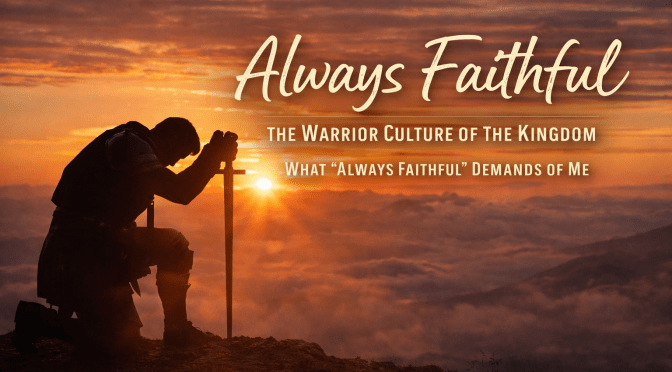
The Warrior Culture of the Kingdom: What “Always Faithful” Demands of Me

There are phrases that sound inspiring on a shirt, but carry weight when you try to live them on an ordinary Tuesday.

“Always Faithful” is one of those phrases for me.

It’s simple. It’s direct. It doesn’t leave much room for loopholes. And that’s exactly why it confronts me in the best way. Because if I’m honest, my default setting is not “always.” My default is “mostly.” Or “when I’m in the mood.” Or “when it’s convenient.” Or “when I feel strong.”

But “Always Faithful” calls me higher than convenience. It calls me into a kind of warrior culture that isn’t built on aggression or swagger, but on steadfast loyalty—especially when nobody is watching, when the pressure is real, and when the cost is personal.

When I talk about warrior culture, I’m not talking about a personality type. I’m talking about a posture. A way of standing in the world. A way of carrying responsibility without collapsing under it. A way of living as if good and evil are not just abstract concepts, but forces that press against the heart every day.

And in that sense, the battlefield is not only “out there.” The battlefield is also within.

This is where Jamie Walden’s “Omega Dynamics” has been useful for me as a frame—because it doesn’t treat life like a neutral stroll through history. It calls believers to wake up, to recognize the reality of spiritual conflict, and to become what he describes as a “warrior class” of Christians: grounded, disciplined, and ready for the days ahead. Not paranoid. Not theatrical. Not violent. Ready.

Ready to stay faithful.

What Warrior Culture Is—and What It Isn’t

Before I go further, I need to define what I mean, because “warrior culture” can get twisted fast.

True warrior culture is not a love affair with violence. It’s not a fetish for conflict. It’s not posturing, bullying, or trying to dominate people. That’s not strength. That’s insecurity dressed up as toughness.

Real warrior culture is ordered courage.

It is strength under authority.

It is the willingness to carry responsibility when it would be easier to walk away.

It is discipline that shows up even when the feelings don’t.

It is loyalty to mission and to people—especially when there’s no applause.

And in the Kingdom of God, warrior culture must be shaped by the character of Christ. That means humility has to sit inside strength. Love has to guide power. Truth has to outrank ego.

If my “warrior culture” makes me cruel, I’m not becoming a warrior—I’m becoming a threat.

If it makes me proud, I’m not being forged—I’m being inflated.

But if it makes me faithful—steady, sober, courageous, resilient, loving—then I’m moving in the right direction.

“Always Faithful” Is a Standard, Not a Mood

The reason “Always Faithful” hits me is because it doesn’t ask how I feel. It asks who I am.

And that’s the core of it: faithfulness is identity, not emotion.

A faithful person doesn’t wake up every day with perfect enthusiasm. A faithful person wakes up and does what is right anyway. Faithfulness is what you do when motivation is low, temptation is high, and the path is narrow.

In a spiritual sense, I think “Always Faithful” means this:

Faithful to God’s truth even when the culture calls it foolish.

Faithful to God’s ways even when shortcuts look easier.

Faithful in private before I try to be faithful in public.

Faithful when my prayers feel powerful, and faithful when my prayers feel like they bounce off the ceiling.

Faithful when my circumstances are calm, and faithful when my life is shaking.

That’s not perfection. That’s posture.

And I believe God honors posture.

Omega Dynamics and the Call to Stop Living Like a Spectator

One idea I’ve taken from “Omega Dynamics” is the insistence that believers should stop living like spectators.

There’s a difference between believing in God and being enlisted under His leadership.

There’s a difference between knowing Scripture and being formed by it.

There’s a difference between admiring courage and practicing it.

The “warrior class” concept, as I understand it, isn’t about elitism. It’s about maturity. It’s a call to become the kind of believer who doesn’t fold at the first sign of pressure. The kind of believer who can discern what’s happening in the world without becoming hysterical. The kind of believer who can stand firm, love well, and think clearly while other people panic.

That matters, because we live in an age where confusion is celebrated, distraction is constant, and compromise is marketed as compassion.

If I’m not intentional, I drift.

And drift is one of the enemy’s favorite strategies—not a dramatic fall, but a slow fade.

The Modern Battlefield Between Good and Evil

When I say “battlefield,” I’m not trying to sound dramatic. I’m describing what it feels like to live in a world where the pressure to compromise is constant.

The modern battlefield between good and evil is fought in places that don’t always look “spiritual” at first glance:

In the mind—what I allow to shape my beliefs.

In my attention—what gets my focus, my time, my imagination.

In my desires—what I chase when I’m stressed, lonely, or bored.

In my identity—who I believe I am and what I believe I’m for.

In my speech—whether my words heal or poison.

In my relationships—whether I love people with truth or use people for comfort.

In my home—whether I lead with presence or surrender the atmosphere to chaos.

Evil rarely announces itself as evil. It often shows up as a “reasonable” trade:

Trade conviction for comfort.

Trade prayer for distraction.

Trade truth for approval.

Trade courage for safety.

Trade holiness for “just this once.”

And the problem with trades is this: you rarely notice the cost until you’ve been doing it for a while.

Drift Is Not Neutral—It’s a Direction

One of the most thought-provoking realities for me is this: nobody accidentally becomes faithful. But a lot of people accidentally become compromised.

Drift doesn’t require effort. Drift requires neglect.

If I neglect prayer, I don’t become neutral—I become vulnerable.

If I neglect Scripture, I don’t become “free”—I become shaped by whatever is loudest.

If I neglect community, I don’t become independent—I become isolated, and isolation is where temptation speaks the clearest.

If I neglect repentance, I don’t become “confident”—I become hardened.

This is why “Always Faithful” feels like a battle cry. Not because I’m trying to win arguments, but because I’m trying to keep my soul alive.

Faithfulness is how I resist drift.

Applying Warrior Culture to the Real War: Staying Sane, Staying Soft, Staying Strong

If the modern battlefield is spiritual, then the weapons aren’t primarily physical. The weapons are disciplines, virtues, and decisions—repeated until they become instinct.

Here’s what applying these concepts looks like in my life.

1) I Start the Day Like I’m On Watch

Warrior culture includes an understanding of watchfulness. Someone is always on post. Someone is always guarding the gate. That mindset translates spiritually.

I cannot afford to start my day with chaos and call it “normal.”

So I treat prayer like a briefing. Not a performance—alignment.

Sometimes it’s simple: “Lord, keep me faithful today. Guard my mouth. Guard my eyes. Guard my mind. Make me courageous. Make me clean. Make me useful.”

That’s not fancy, but it’s real.

And reality is where battles are won.

2) I Treat Scripture Like a Map, Not a Decoration

If I’m not anchored in truth, I will be tossed by trends. That’s not a theory—it’s predictable.

The point of Scripture is not to make me sound smart. The point is to make me steady.

On the modern battlefield, deception is common. Half-truths are everywhere. Emotional manipulation is normal. Outrage is profitable. If I don’t know what God says, I’ll start repeating what the crowd says—and I’ll call it wisdom because it has likes.

A warrior can’t afford that.

So I return to the Word, not as a ritual, but as reinforcement. Truth has to be installed in me, not just visited.

3) I Build Rules of Engagement for My Life

Warriors don’t walk into conflict without rules of engagement. In the spiritual realm, I need boundaries, because my heart is not indestructible.

Rules of engagement sound like this:

I don’t entertain what I would hate to become.

I don’t flirt with what I pray against.

I don’t call weakness “self-care” if it’s actually self-indulgence.

I don’t excuse sin because the culture renamed it.

I don’t keep secrets that thrive in darkness.

I don’t feed anger and call it righteousness.

I don’t weaponize truth to hurt people.

I tell the truth, but I tell it with a clean heart.

If my methods contradict Christ, my mission is already compromised.

4) I Refuse the Counterfeit Warrior Spirit

There is a counterfeit warrior spirit that is loud, reactive, and addicted to conflict. It always needs an enemy. It always needs a fight. It confuses aggression for authority and sarcasm for discernment.

I’ve had to check myself here.

Because there’s a kind of “strength” that is really just unresolved anger.

There’s a kind of “boldness” that is really just pride.

There’s a kind of “discernment” that is really just suspicion.

But the warrior culture of the Kingdom is different.

It is steady.

It is patient.

It is courageous without being cruel.

It is strong enough to stay gentle.

It is bold enough to stay humble.

It can confront evil without becoming evil.

That’s not weakness. That’s mastery.

5) I Fight for Faithfulness in the Small Things

One of the most practical shifts for me has been realizing that the biggest battles are often won or lost in small decisions:

Will I tell the truth when a lie would be easier?

Will I apologize without defending myself?

Will I shut down temptation at the first knock, or invite it in for conversation?

Will I be present with my family, or disappear into screens?

Will I serve when I feel unnoticed?

Will I keep my word when it costs me?

Will I choose integrity when I could get away with compromise?

Warrior culture is forged in repetition. Faithfulness is built the same way.

Small obediences become spiritual strength.

The “Always” Part: Faithful When It’s Hard, Not Just When It’s Holy

“Always Faithful” sounds inspiring until you realize it includes days you didn’t plan for:

Days when you’re tired and irritable.

Days when temptation is loud.

Days when your prayers feel dry.

Days when people misunderstand you.

Days when doing the right thing costs you socially, financially, or emotionally.

This is where the phrase becomes more than a motto. It becomes a decision.

I cannot control everything that happens to me. But I can control whether I stay faithful in it.

Faithful doesn’t mean I never struggle. It means I don’t surrender.

Faithful doesn’t mean I never doubt. It means I bring my doubts to God instead of running from Him.

Faithful doesn’t mean I never get wounded. It means I refuse to let wounds become excuses for sin.

And this is where the modern battlefield reveals itself: the enemy loves to use fatigue as leverage. Burnout can become a doorway to compromise. Discouragement can become permission to quit.

So I have to fight for resilience—not the kind that pretends everything is fine, but the kind that keeps walking with God when life is not fine.

Every Warrior Needs a Unit

A lone-wolf mentality is not warrior culture. It’s vulnerability.

Even the strongest person becomes unstable without support.

So part of applying these concepts is building brotherhood and sisterhood—people who can speak truth, pray, challenge, encourage, and remind you who you are when your emotions get loud.

Accountability is not control. It’s protection.

And protection is love.

If I want to be “Always Faithful,” I need relationships where faithfulness is normal, not strange.

The Goal Is Not to Be Dangerous—It’s to Be Holy

This is a key point I want to keep clear.

Some people confuse “warrior” with “dangerous.” They want to feel intimidating. They want to feel feared. They want to feel like they can crush opposition.

But the goal in the Kingdom is not intimidation. The goal is transformation.

Holiness is not fragility. Holiness is power with purity.

A holy person is not controlled by impulse.

A holy person is not enslaved to addiction.

A holy person is not owned by pride.

A holy person is not manipulated by fear.

Holiness is the strength to obey God consistently.

That is warrior culture at its highest level.

A Thought-Provoking Question I Keep Asking Myself

If “Always Faithful” is the standard, I have to ask:

Where am I not faithful yet?

Not where someone else is failing. Where I am.

Where do I compromise quietly?

Where do I entertain what I should resist?

Where do I call convenience “wisdom” when it’s really avoidance?

Where do I let my emotions drive the wheel instead of letting truth drive the wheel?

Where am I more loyal to comfort than to calling?

These questions don’t exist to condemn me. They exist to calibrate me.

A warrior who refuses evaluation becomes a liability.

A believer who refuses repentance becomes brittle.

But a person who stays teachable stays dangerous in the right way: dangerous to darkness, because they won’t be owned by it.

Conclusion: “Always Faithful” Is How I Hold the Line With Hope

In the end, “Always Faithful” is not a call to become harsh. It’s a call to become steady.

It’s not a demand to become perfect. It’s a demand to stay committed.

It’s not about winning every moment. It’s about not abandoning the mission.

Warrior culture—rightly understood—forms people who can be trusted under pressure. People who don’t collapse when life gets heavy. People who don’t betray their convictions for temporary relief. People who love well, tell the truth, serve quietly, and stand firm when the wind shifts.

And that is exactly what I want to be in the modern battlefield between good and evil:

Not loud. Not performative. Not fueled by rage.

Faithful.

Always faithful.

Shamgar: A Minor Mention, a Mighty Deed — What His Story Teaches Us

In a world captivated by big personalities, sweeping narratives, and detailed biographies, it’s easy to overlook those who appear only briefly in the pages of Scripture. Yet sometimes, within those fleeting mentions, there lies a powerful testimony about God’s ways, His strength, and how He chooses to work in the lives of ordinary people. One of the most intriguing of these lesser‑known biblical figures is Shamgar, Israel’s third judge.

Shamgar isn’t a household name like David, Gideon, or Samson. If you blink while reading the Book of Judges, you can easily miss his story. His name appears in just one terse sentence in Judges, yet THAT sentence contains one of the most surprising stories of courage, deliverance, and divine empowerment in the entire Old Testament. And the impact of that story—though brief—is anything but small.

In today’s blog, I want to explore who Shamgar was, why his story matters, and how the life of this unexpected hero speaks directly into our lives today. We will dive into the heart of his narrative, and uncover how God uses hidden warriors in ordinary places to accomplish extraordinary things.


Who Was Shamgar?

The Bible gives very little information about Shamgar. He is introduced simply in Judges 3:31 as “Shamgar son of Anath,” who *struck down six hundred Philistines with an oxgoad and saved Israel.” That’s it. One verse, no backstory, no recorded speeches or profound speeches — just a single sentence depicting a dramatic victory.

As scholars note, Shamgar’s story doesn’t follow the typical pattern of other judges in Israel — there’s no mention of his tribe, his period of leadership, or even how long he served. Unlike Gideon or Samson, we don’t know where he came from, how he was raised, or how he trained for battle. His appearance is sudden and his disappearance almost as swift as his mention in Scripture.

Yet that brief note tells us something significant: Shamgar was a deliverer, and God used him in a powerful way.

Interestingly, he is also mentioned in the poetic Song of Deborah in Judges 5:6, which recalls a time of danger in Israel when travelers avoided the main roads because of the threat from enemies. This second mention suggests that his story was known in Israel’s oral tradition — even if the details were lost, the memory of his mighty deed endured.


A Tool Turned Weapon: The Oxgoad

One of the most remarkable aspects of Shamgar’s story isn’t just the victory — it’s the weapon he used.

An oxgoad was not a sword, spear, or battle‑ready weapon. It was a long, sharpened stick used to prod and guide oxen in the fields — essentially a farming tool.

Think about that for a moment:

Here was a man, likely a farmer or laborer by trade, wielding a tool that had nothing to do with battle — and yet, in God’s hands, it became an instrument of deliverance.

This detail is not incidental. It serves as one of the great themes woven throughout Scripture: God often uses ordinary things and ordinary people, equipping them to accomplish extraordinary acts when they trust Him. Moses had a shepherd’s staff. David had a sling. Mary was a young girl from Nazareth. And Shamgar used an oxgoad. God’s greatness is often revealed through human weakness and unexpected means.


A Mighty Deed in a Forgotten Moment

It’s worth reflecting that Shamgar is not the main focus of the Judges narrative — and yet his deed is mighty. Killing six hundred Philistines with a farming implement is no small feat. Whether it happened in a single battle or over the course of multiple skirmishes, the text makes clear that his victory was significant enough to count as deliverance for Israel.

Imagine being in the place of the people in that time — facing a fierce enemy with limited resources, untrained for war, and yet encountering a deliverer who stood in the gap and acted boldly. They might not have known his name as we do now, but surely they felt the relief that came with safety restored.

Shamgar’s story reminds us that:

  • God often works behind the scenes — in moments too brief or too subtle for us to notice at first glance.
  • A single act can have a profound impact on those around us.
  • Courage and obedience, even when unseen, are powerful in the hands of God.

How Does Shamgar’s Story Relate to Our Lives Today?

You may be wondering: What relevance does a one‑verse judge from ancient Israel have for me today?

The answer is more profound than you might expect.

1. God Uses the Ordinary

Shamgar was likely not a warrior. He wasn’t described with titles of nobility, extensive training, or renowned lineage. Yet God used him to deliver His people.

Likewise, God doesn’t only use scholars, pastors, or telegenic personalities for His work. He uses ordinary people with willing hearts — people like you.

Have you ever thought:

  • I don’t have the right background?
  • I’m not talented enough?
  • I’m too ordinary to make a difference?

Shamgar’s story reminds us that God’s strength is perfected in our weakness (2 Corinthians 12:9). It isn’t our training but our obedience that qualifies us.


2. God Can Turn Your Tools Into Weapons of Deliverance

Shamgar’s oxgoad is deeply symbolic. God didn’t give him a sword — He used what was already in his hand and multiplied its effect.

This mirrors the way God works in our lives:

  • Your influence at work can be a platform for kindness and integrity.
  • Your home may be a place of spiritual leadership in your family.
  • Your prayers can be powerful intercessions in unseen battles.

God doesn’t always give us shiny new tools — sometimes He redeploys what we already have, refining and empowering it for His purposes.


3. You Don’t Need To Be Seen to Be Used

The Bible doesn’t give details about Shamgar’s life. We don’t know his family. We don’t hear long speeches or sermons attributed to him. Yet his one sentence of Scripture continues to speak centuries later.

That tells us something profound about visibility.

In today’s world of social media, public platforms, and personal branding, it’s easy to feel like you need visibility to be valuable. But God often uses people in quiet places, unseen by the masses, yet mighty in His kingdom.

Whether you serve in your community, labor faithfully in your vocation, or love people without fanfare — what matters is obedience, not applause.

Shamgar was hardly known. Yet his deed was mighty. You can be the same.


4. What God Uses Can Also Be Unexpected

It’s worth noting that Shamgar was “the son of Anath.” Scholars aren’t entirely sure what this designation means — whether it signifies lineage, a title, or a cultural background — and some suggest it might imply he wasn’t even an Israelite.

This raises an incredible point: God’s call is not limited by human categories or expectations.

God used Jethro, a Midianite priest, to support Moses. He used Rahab, a Canaanite woman, to protect His people. And He used Shamgar — a seemingly unlikely figure — to defend Israel.

God calls us where we are, with who we are, and He equips us for the purpose He has for us.


Lessons From Shamgar We Can Apply Today

As I reflect on Shamgar’s life, a few key truths come to the forefront — truths that have shaped my own walk of faith and that I believe can encourage you as well:

1. You Don’t Have to Wait For Permission to Act

Shamgar didn’t wait for recognition or royal commission. When he saw a need — a threat — he acted. In our lives, there are moments where God calls us to step out, even without clear instructions. God often equips us as we walk in obedience.

2. Faith Works Through What You Already Have

You might not have the latest training or the most impressive resources — but God can use what you already possess. Just like Shamgar’s oxgoad, your gifts, your experiences, and your presence can be instruments of God’s deliverance in someone else’s life.

3. Your Story Doesn’t Have to Be Long to Be Impactful

Shamgar’s story fills less than a paragraph — yet it resonates across centuries. Your story, too, doesn’t have to be lavish or extensive. What matters most is the impact of your obedience to God.

4. God’s Victories Often Come Through Human Weakness

Shamgar’s achievement reminds us that human strength on its own is insufficient. God’s power is revealed when we surrender our limitations to Him.


Conclusion: Be Mighty Where You Are

When I reflect on Shamgar, I see a man who didn’t fit the mold of a typical biblical hero. He wasn’t called out at birth, he didn’t have an epic narrative arc, and Scripture doesn’t tell us how he felt or what drove him. All we know is this: God used him mightily in a moment of deliverance.

That truth transforms the way I see my own life — and I pray it transforms the way you see yours.

You don’t need:

  • The loudest voice.
  • The greatest title.
  • The biggest stage.

What you do need is a willing heart, a yielded spirit, and faith that believes that when God calls, He hands you what you need — even if it’s as humble as an oxgoad.

God uses ordinary people for extraordinary purposes.
God empowers you in the moment of obedience.
God sees even the stories that seem small — and He magnifies them for His glory.

May we be people who, like Shamgar, stand when others flee — who act when courage is required — and whose lives testify that God can take the humble and achieve the mighty through them.

Thank you for reading — and may your story, like Shamgar’s, be an unexpected tribute to the greatness of our God.