Tag Archives: Christian

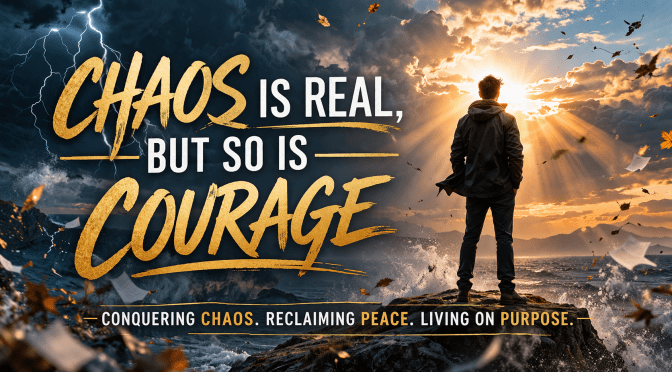
Chaos Is Real, But So Is Courage

There are moments when I look at the world and feel the weight of just how chaotic it has become. The noise is constant. The pressure is relentless. Everywhere I turn, there seems to be another reason for people to feel anxious, divided, angry, exhausted, or uncertain about what comes next. Chaos shows up in our culture, in our homes, in our schedules, in our thinking, and sometimes in the private places of our hearts that no one else can see.

What I have come to realize is that chaos is not only dangerous because of what it does around us. It is dangerous because of what it tries to do within us. It wants to pull us out of alignment. It wants to steal our peace, cloud our judgment, weaken our discipline, and convince us that disorder is simply the new normal. Left unchecked, chaos does not just surround a person. It slowly starts shaping a person.

That is why I believe this conversation matters so much. We cannot afford to be passive in a chaotic world. We cannot afford to drift through life hoping peace will somehow appear on its own. If we want stability, we have to become intentional. If we want clarity, we have to pursue it. If we want to conquer chaos, we have to stop treating it like an unavoidable master and start confronting it like an enemy that can be resisted.

And that is the good news I keep coming back to: chaos is real, but so is courage. Chaos is powerful, but it is not absolute. It may test us, but it does not have to define us. We can face it. We can push back against it. We can build lives that are not ruled by fear, confusion, or constant emotional turmoil. We can become the kind of people who stand steady in a world that often feels unstable.

The Danger of Chaos in the World

One of the greatest dangers of chaos is how subtle it can be at first. It does not always begin with some obvious collapse. Sometimes it begins with disorder in our thinking. Sometimes it enters through distraction, hurry, emotional overload, or the endless stream of messages competing for our attention. Sometimes it looks like losing our focus little by little until one day we realize we are living reactively instead of intentionally.

That is what makes chaos so deceptive. It often starts small, but it rarely stays small.

When chaos takes hold in the world, people begin to lose their bearings. Truth becomes harder to hold onto. Emotions become easier to manipulate. Conviction gets replaced by impulse. Thoughtfulness gets replaced by outrage. Instead of responding wisely, people react emotionally. Instead of building what is good, they spend their energy surviving what is urgent. Chaos thrives when people no longer know where to stand, what to believe, or how to remain grounded under pressure.

I think that is why chaos feels so exhausting. It is not just about disorder in the external sense. It is about the breakdown of inner steadiness. It creates environments where confusion becomes common, peace becomes rare, and people begin to feel like they are always one step away from being overwhelmed.

And when that happens long enough, chaos starts telling a lie: that instability is just the way life is, and there is nothing we can do about it.

I do not accept that lie.

Yes, the world can be chaotic. Yes, life can be unpredictable. Yes, there are seasons when things feel messy, heavy, and difficult to manage. But I refuse to believe that chaos gets to dictate the terms of how I live. I refuse to believe that because disorder exists around me, I must surrender to disorder within me.

What Chaos Does to the Human Heart

Chaos has a way of working from the outside in. It begins with pressure around us, but if we are not careful, it starts producing pressure within us. That is when it becomes especially dangerous.

I have seen how chaos can distort perspective. It can make small problems feel enormous and important things feel impossible. It can make a person feel trapped in survival mode, where every day becomes about getting through instead of growing through. When that happens, hope begins to shrink. Patience gets thinner. Relationships become harder to nurture. Focus becomes harder to hold. Joy becomes harder to access.

Chaos also attacks identity. It whispers things like, “You are too late. You are too overwhelmed. You are too far behind. You are not strong enough for this.” It tries to turn hard circumstances into personal conclusions. Instead of seeing chaos as something I am experiencing, I begin to feel like chaos is who I am.

That is one of the most destructive things it does.

When people internalize chaos, they stop fighting it. They start organizing their lives around instability. They lose confidence in their ability to change, lead, heal, rebuild, or move forward. They begin to expect confusion, so they stop pursuing clarity. They begin to expect stress, so they stop protecting peace. They begin to expect failure, so they stop acting with courage.

That is why this battle matters. Chaos is never just about what is happening around me. It is also about what I am allowing to settle within me.

Why Chaos Grows When We Stop Leading Ourselves

I have learned that chaos tends to grow wherever self-leadership is absent. If I do not lead my thoughts, my thoughts will lead me. If I do not lead my time, distractions will consume it. If I do not lead my habits, comfort will shape them. If I do not lead my responses, emotion will do it for me.

That is not freedom. That is drift.

And drift is dangerous because it often feels harmless while it is happening. A little more procrastination. A little less reflection. A little more compromise. A little less discipline. A little more mental clutter. A little less intentional living. None of it seems significant in the moment, but over time it creates an environment where chaos can multiply.

I do not believe peace is maintained accidentally. I think peace requires stewardship. It requires awareness. It requires me to notice when my inner world is becoming disordered and to respond before that disorder becomes my new pattern.

For me, that means asking honest questions. What have I been tolerating that I should be confronting? What habits are feeding confusion instead of clarity? Where have I become passive? What am I giving too much power over my mind and emotions? What am I consuming that is making me weaker, more reactive, or more cynical?

Those questions matter because they expose where chaos is gaining unnecessary ground.

There comes a point when I have to stop blaming the noise around me for everything happening within me. Not because external pressures are not real, but because I still have responsibility for how I respond. I may not control every storm, but I do have influence over how I prepare, how I think, how I act, and what I build in the middle of it.

What I Can Do to Stave Off Chaos in Life

One of the most practical things I have learned is that chaos is best resisted with intentional order. Not perfection. Not rigid control. Order.

For me, that begins with grounding. In a chaotic world, I need stable foundations. I need convictions that do not change with every headline, every opinion, or every emotional swing. I need to know what matters most. I need to remember who I am, what I value, and what kind of person I want to be when life gets hard.

Without that grounding, everything starts to feel equally urgent. And when everything feels urgent, clarity disappears.

I also need structure. Simple structure has saved me more times than dramatic breakthroughs ever have. A healthy routine. A clear priority list. Time set aside for reflection. Time protected for rest. A plan for the day. Limits on what gets my attention. These things may seem small, but they create space for peace to live.

Chaos loves clutter, both mental and practical. That is why I have found it so important to simplify. I do not need to respond to everything. I do not need to carry what is not mine to carry. I do not need to say yes to every request, opportunity, or expectation. One of the strongest ways I stave off chaos is by refusing to overcrowd my life.

Another way I resist chaos is by guarding my mind. What I repeatedly consume will eventually shape the way I think. If I fill my mind with fear, outrage, comparison, and negativity, I should not be surprised when my internal world feels unstable. But when I feed my mind with truth, wisdom, discipline, encouragement, and perspective, I strengthen my ability to stay calm under pressure.

I also believe boundaries are essential. Not every voice deserves influence. Not every conflict deserves access. Not every demand deserves a response. Boundaries are not a sign of weakness. They are often a sign of maturity. They help preserve the peace, focus, and strength required to live on purpose.

How to Conquer Chaos Instead of Just Managing It

There is a difference between managing chaos and conquering it. Managing chaos often means learning how to function while staying internally overwhelmed. Conquering chaos means refusing to let it dominate the condition of my soul.

The first step is to pause.

Chaos wants immediate reaction. It wants panic, impulse, and emotional overcorrection. But I have found that some of the most powerful moments in life begin with a pause. A pause helps me breathe. A pause helps me think. A pause creates room for perspective before emotion takes over.

The second step is to identify what is real. I ask myself: What is actually happening here? What am I assuming? What is fact, and what is fear? What is within my control, and what is outside of it? These questions matter because chaos becomes larger when everything feels tangled together. Clarity begins when I separate what is true from what is merely loud.

The third step is to take the next right action. Not every answer comes at once. Not every problem gets solved overnight. But progress often begins the moment I stop staring at the entire mountain and take one faithful step forward. Chaos wants to overwhelm me with the size of everything. Courage reminds me that I only need to obey the next clear step.

The fourth step is consistency. This is where real victory is built. Not in one emotional breakthrough, but in repeated acts of disciplined living. Waking up and choosing peace again. Choosing focus again. Choosing truth again. Choosing responsibility again. Choosing faith over fear again. That is how inner strength is formed.

The fifth step is perspective. I have to remember that a chaotic moment is not the same as a chaotic identity. A hard season is not the same as a hopeless future. Just because things feel unstable today does not mean they will remain that way forever. Perspective helps me stop giving temporary storms permanent authority.

What Strength Really Looks Like in Chaotic Times

I think many people imagine strength as intensity, force, or emotional hardness. But the older I get, the more I believe true strength often looks quieter than that.

Strength is remaining calm when panic would be easier.

Strength is telling the truth when it would be more convenient to avoid it.

Strength is staying disciplined when nobody else sees the effort.

Strength is protecting peace when the world rewards outrage.

Strength is refusing to let fear become the loudest voice in the room.

Strength is showing compassion without losing conviction.

Strength is holding onto hope without denying reality.

In chaotic times, I do not want to become a louder version of the disorder around me. I want to become a steadier presence in the middle of it. I want to be someone who carries clarity into confusion, courage into fear, and peace into environments that feel unstable.

That kind of strength does not happen by accident. It is cultivated. It is practiced. It is tested. And in many cases, it is forged precisely in the fires we would rather avoid.

Turning Chaos Into a Catalyst for Growth

As difficult as chaos can be, I also believe it can reveal things that comfort never will. It can expose weak foundations. It can show me where I have been distracted. It can uncover unhealthy attachments, misplaced priorities, and habits that have been weakening me. It can force me to ask whether I am truly living with intention or simply reacting to whatever comes next.

That kind of exposure can be uncomfortable, but it can also be deeply valuable.

Some of the most important growth in life begins when I stop asking only, “How do I escape this?” and start asking, “What can this teach me?” That question changes everything. It shifts me from victimhood to responsibility. It moves me from panic to reflection. It helps me see that while I may not have chosen every challenge I face, I can still choose how I will be shaped by it.

Chaos can make me bitter, or it can make me wiser.

It can harden me, or it can deepen me.

It can scatter me, or it can teach me to become more anchored.

That does not mean I glorify hardship. It means I refuse to waste it.

Chaos Is Real, but So Is Courage

At the end of the day, I do not believe the answer to chaos is pretending it does not exist. The answer is to face it honestly without giving it the final word.

Yes, chaos is real.

But so is courage.

So is peace.

So is clarity.

So is discipline.

So is purpose.

So is hope.

And when I build my life around those things, chaos loses some of its power. It may still knock at the door, but it does not have to move in. It may still test me, but it does not have to own me. It may still challenge my peace, but it does not have to conquer my spirit.

That is the posture I want to live with. Not denial. Not passivity. Not fear. Courage.

Courage to slow down when the world says hurry.

Courage to think clearly when emotions run high.

Courage to protect peace when conflict feels contagious.

Courage to lead myself when passivity would be easier.

Courage to keep building order, truth, and purpose in a world that often celebrates confusion.

Chaos may be part of life, but it does not have to become the ruler of my life. I can meet it with steadiness. I can answer it with discipline. I can confront it with faith, wisdom, and action. I can refuse to let disorder define who I am.

Because chaos is real, but so is courage.

And courage, when practiced daily, has a way of changing everything.

Complacency Kills: Why Spiritual Readiness Still Matters

There are some phrases that hit harder than others because they carry the weight of lived reality. “Complacency kills” is one of them.

It is simple. Direct. Uncomfortable. And absolutely necessary.

As I continue this discussion on Warrior Culture, I keep coming back to the fact that this phrase is not just something that belongs in military language, tactical spaces, or high-risk environments. It belongs in everyday life. It belongs in the home, in the church, in leadership, in fatherhood, in marriage, in discipleship, and in the hidden places of the heart. It belongs anywhere there is something worth protecting and anywhere there is a battle worth fighting.

That is one of the reasons Jamie Walden’s Omega Dynamics resonates so deeply with me. It forces the reader to confront a truth that many people would rather avoid: we are not living in neutral territory. We are living in contested ground. There is a real conflict between good and evil, truth and deception, courage and cowardice, conviction and compromise. And in that kind of environment, complacency is never harmless.

It is deadly.

When I say “complacency kills,” I am not only talking about physical danger, although that absolutely matters. I am also talking about spiritual drift, moral laziness, emotional passivity, and the slow erosion of conviction. I am talking about what happens when a man, a woman, a family, or a community stops watching, stops praying, stops training, stops discerning, and starts assuming that because nothing has gone wrong yet, nothing ever will.

That assumption is where many defeats begin.

What Complacency Really Is

Complacency is not rest. It is not peace. It is not confidence.

Complacency is a false sense of security that convinces us vigilance is no longer necessary.

It whispers that the standards can relax. It says the threat is exaggerated. It tells us that one more compromise is no big deal, one more distraction is harmless, one more neglected responsibility can wait until tomorrow. It persuades us to lower our guard without realizing that our guard was the very thing preserving us.

That is why complacency is so dangerous. It rarely announces itself as collapse. It usually presents itself as comfort.

That is what makes it lethal.

In a physical battle, complacency gets people hurt because they stop paying attention to the terrain, the patterns, the weaknesses, the indicators, and the possibility of contact. In the spiritual and moral battle, it works the same way. People stop paying attention to what is forming them. They stop paying attention to what they are tolerating. They stop paying attention to the condition of their own soul. They stop paying attention to the forces trying to shape their mind, their family, their values, and their priorities.

And because the decline is gradual, it feels manageable right up until the consequences become undeniable.

Warrior Culture Is Not About Aggression

This matters to say clearly: Warrior Culture is not about becoming harsh, loud, reactive, or obsessed with conflict.

True warrior culture is not reckless. It is disciplined.

It is not insecure bravado. It is governed strength.

It is not domination. It is responsibility.

A warrior, in the highest sense, is someone who understands that strength exists for service, not vanity. It exists to protect, to endure, to stand firm, to bear weight, to confront evil when necessary, and to remain faithful under pressure. Warrior culture, at its best, forms people who are hard to deceive, hard to intimidate, hard to corrupt, and hard to move off truth.

That is why this conversation matters so much in our time. We live in an age that often confuses softness with virtue and passivity with peace. But peace is not the absence of conflict. Peace is the presence of order under righteous authority. And order does not sustain itself automatically. It must be guarded. It must be cultivated. It must be defended.

That takes people who are awake.

That takes people who are willing to carry responsibility rather than avoid it.

That takes people who understand that good does not advance merely because it is good. Good must be chosen, practiced, embodied, defended, and handed down.

The Modern Battlefield Between Good and Evil

When I talk about the modern battlefield, I am not reducing everything to politics or headlines. The battlefield is bigger than that.

The battlefield is the human heart.

It is the mind that is being discipled either by truth or by lies.

It is the family that is either being strengthened or slowly fractured.

It is the church that is either becoming bold and clear or vague and compromised.

It is the culture that is either honoring what is good, true, and beautiful or celebrating confusion in the name of progress.

It is the individual who must decide every day whether he will drift with the current or stand against it.

Good and evil are not abstract categories. They become visible in what we normalize, what we reward, what we excuse, what we ignore, and what we are willing to fight for.

That is why complacency is so dangerous on this battlefield. Evil rarely needs our active cooperation at first. It often only needs our silence. Our distraction. Our hesitation. Our desire to stay comfortable. Our willingness to say, “It’s probably fine,” when deep down we know it is not fine.

The modern battlefield is full of subtle invasions. Deception rarely begins as open rebellion. It begins as a slight shift. A little compromise. A little exhaustion. A little indifference. A little moral fog. A little less prayer. A little less conviction. A little less courage.

And then one day we look around and realize we have tolerated what we once would have confronted.

That is what complacency does.

How Complacency Shows Up in Real Life

Complacency is not always dramatic. In fact, it is usually mundane.

It shows up when I know I need to strengthen an area of my life but keep postponing it because today feels easier than discipline.

It shows up when I consume far more than I create, react more than I think, and drift more than I lead.

It shows up when comfort becomes my highest value and conviction becomes negotiable.

It shows up when I stop training my mind, stop guarding my habits, stop evaluating my influences, and stop taking responsibility for my role.

It shows up when I assume somebody else will carry the burden.

Somebody else will speak the truth.
Somebody else will protect the children.
Somebody else will preserve the standard.
Somebody else will confront the lie.
Somebody else will lead with courage.

That mindset is dangerous because the battlefield does not pause while we outsource responsibility.

I believe one of the clearest signs of complacency in our time is the normalization of passivity. We have gotten used to being spectators. We watch. We scroll. We comment. We analyze. But many people never step into responsibility. They never take ownership of their fitness, their home, their habits, their discipleship, their relationships, or their calling.

But Warrior Culture does not allow me to live like a spectator.

It reminds me that I have a post to keep.

How I Apply “Complacency Kills” on the Modern Battlefield

For me, applying this concept begins with remembering that vigilance is a lifestyle.

It means I do not wait for crisis to start becoming serious.

I want to be the kind of person who is already building strength before the pressure hits. That applies spiritually, mentally, emotionally, and physically.

Spiritually, it means staying rooted. Prayer cannot be an emergency-only discipline. Scripture cannot be an occasional reference point. Discernment cannot be outsourced. If I want to stand in a corrupt and confused age, then I have to remain anchored in truth before I am tested by error.

Mentally, it means guarding what shapes my thinking. Not every voice deserves influence. Not every trend deserves attention. Not every popular idea deserves a place in my worldview. Complacency in the mind leads to confusion in judgment. And confusion in judgment eventually produces compromise in action.

Physically, it means respecting the connection between stewardship and readiness. The body matters. Endurance matters. capacity matters. Discipline matters. I do not want to build a life where my spirit is willing but my habits are weak. Readiness requires training.

Relationally, it means leading and loving on purpose. Homes do not become strong accidentally. Marriages do not stay healthy on autopilot. Children are not formed by vague intentions. If complacency is allowed into the home, it will eventually affect everything. So I want to be deliberate with my words, my presence, my protection, and my example.

Morally, it means refusing to make peace with what I know is corrosive. The modern battlefield is full of seductive compromises disguised as normal life. But not everything common is harmless. Not everything convenient is wise. Not everything culturally approved is good.

“Complacency kills” reminds me to stay alert where it would be easiest to go numb.

Vigilance Is Not Fear

This is where I want to keep the discussion positive and grounded.

Vigilance is not paranoia.

Readiness is not anxiety.

Warrior culture, rightly understood, does not produce frantic people. It produces sober people. Clear people. Steady people. Faithful people.

There is a big difference between living in fear and living awake.

Fear reacts from panic.
Vigilance responds from clarity.

Fear imagines threats everywhere.
Vigilance recognizes that danger is real but refuses to be ruled by it.

Fear collapses inward.
Vigilance stands outward.

In my own life, I have found that disciplined readiness actually produces more peace, not less. When I know I am paying attention, strengthening weak areas, staying grounded in truth, and taking responsibility for what has been entrusted to me, there is a deep steadiness that comes with that. Not because I control everything, but because I am no longer pretending the battle is not there.

Denial is fragile.
Preparedness is stabilizing.

That is one of the greatest gifts of this mindset. “Complacency kills” does not have to leave us discouraged. It can wake us up. It can call us higher. It can move us out of passivity and into purposeful living.

What This Means for Good and Evil

If the battlefield between good and evil is real, then every day matters.

Small choices matter.
Private disciplines matter.
Quiet obedience matters.
Integrity matters.
Courage matters.
Attention matters.

Good is strengthened when ordinary people choose faithfulness over drift.

Evil gains ground when people decide that alertness is exhausting, conviction is inconvenient, and courage can be delayed until later.

But later is often where regret lives.

So I want to live now with intention. I want to confront the subtle things before they become strongholds. I want to identify the vulnerabilities before they become failures. I want to build the habits now that will sustain faithfulness later.

That is the challenge in front of all of us.

Stay awake.
Stay grounded.
Stay disciplined.
Stay watchful.
Stay humble enough to examine yourself.
Stay strong enough to act when action is needed.
Stay close enough to truth that lies become easier to recognize.

Final Thoughts

When I think about Warrior Culture through the lens of Omega Dynamics and the phrase “complacency kills,” I do not walk away feeling hopeless. I walk away feeling summoned.

Summoned to greater clarity.
Summoned to greater discipline.
Summoned to greater courage.
Summoned to greater responsibility.

This is not a call to live angry. It is a call to live awake.

It is a call to reject the slow death of passivity and to embrace the kind of life that is spiritually alert, morally anchored, and ready to stand. The modern battlefield between good and evil is not won by people who are casually drifting through life. It is faced by men and women who understand that vigilance is love in action, discipline is stewardship, and courage is still required.

Complacency kills.

So I do not want to coast.
I do not want to sleep through the hour.
I do not want to hand off my responsibility to someone else.
I do not want comfort to become my commander.

I want to be found faithful at my post.

And I believe that is the heart of Warrior Culture: not obsession with battle for its own sake, but readiness to stand for what is good, true, and worth defending when the battle comes.

Get in the Fight: A Christian Response to the Battle Between Good and Evil

There are certain phrases that do more than inspire me. They confront me. They strip away excuses, expose passivity, and call me to account. One of those phrases is this: Get in the fight.

The more I reflect on warrior culture, the more I realize this idea is not about performance, posturing, or pretending to be tougher than I really am. It is not about trying to look fearless. It is not about cultivating an image. It is about accepting responsibility in a world where too many people are content to watch from a distance while truth is eroded, convictions are softened, families are weakened, and evil advances through apathy as much as open rebellion.

For me, Get in the fight is not a call to aggression. It is a call to engagement. It is a refusal to remain passive on the battlefield between good and evil. It is a challenge to step fully into the responsibilities God has placed in front of me and to stop pretending that neutrality is a harmless option.

The modern battlefield is not always loud. It is not always dramatic. Most of the time, it does not look the way people imagine warfare to look. It shows up in the mind, in the home, in the heart, in habits, in convictions, in conversations, and in the hidden places where compromise quietly grows if it is left unchallenged. That is where the fight often begins. And that is why I believe getting in the fight matters now more than ever.

Warrior Culture Is Not About Ego

When I talk about warrior culture, I want to be careful. That phrase can be misunderstood. Some hear it and immediately think of anger, dominance, intensity, or a need to prove something. But that is not the kind of strength I am talking about.

Real warrior culture, at least the kind I believe is worth pursuing, is not rooted in ego. It is rooted in stewardship. It is the understanding that strength is not given to me so I can glorify myself. It is given to me so I can be faithful under pressure, protect what matters, stand when others fold, and remain anchored when the world around me becomes unstable.

A warrior spirit without humility becomes dangerous. A warrior mentality without love becomes destructive. A warrior posture without obedience becomes pride wearing religious language. So when I say I want to embrace warrior culture, I do not mean I want to become hard in heart or harsh with people. I mean I want to become the kind of man who can be trusted with conviction, trusted with responsibility, and trusted in moments that require courage.

That is a very different thing.

The Real Battlefield Is Closer Than We Think

One of the biggest mistakes I can make is assuming the battle between good and evil is always somewhere “out there,” somewhere far removed from my daily life. It is easy to think of spiritual warfare only in large, dramatic, cultural terms. But the truth is, the battle is often much closer and much more personal.

It is there when I am tempted to compromise truth for comfort.

It is there when I know I should speak up but choose silence because silence feels safer.

It is there when distraction becomes easier than discipline.

It is there when anger feels stronger than patience, when cynicism feels smarter than hope, and when passivity disguises itself as peace.

The modern battlefield is the fight for the soul in an age of endless noise. It is the fight for moral clarity in a culture of confusion. It is the fight for faithfulness in a world that rewards compromise. It is the fight for presence in a distracted generation. It is the fight for integrity when shortcuts are always available.

This is why “Get in the fight” hits me so deeply. It reminds me that I do not have the luxury of sleepwalking through life and still expecting to stand firm when it matters most. If I am passive in ordinary moments, I should not be surprised if I become weak in critical ones.

Getting in the Fight Starts With Me

Before I talk about confronting darkness in the culture, I have to confront what is happening in my own heart. That may be the hardest battlefield of all, because it is easier to point outward than inward.

If I am serious about getting in the fight, then I have to ask uncomfortable questions. Where have I become lazy? Where have I made room for compromise? Where have I stopped resisting things that I know are shaping me in the wrong direction? Where am I tolerating attitudes, appetites, or habits that weaken my soul?

Sometimes the most important fight is not public. It is deeply private.

It is the fight to reject pride before it hardens into self-righteousness.

It is the fight to reject lust before it distorts the heart.

It is the fight to reject bitterness before it poisons relationships.

It is the fight to reject spiritual drift before I wake up one day wondering how I became so distant from God.

There is no strength in pretending I do not have these battles. Strength comes in facing them honestly. Strength comes in repentance. Strength comes in discipline. Strength comes in obedience when obedience is costly, inconvenient, and unseen.

To get in the fight, I have to stop excusing what God is calling me to confront.

The Fight for the Mind, the Home, and the Heart

I believe one of the clearest ways to apply this concept today is to recognize where the pressure is greatest.

The mind is under attack constantly. Every day there are competing voices trying to shape what I believe, what I fear, what I value, and what I will tolerate. If I do not intentionally guard my mind, someone else will happily fill it with confusion, outrage, compromise, and distraction. Getting in the fight means I become more deliberate about what forms my thinking. It means I choose truth over noise and wisdom over emotional manipulation.

The home is under attack too. Families rarely fall apart overnight. More often, they erode through neglect, disconnection, spiritual passivity, and the slow replacement of presence with distraction. If I say I care about good, then I need to care deeply about what kind of atmosphere I am building in my home. Peace does not happen by accident. Leadership does not happen by accident. Intentional love does not happen by accident. If my home matters, then I need to get in the fight there first.

The heart is another battlefield. A person can look composed on the outside while losing ground internally. That is why I have to pay attention to what is growing inside me. Am I becoming more grateful or more entitled? More tender or more calloused? More courageous or more avoidant? More faithful or more compromised? These are not small questions. They reveal whether I am actually engaged in the fight or merely talking about it.

Why Passivity Is More Dangerous Than It Looks

One of the strongest convictions I have about this subject is that passivity is often far more destructive than people realize.

Passivity rarely feels evil in the moment. It feels mild. It feels reasonable. It feels safe. It sounds like, “This is not the right time.” It sounds like, “I do not want to make things worse.” It sounds like, “Someone else will handle it.” It sounds like, “I am just staying out of it.”

But there are moments when staying out of it is not wisdom. It is surrender.

There are moments when silence is not peace. It is permission.

There are moments when disengagement is not maturity. It is fear dressed up as restraint.

That does not mean I need to react to everything. It does not mean I should become impulsive, argumentative, or intense about every disagreement. But it does mean I need discernment. I need to know when love requires gentleness and when love requires courage. I need to know when patience is wise and when delay becomes disobedience. I need to know when peacemaking is righteous and when conflict avoidance is simply cowardice.

To get in the fight is to reject the lie that passive people are automatically peaceful people. Sometimes the most loving thing I can do is stand up, speak clearly, and refuse to yield ground that should not be surrendered.

Getting in the Fight Without Losing My Soul

This matters to me because I do not want to become so focused on fighting darkness that I begin to reflect it. It is possible to be loud about truth and still be deeply un-Christlike in spirit. It is possible to claim conviction while operating in pride, contempt, and anger. It is possible to be technically right while being morally out of step with the One I claim to follow.

That is why getting in the fight must never mean abandoning love, humility, or self-control.

I want to fight in a way that honors God.

I want to resist evil without becoming consumed by rage.

I want to confront lies without losing compassion for people.

I want to stand firm without becoming self-righteous.

I want to be bold without becoming reckless.

I want my strength to be governed, not wild. I want my convictions to be anchored, not performative. I want my courage to come from faith, not ego. That kind of posture is not weakness. It is disciplined strength. And in many ways, disciplined strength is far harder than emotional intensity.

Anyone can react. Not everyone can remain steady.

What It Looks Like in Everyday Life

The phrase “Get in the fight” becomes meaningful only when I apply it in the ordinary places of life.

It means I get serious about prayer instead of treating it like an afterthought.

It means I tell the truth even when a softer lie would make things easier.

It means I take responsibility for my spiritual health instead of blaming circumstances for my drift.

It means I choose discipline over comfort when comfort is making me weak.

It means I become more intentional with my words, because speech can either strengthen what is good or contribute to what is broken.

It means I show up for my family, not just physically but emotionally and spiritually.

It means I encourage others who are weary instead of assuming someone else will do it.

It means I resist the temptation to scroll endlessly, numb out, or escape into convenience when I know God is calling me to presence and purpose.

It means I become harder to seduce with comfort and easier to move with conviction.

None of that sounds glamorous. But that is exactly the point. The real fight is often won or lost in quiet acts of obedience. It is won in consistency. It is won in hidden faithfulness. It is won when I choose what is right before anyone else sees the outcome.

A Positive Vision of the Fight

I wanted this discussion to remain positive because I do not believe this call is ultimately about fear. It is about purpose.

I am not getting in the fight because I am obsessed with darkness. I am getting in the fight because I believe goodness is worth defending. Truth is worth protecting. Faithfulness is worth pursuing. Families are worth strengthening. Souls are worth contending for. Courage is worth cultivating.

That is a fundamentally hopeful vision.

I am not called merely to resist what is evil. I am called to build what is good.

I am called to build a life marked by integrity.

I am called to build a home marked by peace.

I am called to build habits that make me stronger, not weaker.

I am called to build a witness that is courageous, grounded, and loving.

I am called to build endurance so that when harder days come, I am not meeting resistance as a stranger.

To me, that is one of the most powerful dimensions of this phrase. Getting in the fight is not only about opposition. It is also about construction. It is about becoming, through grace and obedience, the kind of person who can carry responsibility well in a time of confusion.

My Response to the Battle Between Good and Evil

When I bring all of this together, this is where I land: I do not want to be a spectator in the generation I have been called to serve.

I do not want to spend my life analyzing the fight from a safe distance. I do not want to admire courage while avoiding the places where courage is required of me. I do not want to use wisdom as a disguise for passivity. I do not want to call compromise “balance” just because compromise is easier to live with than conviction.

I want to get in the fight.

I want to get in the fight first in my own heart, where honesty, repentance, and discipline have to do their work.

I want to get in the fight in my home, where leadership, love, truth, and peace have to be cultivated intentionally.

I want to get in the fight in my mind, where clarity has to be guarded and deception has to be rejected.

I want to get in the fight in my daily life, where my choices either reinforce what is good or quietly weaken it.

And I want to do all of that with humility, courage, and hope.

Because that is the kind of fight worth entering.

Conclusion

The battle between good and evil is not an abstract idea to me. It is a present reality. It touches every part of life. The question is not whether the battle exists. The question is whether I will engage it faithfully.

For me, Get in the fight means I stop drifting.

It means I stop outsourcing courage.

It means I stop confusing comfort with peace and passivity with wisdom.

It means I accept that faithfulness requires action.

It means I choose to stand where God has called me to stand, even when that standing costs me something.

And it means I do not fight with pride, fear, or rage, but with conviction, humility, discipline, and love.

That is the kind of warrior culture I believe we desperately need.

Not a culture of noise, but a culture of responsibility.

Not a culture of ego, but a culture of strength under control.

Not a culture of posturing, but a culture of faithfulness.

So my challenge to myself is simple: wake up, stand firm, and get in the fight.

Because good is worth defending.

Because truth is worth living.

Because faithfulness is worth the cost.

And because this is not the time to watch from the sidelines.


FAQs

What does “Get in the Fight” mean in a Christian context?

It means refusing spiritual passivity and choosing to engage the daily battle for truth, holiness, courage, faithfulness, and love. It is about responsibility, not aggression.

Is warrior culture compatible with Christian character?

Yes, when it is shaped by humility, obedience, self-control, and love. Biblical strength is never about ego or domination. It is about faithfulness under pressure.

What is the modern battlefield between good and evil?

It is the everyday struggle for the mind, heart, home, character, convictions, and habits. This battlefield often appears in subtle forms such as compromise, confusion, distraction, fear, and apathy.

How can I apply “Get in the Fight” in everyday life?

Start with prayer, discipline, truthfulness, repentance, intentional leadership in your home, and the courage to confront compromise in your own life before trying to confront it in others.

How can I stand for good without becoming harsh or self-righteous?

By keeping your strength submitted to God, your convictions anchored in truth, and your posture governed by humility, love, and self-control.

Suck It Up, Stand Your Post: A Kingdom Warrior’s Guide to Modern Pressure

There’s a phrase I’ve heard my whole life that can land two very different ways depending on who says it, when they say it, and what they mean by it.

“Suck it up.”

For some people, it’s the language of grit—the push that keeps you moving when you’d rather quit. For others, it’s the language of neglect—a way to silence pain, dismiss weakness, and pretend the heart doesn’t matter.

As I continue this conversation on warrior culture—especially through the lens of Jamie Walden’s Omega Dynamics—I want to redeem that phrase and put it in its proper place. Because I believe there is a Kingdom way to “suck it up” that doesn’t make me numb, harsh, or spiritually brittle. And I believe that kind of endurance is urgently needed on the modern battlefield between good and evil.

Not because we’re trying to become cold. But because we’re trying to become faithful.

Not because we’re trying to ignore pain. But because we refuse to let pain become our master.

Not because we’re trying to “man up” in some shallow, performative way. But because there is a real war for the mind, for the home, for the conscience, for the next generation—and warriors who fold under pressure don’t hold the line very long.

So when I say “suck it up,” I’m not talking about stuffing emotions until they explode sideways. I’m talking about choosing faithful endurance in the face of real pressure. I’m talking about standing my post when my feelings are loud and my strength is low. I’m talking about doing the next right thing—again and again—until obedience becomes instinct.

Why I’m Talking About This at All

I’m continuing this warrior culture discussion because I’ve watched something happen in the modern world: discomfort has been treated like an emergency, and discipline has been treated like oppression.

We’ve been trained to believe that if something is hard, it must be wrong.

If it costs something, it must be unhealthy.

If it requires endurance, it must be toxic.

But the truth is, a life without endurance isn’t a life of freedom—it’s a life of fragility.

And fragility is expensive. It costs your relationships. It costs your calling. It costs your clarity. It costs your witness. It costs your peace.

I’ve also seen the opposite extreme: a counterfeit toughness that pretends pain doesn’t exist, that mocks weakness, that refuses help, and that uses “suck it up” as a weapon to shut down the human soul.

That’s not Kingdom warrior culture either.

So I’m aiming for something better: strength with humility, endurance with honesty, discipline with love, grit with a clean heart.

That kind of warrior doesn’t just survive the battle. That kind of warrior becomes an anchor for others in the storm.

Defining “Suck It Up” the Kingdom Way

Let me put this plainly.

“Suck it up,” in a redeemed, Kingdom sense, means I refuse to let discomfort, fear, temptation, or fatigue drive the decisions of my life.

It means I don’t obey my mood. I obey my mission.

It means I don’t ask, “What do I feel like doing?” first. I ask, “What does faithfulness require?” first.

It means when I’m pressured, I don’t reach for the fastest relief. I reach for the truest response.

It means I accept that sometimes the right path feels heavy—and I walk it anyway.

But I need to say what it does not mean:

It does not mean I pretend I’m okay when I’m not.

It does not mean I suppress pain until it becomes anger or addiction.

It does not mean I isolate and call it strength.

It does not mean I refuse counsel and call it independence.

It does not mean I stay wounded forever and call it “just how I am.”

The Kingdom way doesn’t produce robots. It produces resilient disciples.

So I’m not trying to become less human. I’m trying to become more whole.

Omega Dynamics and the Warrior-Class Mindset

One of the reasons Omega Dynamics resonates with people is because it refuses to treat life as neutral. It frames the believer’s life as something more than passive church attendance. It calls for readiness, discipline, sobriety, and spiritual clarity—what Walden describes in terms of a “warrior class” of Christians.

When I read that concept, I don’t hear elitism. I hear responsibility.

Because the world doesn’t need more spectators who can comment on the battle. The world needs more believers who can stand steady inside it.

In a war, you can’t always choose the conditions. But you can choose whether you’re prepared. You can choose whether you’re disciplined. You can choose whether you’ll become the kind of person who holds the line when others panic.

And that’s where “suck it up” becomes more than a phrase. It becomes a mindset of readiness:

I won’t be ruled by comfort.

I won’t be manipulated by fear.

I won’t be seduced by distraction.

I won’t be owned by my appetites.

I won’t abandon my post because it got hard.

That’s not bravado. That’s maturity.

The Modern Battlefield Between Good and Evil Isn’t Always Loud

When people think of “good versus evil,” they often imagine dramatic scenes—headline-level evil, obvious villains, obvious crises. But the battle we face most days is quieter than that.

The modern battlefield is often fought in:

My thought life—what I believe, what I rehearse, what I allow to live rent-free in my mind.

My attention—what gets my time, my focus, my imagination.

My appetite—what I reach for when I’m stressed or lonely.

My integrity—what I do when nobody’s watching.

My speech—whether I bless or curse with my words.

My home—whether peace or chaos is being cultivated.

My relationships—whether I’m present, honest, faithful.

In that sense, the battle is not only external. It’s internal. And one of the enemy’s most effective strategies is not to make me commit some dramatic sin—it’s to make me drift.

A little compromise here.

A little distraction there.

A little bitterness tucked away.

A little fatigue that becomes permission.

A little resentment that becomes identity.

And suddenly I’m not fighting. I’m coping.

Pressure Is Real—But Pressure Doesn’t Have to Win

Here’s something I’ve had to learn the hard way: pressure itself is not the problem. What I do with pressure is the problem.

Pressure can form me or fracture me.

Pressure can refine me or reveal what’s already weak.

Pressure can push me toward God—or pressure can become the excuse I use to abandon Him.

This is why the phrase “suck it up” matters on a spiritual battlefield.

Because there will be pressure:

You will get tired.

You will feel misunderstood.

You will want to quit.

You will feel tempted.

You will feel discouraged.

You will be disappointed by people.

You may even be disappointed with yourself.

And in those moments, the enemy whispers the same kinds of lies:

“You’re tired. Just check out.”

“You’re stressed. You deserve this.”

“You’re hurt. Become cynical.”

“You’re alone. Compromise.”

“You’ve failed before. Why try again?”

The war is often fought at the level of narrative—the story I tell myself about why I’m allowed to drift.

So when I say “suck it up,” I mean I refuse to let those lies become my permission slip.

I refuse to let pressure rewrite my convictions.

What “Suck It Up” Looks Like When I Apply It Correctly

Let me make this practical. Here’s what it looks like when I try to live this out as a Kingdom-minded warrior.

1) I Choose the Next Right Step, Not the Perfect Feeling

There are days I don’t feel spiritual. There are days I don’t feel strong. There are days my emotions are loud and my mind is foggy.

On those days, I don’t need a dramatic spiritual breakthrough as much as I need the next right step.

Pray anyway.

Open the Word anyway.

Tell the truth anyway.

Apologize anyway.

Show up anyway.

Get to work anyway.

Love my family anyway.

Do the responsible thing anyway.

The enemy loves to make me think I need to “feel it” before I live it. But discipline teaches me that obedience often comes before emotion catches up.

2) I Refuse to Negotiate With Temptation

Temptation always wants a conversation.

It wants me to sit down with it, analyze it, justify it, rationalize it, delay resistance until my willpower is exhausted.

Warrior culture trains decisiveness.

So my goal is not to “manage temptation.” My goal is to shut it down early.

When the thought comes, I don’t feed it.

When the opportunity appears, I don’t flirt with it.

When the old habit calls, I don’t take the call.

“Suck it up” means I accept the discomfort of saying no now so I don’t suffer the consequences of saying yes later.

3) I Endure Without Becoming Harsh

This is huge for me.

Endurance can accidentally harden a person. You can become so “tough” that you lose tenderness. You can become so “disciplined” that you become impatient with weakness—your own and everyone else’s.

But Kingdom warrior culture doesn’t make me cruel. It makes me steady.

So I’m learning to endure without losing compassion.

To stand firm without becoming arrogant.

To hold the line without needing to demean anyone to do it.

To correct without humiliating.

To speak truth without enjoying the fight.

If my endurance makes me less loving, then I’m not becoming strong—I’m becoming damaged.

4) I Stay Faithful in Private

Private faithfulness is the real battlefield.

It’s easy to talk about discipline publicly.

It’s harder to practice it quietly:

The integrity choice when nobody will know.

The faithful habit when nobody will clap.

The consistent prayer life when nobody sees it.

The decision to turn off what I shouldn’t watch.

The decision to stop scrolling and start listening.

The choice to guard my eyes and mind.

The choice to keep my word.

“Suck it up” means I don’t need an audience to obey.

5) I Let Responsibility Be a Form of Love

Warrior culture respects responsibility. It doesn’t treat it like a curse; it treats it like an honor.

I’ve started viewing responsibility as love in action.

Providing is love.

Protecting is love.

Staying emotionally present is love.

Leading my household toward peace is love.

Refusing to lash out when I’m stressed is love.

Enduring hardship without making everyone else pay for my mood is love.

Sucking it up, in that sense, is not about ego. It’s about servanthood.

The Line I Refuse to Cross: “Suck It Up” Cannot Mean “Shut Down”

Now let me speak to the danger.

Some people “suck it up” by shutting down emotionally. They stop feeling. They stop talking. They stop processing. They stop letting anyone in. They confuse silence with strength.

But what happens when you don’t process pain?

It doesn’t disappear. It relocates.

It leaks out as anger.

It leaks out as addiction.

It leaks out as workaholism.

It leaks out as cynicism.

It leaks out as control.

It leaks out as numbness.

That’s not warrior culture—that’s a slow internal collapse with a tough exterior.

The Kingdom way includes honesty.

I can be strong and still grieve.

I can be disciplined and still ask for help.

I can endure and still confess, “Lord, this is heavy.”

Even Christ, in His humanity, expressed sorrow and anguish. Strength is not the absence of emotion. Strength is choosing obedience while emotions are present.

So if “suck it up” becomes a way to avoid healing, it turns toxic.

My goal is not denial. My goal is endurance with God.

The Warrior Tools That Help Me Live This Out

If I’m going to apply this on the modern battlefield, I need practices—not just ideas.

Here are tools I return to again and again.

Prayer as a Briefing

I don’t always pray long prayers. But I try to pray honest ones.

“Lord, keep me faithful today.”

“Guard my mind.”

“Help me endure without becoming bitter.”

“Give me courage to do what I already know is right.”

Simple. Direct. Daily.

Scripture as a Map

Truth counters lies. And most spiritual battles begin with lies.

Lies about God.

Lies about me.

Lies about what sin will cost.

Lies about what obedience will require.

The Word anchors me when narratives start swirling.

Physical Stewardship

I’ve learned that the body and soul are connected. When I’m exhausted, I’m more tempted. When I’m undisciplined physically, I’m often undisciplined mentally.

Rest matters.

Training matters.

Routine matters.

Not as vanity—stewardship.

A warrior doesn’t despise the body. A warrior maintains it for the mission.

Accountability and Brotherhood

Every warrior needs a unit.

Isolation is where excuses thrive.

So I need people I can be real with—people who will call me higher, pray with me, and keep me honest when I start rationalizing compromise.

Guarding the Gates

What I watch shapes what I tolerate.

What I scroll shapes what I desire.

What I repeat shapes what I believe.

Warrior culture means I protect the gates of my mind and home with intentionality.

The Positive Side of “Suck It Up”: I Become Someone Others Can Rely On

Here’s the fruit of doing this the right way: faithfulness starts blessing people around me.

When I “suck it up” in a redeemed sense—meaning I endure with humility and discipline—I become more reliable.

I become steadier in crisis.

I become less reactive.

I become safer to be around.

I become more present.

I become the kind of person who can carry weight without making everyone else carry my emotional spillover.

And that is deeply needed right now.

Because many people don’t need another opinion. They need an example.

They need someone who can stand firm without becoming cruel.

Someone who can endure without becoming numb.

Someone who can suffer without becoming selfish.

Someone who can fight evil without adopting evil’s methods.

That’s Kingdom warrior culture.

A Thought-Provoking Self-Check I’m Using

This phrase forces me to ask questions I can’t dodge:

Am I calling comfort “wisdom” when it’s actually compromise?

Am I avoiding responsibility and naming it “boundaries”?

Am I enduring with God—or merely surviving without Him?

Am I becoming stronger—or just becoming harder?

What would change if I treated today like I’m on watch?

Those questions don’t condemn me. They correct me. They pull me back to center.

Conclusion: Suck It Up and Stand Your Post—With God

The modern battlefield between good and evil is not a movie scene. It’s daily life.

It’s the pressure to drift.

It’s the temptation to cope instead of conquer.

It’s the subtle invitation to compromise and call it maturity.

So my goal is not to become a harsh person with a hard face. My goal is to become a faithful person with a steady soul.

“Suck it up,” the Kingdom way, means I accept that faithfulness costs something—and I pay the cost with humility.

It means I endure the discomfort of obedience because I believe the fruit of obedience is worth it.

It means I stand my post when nobody cheers.

It means I keep my word.

I guard my gates.

I refuse the lies.

I take the next right step.

And when I’m tired, I don’t quit—I pray, I recalibrate, I lean into my brothers, and I stand again.

Because warrior culture in the Kingdom is not about being the loudest voice in the room.

It’s about being the most faithful presence in the room.

And on this battlefield, faithfulness is not weakness.

Faithfulness is warfare.

“Without Excuse”: The Chapter That Won’t Let Me Stay Comfortable

There are chapters in Scripture that feel like a warm blanket—comforting, steady, familiar. And then there are chapters that feel like a mirror held up under bright light. Romans 1 is that kind of chapter for me.

It doesn’t let me hide behind vague spirituality. It doesn’t let me settle for “I’m doing my best.” It doesn’t let me pretend that my choices are neutral or harmless. Romans 1 presses me with a question I can’t politely sidestep: What am I doing with what I already know about God?

When I sit with the first chapter of Romans, I hear Saint Paul laying a foundation that is both sobering and strangely hopeful. Sobering, because he dismantles the many excuses human beings use to turn away from the Lord. Hopeful, because the only reason God exposes what’s broken is because He intends to heal it. Paul isn’t writing to entertain us. He’s writing to wake us up.

Romans 1 does not read like a casual devotional thought. It reads like a spiritual diagnosis. And the uncomfortable truth is this: I can recognize myself in the patterns Paul describes if I’m willing to be honest.

The Gospel Isn’t Decoration—It’s Power

Paul opens Romans with clarity about who he is and what he’s been called to do. He is not presenting a self-help strategy or a philosophical theory. He is announcing good news—news that carries power.

That’s one of the first places my excuses get challenged.

Because I can treat faith like decoration. A nice addition. A background song. Something I nod at but don’t build my life on. I can hold Christian vocabulary and still live as though I’m the final authority over my own heart.

Paul doesn’t allow that kind of split life. He speaks about the gospel as the power of God for salvation. Not just information—power. Not just inspiration—transformation. If the gospel is true, then it has claims on me. It means God is not merely a concept; He is Lord.

And if He is Lord, then I don’t get to make excuses as if my choices are private and consequence-free.

The Excuse of Ignorance: “I Didn’t Know”

One of the most common excuses people make for turning their backs on God is the claim of ignorance: “I didn’t know any better.” “No one taught me.” “How could I be expected to understand?”

Paul speaks directly to that instinct. He says that what can be known about God is plain because God has shown it. He points to creation—God’s invisible attributes made visible through what has been made. In other words, the world itself bears witness. The design, the order, the beauty, the moral awareness that tugs at the human conscience—these are not accidents.

Paul’s point is not that every person has perfect theological knowledge. His point is that we’re not starting from zero.

And that’s where the excuse starts to crumble.

Because if I’m honest, my problem is rarely a lack of information. My problem is often a lack of surrender. I can know enough to seek God and still choose not to. I can sense God’s presence and still resist Him. I can recognize that life has meaning and still live as though it doesn’t.

Ignorance can be real. But it can also be a mask I wear when I don’t want responsibility. Paul’s words push me to ask a more direct question: Am I truly unaware—or am I unwilling?

The Excuse of Disappointment: “God Didn’t Show Up for Me”

Another excuse people make is rooted in pain. “If God were real, He wouldn’t have let that happen.” “I prayed and nothing changed.” “I tried faith and it didn’t work.”

I don’t say those words lightly. Disappointment is not imaginary. Grief is not theoretical. Trauma leaves marks. And I never want to speak about suffering as if it’s simple.

But Romans 1 confronts something else: the way suffering can become permission.

There is a difference between wrestling with God in pain and using pain as an alibi to reject Him entirely. I can be wounded and still turn toward the Lord—or I can be wounded and decide that my hurt gives me the right to live however I want.

This is one of the hardest spiritual crossroads: when pain tempts me to enthrone myself. When the logic becomes, “Because I suffered, I get to decide what’s right.” That kind of reasoning feels protective. It feels like control. But it can also become a door into deeper darkness.

Paul is not dismissing pain. He’s exposing the danger of turning pain into a permanent excuse for unbelief, bitterness, or rebellion.

The Excuse of Self-Approval: “I’m a Good Person”

This is a popular one, and it can sound so reasonable: “I’m a good person. I’m kind. I’m not hurting anyone. Surely that counts for something.”

There’s a subtle trap here. When I say “good,” I often mean “better than someone else.” I compare myself downward to find comfort upward.

Paul doesn’t let me do that. Romans is not primarily about grading on a curve. It’s about God’s holiness and humanity’s need.

Being “nice” is not the same as being righteous. Being socially acceptable is not the same as being spiritually aligned. And the heart can be full of pride while the hands look polite.

The excuse of self-approval keeps me from repentance because it convinces me I don’t need it. It tells me that the standard is my own best intentions rather than God’s truth.

But Romans 1 pushes me to realize: the issue is not whether I can point to a few respectable traits. The issue is whether I honor God as God.

The Excuse of Identity: “This Is Just Who I Am”

One of the most powerful excuses of our time is the claim that desire equals destiny. “This is just who I am.” “God made me this way.” “If I deny myself, I’m denying my true self.”

Paul’s logic cuts deeper than modern slogans. He shows how human beings exchange truth for lies, how desires can become disordered, and how the heart can worship the created instead of the Creator.

I have to be careful here, because this conversation can quickly become combative in the wrong hands. But Paul is not writing to pick fights. He is writing to show what happens when we detach identity from God.

Every one of us has desires. Every one of us has impulses. Every one of us has a will that wants control. The question isn’t whether I feel something. The question is whether my feelings are my final authority.

“This is just who I am” can be a confession of helplessness masquerading as empowerment. It can be a way of saying, “Don’t ask me to change. Don’t challenge my choices. Don’t call me higher.”

But the gospel calls every person—me included—into transformation. Grace does not flatter my bondage. Grace breaks it.

The Excuse of Culture: “Everyone’s Doing It”

Another excuse slips in quietly: normalcy. “It’s just the way things are now.” “You’re being outdated.” “Times have changed.”

Romans 1 reminds me that culture can train the conscience. What used to shock can become entertainment. What used to grieve can become a joke. What used to be resisted can become celebrated.

This is one of the most dangerous drifts because it rarely feels like rebellion. It feels like adaptation. It feels like being reasonable. But Paul describes a downward spiral that begins with a refusal to honor God and ends with confusion so deep that people not only practice what’s destructive but approve of it in others.

That last part is haunting: approval. Not just doing wrong, but clapping for it. Not just stumbling, but recruiting.

I’ve learned to watch for the moment my heart starts calling darkness “freedom” simply because it’s popular. That’s not progress. That’s a trade.

The Great Exchange: Worship Traded for Substitutes

One theme in Romans 1 hits me like a drumbeat: exchange.

Paul describes people exchanging the glory of God for images. Exchanging truth for a lie. Exchanging gratitude for entitlement. Exchanging worship for substitutes.

When I hear “idols,” I don’t only think of statues. I think of the modern things that promise me what only God can give:

Comfort that replaces obedience.
Approval that replaces integrity.
Control that replaces trust.
Pleasure that replaces peace.
Success that replaces sanctity.
Distraction that replaces prayer.

Idolatry isn’t always loud. Sometimes it’s incredibly practical. It’s whatever I run to first, whatever I fear losing most, whatever I use to define my worth, whatever I cling to when God asks me to let go.

Paul is not merely listing sins. He’s revealing a heart condition: worship disorder. When I stop worshiping God, I do not become neutral. I become a worshiper of something else.

The Phrase That Stops Me: “God Gave Them Over”

There is a line in Romans 1 that should sober any honest soul: “God gave them over.”

Paul repeats it in different forms, and it reveals something deeply unsettling: sometimes judgment looks like permission. Not God striking someone down in dramatic fashion, but God allowing a person to have what they insist on.

This is not God being petty. This is God honoring human choice. If I continually reject His truth, if I continually resist His conviction, if I continually harden myself, there can come a point where God lets me walk further into what I’ve chosen.

And what happens then?

Paul describes a life that starts to unravel from the inside out. Thinking becomes futile. The heart grows dark. Gratitude disappears. Pride increases. Desires escalate. Relationships distort. The conscience dulls.

I’ve seen versions of this in real life, and if I’m honest, I’ve seen seeds of it in myself when I refuse correction.

When I give in to my own human devices—my impulses, my pride, my appetite for control—things don’t stay stable. Sin is never satisfied with “a little.” It always demands more. It expands. It excuses itself. It rewires the mind.

Romans 1 isn’t just warning about consequences out there in society. It’s warning me about what happens in here, in the inner world of the heart.

How Excuses Multiply—and So Does the Damage

Excuses are rarely singular. They stack.

“I didn’t know” becomes “I don’t care.”
“I’m hurt” becomes “I’m entitled.”
“I’m fine” becomes “I’m superior.”
“This is who I am” becomes “Don’t you dare challenge me.”
“Everyone’s doing it” becomes “It must be right.”

And with each excuse, something precious erodes: humility. The ability to repent. The willingness to listen. The tenderness that once responded to God.

Paul describes people who not only do what is wrong but also approve it in others. That’s the social ripple. When I excuse my own sin, I often need others to validate it. Approval becomes a form of anesthesia. If enough people clap, maybe I won’t have to feel the conviction.

But conviction is mercy.

And that’s where Romans 1, surprisingly, becomes hopeful.

The Point Isn’t Shame—It’s Rescue

If Romans 1 only produced despair, it wouldn’t be from the heart of God. God does not expose for entertainment. God exposes to heal.

This chapter is not an invitation to self-righteousness. It’s an invitation to repentance.

Paul is building a case—not so we can look down on “those people,” but so every person can see the danger of drifting from God and the necessity of the gospel.

When I read Romans 1 in the right spirit, it doesn’t make me arrogant. It makes me alert. It reminds me that I am not above temptation. It reminds me that my heart needs guarding. It reminds me that faith is not passive.

Most importantly, it reminds me that the Lord is not indifferent. If He were indifferent, He would let me sleepwalk into destruction without warning. But Romans 1 is a warning label written in love.

What I Do When I Catch Myself Making Excuses

So what do I do with this chapter—practically, personally?

First, I name the excuse. Not vaguely. Specifically. I bring it into the light.

Second, I ask what I’m protecting. Excuses are usually shields. They protect my pride, my comfort, my habits, my reputation, my secret pleasures, my fear of change.

Third, I replace the excuse with a next step. Not an emotional promise, but an actual step:
I pray honestly, even if it’s simple.
I return to Scripture, not for ammunition, but for alignment.
I confess sin instead of defending it.
I seek accountability instead of isolation.
I worship even when I don’t feel like it, because worship reorders desire.
I choose obedience over impulse, even in small ways, because small obediences build spiritual strength.

I’ve learned that repentance is not humiliation. It’s relief. It’s the moment I stop carrying the exhausting burden of pretending I’m fine.

No Excuses Doesn’t Mean No Hope

Romans 1 doesn’t end with a cute slogan, and it doesn’t hand me an easy exit. It confronts me. It challenges me. It insists that God is God and I am not.

But that confrontation is not cruelty. It is clarity.

If I have been making excuses, I can stop. If I have been drifting, I can return. If I have been worshiping substitutes, I can lay them down. If I have been living by my own devices, I can submit my life again to the Lord who loves me enough to warn me.

The thought that keeps ringing in my mind when I close Romans 1 is this: excuses don’t protect me—they imprison me.

And the Lord is not calling me into a smaller life of restriction. He is calling me into a larger life of truth—where I’m not ruled by impulse, not carried by culture, not numbed by distraction, and not defended by endless justifications.

“Without excuse” is not a sentence of doom. It’s a doorway to honesty.

And honesty, before God, is where healing begins.

Am I My Brother’s Keeper? — Why Your Spiritual, Mental & Physical Health Matters More Than You Think

When I first encountered Oswald Chambers’s devotion “Am I My Brother’s Keeper?” in My Utmost for His Highest, it stopped me in my tracks. The words leapt off the page, not as gentle encouragement but as a stark reminder of how deeply our lives are interconnected in the Body of Christ. Chambers’s core message is clear: our private walk with God affects not only us, but everyone around us — spiritually, mentally, and physically.

In the podcast episode “Am I My Brother’s Keeper?” (3 Pillars Podcast, Season 5, Ep. 9), I reflected on this and wrestled together with listeners how easily we underestimate our influence — both for good and for harm. Here, I want to go deeper, personally and practically, into what it looks like to live with integrity in all areas of life, to care for others as Scripture calls us to, and to live with purpose knowing that the Christian life is not solitary but communal.


Understanding the Call: “None of Us Lives to Himself”

Chambers begins with the sobering statement drawn from Scripture: “None of us lives to himself…” (Romans 14:7). The implication here is massive: our lives are not private — they are public in their effect.

He goes on to point out that if we allow turning away from God, even in private, it ultimately impacts those connected to us — family, friends, coworkers, neighbors, and fellow believers. The analogy used in 1 Corinthians 12 puts it plainly: we are one body. When one part suffers, the whole body suffers.

This relational emphasis is not sentimental. It’s a theological truth rooted in the very nature of the Church as Christ’s Body. What happens in your heart echoes into the lives of others.


Spiritual Disarray: The First Domino to Fall

When we drift spiritually — whether through neglecting prayer, ignoring Scripture, or allowing unresolved sin — it’s not just our momentary peace that suffers; our ability to be present, compassionate, and spiritually discerning also deteriorates.

Chambers uses vivid language: if we give way to spiritual weakness, mental slovenliness, moral obtuseness, or physical selfishness, those around us will suffer. In everyday life, this might look like:

  • Losing patience with loved ones because we haven’t grounded ourselves in prayer.
  • Avoiding challenging conversations about faith because our own trust in God feels fragile.
  • Becoming irritable, distracted, or self‑absorbed, draining others rather than encouraging them.

This is not just an abstract teaching — it’s experiential truth. When my own devotional life wanes, I notice it first in how I relate to people. I find myself more irritable with my spouse, less generous in listening, and more prone to cynicism rather than hope.

Chambers doesn’t sugarcoat this. He reminds us that a Christian’s primary calling isn’t comfort or personal holiness alone — it’s active, engaged service to God and others.

We were not left on this earth merely to be saved and sanctified. We were left here to be at work for Him. That means being spiritually alert, mentally disciplined, and physically ready to serve — not just for our own benefit, but as a testimony to others.


Physical & Mental Disarray: The Hidden Ripples of Neglect

Often, when we think about spiritual life, we think purely of prayer and Scripture. But Chambers reminds us that spiritual health cannot be separated from mental and physical health.

Consider this:

  • Physical exhaustion weakens our resilience and patience. We become short‑tempered, withdrawn, or disengaged.
  • Mental clutter — whether stress, distraction, or unresolved anxiety — makes us less able to listen, empathize, and respond with wisdom.
  • Spiritual disconnection often shows up first in silence with God, then in silence with people.

These aren’t separate categories. They feed into each other. Physically depleted people are mentally overwhelmed; mentally overwhelmed people are spiritually distant; spiritually distant people become emotionally unavailable. The net effect is predictable: relationships strain, families suffer, communities weaken.

When I look back on seasons where I allowed neglect in one area — whether sleep, solitude with God, or honest reflection — the consequences are always relational first. I became harder to love, harder to reach, harder to walk alongside.


Others Don’t Just Notice — They Depend On You

Chambers’s point that everyone around us suffers when we suffer sounds dramatic until you pause and reflect on real relationships.

Your spouse may not say a word, but they notice when you’re spiritually distracted.

Your children may not articulate it, but they feel the shift when you are emotionally absent.

Your friends — especially those struggling — feel the impact when you withdraw or lose passion.

Church communities feel it when leaders falter.

Workplaces feel it when you’re disengaged.

The apostle Paul’s metaphor of the Body of Christ is not just theological poetry — it’s diagnostic. When one part fails, the entire body’s functioning changes. It’s like a domino effect: one weakened link changes how the entire chain holds tension.

And yet, Chambers doesn’t leave us in despair. He reminds us that our sufficiency is from God. We don’t muster the strength alone — we draw it from Him.


What Happens When We Rediscover Our Calling?

Jesus’s command “You shall be witnesses to Me” (Acts 1:8) defines discipleship not as a passive state, but as active engagement of every ounce of our mental, moral, and spiritual energy.

Chambers pushes us to ask: How much of ourselves are we willing to give? Are we willing to be spiritually present, emotionally available, mentally alert?

Too often, we think of discipleship as something we “do” after we get our lives in order. But Chambers flips the logic: it’s through doing discipleship — by pouring ourselves out for Christ and for others — that our lives get ordered.

This is risky. It means:

  • Vulnerability with others.
  • Honest self‑examination.
  • Confession and reconciliation.
  • Stepping into discomfort for the sake of someone else’s growth.

But this risk is the very heart of spiritual life. Prayer isn’t just a ritual — it’s a lifeline that keeps us tethered to God so we can serve others with strength and compassion.


Learning to Be One Another’s Keeper

To truly be our brother’s keeper requires more than good intentions. It requires intentional spiritual practices that align us with God and enable us to serve others without burning out or turning selfish.

Here are some ways I’ve learned to live this out:

1. Transparency in Community

We need spaces where we can be real — not perfect — with others. Vulnerability invites others to share honestly, creating environments where we don’t just duplicate weakness but strengthen each other.

2. Accountability That Isn’t Condemning

Accountability isn’t about control — it’s about mutual care. When I share struggles with a trusted friend, we both become stronger, not weaker. And we both learn what it means to bear each other’s burdens.

3. Intentional Spiritual Rhythm

Keeping daily walk with God — prayer, Scripture, reflection — isn’t about performance. It’s about formation. When we return daily to God, we build resilience and clarity to support others effectively.

4. Emotional Investment in Others

Sometimes being my brother’s keeper simply means listening deeply, withholding judgment, and offering presence. Not solutions first — presence first.


Conclusion: You Matter — Far Beyond What You See

Chambers’s challenge is both convicting and hopeful:

If one part suffers, every part suffers with it.

Your inner life — spiritually, mentally, physically — is not private. It is joined with others in a profound web of influence. What you do in solitude affects your effectiveness in community. What you nurture in prayer, you bring to others in compassion.

Christ didn’t call us to be lone saints. He called us to be witnesses — for Him and for each other.

So I ask again, and now ask of myself:

Am I my brother’s keeper?

Yes — not perfectly, not effortlessly, and not alone — but faithfully, with God’s strength, and with love that empowers others to thrive.

Dangerous D’s: How I Learned to Recover from Setbacks and Keep Pressing On

We all hit walls.

Not metaphorical ones — actual emotional, mental, or spiritual walls. Those moments when life seems to push back harder than we push forward. Every one of us knows what it’s like to feel stuck, derailed, or defeated. In Season 5, Episode 6 of my podcast, “Back on the Path,” I opened up about hitting one of those walls and what it took to get back up. What I didn’t expect was just how many of us are battling the same struggles — not just in the external world, but internally, with the fears and doubts that arise when we fall short of our goals.

In my own journey, one framework has helped me interpret setbacks in a fresh, grounded, and ultimately empowering way: the Dangerous D’s. These are the internal barriers — the self‑sabotaging mindsets that threaten to impede our progress and derail our momentum. Though I first encountered them in motivational teaching literature, they have since become a lens through which I understand my own reactions to adversity.


What Are the Dangerous D’s?

In life’s journey toward growth, success, or fulfillment, certain pitfalls lure us away from forward motion. Often, the danger isn’t the external setback itself — it’s the inner response we default to in the wake of that challenge. These internal struggles are what I call the Dangerous D’s:

  • Discouragement
  • Deception
  • Defeat
  • Disbelief
  • Diversion
  • Delay
  • Depression

These aren’t just abstract concepts — they show up in our thoughts, our conversations, and our habits. Understanding them is the first step in learning how to recover from setbacks and continue pressing on.


1. Discouragement — The First Sting After a Setback

Discouragement hits us first. It’s that voice that says, “This setback means you’re not meant for this.” I’ve felt it — like the rug being pulled out from under my confidence. After one episode of defeat, I caught myself thinking that maybe I wasn’t cut out for the path I had chosen. The dream deferred became a threat to my identity.

But here’s what I’ve learned:

Discouragement is a feeling, not a verdict.

Feelings are honest — but they aren’t always true. Just because something feels hopeless doesn’t mean it is. When discouragement tries to take the wheel, I now pause, breathe, and re‑frame it as information, not instruction. It’s simply your heart reacting to pain. It doesn’t define your capacity for growth.

How to overcome discouragement:

  • Name the feeling — identify it. (“This is discouragement, not failure.”)
  • Separate emotion from identity.
  • Remind yourself of past recoveries and lessons learned.

Discouragement loses its power when you see it for what it is — a temporary emotional response.


2. Deception — The Trap of Misreading Reality

Deception shows up when discouragement turns deceptive. It whispers things like:

  • “You’re not as capable as you thought.”
  • “This barrier means you’re finished.”
  • “Everyone else is doing better than you.”

This is where your inner critic becomes your worst enemy. Deception isn’t truth; it’s your doubt wearing a mask.

I battled this the hard way. After a major goal collapsed, I started telling myself stories that weren’t true — stories that were built on fear and insecurity, not facts. That’s when I realized: my mind was lying to me. It was filling the gaps of uncertainty with fear‑generated fiction.

How to overcome deception:

  • Do a reality check — What’s actual fact?
  • Ask, “Is this thought true, useful, kind, or empowering?”
  • Replace distorted thoughts with grounded truths.

Truth liberates you from fear’s imagination.


3. Defeat — The Wall That Feels Final

Of all the Dangerous D’s, defeat feels the most permanent. It arrives after we’ve tried, stumbled, and struggled. It sounds like, “You’ve failed. There’s no coming back from this.”

I once went weeks believing that one professional setback meant my career was over — not because it was, but because defeat had whispered that lie so convincingly.

But here’s the reality:

A set‑back is not a stop sign — it’s a learning moment.

Defeat only wins when you stop trying. It loses when you pivot, adjust, and take another step — no matter how small.

How to overcome defeat:

  • Acknowledge the setback without surrendering to it.
  • Break your path into smaller, manageable steps.
  • Celebrate every tiny forward movement.

Momentum doesn’t come from perfection — it comes from persistence.


4. Disbelief — When You Stop Believing in Yourself

Disbelief creeps in when discouragement and defeat stick around too long. It’s when you begin to question:

  • “Am I capable?”
  • “Do I have what it takes?”
  • “Is this worth it anymore?”

I remember sitting in my office, staring at a blank page for what felt like hours, whispering to myself, “Maybe I’m not a writer.” That disbelief was a shadow — not reality.

Disbelief doesn’t mean you lack ability — it means your confidence is wounded. But here’s the thing:

Belief is not built in a moment — it’s rebuilt through action.

One completed task — even a small one — rebuilds a piece of belief. It’s incremental. It’s patient. And it’s powerful.

How to overcome disbelief:

  • Start with one action — even a small one.
  • Track progress publicly or with accountability.
  • Recognize momentum as belief’s fuel.

Belief thrives when it is witnessed — by you and others.


5. Diversion — The Sneaky Distraction of Disappointment

Diversion is subtle. It doesn’t look like defeat or disbelief. It looks like anything else that draws your focus away from your goal:

  • Social media scrolling instead of action.
  • Busywork instead of productive work.
  • Emotional numbing instead of processing.

When hope feels fragile, diversion feels comforting. It’s easier to binge videos than rebuild a dream.

I’ve fallen into this trap more times than I’d care to admit. But what I learned is this:

Diversion only feels like relief — but it delays growth.

Setbacks demand attention, not avoidance.

How to overcome diversion:

  • Schedule intentional time for rest and reflection — not distraction.
  • Define your highest‑priority actions for the day.
  • Protect your focus like a sacred resource.

Distraction dims your potential. Focus awakens it.


6. Delay — The False Promise of “Later”

Delay sounds responsible. It says things like:

  • “I’ll start again tomorrow.”
  • “I need more time.”
  • “Once I feel ready…”

But in reality, it’s just another form of self‑procrastination. Delay is different from rest. Rest is intentional; delay is avoidance dressed in productivity clothes.

There were seasons of my life where I planned more than I acted — and that loop of planning became a prison of delay.

Here’s what I finally grasped:

The best time to restart is now — imperfectly, without permission.

Delay is the enemy of momentum.

How to overcome delay:

  • Set a start date — and stick to it.
  • Commit publicly — so accountability replaces avoidance.
  • Act before you feel ready.

Action cures fear — not preparation.


7. Depression — The Deepest D and the Realest Struggle

Depression isn’t just a mindset — it’s an emotional experience that can be clinical, overwhelming, and heavy. It’s not something you simply “snap out of.” I don’t gloss over this because for many, it’s the most real and painful of all.

The dangerous part is when depression tells you:

  • “Nothing matters.”
  • “You can’t do this.”
  • “You should give up.”

If you’re reading this and depression feels like a daily burden, please know this:

Recovery is not linear — and you don’t walk it alone.

Professional help, supportive communities, and daily care routines are not weaknesses — they are strength tools. Recovery from depression requires compassion, patience, and support.

How to navigate depression in setbacks:

  • Seek professional support when needed.
  • Create structure in your day.
  • Celebrate small wins — progress is not always big steps.

Healing isn’t a race — it’s a series of small, intentional steps forward.


Recovering from Setbacks: A Path Forward

The Dangerous D’s don’t have to be traps — they can be teachers. Each one reveals something about your heart, your habits, and your capacity to grow.

When I think about my own setbacks — the moments I felt lost, discouraged, or disbelieving — I now see them not as evidence of failure, but as calls to deepen resilience.

Here are the core lessons I’ve taken from walking through these D’s:

1. Setbacks Are Not Stop Signs

Even when life throws you to your knees, the journey doesn’t end — it redirects. Every setback carries within it a seed of insight.

2. Your Response Matters More Than the Setback

You can’t always control what happens to you — but you can control how you respond. That response shapes your trajectory more than the event itself.

3. Growth Is Incremental, Not Immediate

Rebuilding belief, momentum, and clarity happens one step at a time. Celebrate progress — no matter how small.

4. You Don’t Have to Do It Alone

Community, mentorship, prayer, therapy, and accountability are not optional luxuries — they are essential supports along the path.


Final Thoughts: Press On — With Courage and Clarity

If you’ve ever been tempted to walk away from a dream, if discouragement has whispered in your ear, if defeat has felt permanent — you’re not alone. These Dangerous D’s are universal, not personal.

But here’s the hope:

You can rise from every setback more sure of yourself than before.

You can learn from each dangerous D, not be stopped by it. You can recover, rebuild, and renew your purpose.

Pressing on doesn’t mean ignoring pain. It means acknowledging it, learning from it, and using it to fuel forward motion. Every stumble becomes an ingredient in your strength. Every delay, a lesson in timing. Every doubt, an opportunity to reaffirm faith in yourself.

So today, if you’re facing discouragement, deception, or disbelief … remember:

You can keep walking forward. One step. One choice. One day at a time.

You don’t need perfection — you just need persistence. And that is where true recovery begins.

Shamgar: A Minor Mention, a Mighty Deed — What His Story Teaches Us

In a world captivated by big personalities, sweeping narratives, and detailed biographies, it’s easy to overlook those who appear only briefly in the pages of Scripture. Yet sometimes, within those fleeting mentions, there lies a powerful testimony about God’s ways, His strength, and how He chooses to work in the lives of ordinary people. One of the most intriguing of these lesser‑known biblical figures is Shamgar, Israel’s third judge.

Shamgar isn’t a household name like David, Gideon, or Samson. If you blink while reading the Book of Judges, you can easily miss his story. His name appears in just one terse sentence in Judges, yet THAT sentence contains one of the most surprising stories of courage, deliverance, and divine empowerment in the entire Old Testament. And the impact of that story—though brief—is anything but small.

In today’s blog, I want to explore who Shamgar was, why his story matters, and how the life of this unexpected hero speaks directly into our lives today. We will dive into the heart of his narrative, and uncover how God uses hidden warriors in ordinary places to accomplish extraordinary things.


Who Was Shamgar?

The Bible gives very little information about Shamgar. He is introduced simply in Judges 3:31 as “Shamgar son of Anath,” who *struck down six hundred Philistines with an oxgoad and saved Israel.” That’s it. One verse, no backstory, no recorded speeches or profound speeches — just a single sentence depicting a dramatic victory.

As scholars note, Shamgar’s story doesn’t follow the typical pattern of other judges in Israel — there’s no mention of his tribe, his period of leadership, or even how long he served. Unlike Gideon or Samson, we don’t know where he came from, how he was raised, or how he trained for battle. His appearance is sudden and his disappearance almost as swift as his mention in Scripture.

Yet that brief note tells us something significant: Shamgar was a deliverer, and God used him in a powerful way.

Interestingly, he is also mentioned in the poetic Song of Deborah in Judges 5:6, which recalls a time of danger in Israel when travelers avoided the main roads because of the threat from enemies. This second mention suggests that his story was known in Israel’s oral tradition — even if the details were lost, the memory of his mighty deed endured.


A Tool Turned Weapon: The Oxgoad

One of the most remarkable aspects of Shamgar’s story isn’t just the victory — it’s the weapon he used.

An oxgoad was not a sword, spear, or battle‑ready weapon. It was a long, sharpened stick used to prod and guide oxen in the fields — essentially a farming tool.

Think about that for a moment:

Here was a man, likely a farmer or laborer by trade, wielding a tool that had nothing to do with battle — and yet, in God’s hands, it became an instrument of deliverance.

This detail is not incidental. It serves as one of the great themes woven throughout Scripture: God often uses ordinary things and ordinary people, equipping them to accomplish extraordinary acts when they trust Him. Moses had a shepherd’s staff. David had a sling. Mary was a young girl from Nazareth. And Shamgar used an oxgoad. God’s greatness is often revealed through human weakness and unexpected means.


A Mighty Deed in a Forgotten Moment

It’s worth reflecting that Shamgar is not the main focus of the Judges narrative — and yet his deed is mighty. Killing six hundred Philistines with a farming implement is no small feat. Whether it happened in a single battle or over the course of multiple skirmishes, the text makes clear that his victory was significant enough to count as deliverance for Israel.

Imagine being in the place of the people in that time — facing a fierce enemy with limited resources, untrained for war, and yet encountering a deliverer who stood in the gap and acted boldly. They might not have known his name as we do now, but surely they felt the relief that came with safety restored.

Shamgar’s story reminds us that:

  • God often works behind the scenes — in moments too brief or too subtle for us to notice at first glance.
  • A single act can have a profound impact on those around us.
  • Courage and obedience, even when unseen, are powerful in the hands of God.

How Does Shamgar’s Story Relate to Our Lives Today?

You may be wondering: What relevance does a one‑verse judge from ancient Israel have for me today?

The answer is more profound than you might expect.

1. God Uses the Ordinary

Shamgar was likely not a warrior. He wasn’t described with titles of nobility, extensive training, or renowned lineage. Yet God used him to deliver His people.

Likewise, God doesn’t only use scholars, pastors, or telegenic personalities for His work. He uses ordinary people with willing hearts — people like you.

Have you ever thought:

  • I don’t have the right background?
  • I’m not talented enough?
  • I’m too ordinary to make a difference?

Shamgar’s story reminds us that God’s strength is perfected in our weakness (2 Corinthians 12:9). It isn’t our training but our obedience that qualifies us.


2. God Can Turn Your Tools Into Weapons of Deliverance

Shamgar’s oxgoad is deeply symbolic. God didn’t give him a sword — He used what was already in his hand and multiplied its effect.

This mirrors the way God works in our lives:

  • Your influence at work can be a platform for kindness and integrity.
  • Your home may be a place of spiritual leadership in your family.
  • Your prayers can be powerful intercessions in unseen battles.

God doesn’t always give us shiny new tools — sometimes He redeploys what we already have, refining and empowering it for His purposes.


3. You Don’t Need To Be Seen to Be Used

The Bible doesn’t give details about Shamgar’s life. We don’t know his family. We don’t hear long speeches or sermons attributed to him. Yet his one sentence of Scripture continues to speak centuries later.

That tells us something profound about visibility.

In today’s world of social media, public platforms, and personal branding, it’s easy to feel like you need visibility to be valuable. But God often uses people in quiet places, unseen by the masses, yet mighty in His kingdom.

Whether you serve in your community, labor faithfully in your vocation, or love people without fanfare — what matters is obedience, not applause.

Shamgar was hardly known. Yet his deed was mighty. You can be the same.


4. What God Uses Can Also Be Unexpected

It’s worth noting that Shamgar was “the son of Anath.” Scholars aren’t entirely sure what this designation means — whether it signifies lineage, a title, or a cultural background — and some suggest it might imply he wasn’t even an Israelite.

This raises an incredible point: God’s call is not limited by human categories or expectations.

God used Jethro, a Midianite priest, to support Moses. He used Rahab, a Canaanite woman, to protect His people. And He used Shamgar — a seemingly unlikely figure — to defend Israel.

God calls us where we are, with who we are, and He equips us for the purpose He has for us.


Lessons From Shamgar We Can Apply Today

As I reflect on Shamgar’s life, a few key truths come to the forefront — truths that have shaped my own walk of faith and that I believe can encourage you as well:

1. You Don’t Have to Wait For Permission to Act

Shamgar didn’t wait for recognition or royal commission. When he saw a need — a threat — he acted. In our lives, there are moments where God calls us to step out, even without clear instructions. God often equips us as we walk in obedience.

2. Faith Works Through What You Already Have

You might not have the latest training or the most impressive resources — but God can use what you already possess. Just like Shamgar’s oxgoad, your gifts, your experiences, and your presence can be instruments of God’s deliverance in someone else’s life.

3. Your Story Doesn’t Have to Be Long to Be Impactful

Shamgar’s story fills less than a paragraph — yet it resonates across centuries. Your story, too, doesn’t have to be lavish or extensive. What matters most is the impact of your obedience to God.

4. God’s Victories Often Come Through Human Weakness

Shamgar’s achievement reminds us that human strength on its own is insufficient. God’s power is revealed when we surrender our limitations to Him.


Conclusion: Be Mighty Where You Are

When I reflect on Shamgar, I see a man who didn’t fit the mold of a typical biblical hero. He wasn’t called out at birth, he didn’t have an epic narrative arc, and Scripture doesn’t tell us how he felt or what drove him. All we know is this: God used him mightily in a moment of deliverance.

That truth transforms the way I see my own life — and I pray it transforms the way you see yours.

You don’t need:

  • The loudest voice.
  • The greatest title.
  • The biggest stage.

What you do need is a willing heart, a yielded spirit, and faith that believes that when God calls, He hands you what you need — even if it’s as humble as an oxgoad.

God uses ordinary people for extraordinary purposes.
God empowers you in the moment of obedience.
God sees even the stories that seem small — and He magnifies them for His glory.

May we be people who, like Shamgar, stand when others flee — who act when courage is required — and whose lives testify that God can take the humble and achieve the mighty through them.

Thank you for reading — and may your story, like Shamgar’s, be an unexpected tribute to the greatness of our God.

Spiritual Fitness: Strengthening My Walk With God — Why It Matters More Than Ever

If someone asked me, “What is the most important kind of fitness?” — I would answer without hesitation: spiritual fitness. It’s the foundation of all meaningful growth, the engine of peace in trials, and the compass that keeps me anchored in Jesus. In my journey of faith and life, I’ve come to recognize spiritual fitness not just as a concept, but as a daily, living exercise that informs every part of my existence.

We all know the importance of physical fitness — keeping our bodies strong, active, and healthy. And many of us now recognize how mental fitness shapes clarity and resilience. But spiritual fitness — that intentional cultivating of a deep, vibrant relationship with Jesus — is the bedrock upon which everything else stands. If my spirit isn’t strong, then even body and mind can falter under life’s pressures.

In this post, I want to explore what spiritual fitness really means, why it’s essential to life and our connection with God, and how exercising our spiritual muscles transforms us from the inside out.


What Do We Mean by Spiritual Fitness?

I like to think of spiritual fitness like muscle training, but for the soul. Just as we exercise our bodies to build strength and endurance, spiritual fitness is about developing our capacity to live in the presence of God, remain steadfast in faith, and reflect Christ in all we do. It’s a discipline that requires intention, consistency, and surrender. Spiritual fitness isn’t passive — it’s active, vibrant, and life‑changing.

The Bible gives us a framework for this kind of training. Paul encourages believers to “train yourself for godliness.” Paul contrasts spiritual training with bodily exercise, saying spiritual practice is beneficial in every way — holding promise not just for this life but for the next.

This tells me something powerful: spiritual fitness isn’t optional. It’s not something to dabble in when life feels slow or convenient. It’s a lifelong pursuit, a commitment to press toward the prize of the upward call of God in Christ Jesus. (Philippians 3:14)


Why Spiritual Fitness Matters to Life

There are countless reasons spiritual fitness matters, but I’ll start with this: life is spiritual at its core.

We can walk through the motions of daily living — earn a paycheck, maintain relationships, pursue hobbies — but if our spirit is weak or disconnected from God, everything else becomes hollow. Spiritual fitness shapes how I think, love, respond to challenges, and see the world. It doesn’t merely influence my actions — it transforms my heart.

Spiritual fitness means:

1. I See Life Through Eternal Eyes

When my spirit is connected to Jesus, I don’t define success the way the world does. I measure life through the lens of God’s Kingdom — by love, faith, hope, compassion, and obedience. I recognize that earthly achievements are fleeting, but spiritual growth is eternal.

And this perspective brings peace. In moments of disappointment, I don’t lose hope. When life feels heavy, I don’t collapse under pressure — I press into God. This ability to respond rather than react is one of the marks of spiritual fitness. Don’t just survive — you rise.

2. Spiritual Fitness Sharpens Discernment

When I spend time in the Word of God and in prayer, my capacity to discern truth increases. I can recognize the voice of God in the stillness of my heart. I can sift through confusion, temptation, and cultural noise and anchor myself in truth.

Without spiritual fitness, it’s easy to be tossed by every new idea, fearful of every challenge, or swayed by every emotion. With it, I stand firm, rooted in Jesus.

3. It Deepens Relationship With Jesus

Spiritual fitness isn’t religion — it’s relationship.

We don’t exercise our spiritual muscles to earn God’s love — that was already won for us at the cross. Rather, we exercise them to draw closer to the One who first loved us. Through prayer, worship, Scripture, and obedience, we deepen our intimacy with Jesus.

Much like physical fitness strengthens our body, spiritual fitness strengthens our resolve to love God and love others. The more we train spiritually, the more naturally love flows through us — not by striving, but by abiding in Christ.


How Spiritual Fitness Transforms the Heart

We often talk about spiritual fitness as something that equips us for life’s big challenges — and that’s true. But I’ve also learned that spiritual fitness transforms everyday living.

It Shapes My Thoughts

When I start the day in God’s presence, my thoughts are tuned to heaven rather than anxiety. I’m reminded that Jesus inhabits my praise, and that His peace surpasses understanding. The more I lean into this truth, the less my thoughts are ruled by fear.

It Guides My Decisions

Spiritual fitness brings clarity of purpose. Instead of being driven by impulse or fear, I make decisions rooted in prayer and discernment. I ask, “What honors God?” and “Where is Jesus leading me?” Rather than reacting, I respond.

It Fosters Resilience in Hard Times

I’m not exempt from pain, loss, or grief. Far from it. But spiritual fitness gives me strength in those moments — not because I pretend everything is fine, but because I know who holds me when life falls apart. When my spirit is wired to God’s strength, I can endure with an unshakeable hope.


Why Maintaining Your Relationship With Jesus Is Essential

At the heart of spiritual fitness is relationship with Jesus Himself.

Too often, we treat spiritual exercises like tasks: “Did I check my Bible reading off the list?” But the goal is not completion — it’s communion.

Jesus said, “Abide in me, and I in you.” (John 15:4). This isn’t a one‑time event — it’s a daily choice to stay connected to the Vine.

A strong relationship with Jesus offers:

1. Constant Presence

Jesus is not distant. He walks with you. In times of joy, celebration, sorrow, or struggle — He is with you. Spiritual fitness helps you sense His presence more clearly.

2. Power Over Sin

We all wrestle with temptation. But when we’re spiritually strong, those battles don’t define us — they refine us. Scripture and prayer equip us to resist, and the Holy Spirit strengthens us beyond our own capacity.

3. A Life That Reflects Christ

Spiritual fitness changes us from the inside out. We begin to bear fruit — love, joy, peace, patience, kindness, goodness, faithfulness, gentleness, and self‑control.

I’ve noticed something profound: the stronger my connection with Jesus, the more naturally I find joy — not dependent on circumstances, but on His presence. That’s spiritual fitness at work.


How to Exercise Your Spiritual Muscles

Now that we understand why spiritual fitness matters, let’s talk about how we grow in it.

Spiritual fitness is built through intentional practices — and these aren’t rigid tasks but rhythms of life that shape your heart toward God. Here are the ones that have been most transformative for me:

1. Daily Time in God’s Word

The Bible isn’t just literature — it is living and active, shaping our hearts and minds. Regular reading grounds me in God’s truth and renews my spirit. Even a few minutes a day can grow your spiritual endurance.

2. Prayer as Conversation

Prayer isn’t only about requests. It’s about relationship. I talk to Jesus, listen for His voice, and align my heart to His. Some days prayer is quiet listening — other days it’s honest expression. Both draw me closer.

3. Worship With Intention

Worship shifts my focus from life’s distractions to God’s greatness. Worship doesn’t have to be in a building — it can be in solitude, in praise through music, in gratitude, or in silence before Him.

4. Serving Others

One of the greatest ways to grow spiritually is to serve. Jesus said, “Whoever wants to be great must be a servant.” Serving others nurtures humility, love, and spiritual maturity.

5. Community and Fellowship

Spiritual growth seldom happens in isolation. Being in community encourages accountability, shared prayer, and encouragement in faith. It’s where we sharpen one another and strengthen our walk with Jesus.

6. Reflection and Response

End your day reflecting on God’s goodness — where you felt His presence, where you see growth, and where He invites deeper trust. This reflection trains your heart toward gratitude and awareness of God’s movement in your life.


Overcoming Obstacles in Spiritual Fitness

Just like physical training, there are obstacles that can make spiritual growth difficult — busyness, distraction, discouragement, or spiritual fatigue. But here’s what I’ve learned:

Discouragement Isn’t Defeat

Sometimes we feel weak spiritually — that’s normal. God isn’t surprised by your struggle. He meets you there. Spiritual fitness is not about never failing, but about rising again and leaning into God.

Consistency Over Intensity

You don’t need perfection. You need persistence. Even small, consistent steps — quiet prayer, a verse in the morning, a moment of worship — build strength over time.

God’s Strength Is Your Source

You’re not left alone in this journey. The Holy Spirit guides, comforts, and strengthens. Spiritual fitness isn’t about self‑effort — it’s Christ in you, the hope of glory. (Colossians 1:27)


Conclusion: Spiritual Fitness Isn’t a Goal — It’s a Journey

Spiritual fitness has become central to how I live, lead, love, and serve. It’s not a checklist — it’s a relationship. Not perfection — but progression. It’s not a season — but a lifelong pursuit of Jesus.

My challenge to you is this:

Focus on your relationship with Jesus today.
Choose to train your spirit, not just your body or mind.
Let your heart be transformed by His love, truth, and presence.

This is the kind of fitness that endures through trials, thrives in joy, and carries into eternity.

You were made for glory. Your spirit thrives when anchored in Jesus.

Keep pressing in. Keep seeking Him. And watch how your life — and your walk with God — becomes stronger, deeper, and more alive.

Mental Fitness: A Pillar of Fitness, Life, and My Walk with God

Whenever I talk about fitness, many people immediately think of physical strength, weight training, cardio, or that daily walk or run. But fitness — true fitness — extends far beyond the body. If I’ve learned anything through life, ministry, conversations, and my own personal journey with God, it’s this: mental fitness is as essential as physical fitness and spiritual fitness. It shapes how we experience life, how we connect with others, and how intimately we relate to God.

Today, I want to explore why mental fitness matters, why we must exercise our minds, and how strengthening our mental life opens our hearts deeper to God and others. I’ll share from my own perspective and experiences, offering encouragement and truth rooted not just in emotion but in purpose, scripture, and lived faith.


What Is Mental Fitness?

When we hear the term mental fitness, many of us think automatically about mental health — perhaps depression, anxiety, or emotional struggles. But mental fitness goes beyond that. Mental fitness is the intentional training of our minds, hearts, and emotional capacities so that we can live fully, resiliently, and purposefully — not merely reacting to life, but engaging it with strength and clarity. Smiling Mind Blog

Think of mental fitness like physical fitness: Just as physical training builds muscle, endurance, and flexibility, mental fitness strengthens our ability to manage emotions, think clearly, adapt to challenges, and lead others with wisdom. It’s not about being “mentally well” in the clinical sense alone — it’s about building mental resilience, emotional balance, and cognitive strength that prepare us to thrive.

This distinction matters: physical fitness doesn’t mean we’ll never get hurt. Likewise, mental fitness doesn’t mean we’ll never experience stress or hardship. It means we have the cognitive and emotional tools to meet those moments with strength, not surrender. LCMC Health


Why Mental Fitness Is One of the 3 Pillars of Fitness

For many of us who grew up in church, we understand the importance of spiritual fitness: spending time with God, prayer, scripture study, worship, and community. Some of us also embrace physical fitness as part of stewardship of our bodies. But mental fitness often gets overlooked, even though it’s deeply tied to both physical and spiritual well‑being.

In fact, mental, physical, and spiritual health are interconnected. What affects one often affects the others. For example:

  • Physical exercise boosts blood flow to the brain, releases chemicals that improve mood and clarity, and supports emotional balance. LCMC Health
  • Spiritual practice, such as prayer and meditation, calms the nervous system, guides our purpose, and centers our thoughts on God’s truth.
  • Mental fitness gives us the resilience, awareness, and emotional stability to engage life — and God — more fully. Thrive Center

When these pillars are strong and aligned, we experience life more fully — not with denial of hardship, but with inner strength and hope.


Why Mental Fitness Matters for Life

Mental fitness gives us clarity in a chaotic world. We live in a time of unprecedented information, constant interruptions, and emotional overload. Our minds are bombarded with data, opinions, and noise every second. Without mental fitness, we drift — pulled by emotions, doubts, or fear.

But with mental fitness:

  • We think more clearly, prioritizing what matters most rather than reacting impulsively.
  • We regulate emotions, which helps us live peacefully and avoid destructive cycles of anxiety or discouragement.
  • We adapt to change, knowing that life will always have ups and downs. getforte.com

Mental fitness doesn’t mean perfection — it means preparedness. Just as athletes train before competition, we train our minds before stress, decision fatigue, or conflict challenges us.

I know what it feels like to be overwhelmed, distracted, or mentally exhausted. But building mental fitness has helped me stay grounded not just in life’s routines, but in my relationship with God and others.


Mental Fitness and Mental Health: Why the Difference Matters

People sometimes use the terms mental fitness and mental health interchangeably — but they’re distinct. Mental health describes a state of emotional and psychological well‑being, including the presence or absence of mental health challenges. Mental fitness, on the other hand, is the intentional practice that strengthens mental functioning and emotional resilience so that we perform well day to day and navigate life with strength. Art of Living

Mental fitness doesn’t prevent hard circumstances, but it equips us to respond well. Your mental fitness can buffer stress, sharpen decision‑making, and increase your capacity to love others.


How Mental Fitness Helps Us Connect to God

This is where things get personal and profound: our mental fitness directly influences our spiritual lives.

When we think clearly, we can:

  • Discern truth from confusion,
  • Recognize God’s voice in the quiet moments of life,
  • Engage scripture with understanding,
  • Pray with focus rather than distraction.

Scripture repeatedly emphasizes the importance of the mind:

“Do not be conformed to this world, but be transformed by the renewing of your mind…”
— Romans 12:2

This renewal is not accidental: it’s intentional. Just as Paul encourages believers to renew their minds, mental fitness practices help us align our thinking with God’s truth, resisting confusion, anxiety, and distraction.

You see, when our mental muscles are weak:

  • We jump to fear instead of faith.
  • We default to doubt instead of hope.
  • We become reactive instead of responsive to God’s leading.

But when we actively cultivate mental strength — through prayer, reflection, gratitude, focused thinking, and intentional focus — we position ourselves to experience God more fully and deeply.


How to Exercise Your Mental Fitness

Let me be clear: mental fitness isn’t a one‑time fix. It’s a lifestyle — intentional, continuous, and integrative.

Here are practices that have helped me, and many others:

1. Prayerful Reflection

Just as meditation can calm the brain and reduce stress, focused prayer invites God into our thoughts and emotions. It anchors us, reminding us that we’re not alone in our struggles.

2. Scripture Meditation

Reading scripture slowly, allowing it to penetrate your thoughts, transforms your mind over time — aligning your thinking with God’s wisdom rather than the world’s noise.

3. Gratitude Practice

Scientific research has shown that practicing gratitude increases positive emotions and resilience. When we intentionally give thanks, our brains build patterns of hope and joy. LCMC Health

4. Cognitive Training

Activities that challenge the brain — reading, journaling, problem‑solving, learning new skills, or even memory exercises — strengthen neural pathways and cultivate deeper thinking. Healthline

5. Rest and Sleep

Rest isn’t a luxury — it’s foundational. Sleep restores the brain and resets emotional balance. Quality sleep supports better thinking, quicker decision‑making, and improved emotional regulation. HPRC-online.org

6. Healthy Community

Connecting with others in supportive, authentic relationships builds relational and emotional intelligence. We weren’t meant to live in isolation; community sharpens us. getforte.com

7. Mind‑Body Practices

Physical exercise, breath work, and movement stimulate brain health and emotional balance. A healthy body supports a healthy mind, and vice versa. Wikipedia

These practices aren’t just “activities.” They are investments in resilience, clarity, and spiritual alignment.


Mental Fitness Helps Us Love Better

One of the greatest tests of mental fitness is love.

When I’m mentally fit:

  • I listen more genuinely.
  • I respond with empathy.
  • I stay patient in conflict.
  • I forgive more readily.
  • I can love like Jesus commanded.

Paul wrote in 1 Corinthians 13 that love is patient, kind, and enduring. But patient, kind love has a strong mind behind it — one that chooses self‑control over impulse, grace over anger, and connection over isolation.

Mental fitness fuels love that lasts.


Mental Fitness and God’s Purpose for You

I believe God created each of us with intention — with purpose. But purpose requires clarity. And clarity requires a sound mind.

Without mental fitness:

  • Purpose gets clouded by confusion.
  • Calling gets muffled by fear.
  • Faith gets replaced with anxiety.

But with mental fitness:

  • We discern God’s direction more clearly.
  • We respond to life’s challenges with strength.
  • We persevere when the road feels long.

Mental fitness doesn’t guarantee ease — but it guarantees endurance.


A Life Transformed by Mental Fitness

I can honestly tell you this: practicing mental fitness has changed my walk with God, myself, and others.

I still have struggles — I’m human. But I’m no longer tossed by every emotional wind or thought that comes my way. I’ve learned to think well, pray well, and live well.

I believe this is the invitation God offers to all of us: not a life without struggle, but a mind increasingly aligned with truth, strength rooted in God, and a heart anchored in love.

And that, my friends, is a life worth pursuing.


Conclusion: Commit to Mental Fitness Today

If you only remember one thing from this post, remember this: mental fitness is not optional — it’s essential. It influences everything you choose, think, feel, and become.

Your mind matters. Your thoughts matter. Your connection with God — deeply informed by your mental state — matters.

So today, choose growth.
Choose intentional thought.
Choose reflection over reaction.
Choose God in your thinking.

Because a sound mind builds a united heart — one that loves deeply, lives resiliently, and walks faithfully with God.