Tag Archives: Men’s Mental Health

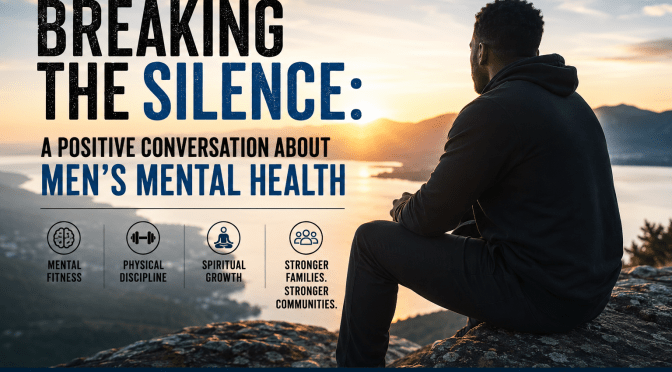
Breaking the Silence: A Positive Conversation About Men’s Mental Health

There are conversations men need to have that too many of us have avoided for too long. Men’s mental health is one of them.

For generations, men have been taught to carry weight quietly. We have been told to provide, protect, lead, endure, and keep moving no matter what is happening inside of us. There is honor in responsibility. There is dignity in discipline. There is strength in perseverance. But there is also danger when a man believes he must suffer silently in order to be considered strong.

I believe it is time to have a better conversation.

Men’s mental health is not a sign of weakness. It is not an excuse. It is not a trend. It is not something we should only talk about after crisis strikes. Men’s mental health is a foundation. It affects how we think, how we lead, how we love, how we serve, how we parent, how we work, how we worship, and how we show up for the people who depend on us.

When I talk about men becoming healthier, I am not talking about men becoming softer, less responsible, or less disciplined. I am talking about men becoming more whole. I am talking about men developing the spiritual, mental, and physical fitness needed to function at optimal levels for their families, their communities, and their purpose.

A man who is healthy internally is better equipped to lead externally.

Why Men’s Mental Health Matters

Men’s mental health matters because men matter.

That statement may sound simple, but it needs to be said clearly. Men are fathers, husbands, sons, brothers, mentors, coaches, pastors, business owners, employees, protectors, leaders, and servants. The condition of a man’s mind and spirit does not remain isolated inside him. It affects everyone connected to him.

If a man is angry, disconnected, exhausted, anxious, bitter, or quietly defeated, that emotional weight often spills into his home, his workplace, and his community. He may not intend to hurt anyone. He may even believe he is doing the right thing by pushing through. But unaddressed pressure has a way of coming out.

Sometimes it comes out as irritability. Sometimes it comes out as isolation. Sometimes it comes out as control. Sometimes it comes out as addiction, overworking, emotional distance, or destructive decision-making.

This is why men’s mental health cannot be treated like a private issue that has no public consequence. Healthy men help build healthy homes. Healthy homes help build healthy communities. Healthy communities help build a stronger society.

When men are mentally clear, spiritually grounded, and physically disciplined, they become more present, patient, and purposeful. They make better decisions. They listen more carefully. They lead with greater humility. They respond instead of react. They become the kind of men their families can trust and their communities can count on.

The Weight Men Carry in Silence

One of the biggest challenges men face is the pressure to appear fine even when they are not.

Many men wake up every day carrying financial pressure, family pressure, spiritual pressure, career pressure, physical pressure, and emotional pressure. They may feel responsible for everyone else while feeling unsure of where to take their own pain.

A man can be surrounded by people and still feel alone. He can have a family, a job, a platform, a ministry, or a mission and still feel like no one truly sees what he is carrying. He may be the one everyone calls when something goes wrong, yet he may not know who to call when he is the one struggling.

That kind of silence can become heavy.

I believe one of the most dangerous lies a man can believe is that he must handle everything by himself. Independence has value, but isolation is dangerous. Self-control is necessary, but emotional suppression is not the same as strength. There is a difference between being steady and pretending nothing affects you.

Real strength requires honesty.

A man must be able to look himself in the mirror and ask, “How am I really doing?” Not how do I appear to be doing. Not how do people assume I am doing. Not how do I want people to think I am doing. But how am I really doing?

That question can change a man’s life.

Mental Health Is Maintenance, Not Weakness

I look at mental health the same way I look at physical fitness. You do not work out once and expect to stay strong forever. You do not eat one healthy meal and expect your body to operate at its best for the rest of your life. You do not pray once, reflect once, or rest once and assume your spirit and mind never need attention again.

Health requires maintenance.

Mental health is mental maintenance. It is the daily work of paying attention to thoughts, emotions, stress, habits, relationships, and purpose. It is learning how to process life instead of simply reacting to it.

As men, we often respect physical strength because we can see it. We can measure it. We can track progress in the gym, on the scale, or through performance. But mental strength is often quieter. It looks like patience. It looks like clarity. It looks like self-control. It looks like forgiveness. It looks like asking for help before things fall apart. It looks like having the discipline to rest instead of running yourself into the ground.

A man who takes care of his mental health is not weak. He is responsible.

He understands that his family needs more than his income. They need his presence. They need his peace. They need his wisdom. They need his emotional maturity. They need his ability to lead without allowing stress, fear, or frustration to control the atmosphere of the home.

The Three Pillars of a Healthier Man

I believe a man functions best when he pays attention to three essential areas: spiritual fitness, mental fitness, and physical fitness.

These three areas are connected. When one is neglected, the others often suffer. When a man is spiritually dry, his mind can become unstable. When his mind is overwhelmed, his body can begin to break down. When his body is undisciplined, his thoughts and emotions can become harder to manage.

A healthier man does not separate these areas. He strengthens them together.

Spiritual Fitness

Spiritual fitness gives a man foundation.

For me, spiritual health means staying connected to God, purpose, truth, humility, and conviction. It means understanding that I am not just here to survive. I am here to serve. I am here to grow. I am here to become the man I was created to be.

A spiritually grounded man does not have to be perfect. He simply has to be willing to surrender pride, seek wisdom, and walk with purpose. Prayer, scripture, reflection, worship, gratitude, and repentance all help a man stay aligned.

When a man loses spiritual alignment, he can begin chasing things that never satisfy him. He may chase status, money, attention, control, pleasure, or approval, only to realize that none of those things can give him peace.

Spiritual fitness reminds a man who he is, whose he is, and why his life matters.

Mental Fitness

Mental fitness is the discipline of managing the inner life.

This includes thoughts, emotions, stress, perspective, decision-making, and self-awareness. A mentally fit man does not ignore his emotions. He learns how to understand them. He does not allow every feeling to dictate his actions. He learns how to respond with wisdom.

Mental fitness requires honesty. It requires a man to recognize when he is becoming overwhelmed, bitter, anxious, distracted, or disconnected. It requires him to stop pretending that being busy means being healthy.

A man can be productive and still be unhealthy. He can be successful and still be empty. He can be respected publicly and still be struggling privately.

Mental fitness helps a man become whole from the inside out.

Physical Fitness

Physical fitness matters because the body affects the mind.

When I take care of my body, I think more clearly. I manage stress better. I sleep better. I have more energy. I become more disciplined. Physical fitness does not mean every man has to look the same or train the same. It means every man should respect the body he has been given.

Movement, strength training, walking, stretching, proper sleep, hydration, and better nutrition are not just physical habits. They support mental and emotional health as well.

A man who is physically disciplined often develops confidence that carries into other areas of life. He learns consistency. He learns patience. He learns that growth takes time. He learns how to keep showing up even when motivation is low.

That lesson matters far beyond the gym.

How Men’s Mental Health Impacts the Family

A man’s mental health affects the atmosphere of his home.

When I am healthy, I am more patient. I listen better. I am slower to anger. I am quicker to apologize. I am more present. I am more consistent. I can lead without dominating. I can correct without crushing. I can love without making people feel like they have to earn my peace.

But when I neglect my mental health, my family can feel it. Stress can become sharp words. Exhaustion can become emotional distance. Pressure can become irritability. Fear can become control. Unprocessed pain can become silence.

That is a sobering truth, but it is also empowering.

It means that when a man chooses healing, his family benefits. When he chooses discipline, his family benefits. When he chooses counseling, accountability, prayer, rest, and growth, his family benefits. His children see a healthier example of manhood. His spouse or partner experiences greater emotional safety. The home becomes more peaceful because the man is no longer allowing unresolved internal battles to set the tone.

Men must understand that leadership begins with self-leadership. Before I can lead my family well, I must be willing to lead myself well.

How Men’s Mental Health Impacts the Community

Communities need healthy men.

We need men who mentor young men. We need men who show boys what discipline, respect, faith, courage, and emotional maturity look like. We need men who serve without needing applause. We need men who protect without controlling. We need men who speak truth without cruelty. We need men who lead with strength and compassion.

A mentally healthy man becomes an asset to his community. He is more likely to build, serve, teach, guide, and encourage. He is less likely to be ruled by pride, insecurity, bitterness, or anger. He becomes the type of man who can step into difficult situations and bring stability instead of chaos.

This is why men’s mental health is bigger than the individual. When men heal, communities heal. When men grow, younger generations gain better examples. When men become emotionally and spiritually grounded, they help break cycles that may have existed for years.

A healthy man does not just change his own life. He changes the environment around him.

Practical Ways Men Can Strengthen Their Mental Health

Improving mental health does not always require a dramatic life change. Sometimes it starts with small, consistent decisions made every day.

The first step is honesty. A man has to be willing to admit when something is off. He has to stop minimizing everything. He has to stop saying “I’m good” when he knows he is not. He has to stop treating exhaustion, anger, isolation, and emotional numbness like normal parts of manhood.

The second step is structure. Men need healthy rhythms. We need time to pray, think, move, rest, work, connect, and recover. Without structure, life can become reactive. We move from one demand to the next without ever checking the condition of our soul.

The third step is connection. Every man needs people he can talk to honestly. Not just people who laugh with him, work with him, or watch sports with him. He needs people who can ask deeper questions and hold him accountable.

The fourth step is action. Awareness matters, but action creates change. Make the appointment. Take the walk. Join the group. Call the brother. Start the routine. Open the Bible. Write down the thoughts. Apologize. Set the boundary. Get help.

Healing does not happen by accident. Growth requires participation.

A Better Definition of Strength

We need to redefine strength for men in a healthier way.

Strength is not pretending you never hurt. Strength is facing what hurts and refusing to let it rule you.

Strength is not silence. Strength is knowing when to speak.

Strength is not isolation. Strength is having the humility to receive support.

Strength is not anger. Strength is self-control.

Strength is not dominance. Strength is responsibility.

Strength is not perfection. Strength is growth.

The world does not need men who pretend to have no weaknesses. The world needs men who are willing to mature. Families do not need emotionally absent providers. They need present, grounded, loving, disciplined men. Communities do not need men who are driven by ego. They need men who are anchored in purpose.

A better standard of manhood is possible, but it requires men to do the inner work.

Final Thoughts: Breaking the Silence for the Next Generation

I believe we are living in a time when men must become more intentional about their health than ever before. Not just physical health. Not just financial health. Mental, spiritual, and emotional health as well.

We cannot afford to keep ignoring what is happening inside men. We cannot keep telling men to tough it out while families, communities, and future generations deal with the consequences of unaddressed pain. We need to create space for honest conversations without removing responsibility. We need to encourage men to seek help without shame. We need to remind men that healing is not weakness. Healing is wisdom.

My challenge to men is simple: take your mental health seriously before life forces you to.

Do not wait until you are burned out. Do not wait until your relationships are damaged. Do not wait until your anger has cost you trust. Do not wait until your body starts warning you. Do not wait until your family feels the weight of what you refused to face.

Start now.

Pray. Reflect. Exercise. Rest. Talk. Listen. Build discipline. Seek counsel. Strengthen your body. Renew your mind. Guard your spirit. Serve your family. Invest in your community.

A healthier man becomes a stronger man. A stronger man becomes a better husband, father, friend, leader, and servant. And when men become healthier, everyone connected to them benefits.

Breaking the silence around men’s mental health is not about creating excuses. It is about creating stronger men.

And stronger men help build a stronger world.

Am I My Brother’s Keeper? — Why Your Spiritual, Mental & Physical Health Matters More Than You Think

When I first encountered Oswald Chambers’s devotion “Am I My Brother’s Keeper?” in My Utmost for His Highest, it stopped me in my tracks. The words leapt off the page, not as gentle encouragement but as a stark reminder of how deeply our lives are interconnected in the Body of Christ. Chambers’s core message is clear: our private walk with God affects not only us, but everyone around us — spiritually, mentally, and physically.

In the podcast episode “Am I My Brother’s Keeper?” (3 Pillars Podcast, Season 5, Ep. 9), I reflected on this and wrestled together with listeners how easily we underestimate our influence — both for good and for harm. Here, I want to go deeper, personally and practically, into what it looks like to live with integrity in all areas of life, to care for others as Scripture calls us to, and to live with purpose knowing that the Christian life is not solitary but communal.


Understanding the Call: “None of Us Lives to Himself”

Chambers begins with the sobering statement drawn from Scripture: “None of us lives to himself…” (Romans 14:7). The implication here is massive: our lives are not private — they are public in their effect.

He goes on to point out that if we allow turning away from God, even in private, it ultimately impacts those connected to us — family, friends, coworkers, neighbors, and fellow believers. The analogy used in 1 Corinthians 12 puts it plainly: we are one body. When one part suffers, the whole body suffers.

This relational emphasis is not sentimental. It’s a theological truth rooted in the very nature of the Church as Christ’s Body. What happens in your heart echoes into the lives of others.


Spiritual Disarray: The First Domino to Fall

When we drift spiritually — whether through neglecting prayer, ignoring Scripture, or allowing unresolved sin — it’s not just our momentary peace that suffers; our ability to be present, compassionate, and spiritually discerning also deteriorates.

Chambers uses vivid language: if we give way to spiritual weakness, mental slovenliness, moral obtuseness, or physical selfishness, those around us will suffer. In everyday life, this might look like:

  • Losing patience with loved ones because we haven’t grounded ourselves in prayer.
  • Avoiding challenging conversations about faith because our own trust in God feels fragile.
  • Becoming irritable, distracted, or self‑absorbed, draining others rather than encouraging them.

This is not just an abstract teaching — it’s experiential truth. When my own devotional life wanes, I notice it first in how I relate to people. I find myself more irritable with my spouse, less generous in listening, and more prone to cynicism rather than hope.

Chambers doesn’t sugarcoat this. He reminds us that a Christian’s primary calling isn’t comfort or personal holiness alone — it’s active, engaged service to God and others.

We were not left on this earth merely to be saved and sanctified. We were left here to be at work for Him. That means being spiritually alert, mentally disciplined, and physically ready to serve — not just for our own benefit, but as a testimony to others.


Physical & Mental Disarray: The Hidden Ripples of Neglect

Often, when we think about spiritual life, we think purely of prayer and Scripture. But Chambers reminds us that spiritual health cannot be separated from mental and physical health.

Consider this:

  • Physical exhaustion weakens our resilience and patience. We become short‑tempered, withdrawn, or disengaged.
  • Mental clutter — whether stress, distraction, or unresolved anxiety — makes us less able to listen, empathize, and respond with wisdom.
  • Spiritual disconnection often shows up first in silence with God, then in silence with people.

These aren’t separate categories. They feed into each other. Physically depleted people are mentally overwhelmed; mentally overwhelmed people are spiritually distant; spiritually distant people become emotionally unavailable. The net effect is predictable: relationships strain, families suffer, communities weaken.

When I look back on seasons where I allowed neglect in one area — whether sleep, solitude with God, or honest reflection — the consequences are always relational first. I became harder to love, harder to reach, harder to walk alongside.


Others Don’t Just Notice — They Depend On You

Chambers’s point that everyone around us suffers when we suffer sounds dramatic until you pause and reflect on real relationships.

Your spouse may not say a word, but they notice when you’re spiritually distracted.

Your children may not articulate it, but they feel the shift when you are emotionally absent.

Your friends — especially those struggling — feel the impact when you withdraw or lose passion.

Church communities feel it when leaders falter.

Workplaces feel it when you’re disengaged.

The apostle Paul’s metaphor of the Body of Christ is not just theological poetry — it’s diagnostic. When one part fails, the entire body’s functioning changes. It’s like a domino effect: one weakened link changes how the entire chain holds tension.

And yet, Chambers doesn’t leave us in despair. He reminds us that our sufficiency is from God. We don’t muster the strength alone — we draw it from Him.


What Happens When We Rediscover Our Calling?

Jesus’s command “You shall be witnesses to Me” (Acts 1:8) defines discipleship not as a passive state, but as active engagement of every ounce of our mental, moral, and spiritual energy.

Chambers pushes us to ask: How much of ourselves are we willing to give? Are we willing to be spiritually present, emotionally available, mentally alert?

Too often, we think of discipleship as something we “do” after we get our lives in order. But Chambers flips the logic: it’s through doing discipleship — by pouring ourselves out for Christ and for others — that our lives get ordered.

This is risky. It means:

  • Vulnerability with others.
  • Honest self‑examination.
  • Confession and reconciliation.
  • Stepping into discomfort for the sake of someone else’s growth.

But this risk is the very heart of spiritual life. Prayer isn’t just a ritual — it’s a lifeline that keeps us tethered to God so we can serve others with strength and compassion.


Learning to Be One Another’s Keeper

To truly be our brother’s keeper requires more than good intentions. It requires intentional spiritual practices that align us with God and enable us to serve others without burning out or turning selfish.

Here are some ways I’ve learned to live this out:

1. Transparency in Community

We need spaces where we can be real — not perfect — with others. Vulnerability invites others to share honestly, creating environments where we don’t just duplicate weakness but strengthen each other.

2. Accountability That Isn’t Condemning

Accountability isn’t about control — it’s about mutual care. When I share struggles with a trusted friend, we both become stronger, not weaker. And we both learn what it means to bear each other’s burdens.

3. Intentional Spiritual Rhythm

Keeping daily walk with God — prayer, Scripture, reflection — isn’t about performance. It’s about formation. When we return daily to God, we build resilience and clarity to support others effectively.

4. Emotional Investment in Others

Sometimes being my brother’s keeper simply means listening deeply, withholding judgment, and offering presence. Not solutions first — presence first.


Conclusion: You Matter — Far Beyond What You See

Chambers’s challenge is both convicting and hopeful:

If one part suffers, every part suffers with it.

Your inner life — spiritually, mentally, physically — is not private. It is joined with others in a profound web of influence. What you do in solitude affects your effectiveness in community. What you nurture in prayer, you bring to others in compassion.

Christ didn’t call us to be lone saints. He called us to be witnesses — for Him and for each other.

So I ask again, and now ask of myself:

Am I my brother’s keeper?

Yes — not perfectly, not effortlessly, and not alone — but faithfully, with God’s strength, and with love that empowers others to thrive.

Dangerous D’s: How I Learned to Recover from Setbacks and Keep Pressing On

We all hit walls.

Not metaphorical ones — actual emotional, mental, or spiritual walls. Those moments when life seems to push back harder than we push forward. Every one of us knows what it’s like to feel stuck, derailed, or defeated. In Season 5, Episode 6 of my podcast, “Back on the Path,” I opened up about hitting one of those walls and what it took to get back up. What I didn’t expect was just how many of us are battling the same struggles — not just in the external world, but internally, with the fears and doubts that arise when we fall short of our goals.

In my own journey, one framework has helped me interpret setbacks in a fresh, grounded, and ultimately empowering way: the Dangerous D’s. These are the internal barriers — the self‑sabotaging mindsets that threaten to impede our progress and derail our momentum. Though I first encountered them in motivational teaching literature, they have since become a lens through which I understand my own reactions to adversity.


What Are the Dangerous D’s?

In life’s journey toward growth, success, or fulfillment, certain pitfalls lure us away from forward motion. Often, the danger isn’t the external setback itself — it’s the inner response we default to in the wake of that challenge. These internal struggles are what I call the Dangerous D’s:

  • Discouragement
  • Deception
  • Defeat
  • Disbelief
  • Diversion
  • Delay
  • Depression

These aren’t just abstract concepts — they show up in our thoughts, our conversations, and our habits. Understanding them is the first step in learning how to recover from setbacks and continue pressing on.


1. Discouragement — The First Sting After a Setback

Discouragement hits us first. It’s that voice that says, “This setback means you’re not meant for this.” I’ve felt it — like the rug being pulled out from under my confidence. After one episode of defeat, I caught myself thinking that maybe I wasn’t cut out for the path I had chosen. The dream deferred became a threat to my identity.

But here’s what I’ve learned:

Discouragement is a feeling, not a verdict.

Feelings are honest — but they aren’t always true. Just because something feels hopeless doesn’t mean it is. When discouragement tries to take the wheel, I now pause, breathe, and re‑frame it as information, not instruction. It’s simply your heart reacting to pain. It doesn’t define your capacity for growth.

How to overcome discouragement:

  • Name the feeling — identify it. (“This is discouragement, not failure.”)
  • Separate emotion from identity.
  • Remind yourself of past recoveries and lessons learned.

Discouragement loses its power when you see it for what it is — a temporary emotional response.


2. Deception — The Trap of Misreading Reality

Deception shows up when discouragement turns deceptive. It whispers things like:

  • “You’re not as capable as you thought.”
  • “This barrier means you’re finished.”
  • “Everyone else is doing better than you.”

This is where your inner critic becomes your worst enemy. Deception isn’t truth; it’s your doubt wearing a mask.

I battled this the hard way. After a major goal collapsed, I started telling myself stories that weren’t true — stories that were built on fear and insecurity, not facts. That’s when I realized: my mind was lying to me. It was filling the gaps of uncertainty with fear‑generated fiction.

How to overcome deception:

  • Do a reality check — What’s actual fact?
  • Ask, “Is this thought true, useful, kind, or empowering?”
  • Replace distorted thoughts with grounded truths.

Truth liberates you from fear’s imagination.


3. Defeat — The Wall That Feels Final

Of all the Dangerous D’s, defeat feels the most permanent. It arrives after we’ve tried, stumbled, and struggled. It sounds like, “You’ve failed. There’s no coming back from this.”

I once went weeks believing that one professional setback meant my career was over — not because it was, but because defeat had whispered that lie so convincingly.

But here’s the reality:

A set‑back is not a stop sign — it’s a learning moment.

Defeat only wins when you stop trying. It loses when you pivot, adjust, and take another step — no matter how small.

How to overcome defeat:

  • Acknowledge the setback without surrendering to it.
  • Break your path into smaller, manageable steps.
  • Celebrate every tiny forward movement.

Momentum doesn’t come from perfection — it comes from persistence.


4. Disbelief — When You Stop Believing in Yourself

Disbelief creeps in when discouragement and defeat stick around too long. It’s when you begin to question:

  • “Am I capable?”
  • “Do I have what it takes?”
  • “Is this worth it anymore?”

I remember sitting in my office, staring at a blank page for what felt like hours, whispering to myself, “Maybe I’m not a writer.” That disbelief was a shadow — not reality.

Disbelief doesn’t mean you lack ability — it means your confidence is wounded. But here’s the thing:

Belief is not built in a moment — it’s rebuilt through action.

One completed task — even a small one — rebuilds a piece of belief. It’s incremental. It’s patient. And it’s powerful.

How to overcome disbelief:

  • Start with one action — even a small one.
  • Track progress publicly or with accountability.
  • Recognize momentum as belief’s fuel.

Belief thrives when it is witnessed — by you and others.


5. Diversion — The Sneaky Distraction of Disappointment

Diversion is subtle. It doesn’t look like defeat or disbelief. It looks like anything else that draws your focus away from your goal:

  • Social media scrolling instead of action.
  • Busywork instead of productive work.
  • Emotional numbing instead of processing.

When hope feels fragile, diversion feels comforting. It’s easier to binge videos than rebuild a dream.

I’ve fallen into this trap more times than I’d care to admit. But what I learned is this:

Diversion only feels like relief — but it delays growth.

Setbacks demand attention, not avoidance.

How to overcome diversion:

  • Schedule intentional time for rest and reflection — not distraction.
  • Define your highest‑priority actions for the day.
  • Protect your focus like a sacred resource.

Distraction dims your potential. Focus awakens it.


6. Delay — The False Promise of “Later”

Delay sounds responsible. It says things like:

  • “I’ll start again tomorrow.”
  • “I need more time.”
  • “Once I feel ready…”

But in reality, it’s just another form of self‑procrastination. Delay is different from rest. Rest is intentional; delay is avoidance dressed in productivity clothes.

There were seasons of my life where I planned more than I acted — and that loop of planning became a prison of delay.

Here’s what I finally grasped:

The best time to restart is now — imperfectly, without permission.

Delay is the enemy of momentum.

How to overcome delay:

  • Set a start date — and stick to it.
  • Commit publicly — so accountability replaces avoidance.
  • Act before you feel ready.

Action cures fear — not preparation.


7. Depression — The Deepest D and the Realest Struggle

Depression isn’t just a mindset — it’s an emotional experience that can be clinical, overwhelming, and heavy. It’s not something you simply “snap out of.” I don’t gloss over this because for many, it’s the most real and painful of all.

The dangerous part is when depression tells you:

  • “Nothing matters.”
  • “You can’t do this.”
  • “You should give up.”

If you’re reading this and depression feels like a daily burden, please know this:

Recovery is not linear — and you don’t walk it alone.

Professional help, supportive communities, and daily care routines are not weaknesses — they are strength tools. Recovery from depression requires compassion, patience, and support.

How to navigate depression in setbacks:

  • Seek professional support when needed.
  • Create structure in your day.
  • Celebrate small wins — progress is not always big steps.

Healing isn’t a race — it’s a series of small, intentional steps forward.


Recovering from Setbacks: A Path Forward

The Dangerous D’s don’t have to be traps — they can be teachers. Each one reveals something about your heart, your habits, and your capacity to grow.

When I think about my own setbacks — the moments I felt lost, discouraged, or disbelieving — I now see them not as evidence of failure, but as calls to deepen resilience.

Here are the core lessons I’ve taken from walking through these D’s:

1. Setbacks Are Not Stop Signs

Even when life throws you to your knees, the journey doesn’t end — it redirects. Every setback carries within it a seed of insight.

2. Your Response Matters More Than the Setback

You can’t always control what happens to you — but you can control how you respond. That response shapes your trajectory more than the event itself.

3. Growth Is Incremental, Not Immediate

Rebuilding belief, momentum, and clarity happens one step at a time. Celebrate progress — no matter how small.

4. You Don’t Have to Do It Alone

Community, mentorship, prayer, therapy, and accountability are not optional luxuries — they are essential supports along the path.


Final Thoughts: Press On — With Courage and Clarity

If you’ve ever been tempted to walk away from a dream, if discouragement has whispered in your ear, if defeat has felt permanent — you’re not alone. These Dangerous D’s are universal, not personal.

But here’s the hope:

You can rise from every setback more sure of yourself than before.

You can learn from each dangerous D, not be stopped by it. You can recover, rebuild, and renew your purpose.

Pressing on doesn’t mean ignoring pain. It means acknowledging it, learning from it, and using it to fuel forward motion. Every stumble becomes an ingredient in your strength. Every delay, a lesson in timing. Every doubt, an opportunity to reaffirm faith in yourself.

So today, if you’re facing discouragement, deception, or disbelief … remember:

You can keep walking forward. One step. One choice. One day at a time.

You don’t need perfection — you just need persistence. And that is where true recovery begins.

Traditional Masculinity: Rediscovering Strength, Purpose, and a Better Future

When we hear the phrase “traditional masculinity” today, it often comes with charged reactions — some positive, others negative, and many rooted more in cultural opinion than clear understanding. But I want to bring this conversation back to something rooted in truth, dignity, and clarity: traditional masculinity is not obsolete — it’s essential. Not as a rigid stereotype, not as an excuse for aggression or dominance, but as a foundation for strength, responsibility, courage, resilience, and purposeful living.

In a world where roles, expectations, and identities are constantly being re‑examined, it’s understandable that the conversation around masculinity can become confusing. Yet if we strip away the noise, one thing remains clear: society benefits when men embrace their strengths in healthy ways, grow through challenges, and live with purpose and integrity.

In today’s blog post — drawing from my reflections in the “Traditional Masculinity” episode of my podcast — I want to explore what traditional masculinity really is, why it still matters, and how men today can break cycles of hardship to build a better future for themselves, their families, and society as a whole. This is not a nostalgic return to some idealized past, but a practical and positive look at how core masculine strengths can be harnessed for good in the modern world.


What Is Traditional Masculinity?

First, we have to define what we’re talking about.

Traditional masculinity — at its core — refers to qualities that have historically been associated with manhood: courage, leadership, responsibility, provider‑mindset, protection, emotional strength, resilience, and a willingness to act rather than merely talk.

But here’s the thing: traditional masculinity is not toxic by definition. Toxicity comes whenever any human quality — male or female — is taken to an extreme, used to dominate others, or expressed without empathy and self‑awareness. What we want to reclaim is the positive, constructive side of masculinity — strength that protects rather than oppresses, leadership that serves rather than dictates, and resilience that builds rather than breaks.

At its best, traditional masculinity is about stepping up, being dependable, standing firm in the face of challenge, and leading with honor and purpose. These traits have played a role in building families, communities, nations, and movements for good.

Today, we’re not talking about outdated gender roles or limiting identities — we’re talking about values that benefit all people, but which men particularly embody in healthy expression.


Why Traditional Masculinity Still Matters

You don’t have to look very far to see why this conversation is crucial.

We live in an age where:

  • Family structures are strained, and fatherlessness is a crisis in many communities.
  • Young men feel lost, unsure of purpose, identity, or direction.
  • There’s confusion about what it means to be a man, resulting in extremes of apathy on one hand and aggression on the other.
  • Society feels adrift, longing for leadership, stability, and strength that doesn’t harm but heals.

In such a landscape, traditional masculinity — properly understood and expressed — can be a stabilizing force.

Why?

Because strength without compassion becomes brutality, and compassion without strength becomes weakness. True masculinity brings both — strength anchored by purpose and guided by character.

Let me unpack why this matters.


1. Men Are Built to Lead and Protect — But Not Dominate

For centuries, men have played central roles in protecting families, communities, and nations. Not because men crave power, but because many men naturally respond to responsibility with strength.

Leadership and protection are not toxic when exercised with wisdom and love. In fact, these qualities are foundational for healthy families and communities.

The modern challenge is this: many men today find themselves disengaged — lacking purpose, direction, and healthy outlets for their strength. When strength is untethered from purpose, it either withers or seeks expression in destructive ways.

But when strength is aligned with service, something beautiful happens:

  • Fathers protect and provide not out of dominance, but out of love.
  • Leaders influence not through force, but through integrity.
  • Communities flourish when men serve with courage and compassion.

This is the heart of traditional masculinity: strength that serves, not harms.


2. Responsibility Isn’t a Burden — It’s a Calling

When I talk about responsibility in the context of masculinity, I’m talking about the willingness to take ownership of one’s life, actions, and purpose.

There’s something deeply human about this. Every time a man steps up to face challenges — whether in his career, in relationships, or in community — he contributes to stability and progress. He doesn’t wait for someone else to fix problems; he engages them.

Yet in recent years, we’ve seen a cultural push that suggests responsibility — especially responsibility rooted in strength — is somehow oppressive or outdated. This is a misunderstanding.

Responsibility isn’t a burden — it’s a calling. And when men answer that calling:

  • They become dependable partners in marriage.
  • They become role models for children.
  • They become steady contributors to society.

Responsibility doesn’t diminish freedom; it magnifies purpose.


3. Resilience Is Masculine — But So Is Vulnerability

Here’s a truth we need to embrace: resilience and vulnerability are not opposites — they are companions.

Traditional masculinity has sometimes been caricatured as emotional suppression — the idea that men shouldn’t show weakness, ever. This is not strength. True strength allows men to feel deeply, express honestly, and grow through difficulty — not bury it.

Resilience means standing firm in challenge. But vulnerability means acknowledging our humanity. A man who refuses to confront pain, emotion, or failure isn’t strong — he’s stuck.

The balance, then, is this:

  • Stand firm when life gets hard.
  • But let your heart be honest with God and those you trust.

This is a masculinity that doesn’t fear emotion — it processes it. A masculinity that doesn’t hide pain — it transforms it.

A man who can be strong and honest is a man who can lead with grace.


4. Traditional Masculinity Offers Purpose — Not Just Identity

One of the reasons so many young men feel lost today is that they lack purpose. Identity without purpose is like a ship without a rudder.

Traditional masculine values — such as duty, service, courage, and leadership — provide direction. They give men something bigger than themselves to stand for.

Purpose isn’t a byproduct of popularity. It isn’t earned by meeting cultural trends. Purpose is forged in service, responsibility, and contribution.

When men wake up each day knowing they are meant to protect, to lead, to build, and to serve — not out of ego, but out of conviction — it transforms not just their own lives, but their families and communities.


How Men Can Stop the Cycle of Hard Times and Build a Better Future

Now that we’ve talked about why traditional masculinity matters, let’s get practical.

How can men today break cycles of struggle and contribute to a better future?

Here are six principles — rooted in strength, purpose, and integrity — that can guide this transformation.


1. Embrace Responsibility — Don’t Reject It

Too many men avoid responsibility because it feels heavy or inconvenient. But responsibility is where character is formed.

Responsibility isn’t something to escape — it’s something to own.

Take responsibility for:

  • Your actions
  • Your relationships
  • Your finances
  • Your spiritual growth
  • Your personal development

A man who owns his life doesn’t blame others, circumstances, or culture. He acts — and his actions shape outcomes, not excuses.


2. Cultivate Purpose Before Comfort

Comfort is a great enemy of growth.

A man committed to purpose — higher than leisure, entertainment, or avoidance — is a man who moves forward even when it costs something.

Ask yourself:

  • What is my higher calling?
  • What legacy do I want to leave?
  • What impact do I want to make?

Purpose creates momentum. Comfort simply creates stagnation.


3. Lead With Integrity — Even When It’s Hard

Integrity means doing the right thing even when no one is watching.

Traditional masculinity without integrity is hollow. But integrity rooted in conviction and courage is transformative.

It means:

  • Keeping promises
  • Speaking truth with love
  • Treating others with dignity
  • Standing firm for what’s right

A man of integrity doesn’t waver with the wind of popular opinion — he stands unwavering because he answers to a higher standard.


4. Build Emotional Strength — Not Emotional Suppression

Strong men feel deeply. They don’t hide their emotions — they process them.

This means:

  • Talking about struggles with trusted friends or mentors
  • Being honest about fear, hurt, or confusion
  • Learning how to communicate needs without aggression

Emotional strength isn’t about being unfeeling — it’s about being skillful with your feelings. This makes men better husbands, fathers, friends, and leaders.


5. Serve Others — Don’t Just Seek Success

Traditional masculinity is not about dominating others — it’s about serving them.

A man’s strength is best seen when it’s used for:

  • Protecting the vulnerable
  • Providing encouragement
  • Supporting family
  • Serving community
  • Making sacrifices when necessary

Success without service is hollow. But a life of service creates a legacy that outlasts fame or wealth.


6. Grow Spiritually — Strength Begins Within

Lastly, and perhaps most importantly, true manhood is spiritual at its core.

Integrity, purpose, courage — all grow out of the spirit. A man who neglects his spiritual life will find himself adrift, regardless of worldly accomplishments.

Spiritual growth:

  • Grounds a man in meaning
  • Teaches humility
  • Builds resilience
  • Connects him to values beyond self

A strong spiritual foundation transforms how a man leads, loves, and lives.


What a Better Future Looks Like

When men embrace traditional masculine values in healthy ways, the effects ripple outward:

  • Families become more stable, nurtured by men who lead with love and responsibility.
  • Communities thrive with leaders who build rather than divide.
  • Children see examples of strength coupled with integrity and compassion.
  • Society benefits from men who stand for truth and serve with humility.

We don’t need less masculinity. We need better masculinity — strength rooted in purpose, tempered with love, and expressed through responsibility.

We don’t need men who dominate. We need men who serve courageously.
We don’t need emotionless strength. We need strong emotional maturity.
We don’t need outdated stereotypes. We need true character.


Conclusion: Real Men — Strong, Purposeful, and Kind

Traditional masculinity — when rightly understood — is not a relic of the past. It’s a living heritage of values that can guide men into a future of strength, meaning, and service.

Men aren’t the problem. When they are disconnected from purpose, unsupported in growth, or discouraged from expressing healthy strength, society suffers. But when men embrace responsibility, sharpen their character, cultivate emotional intelligence, live with integrity, and serve with love — they become builders of a better future.

This is not about rejecting progress — it’s about reclaiming what is good in tradition and applying it with wisdom in a modern world.

We need men who are:

  • Courageous, not reckless
  • Responsible, not disengaged
  • Purpose‑driven, not directionless
  • Emotionally aware, not numb
  • Spiritually grounded, not adrift

This is the strength the world needs — not loud or abusive — but firm, thoughtful, and kind.

Traditional masculinity has a place — not as a rigid stereotype, but as a framework for character, courage, and contribution.

If we want a better future, let’s build it with men who are strong in spirit, clear in purpose, and generous in heart.

Finding Peace in Purpose: How Paul’s Letter to the Philippians Helps Us Navigate Anxiety

Introduction: A Voice of Calm Amid Chaos

Anxiety has been my constant companion—sometimes a whisper, other times a tidal wave. In Episode 113—“Dealing With Anxiety”—I realized that anxiety isn’t something to defeat through sheer willpower but through cultivating trust in Christ and transforming my mind. That journey brought me back to Paul’s letter to the Philippians—one of Scripture’s most profound resources on mental and emotional well-being.

Paul didn’t write this letter from a place of peace—it was penned from prison, under duress, with every reason to feel anxious. Yet in it, he models a peace so deep it surprised me. Through Philippians, I discovered not just management techniques, but a lifeline: how to align my anxious thoughts with Jesus’ steadfast presence.

This post explores how Philippians guides us through anxiety—from prayer to renewal of mind and preventative practices—empowered always by the most important reality: trusting in our Lord Jesus.


1. Turning Worry into Prayer: Philippians 4:6–7

Paul’s words in Philippians 4:6–7 are some of the most quoted verses in Scripture for anxious hearts:

“Do not be anxious about anything, but in every situation, by prayer and petition, with thanksgiving, present your requests to God. And the peace of God, which transcends all understanding, will guard your hearts and your minds in Christ Jesus.”

This isn’t a call to suppress anxiety, but an invitation to transform it. Prayer becomes the act of turning a burden into a dialogue—with transparency, vulnerability, and gratitude.

One reflection explains that obeying this isn’t about self-effort; it’s about entrusting our hearts to the Lord, who responds with a peace so profound it exceeds our understanding—and that peace will guard us.

My Practice in Prayer:

  • I consciously say out loud what’s weighing on me—work worries, relational tension, health fears.
  • Then I shift to thanksgiving, even something small: a friend’s message, a moment of clarity, a favorite song.
  • Often, I sense a tangibly calm presence—not because circumstances changed, but because my focus shifted to His character.

2. Renewing the Mind with Philippians 4:8

Paul knew anxiety starts in our thoughts. So he redirects us:

“Finally, brothers and sisters, whatever is true, whatever is noble, whatever is right, whatever is pure, whatever is lovely, whatever is admirable—if anything is excellent or praiseworthy—think about such things.”

This isn’t passive reflection—it’s an act of discipline. Choose what your mind dwells on. Truth, purity, loveliness—such focus changes inner atmosphere.

My Thought-Shift Routine:

  • When worry creeps in, I pause and name one “true” thought: “God is with me.”
  • Then I look for something “lovely”—a scripture, a memory, a quiet moment.
  • I repeat with one more “praiseworthy” focus before returning to tasks—anchored now, not anxious.

3. Understanding Context: Why Paul Could Say “Don’t Be Anxious”

Paul didn’t say these things lightly. He wrote Philippians from prison—under threat, uncertainty, and separation from the people he loved.

A commentary reminds us: this isn’t blatant denial of anxiety. Instead, it’s grounded in deep reliance on the Spirit—a grace-enabled calm amid real trials.

How This Changes My Perspective:

  • I stop comparing my anxiety to others’.
  • I acknowledge it’s real but not final.
  • I ask—not for denial of difficulty—but spiritual strength to face it.

4. Strategies for Managing Anxiety

A. Immediate Strategies for Overwhelmed Moments:

  1. Pray transparently—bring specifics, not just generic fears.
  2. Thank God for something specific—even small grace matters.
  3. Take a physical pause—walk outside, breathe, let your body reset.
  4. Refocus thoughts with Philippians 4:8 themes—actively redirect your mind.

B. Preventative Habits to Build Resilience:

  • Daily habit of journaling—notes of gratitude and truth.
  • Memorize Philippians 4:6–7—setting it as a mental anchor.
  • Create ritual—a morning or evening rhythm of prayer + Philippians reading.
  • Community connection—share honest prayers with a trusted friend or small group.

5. Trusting Jesus: The Foundation of Peace

Underlying all of Paul’s instruction is this: Jesus is near, He cares, and He sustains.

One reflection emphasizes our relationship with God—not self-help or surface platitudes—is the antidote to worry. Prayer plus thanksgiving reveals our dependence is not weakness but trust.

Walking in Trust Daily:

  • Remind myself, Jesus is real and present, not distant.
  • When anxiety nags, I whisper, Jesus, I trust You.
  • Use the landscape of Philippians as both mirror and map—truth to see my need, hope to lead me forward.

6. Stories from Scripture: Paul’s Peace in Prison

In prison, Paul wrote about rejoicing, contentment, and serving Christ joyfully—despite threat and uncertainty.

His lived experience pulled me from conceptualizing anxiety into spiritual formation. If Paul could rejoice amid chains, I could walk forward in relative discomfort—with peace.


7. Reflecting on Anxiety, Not Avoiding It

If you rush past anxiety by refusing to acknowledge it, you miss God’s invitation.

Philippians doesn’t say “don’t feel anxious”; it guides us to not be shaped by anxiety. It invites us to notice it, navigate through it, and redirect toward Jesus.

Personal Takeaway:

  • I started labeling anxious thoughts as “not from the Spirit.”
  • Then I pause—pray Psalm 46:10, or whisper Philippians 4:7.
  • Then I journal or walk away—not running from anxiety, but redirecting from it.

8. Preventative Spiritual Fitness

Think of spiritual habits like emotional vitamins.

  • Regular prayers with thanksgiving create immunity.
  • Meditating on verses like Philippians 4:6–9 sets a guard around your heart.
  • *Community, worship, and confessing your anxiety—don’t walk that path alone.

Conclusion: Trust Jesus, Take Every Thought Captive

Here’s the truest freedom I’ve found:

  • Anxiety is real—don’t deny it.
  • But God offers a different reality: prayer that reshapes, thoughts that reflect truth, peace that protects—and a Savior who walks with us.

In Episode 113, I confessed that habitual anxiety isn’t defeated, it’s navigated—with Jesus as the guiding compass. Philippians isn’t just a chapter—it’s an invitation to live anchored, not anxious.

Take the next step:

  • Memorize 4:6–7.
  • Journal one thanksgiving every day.
  • Share your journey with someone who cares.

This isn’t about elimination—it’s about transformation. Trusting Jesus doesn’t stop storms—but it strengthens you to walk through them in peace.