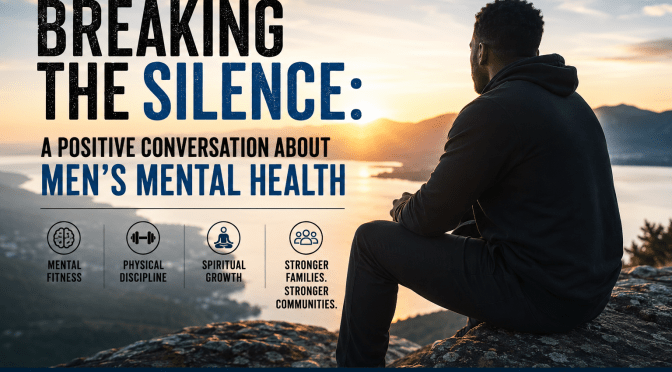
There are conversations men need to have that too many of us have avoided for too long. Men’s mental health is one of them.
For generations, men have been taught to carry weight quietly. We have been told to provide, protect, lead, endure, and keep moving no matter what is happening inside of us. There is honor in responsibility. There is dignity in discipline. There is strength in perseverance. But there is also danger when a man believes he must suffer silently in order to be considered strong.
I believe it is time to have a better conversation.
Men’s mental health is not a sign of weakness. It is not an excuse. It is not a trend. It is not something we should only talk about after crisis strikes. Men’s mental health is a foundation. It affects how we think, how we lead, how we love, how we serve, how we parent, how we work, how we worship, and how we show up for the people who depend on us.
When I talk about men becoming healthier, I am not talking about men becoming softer, less responsible, or less disciplined. I am talking about men becoming more whole. I am talking about men developing the spiritual, mental, and physical fitness needed to function at optimal levels for their families, their communities, and their purpose.
A man who is healthy internally is better equipped to lead externally.
Why Men’s Mental Health Matters
Men’s mental health matters because men matter.
That statement may sound simple, but it needs to be said clearly. Men are fathers, husbands, sons, brothers, mentors, coaches, pastors, business owners, employees, protectors, leaders, and servants. The condition of a man’s mind and spirit does not remain isolated inside him. It affects everyone connected to him.
If a man is angry, disconnected, exhausted, anxious, bitter, or quietly defeated, that emotional weight often spills into his home, his workplace, and his community. He may not intend to hurt anyone. He may even believe he is doing the right thing by pushing through. But unaddressed pressure has a way of coming out.
Sometimes it comes out as irritability. Sometimes it comes out as isolation. Sometimes it comes out as control. Sometimes it comes out as addiction, overworking, emotional distance, or destructive decision-making.
This is why men’s mental health cannot be treated like a private issue that has no public consequence. Healthy men help build healthy homes. Healthy homes help build healthy communities. Healthy communities help build a stronger society.
When men are mentally clear, spiritually grounded, and physically disciplined, they become more present, patient, and purposeful. They make better decisions. They listen more carefully. They lead with greater humility. They respond instead of react. They become the kind of men their families can trust and their communities can count on.
The Weight Men Carry in Silence
One of the biggest challenges men face is the pressure to appear fine even when they are not.
Many men wake up every day carrying financial pressure, family pressure, spiritual pressure, career pressure, physical pressure, and emotional pressure. They may feel responsible for everyone else while feeling unsure of where to take their own pain.
A man can be surrounded by people and still feel alone. He can have a family, a job, a platform, a ministry, or a mission and still feel like no one truly sees what he is carrying. He may be the one everyone calls when something goes wrong, yet he may not know who to call when he is the one struggling.
That kind of silence can become heavy.
I believe one of the most dangerous lies a man can believe is that he must handle everything by himself. Independence has value, but isolation is dangerous. Self-control is necessary, but emotional suppression is not the same as strength. There is a difference between being steady and pretending nothing affects you.
Real strength requires honesty.
A man must be able to look himself in the mirror and ask, “How am I really doing?” Not how do I appear to be doing. Not how do people assume I am doing. Not how do I want people to think I am doing. But how am I really doing?
That question can change a man’s life.
Mental Health Is Maintenance, Not Weakness
I look at mental health the same way I look at physical fitness. You do not work out once and expect to stay strong forever. You do not eat one healthy meal and expect your body to operate at its best for the rest of your life. You do not pray once, reflect once, or rest once and assume your spirit and mind never need attention again.
Health requires maintenance.
Mental health is mental maintenance. It is the daily work of paying attention to thoughts, emotions, stress, habits, relationships, and purpose. It is learning how to process life instead of simply reacting to it.
As men, we often respect physical strength because we can see it. We can measure it. We can track progress in the gym, on the scale, or through performance. But mental strength is often quieter. It looks like patience. It looks like clarity. It looks like self-control. It looks like forgiveness. It looks like asking for help before things fall apart. It looks like having the discipline to rest instead of running yourself into the ground.
A man who takes care of his mental health is not weak. He is responsible.
He understands that his family needs more than his income. They need his presence. They need his peace. They need his wisdom. They need his emotional maturity. They need his ability to lead without allowing stress, fear, or frustration to control the atmosphere of the home.
The Three Pillars of a Healthier Man
I believe a man functions best when he pays attention to three essential areas: spiritual fitness, mental fitness, and physical fitness.
These three areas are connected. When one is neglected, the others often suffer. When a man is spiritually dry, his mind can become unstable. When his mind is overwhelmed, his body can begin to break down. When his body is undisciplined, his thoughts and emotions can become harder to manage.
A healthier man does not separate these areas. He strengthens them together.
Spiritual Fitness
Spiritual fitness gives a man foundation.
For me, spiritual health means staying connected to God, purpose, truth, humility, and conviction. It means understanding that I am not just here to survive. I am here to serve. I am here to grow. I am here to become the man I was created to be.
A spiritually grounded man does not have to be perfect. He simply has to be willing to surrender pride, seek wisdom, and walk with purpose. Prayer, scripture, reflection, worship, gratitude, and repentance all help a man stay aligned.
When a man loses spiritual alignment, he can begin chasing things that never satisfy him. He may chase status, money, attention, control, pleasure, or approval, only to realize that none of those things can give him peace.
Spiritual fitness reminds a man who he is, whose he is, and why his life matters.
Mental Fitness
Mental fitness is the discipline of managing the inner life.
This includes thoughts, emotions, stress, perspective, decision-making, and self-awareness. A mentally fit man does not ignore his emotions. He learns how to understand them. He does not allow every feeling to dictate his actions. He learns how to respond with wisdom.
Mental fitness requires honesty. It requires a man to recognize when he is becoming overwhelmed, bitter, anxious, distracted, or disconnected. It requires him to stop pretending that being busy means being healthy.
A man can be productive and still be unhealthy. He can be successful and still be empty. He can be respected publicly and still be struggling privately.
Mental fitness helps a man become whole from the inside out.
Physical Fitness
Physical fitness matters because the body affects the mind.
When I take care of my body, I think more clearly. I manage stress better. I sleep better. I have more energy. I become more disciplined. Physical fitness does not mean every man has to look the same or train the same. It means every man should respect the body he has been given.
Movement, strength training, walking, stretching, proper sleep, hydration, and better nutrition are not just physical habits. They support mental and emotional health as well.
A man who is physically disciplined often develops confidence that carries into other areas of life. He learns consistency. He learns patience. He learns that growth takes time. He learns how to keep showing up even when motivation is low.
That lesson matters far beyond the gym.
How Men’s Mental Health Impacts the Family
A man’s mental health affects the atmosphere of his home.
When I am healthy, I am more patient. I listen better. I am slower to anger. I am quicker to apologize. I am more present. I am more consistent. I can lead without dominating. I can correct without crushing. I can love without making people feel like they have to earn my peace.
But when I neglect my mental health, my family can feel it. Stress can become sharp words. Exhaustion can become emotional distance. Pressure can become irritability. Fear can become control. Unprocessed pain can become silence.
That is a sobering truth, but it is also empowering.
It means that when a man chooses healing, his family benefits. When he chooses discipline, his family benefits. When he chooses counseling, accountability, prayer, rest, and growth, his family benefits. His children see a healthier example of manhood. His spouse or partner experiences greater emotional safety. The home becomes more peaceful because the man is no longer allowing unresolved internal battles to set the tone.
Men must understand that leadership begins with self-leadership. Before I can lead my family well, I must be willing to lead myself well.
How Men’s Mental Health Impacts the Community
Communities need healthy men.
We need men who mentor young men. We need men who show boys what discipline, respect, faith, courage, and emotional maturity look like. We need men who serve without needing applause. We need men who protect without controlling. We need men who speak truth without cruelty. We need men who lead with strength and compassion.
A mentally healthy man becomes an asset to his community. He is more likely to build, serve, teach, guide, and encourage. He is less likely to be ruled by pride, insecurity, bitterness, or anger. He becomes the type of man who can step into difficult situations and bring stability instead of chaos.
This is why men’s mental health is bigger than the individual. When men heal, communities heal. When men grow, younger generations gain better examples. When men become emotionally and spiritually grounded, they help break cycles that may have existed for years.
A healthy man does not just change his own life. He changes the environment around him.
Practical Ways Men Can Strengthen Their Mental Health
Improving mental health does not always require a dramatic life change. Sometimes it starts with small, consistent decisions made every day.
The first step is honesty. A man has to be willing to admit when something is off. He has to stop minimizing everything. He has to stop saying “I’m good” when he knows he is not. He has to stop treating exhaustion, anger, isolation, and emotional numbness like normal parts of manhood.
The second step is structure. Men need healthy rhythms. We need time to pray, think, move, rest, work, connect, and recover. Without structure, life can become reactive. We move from one demand to the next without ever checking the condition of our soul.
The third step is connection. Every man needs people he can talk to honestly. Not just people who laugh with him, work with him, or watch sports with him. He needs people who can ask deeper questions and hold him accountable.
The fourth step is action. Awareness matters, but action creates change. Make the appointment. Take the walk. Join the group. Call the brother. Start the routine. Open the Bible. Write down the thoughts. Apologize. Set the boundary. Get help.
Healing does not happen by accident. Growth requires participation.
A Better Definition of Strength
We need to redefine strength for men in a healthier way.
Strength is not pretending you never hurt. Strength is facing what hurts and refusing to let it rule you.
Strength is not silence. Strength is knowing when to speak.
Strength is not isolation. Strength is having the humility to receive support.
Strength is not anger. Strength is self-control.
Strength is not dominance. Strength is responsibility.
Strength is not perfection. Strength is growth.
The world does not need men who pretend to have no weaknesses. The world needs men who are willing to mature. Families do not need emotionally absent providers. They need present, grounded, loving, disciplined men. Communities do not need men who are driven by ego. They need men who are anchored in purpose.
A better standard of manhood is possible, but it requires men to do the inner work.
Final Thoughts: Breaking the Silence for the Next Generation
I believe we are living in a time when men must become more intentional about their health than ever before. Not just physical health. Not just financial health. Mental, spiritual, and emotional health as well.
We cannot afford to keep ignoring what is happening inside men. We cannot keep telling men to tough it out while families, communities, and future generations deal with the consequences of unaddressed pain. We need to create space for honest conversations without removing responsibility. We need to encourage men to seek help without shame. We need to remind men that healing is not weakness. Healing is wisdom.
My challenge to men is simple: take your mental health seriously before life forces you to.
Do not wait until you are burned out. Do not wait until your relationships are damaged. Do not wait until your anger has cost you trust. Do not wait until your body starts warning you. Do not wait until your family feels the weight of what you refused to face.
Start now.
Pray. Reflect. Exercise. Rest. Talk. Listen. Build discipline. Seek counsel. Strengthen your body. Renew your mind. Guard your spirit. Serve your family. Invest in your community.
A healthier man becomes a stronger man. A stronger man becomes a better husband, father, friend, leader, and servant. And when men become healthier, everyone connected to them benefits.
Breaking the silence around men’s mental health is not about creating excuses. It is about creating stronger men.
And stronger men help build a stronger world.