
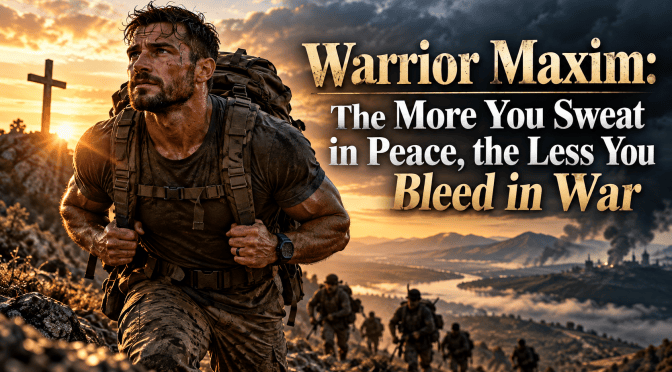
“The more you sweat in peace, the less you bleed in war.”
There are certain phrases that immediately resonate with anyone who has spent time in the military.
They are usually short. Direct. Uncomfortable. They rarely promise an easy road. Instead, they communicate hard-earned truths about preparation, discipline, responsibility, and the consequences of neglecting all three.
“The more you sweat in peace, the less you bleed in war” is one of those sayings.
General Norman Schwarzkopf famously used the maxim while speaking to graduating midshipmen at the United States Naval Academy in 1991, where he emphasized that successful leadership rests upon the decidedly unglamorous foundations of hard work and training.
That message should sound familiar to anyone who has worn a uniform.
You train when you are tired so that you can perform when exhaustion is no longer optional.
You rehearse procedures when nothing is wrong so that when everything goes wrong, your actions are not being invented in the moment.
You practice the fundamentals again and again because under pressure, people rarely rise magically to some unknown level of greatness. More often, they fall back on whatever habits they have developed through repetition.
That is what this warrior maxim means to me.
And although it is rooted deeply in military tradition, I believe its wisdom extends far beyond the battlefield.
Whether you are a veteran transitioning into civilian life, a parent raising children, a professional developing a career, a Christian seeking spiritual maturity, or simply someone trying to become stronger physically, mentally, and spiritually, the principle remains the same:
Do the difficult work before the difficult moment arrives.
The Military Tradition of Preparation
Military organizations cannot afford to treat preparation casually.
The consequences are too serious.
Training is designed to create competence before competence is desperately needed. Weapons are maintained before they malfunction. Equipment is inspected before a mission. Communications are rehearsed. Plans are developed. Contingencies are considered. Physical conditioning is performed long before anyone knows exactly when strength or endurance may be required.
This is not paranoia.
It is professionalism.
During military service, a person quickly learns that preparation itself is part of the mission.
There may be days when training seems repetitive. There may be exercises where the scenario feels artificial or inconvenient. There may be early mornings when physical training is the last thing anyone wants to do.
But repetition has a purpose.
The first time I perform an important task should not be when lives depend upon it.
That concept is central to military tradition.
The objective is not merely to know something intellectually. The objective is to have practiced it enough that sound action becomes increasingly natural under stress.
This applies to marksmanship, communications, physical conditioning, emergency procedures, leadership, tactical planning, first aid, logistics, and countless other responsibilities.
Military training also deliberately introduces hardship.
Why?
Because comfort is a poor instructor for adversity.
If every training environment is perfect, every plan unfolds exactly as expected, everyone is rested, and nothing breaks, then we have not prepared ourselves for reality.
Reality is messy.
People become tired.
Equipment fails.
Plans change.
Weather turns.
Communication becomes difficult.
Fear enters the equation.
Stress changes the way people think.
Training provides an opportunity to encounter controlled adversity before encountering uncontrolled adversity.
That is the sweat in peace.
And although training can never eliminate all danger, disciplined preparation can reduce avoidable mistakes when consequences become serious.
Preparation Is an Act of Respect
I have come to see preparation as something deeper than simple efficiency.
Preparation is an act of respect.
When I prepare properly, I demonstrate respect for the mission.
I demonstrate respect for the people depending upon me.
I demonstrate respect for the responsibilities entrusted to me.
And I demonstrate enough humility to acknowledge that good intentions are not the same thing as competence.
That distinction matters.
I can genuinely want to help someone during an emergency, but if I possess no useful skills, my intentions may accomplish very little.
I can genuinely want to lead others, but if I have never developed judgment, communication skills, discipline, or technical competence, wanting to lead does not make me an effective leader.
I can sincerely want to protect my health while spending years neglecting exercise, nutrition, sleep, and medical care.
Wanting the outcome is not the same as preparing for it.
The warrior maxim challenges me to look beyond my intentions and examine my habits.
What am I doing today to prepare myself for responsibilities I may face tomorrow?
That question applies in uniform.
It also applies long after the uniform comes off.
The Veteran’s Transition: Carrying the Training Forward
Leaving military service creates an unusual challenge.
For years, a servicemember operates within an environment built around standards, accountability, schedules, qualifications, physical readiness, and mission accomplishment.
Then civilian life arrives, and much of that external structure disappears.
No one may be standing there telling you when to exercise.
No one may inspect your room, equipment, appearance, or physical readiness.
There may be no formation tomorrow morning.
The chain of command changes.
Sometimes there is no obvious chain of command at all.
For veterans, I believe one of the challenges of transition is learning how to preserve useful military discipline without needing the military environment to enforce it.
The structure has to become internal.
I still have to prepare.
The battlefield simply looks different.
Maybe the battle is building a civilian career.
Maybe it is learning how to communicate more effectively with a spouse and children.
Maybe it is managing stress, grief, anger, or experiences from military service that were never fully processed.
Maybe it is returning to school after years away from academics.
Maybe it is rebuilding physical health after injuries.
Maybe it is developing new professional skills.
The warrior maxim still applies.
The work I do during relatively peaceful periods of life can make me more capable when hardship arrives.
If I invest in my marriage when things are good, my relationship may be stronger when life becomes difficult.
If I maintain physical fitness before illness or injury occurs, I may possess greater capacity for recovery.
If I build meaningful friendships before I enter a difficult season, I will not have to create an entire support system after the crisis begins.
If I develop professional knowledge before economic uncertainty threatens my employment, I become more adaptable.
The veteran does not have to abandon the warrior mentality.
He simply has to mature it.
The objective is no longer preparation for combat.
The objective is preparation for life.
Civilian Life Has Battles Too
I use the word “battle” carefully.
Not every challenge should be compared to combat, and civilian hardships should not be romanticized as warfare.
But life undeniably contains adversity.
A person may face unemployment.
A parent may discover that a child is seriously ill.
A marriage may enter a difficult season.
Someone may lose a loved one.
A business may fail.
A medical diagnosis may arrive unexpectedly.
Financial pressure may build.
Mental-health struggles may emerge.
Faith may be tested.
None of us receives a complete schedule of these events beforehand.
That uncertainty makes preparation important.
A civilian does not need military experience to understand the value of training before a crisis.
Consider finances.
Building an emergency fund during stable times may provide breathing room during unemployment or an unexpected expense.
Consider physical fitness.
Developing strength, cardiovascular capacity, mobility, and healthy habits before they become urgently necessary is generally more effective than waiting until poor health forces immediate action.
Consider education.
Learning skills before a professional opportunity appears prepares me to take advantage of that opportunity when it arrives.
Consider parenting.
Building trust with my children when life is calm creates a stronger relationship from which to navigate difficult conversations later.
Preparation is not pessimism.
It is responsible optimism.
I prepare because I believe the future is worth preparing for.
The Physical Pillar: Train Before Strength Is Required
The most literal application of the warrior maxim is physical.
Training requires voluntary discomfort.
I lift weight that my muscles would rather not lift.
I push my cardiovascular system beyond its current comfort zone.
I choose consistency when sitting on the couch would be easier.
Over time, the body adapts.
That adaptation is one of the reasons physical fitness has always been such an important component of military readiness.
But physical preparation matters in civilian life as well.
I do not exercise merely because I want to look better.
I want to remain capable.
I want to possess enough strength and endurance to meet the responsibilities God has placed before me.
I want to play with my children.
I want to carry groceries, move furniture, work around the house, travel, swim, hike, and respond when someone needs physical assistance.
I want to age with as much strength and independence as circumstances allow.
None of those outcomes is guaranteed.
But I can prepare.
That is the principle.
The workout I complete today may seem unrelated to some future challenge.
So might the healthy meal.
So might getting enough sleep.
So might attending the medical appointment I have been avoiding.
Small acts of stewardship accumulate.
I sweat now so that I may be more capable later.
The Mental Pillar: Rehearsing the Mind
Mental preparation is every bit as important.
Stress does strange things to our thinking.
Problems can suddenly appear larger.
Options seem narrower.
Emotion becomes louder.
Under sufficient pressure, an untrained mind can become its own adversary.
Mental resilience therefore requires practice.
I can learn to recognize unhealthy thought patterns.
I can practice patience rather than immediate reaction.
I can expose myself gradually to difficult tasks rather than avoiding everything uncomfortable.
I can read, study, journal, seek mentorship, and learn from people whose experiences differ from mine.
I can develop problem-solving skills before a crisis forces me to use them.
Perhaps most importantly, I can become comfortable asking for help.
There is nothing admirable about allowing a manageable problem to become catastrophic merely because pride prevented me from speaking.
Veterans understand that teamwork matters.
We should remember that lesson in civilian life.
Sometimes preparation means developing my own skill.
Sometimes it means knowing who has the skill I lack.
Strength does not require isolation.
The Spiritual Pillar: Preparing the Soul
For me, the deepest application of this warrior maxim is spiritual.
Faith should not become emergency equipment that I reach for only after everything else has failed.
I need to know God in times of peace.
I need Scripture before adversity arrives.
I need prayer before I become desperate.
I need fellowship before I feel isolated.
I need repentance before sin hardens my heart.
If I wait until the darkest moment of my life to develop spiritual habits, I am making an already difficult situation harder.
Jesus never promised His followers a life free from hardship.
Christian preparation therefore does not mean believing that sufficient faith will prevent suffering.
It means developing roots deep enough that suffering does not automatically uproot me.
That is why prayer matters when life is going well.
That is why Scripture matters on ordinary Tuesday mornings.
That is why worship matters when I am not in crisis.
Those practices form the spiritual muscle memory that I return to when emotions become unreliable.
Romans 5 teaches that God demonstrated His love toward us through Christ even while we were sinners. That truth is foundational to the Gospel and was also highlighted in the description accompanying this episode of the 3 Pillars Podcast.
My ultimate confidence therefore cannot rest entirely in my preparation.
Preparation is necessary.
God is greater.
I train faithfully while recognizing that I remain dependent upon Him.
Sweat Is Cheaper Than Regret
There is another uncomfortable lesson contained within this maxim.
Preparation requires payment.
The currency may be time.
It may be effort.
It may be money.
It may be discomfort.
It may be humility.
But neglect also has a price.
And frequently, neglect costs more.
The hours required to maintain physical health may seem inconvenient until years of poor habits create larger consequences.
The difficult conversation within a marriage may feel uncomfortable until months of silence become resentment.
Saving money may require sacrifice until an emergency reveals the value of having prepared.
Studying after work may feel exhausting until a professional opportunity appears for which I am suddenly qualified.
Prayer, discipline, training, education, communication, and planning all demand something from me today.
But the maxim reminds me that today’s controlled discomfort may reduce tomorrow’s uncontrolled suffering.
Not eliminate it.
Reduce it.
That distinction is important because preparation does not guarantee outcomes.
The best-trained military in the world can still suffer casualties.
The healthiest person can still become sick.
A responsible employee can still lose a job.
A faithful Christian can still experience tragedy.
The principle is not that preparation gives me control over life.
It gives me greater capacity to respond faithfully when life refuses to be controlled.
Do Hard Things Before You Have To
I believe one of the healthiest habits a person can develop is voluntarily doing difficult things.
Not reckless things.
Not pointless suffering.
Purposeful difficulty.
Wake up and train.
Read the difficult book.
Have the conversation.
Learn the new skill.
Save the money.
Apologize.
Go to counseling.
Attend church.
Complete the course.
Practice the presentation.
Fix the problem before it becomes an emergency.
Develop competence while the stakes are low.
This is how confidence is built.
Real confidence is rarely produced through motivational slogans alone.
Confidence develops when I have evidence that I can do difficult things because I have repeatedly done difficult things.
The warrior maxim embodies that mentality perfectly.
Training converts uncertainty into familiarity.
Discipline converts intention into action.
Repetition converts knowledge into skill.
Preparation converts fear into something more manageable.
Conclusion: Prepare in Peace
“The more you sweat in peace, the less you bleed in war.”
It sounds like a military saying because it is rooted in the realities of military preparation.
But its wisdom belongs to everyone.
As a Marine veteran, I understand the value of training before a mission, preparation before execution, and discipline before adversity.
As a civilian, husband, father, professional, and Christian, I have discovered that those principles did not become irrelevant when I left the military.
They became broader.
My responsibility now is to prepare for the battles that come with ordinary life.
I prepare physically because my body is a tool through which I serve others.
I prepare mentally because adversity demands clear judgment.
I prepare spiritually because ultimately my strength, identity, and hope are rooted in something greater than myself.
I invest in relationships before they become strained.
I develop skills before they become urgently necessary.
I seek wisdom before decisions become crises.
I pray before desperation forces me to my knees.
That is what this warrior maxim means to me.
It is not a celebration of suffering.
It is a recognition that discipline today can reduce unnecessary suffering tomorrow.
It is a call to readiness.
And it raises a question worth asking:
What difficulty in my future could become more manageable because of the preparation I am willing to undertake today?
None of us knows exactly what tomorrow will bring.
But I do know what I can do today.
I can train.
I can learn.
I can pray.
I can prepare.
I can strengthen the Three Pillars—physical, mental, and spiritual—so that when adversity arrives, I do not have to begin building myself in the middle of the storm.
The peaceful season is not wasted time.
It is training time.
Use it well.
Semper Fi. God Bless.

