Tag Archives: writing

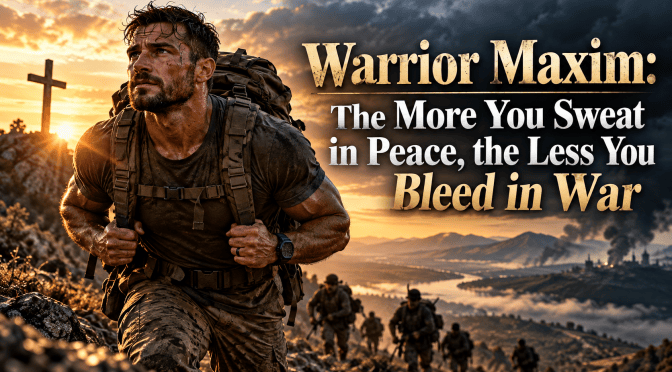
Warrior Maxim: The More You Sweat in Peace, the Less You Bleed in War

“The more you sweat in peace, the less you bleed in war.”

There are certain phrases that immediately resonate with anyone who has spent time in the military.

They are usually short. Direct. Uncomfortable. They rarely promise an easy road. Instead, they communicate hard-earned truths about preparation, discipline, responsibility, and the consequences of neglecting all three.

“The more you sweat in peace, the less you bleed in war” is one of those sayings.

General Norman Schwarzkopf famously used the maxim while speaking to graduating midshipmen at the United States Naval Academy in 1991, where he emphasized that successful leadership rests upon the decidedly unglamorous foundations of hard work and training.

That message should sound familiar to anyone who has worn a uniform.

You train when you are tired so that you can perform when exhaustion is no longer optional.

You rehearse procedures when nothing is wrong so that when everything goes wrong, your actions are not being invented in the moment.

You practice the fundamentals again and again because under pressure, people rarely rise magically to some unknown level of greatness. More often, they fall back on whatever habits they have developed through repetition.

That is what this warrior maxim means to me.

And although it is rooted deeply in military tradition, I believe its wisdom extends far beyond the battlefield.

Whether you are a veteran transitioning into civilian life, a parent raising children, a professional developing a career, a Christian seeking spiritual maturity, or simply someone trying to become stronger physically, mentally, and spiritually, the principle remains the same:

Do the difficult work before the difficult moment arrives.

The Military Tradition of Preparation

Military organizations cannot afford to treat preparation casually.

The consequences are too serious.

Training is designed to create competence before competence is desperately needed. Weapons are maintained before they malfunction. Equipment is inspected before a mission. Communications are rehearsed. Plans are developed. Contingencies are considered. Physical conditioning is performed long before anyone knows exactly when strength or endurance may be required.

This is not paranoia.

It is professionalism.

During military service, a person quickly learns that preparation itself is part of the mission.

There may be days when training seems repetitive. There may be exercises where the scenario feels artificial or inconvenient. There may be early mornings when physical training is the last thing anyone wants to do.

But repetition has a purpose.

The first time I perform an important task should not be when lives depend upon it.

That concept is central to military tradition.

The objective is not merely to know something intellectually. The objective is to have practiced it enough that sound action becomes increasingly natural under stress.

This applies to marksmanship, communications, physical conditioning, emergency procedures, leadership, tactical planning, first aid, logistics, and countless other responsibilities.

Military training also deliberately introduces hardship.

Why?

Because comfort is a poor instructor for adversity.

If every training environment is perfect, every plan unfolds exactly as expected, everyone is rested, and nothing breaks, then we have not prepared ourselves for reality.

Reality is messy.

People become tired.

Equipment fails.

Plans change.

Weather turns.

Communication becomes difficult.

Fear enters the equation.

Stress changes the way people think.

Training provides an opportunity to encounter controlled adversity before encountering uncontrolled adversity.

That is the sweat in peace.

And although training can never eliminate all danger, disciplined preparation can reduce avoidable mistakes when consequences become serious.

Preparation Is an Act of Respect

I have come to see preparation as something deeper than simple efficiency.

Preparation is an act of respect.

When I prepare properly, I demonstrate respect for the mission.

I demonstrate respect for the people depending upon me.

I demonstrate respect for the responsibilities entrusted to me.

And I demonstrate enough humility to acknowledge that good intentions are not the same thing as competence.

That distinction matters.

I can genuinely want to help someone during an emergency, but if I possess no useful skills, my intentions may accomplish very little.

I can genuinely want to lead others, but if I have never developed judgment, communication skills, discipline, or technical competence, wanting to lead does not make me an effective leader.

I can sincerely want to protect my health while spending years neglecting exercise, nutrition, sleep, and medical care.

Wanting the outcome is not the same as preparing for it.

The warrior maxim challenges me to look beyond my intentions and examine my habits.

What am I doing today to prepare myself for responsibilities I may face tomorrow?

That question applies in uniform.

It also applies long after the uniform comes off.

The Veteran’s Transition: Carrying the Training Forward

Leaving military service creates an unusual challenge.

For years, a servicemember operates within an environment built around standards, accountability, schedules, qualifications, physical readiness, and mission accomplishment.

Then civilian life arrives, and much of that external structure disappears.

No one may be standing there telling you when to exercise.

No one may inspect your room, equipment, appearance, or physical readiness.

There may be no formation tomorrow morning.

The chain of command changes.

Sometimes there is no obvious chain of command at all.

For veterans, I believe one of the challenges of transition is learning how to preserve useful military discipline without needing the military environment to enforce it.

The structure has to become internal.

I still have to prepare.

The battlefield simply looks different.

Maybe the battle is building a civilian career.

Maybe it is learning how to communicate more effectively with a spouse and children.

Maybe it is managing stress, grief, anger, or experiences from military service that were never fully processed.

Maybe it is returning to school after years away from academics.

Maybe it is rebuilding physical health after injuries.

Maybe it is developing new professional skills.

The warrior maxim still applies.

The work I do during relatively peaceful periods of life can make me more capable when hardship arrives.

If I invest in my marriage when things are good, my relationship may be stronger when life becomes difficult.

If I maintain physical fitness before illness or injury occurs, I may possess greater capacity for recovery.

If I build meaningful friendships before I enter a difficult season, I will not have to create an entire support system after the crisis begins.

If I develop professional knowledge before economic uncertainty threatens my employment, I become more adaptable.

The veteran does not have to abandon the warrior mentality.

He simply has to mature it.

The objective is no longer preparation for combat.

The objective is preparation for life.

Civilian Life Has Battles Too

I use the word “battle” carefully.

Not every challenge should be compared to combat, and civilian hardships should not be romanticized as warfare.

But life undeniably contains adversity.

A person may face unemployment.

A parent may discover that a child is seriously ill.

A marriage may enter a difficult season.

Someone may lose a loved one.

A business may fail.

A medical diagnosis may arrive unexpectedly.

Financial pressure may build.

Mental-health struggles may emerge.

Faith may be tested.

None of us receives a complete schedule of these events beforehand.

That uncertainty makes preparation important.

A civilian does not need military experience to understand the value of training before a crisis.

Consider finances.

Building an emergency fund during stable times may provide breathing room during unemployment or an unexpected expense.

Consider physical fitness.

Developing strength, cardiovascular capacity, mobility, and healthy habits before they become urgently necessary is generally more effective than waiting until poor health forces immediate action.

Consider education.

Learning skills before a professional opportunity appears prepares me to take advantage of that opportunity when it arrives.

Consider parenting.

Building trust with my children when life is calm creates a stronger relationship from which to navigate difficult conversations later.

Preparation is not pessimism.

It is responsible optimism.

I prepare because I believe the future is worth preparing for.

The Physical Pillar: Train Before Strength Is Required

The most literal application of the warrior maxim is physical.

Training requires voluntary discomfort.

I lift weight that my muscles would rather not lift.

I push my cardiovascular system beyond its current comfort zone.

I choose consistency when sitting on the couch would be easier.

Over time, the body adapts.

That adaptation is one of the reasons physical fitness has always been such an important component of military readiness.

But physical preparation matters in civilian life as well.

I do not exercise merely because I want to look better.

I want to remain capable.

I want to possess enough strength and endurance to meet the responsibilities God has placed before me.

I want to play with my children.

I want to carry groceries, move furniture, work around the house, travel, swim, hike, and respond when someone needs physical assistance.

I want to age with as much strength and independence as circumstances allow.

None of those outcomes is guaranteed.

But I can prepare.

That is the principle.

The workout I complete today may seem unrelated to some future challenge.

So might the healthy meal.

So might getting enough sleep.

So might attending the medical appointment I have been avoiding.

Small acts of stewardship accumulate.

I sweat now so that I may be more capable later.

The Mental Pillar: Rehearsing the Mind

Mental preparation is every bit as important.

Stress does strange things to our thinking.

Problems can suddenly appear larger.

Options seem narrower.

Emotion becomes louder.

Under sufficient pressure, an untrained mind can become its own adversary.

Mental resilience therefore requires practice.

I can learn to recognize unhealthy thought patterns.

I can practice patience rather than immediate reaction.

I can expose myself gradually to difficult tasks rather than avoiding everything uncomfortable.

I can read, study, journal, seek mentorship, and learn from people whose experiences differ from mine.

I can develop problem-solving skills before a crisis forces me to use them.

Perhaps most importantly, I can become comfortable asking for help.

There is nothing admirable about allowing a manageable problem to become catastrophic merely because pride prevented me from speaking.

Veterans understand that teamwork matters.

We should remember that lesson in civilian life.

Sometimes preparation means developing my own skill.

Sometimes it means knowing who has the skill I lack.

Strength does not require isolation.

The Spiritual Pillar: Preparing the Soul

For me, the deepest application of this warrior maxim is spiritual.

Faith should not become emergency equipment that I reach for only after everything else has failed.

I need to know God in times of peace.

I need Scripture before adversity arrives.

I need prayer before I become desperate.

I need fellowship before I feel isolated.

I need repentance before sin hardens my heart.

If I wait until the darkest moment of my life to develop spiritual habits, I am making an already difficult situation harder.

Jesus never promised His followers a life free from hardship.

Christian preparation therefore does not mean believing that sufficient faith will prevent suffering.

It means developing roots deep enough that suffering does not automatically uproot me.

That is why prayer matters when life is going well.

That is why Scripture matters on ordinary Tuesday mornings.

That is why worship matters when I am not in crisis.

Those practices form the spiritual muscle memory that I return to when emotions become unreliable.

Romans 5 teaches that God demonstrated His love toward us through Christ even while we were sinners. That truth is foundational to the Gospel and was also highlighted in the description accompanying this episode of the 3 Pillars Podcast.

My ultimate confidence therefore cannot rest entirely in my preparation.

Preparation is necessary.

God is greater.

I train faithfully while recognizing that I remain dependent upon Him.

Sweat Is Cheaper Than Regret

There is another uncomfortable lesson contained within this maxim.

Preparation requires payment.

The currency may be time.

It may be effort.

It may be money.

It may be discomfort.

It may be humility.

But neglect also has a price.

And frequently, neglect costs more.

The hours required to maintain physical health may seem inconvenient until years of poor habits create larger consequences.

The difficult conversation within a marriage may feel uncomfortable until months of silence become resentment.

Saving money may require sacrifice until an emergency reveals the value of having prepared.

Studying after work may feel exhausting until a professional opportunity appears for which I am suddenly qualified.

Prayer, discipline, training, education, communication, and planning all demand something from me today.

But the maxim reminds me that today’s controlled discomfort may reduce tomorrow’s uncontrolled suffering.

Not eliminate it.

Reduce it.

That distinction is important because preparation does not guarantee outcomes.

The best-trained military in the world can still suffer casualties.

The healthiest person can still become sick.

A responsible employee can still lose a job.

A faithful Christian can still experience tragedy.

The principle is not that preparation gives me control over life.

It gives me greater capacity to respond faithfully when life refuses to be controlled.

Do Hard Things Before You Have To

I believe one of the healthiest habits a person can develop is voluntarily doing difficult things.

Not reckless things.

Not pointless suffering.

Purposeful difficulty.

Wake up and train.

Read the difficult book.

Have the conversation.

Learn the new skill.

Save the money.

Apologize.

Go to counseling.

Attend church.

Complete the course.

Practice the presentation.

Fix the problem before it becomes an emergency.

Develop competence while the stakes are low.

This is how confidence is built.

Real confidence is rarely produced through motivational slogans alone.

Confidence develops when I have evidence that I can do difficult things because I have repeatedly done difficult things.

The warrior maxim embodies that mentality perfectly.

Training converts uncertainty into familiarity.

Discipline converts intention into action.

Repetition converts knowledge into skill.

Preparation converts fear into something more manageable.

Conclusion: Prepare in Peace

“The more you sweat in peace, the less you bleed in war.”

It sounds like a military saying because it is rooted in the realities of military preparation.

But its wisdom belongs to everyone.

As a Marine veteran, I understand the value of training before a mission, preparation before execution, and discipline before adversity.

As a civilian, husband, father, professional, and Christian, I have discovered that those principles did not become irrelevant when I left the military.

They became broader.

My responsibility now is to prepare for the battles that come with ordinary life.

I prepare physically because my body is a tool through which I serve others.

I prepare mentally because adversity demands clear judgment.

I prepare spiritually because ultimately my strength, identity, and hope are rooted in something greater than myself.

I invest in relationships before they become strained.

I develop skills before they become urgently necessary.

I seek wisdom before decisions become crises.

I pray before desperation forces me to my knees.

That is what this warrior maxim means to me.

It is not a celebration of suffering.

It is a recognition that discipline today can reduce unnecessary suffering tomorrow.

It is a call to readiness.

And it raises a question worth asking:

What difficulty in my future could become more manageable because of the preparation I am willing to undertake today?

None of us knows exactly what tomorrow will bring.

But I do know what I can do today.

I can train.

I can learn.

I can pray.

I can prepare.

I can strengthen the Three Pillars—physical, mental, and spiritual—so that when adversity arrives, I do not have to begin building myself in the middle of the storm.

The peaceful season is not wasted time.

It is training time.

Use it well.

Semper Fi. God Bless.

American Ethos: Ask Not What Your Country Can Do for You

Rediscovering the American Spirit Through Faith, Service, and Personal Responsibility

“Ask not what your country can do for you—ask what you can do for your country.”

— President John F. Kennedy, January 20, 1961

A Challenge That Transcends Generations

On January 20, 1961, President John F. Kennedy stood before the American people and delivered an inaugural address that would become one of the most recognizable speeches in American history.

The United States was entering a period of considerable uncertainty. The Cold War presented significant international challenges, the Civil Rights Movement was confronting longstanding inequalities, and technological advancements were rapidly transforming American society.

Kennedy recognized that addressing the challenges of his generation would require more than the efforts of a single administration. His inaugural address called upon Americans to embrace the responsibilities of citizenship and contribute to the preservation of liberty and the advancement of their nation.

His message was simple, yet profound.

Rather than concentrating exclusively on what our country can provide for us, we should consider what we can contribute to our country.

More than six decades later, I believe this question remains relevant.

What does it mean to be an American? What responsibilities accompany the freedoms we enjoy? How can we contribute to the well-being of our communities and the continued development of our nation?

Most importantly, are we willing to take responsibility for the things within our control, or are we constantly waiting for someone else to take the initiative?

As a United States Marine Corps veteran, a father, a Christian, and a working professional, I have developed a deep appreciation for the relationship between individual responsibility and collective success.

I have witnessed how discipline, sacrifice, leadership, and service influence the effectiveness of military units, professional organizations, families, and communities.

These principles are not exclusive to military service. They apply to every aspect of civilian life.

Through the 3 Pillars Podcast, I frequently discuss the importance of developing ourselves spiritually, mentally, and physically. However, personal development should not be an exclusively self-serving pursuit.

The purpose of becoming stronger is not simply to improve our own circumstances, but to become more capable of serving those who depend upon us.

When we apply that principle to our responsibilities as American citizens, Kennedy’s challenge takes on an entirely new meaning.

It becomes a question that each of us must answer through our daily conduct.


Understanding Kennedy’s Message: Citizenship Requires Participation

President Kennedy delivered his inaugural address during a period when Americans faced significant domestic and international challenges.

His speech emphasized freedom, cooperation, public service, and the responsibilities accompanying national leadership.

Kennedy understood that the country’s future would depend, in part, upon the willingness of ordinary citizens to participate in addressing the challenges before them.

In my interpretation, his famous statement challenges us to recognize that citizenship involves more than receiving the benefits associated with living in the United States.

It also involves accepting responsibility for our contributions to society.

We have opportunities to pursue individual goals, establish businesses, obtain an education, practice our religious beliefs, and raise our families according to our convictions.

However, these freedoms also provide opportunities to serve our neighbors, strengthen our communities, and participate in civic life.

Rather than looking exclusively toward government institutions to address every challenge, we can examine what actions are within our own capabilities.

This does not mean that government has no responsibilities to its citizens.

Public institutions have legitimate obligations, and Americans have the right to question their decisions and advocate for improvement.

However, many challenges also benefit from the participation of individuals, families, businesses, churches, charitable organizations, and local communities.

A community’s well-being is influenced by the willingness of its members to recognize problems, accept responsibility, and participate in meaningful solutions.

That is the central principle I take from Kennedy’s message.

Instead of waiting for someone else to act, I can begin by examining what I am capable of contributing.


Community Involvement: Meaningful Change Begins at Home

One of the recurring themes of the 3 Pillars Podcast is that we must recognize the distinction between circumstances we can control and those beyond our immediate influence.

I cannot personally resolve every challenge facing our nation.

I cannot independently eliminate poverty, repair every failing institution, or ensure that every American has access to the opportunities they desire.

However, I can take responsibility for my own conduct.

I can influence the environment within my home.

I can contribute to the well-being of my neighborhood.

I can participate in organizations serving my community.

These actions represent meaningful opportunities to make a difference.

Consider something as simple as volunteering at a local food bank, assisting with a neighborhood cleanup, or mentoring a young person who needs additional guidance.

Individually, these activities may appear insignificant when compared with the challenges facing an entire nation.

However, their significance becomes apparent when we consider the individuals who benefit from them.

A struggling family receives groceries.

A neighborhood becomes cleaner.

A child receives the encouragement necessary to continue pursuing an education.

These outcomes matter.

Imagine what our communities could accomplish if more individuals consistently dedicated a portion of their time and abilities to helping others.

The influence of those actions could extend beyond the immediate recipients.

A child who receives encouragement may eventually become a mentor to someone else.

A family that benefits from community assistance may later find itself in a position to provide assistance to others.

This is how service can create a positive influence extending beyond the original act.

Meaningful change does not always begin with an extraordinary event. Sometimes it begins with an ordinary person deciding to take responsibility for something immediately before them.


Civic Engagement: Citizenship Is Not a Spectator Sport

Another important component of Kennedy’s message involves participation in the civic process.

The American constitutional system provides citizens with opportunities to participate in elections, communicate with elected representatives, attend public meetings, and contribute to discussions concerning their communities.

These opportunities allow individuals to make their perspectives known and participate in decisions affecting their daily lives.

However, meaningful participation requires a willingness to remain informed.

We live in an era when information is readily available through smartphones, computers, newspapers, podcasts, and countless other sources.

Unfortunately, access to information does not automatically produce understanding.

I believe responsible civic engagement requires us to evaluate information carefully, consider multiple perspectives, and distinguish documented facts from speculation or opinion.

It also requires us to engage in respectful discussions.

Two Americans can share a sincere appreciation for their country while holding different opinions concerning public policy, economic priorities, education, or the responsibilities of government.

Disagreement does not have to result in hostility.

I can express my convictions without attacking another person’s character. Likewise, I can listen respectfully without surrendering my own beliefs.

As I discussed in the podcast, we should approach civic discussions with a level head and a willingness to participate in informed conversations.

The ability to communicate respectfully becomes particularly important when discussing complicated issues that do not have universally accepted solutions.

For me, civic responsibility means taking an active interest in the institutions and decisions affecting my community while recognizing that my fellow citizens possess the same right to participate.


Military Service: The Meaning of Duty and Sacrifice

My service in the United States Marine Corps profoundly influenced my understanding of personal responsibility, leadership, and service.

Military service requires individuals to dedicate themselves to a mission extending beyond personal convenience.

It requires sacrifice, discipline, accountability, and a willingness to work alongside people whose backgrounds and personal convictions may differ significantly from their own.

During my time in the Marine Corps, I served alongside individuals who brought different experiences, perspectives, and abilities to our shared responsibilities.

We did not need to agree on every personal matter to accomplish our mission.

We needed to recognize our responsibilities, respect one another’s contributions, and work together toward a common objective.

That experience taught me an important lesson about leadership.

A successful team does not require every individual to possess identical abilities. It requires individuals who are willing to use their strengths to support one another.

One Marine may possess technical knowledge that another lacks.

Another may demonstrate exceptional leadership, physical endurance, or problem-solving ability.

Through training, mentorship, and cooperation, those individuals can strengthen one another.

The same principle applies to civilian life.

Our country benefits when individuals contribute their knowledge, experience, and abilities toward shared objectives.

My military service also required sacrifices from my family. Those sacrifices were real, and they remain part of how I understand the commitment associated with serving something greater than myself.

I am proud to be a Marine, and I am grateful for the lessons that experience has provided.

However, military service is only one of many ways Americans can contribute to their country.

Teachers, first responders, healthcare professionals, parents, volunteers, business owners, and countless others demonstrate service through the responsibilities they fulfill.

What matters is the willingness to recognize those responsibilities and approach them with integrity.


Education: Investing in Ourselves and Future Generations

Education is another important component of individual responsibility and national development.

I have always believed that learning should continue throughout our lives.

Whether we are pursuing higher education, developing professional skills, studying history, reading literature, or learning something entirely new, every opportunity to expand our knowledge can improve our ability to understand and address the challenges before us.

In the podcast, I compared education to adding tools to a toolbox.

Every new skill or piece of knowledge provides another resource that may prove valuable when confronting an unfamiliar problem.

A person equipped with only one approach may struggle when circumstances require a different solution.

However, someone who continually develops new abilities possesses additional opportunities to adapt.

This is particularly relevant to professional development.

The knowledge and skills I acquired during my military service have influenced how I approach leadership, planning, communication, and problem-solving throughout my civilian career.

Continued education allows me to build upon that foundation.

However, education is not exclusively about personal advancement.

It also creates opportunities to assist others.

A retired teacher might volunteer to tutor children struggling academically.

An experienced professional might mentor someone entering the workforce.

A parent might encourage a child’s curiosity by reading together or exploring new subjects.

These activities can provide valuable support to individuals who may otherwise lack access to additional educational opportunities.

I believe one of the most meaningful investments we can make in our communities is sharing knowledge and encouraging others to develop their abilities.

The more capable we become, the more opportunities we may have to contribute.


Supporting Others: Compassion and Personal Responsibility

Personal responsibility is an important principle in my life.

I believe in working hard, developing useful skills, honoring commitments, and accepting accountability for my decisions.

However, I also recognize that people encounter circumstances that extend beyond their immediate control.

Illness, disability, unemployment, family instability, and other challenges can create significant obstacles.

My Christian faith reminds me of the importance of assisting those who are struggling.

Scripture repeatedly emphasizes compassion toward the poor, the vulnerable, widows, orphans, and others experiencing hardship.

For me, there is no contradiction between encouraging personal responsibility and providing meaningful assistance to someone in need.

In fact, the two principles can reinforce one another.

If someone is struggling to obtain employment, helping that individual develop professional skills may provide a pathway toward greater independence.

If a child is having difficulty in school, additional tutoring may provide the encouragement and knowledge necessary to improve.

If a family is experiencing a temporary financial crisis, assistance from a charitable organization may help provide stability while they work toward recovery.

The goal is not simply to offer assistance without considering its purpose.

It is to understand the individual’s circumstances and determine what form of support may be genuinely useful.

Sometimes that means providing resources.

Sometimes it means sharing knowledge.

Sometimes it means offering encouragement, mentorship, or simply being present during a difficult period.

A compassionate community recognizes both the dignity of individuals and the value of helping people develop the abilities necessary to improve their circumstances.


Environmental Stewardship: Taking Responsibility for Our Surroundings

One of the most personal examples of community service I discussed during the podcast involves an initiative my family and I undertake in honor of my late grandmother.

We sponsor a three-mile stretch of road and dedicate time each quarter to cleaning it.

On those mornings, we wake up early, head to our designated section of roadway, and spend approximately two hours collecting litter.

The amount of trash we encounter can be astonishing.

Food containers, discarded packaging, beverage cans, and other waste accumulate along the roadside.

Much of it could have been disposed of properly through ordinary acts of personal responsibility.

This experience has reinforced my belief that environmental stewardship begins with the decisions we make every day.

I do not need to wait for a large-scale environmental initiative to recognize the importance of keeping my community clean.

I can dispose of my own trash responsibly.

I can participate in neighborhood cleanup efforts.

I can help maintain public parks and natural spaces.

I can conserve resources where practical and encourage my children to develop respect for the environment.

As a Christian, I believe we have a responsibility to exercise responsible stewardship over God’s creation.

That responsibility includes caring for the places in which we live.

Our family’s roadside cleanup is also an opportunity to honor my grandmother’s memory through meaningful action.

It allows us to spend time together, contribute to our community, and demonstrate the importance of taking responsibility for our surroundings.

We are not changing the entire world during those two hours.

However, we are making a tangible difference within our immediate sphere of influence.

That is an important application of Kennedy’s challenge.


National Unity: A Tapestry of Shared Responsibility

America is home to people representing many different cultural backgrounds, religious traditions, personal experiences, and philosophical perspectives.

These differences can influence how individuals understand their responsibilities and approach the challenges facing their communities.

However, cooperation does not require everyone to possess identical beliefs or experiences.

During the podcast, I described the American nation as a tapestry.

A tapestry is composed of individual threads that retain their distinct characteristics while contributing to a larger design.

I believe this provides a useful metaphor for understanding our shared civic life.

Americans can maintain their individual identities, cultural traditions, and religious convictions while recognizing their shared responsibilities toward one another.

We can disagree about public policy while working together to assist families experiencing hardship.

We can approach religious questions differently while respecting one another’s freedom of belief.

We can hold different professional interests while contributing our abilities to the well-being of our communities.

Unity does not require uniformity.

It requires recognizing opportunities for cooperation despite our differences.

My experiences in the Marine Corps reinforced this principle.

People from different backgrounds can develop mutual respect through shared responsibilities, honest communication, and a willingness to support one another.

That lesson remains relevant to how I approach my responsibilities as an American citizen.


The Three Pillars: Preparing Ourselves to Serve

The foundation of the 3 Pillars Podcast is the development of spiritual, mental, and physical strength.

I believe these areas of personal development influence our ability to fulfill our responsibilities toward others.

Spiritual strength provides a foundation for the values guiding my decisions.

Through prayer, Scripture, worship, and fellowship, I seek to develop humility, compassion, integrity, and a greater commitment to serving others.

My Christian faith reminds me that my responsibilities extend beyond personal achievement.

In Mark 10:45, Jesus explains that He came not to be served, but to serve.

That example challenges me to consider how my actions influence the people around me.

Mental strength allows me to approach difficulties with discipline, patience, and sound judgment.

The ability to evaluate information, develop useful skills, communicate effectively, and manage emotional responses is valuable in professional and civic life.

Mental resilience also helps me remain engaged when meaningful progress requires sustained effort.

Physical strength supports my ability to fulfill responsibilities that require energy, mobility, and endurance.

I pursue physical fitness because I value my health and want to remain capable of supporting my family, meeting my professional obligations, and assisting others when circumstances require it.

Not everyone possesses the same physical abilities, and meaningful service takes many forms.

The principle is to develop and responsibly use the abilities available to us.

When considered together, these three pillars represent more than a personal development philosophy.

They provide a framework for becoming more dependable, disciplined, and capable of contributing to the lives of others.


Conclusion: What Can I Do for My Country?

President Kennedy’s inaugural address challenged Americans to consider the responsibilities accompanying citizenship and the importance of contributing to the well-being of their nation.

His question remains relevant to the way I approach my everyday life.

What can I do for my country?

I can begin by taking responsibility for the things within my control.

I can strive to be a dependable husband and father.

I can conduct myself with integrity in my professional life.

I can continue developing my knowledge and abilities while sharing what I have learned with others.

I can participate in civic discussions, volunteer within my community, and treat my fellow Americans with dignity.

I can assist people experiencing hardship, support charitable initiatives, and take responsibility for caring for the environment.

Most importantly, I can recognize that my contributions do not need to receive widespread recognition to possess meaningful value.

The opportunities before me may appear ordinary.

However, ordinary responsibilities performed consistently can have a lasting influence on the people around us.

As a Christian, I want my life to demonstrate the principles I profess.

As a father, I want my children to understand the importance of integrity, service, and personal responsibility.

As a Marine Corps veteran, I remain grateful for the opportunity to have served my country and for the lessons that experience continues to provide.

And as an American citizen, I recognize that meaningful contributions can take many forms.

I cannot personally resolve every challenge facing our nation.

However, I can take responsibility for the decisions I make today.

I can become more knowledgeable.

I can become more disciplined.

I can become more compassionate.

I can become more capable of serving others.

The American ethos is not merely something we inherit. It is something we have an opportunity to demonstrate through our daily conduct.

When I consider Kennedy’s famous challenge, I am reminded that meaningful service does not necessarily begin in Washington, D.C., or within the halls of a government institution.

Sometimes it begins in our homes, our workplaces, our churches, and our neighborhoods.

Sometimes it begins with a father teaching his children about responsibility.

Sometimes it begins with a volunteer helping a struggling family.

Sometimes it begins with a group of neighbors deciding to clean up a neglected street.

And sometimes it begins with a simple question:

What can I do today to make a positive difference in someone else’s life?

I believe that question deserves a place in our daily reflections.

Each of us possesses different abilities, resources, and opportunities.

We also encounter different responsibilities and challenges throughout our lives.

Nevertheless, we can examine how our individual actions influence the people around us and consider where we might make a meaningful contribution.

That is what President Kennedy’s challenge means to me.

Not merely asking what my country can provide, but taking responsibility for what I can contribute to the people who share it with me.

Semper Fi. God Bless.


Listen to the 3 Pillars Podcast

This article accompanies American Ethos, Episode 28, Season 5 of the 3 Pillars Podcast.

In this episode, I examine President John F. Kennedy’s inaugural address and discuss how Americans can apply its central message through community involvement, civic participation, military service, education, personal responsibility, environmental stewardship, and national unity.

The discussion also explores how developing ourselves spiritually, mentally, and physically can better prepare us to fulfill our responsibilities and serve others.