
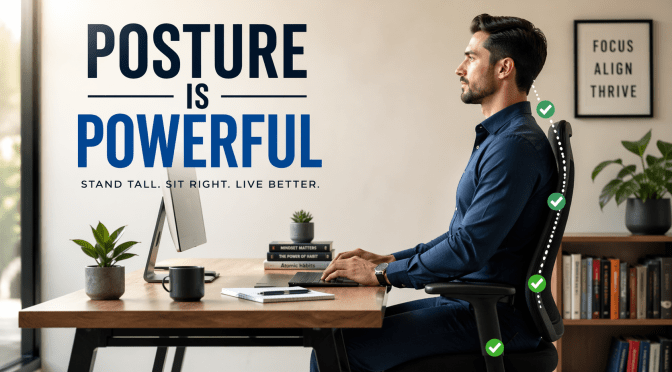
When most people think about health and wellness, they think about the usual categories first. They think about nutrition, fitness, sleep, hydration, stress management, and maybe even supplementation. Those things matter, and they deserve attention. But I have come to believe there is another part of the conversation that is too often ignored, even though it affects nearly every part of daily life.
That part is posture.
Posture is not usually the headline topic in health discussions. It does not feel exciting. It is not often marketed as the secret to transformation. Most people do not wake up and say, “Today I’m going to focus on improving my posture,” even though posture influences how they sit, stand, walk, work, breathe, and move through the world.
That is exactly why I think it deserves more attention.
To me, posture is one of the most overlooked and underrated parts of overall wellness. It sits in the background of daily life so quietly that many people barely think about it at all. But the more I reflect on it, the more convinced I become that posture is not a small side issue. It is part of the foundation. It affects comfort, energy, confidence, presence, and the way the body handles the demands of everyday life.
In a culture that often chases quick fixes and dramatic solutions, posture reminds me of something simple but important: sometimes the most powerful health habits are the ones hiding in plain sight.
Why Posture Gets Overlooked
I think posture gets overlooked for a few reasons.
First, it is easy to ignore what becomes familiar. We live in a world where slouching has become normal. People spend hours bent over phones, hunched over laptops, sitting in cars, leaning into couches, and moving through the day in positions that slowly teach the body poor habits. When something becomes common, people start assuming it is harmless. They stop seeing it as a problem because it looks like everyday life.
But common does not always mean healthy.
Second, posture is often associated with appearance instead of function. Many people hear the word posture and immediately think about looking more polished, more confident, or more disciplined. They think about being told to “sit up straight” as a child. Because of that, posture can get reduced to something cosmetic, when in reality it has much deeper implications.
Third, most people focus on symptoms rather than patterns. If someone feels neck tension, tight shoulders, fatigue, back discomfort, or stiffness, they usually try to relieve the symptom. That is understandable. But what often gets missed is the fact that symptoms can grow out of daily patterns, and posture is one of the biggest patterns we repeat.
That is what makes this so important to me. Posture is not just one moment. It is a repeated position. It is a repeated habit. It is a repeated relationship between the body and gravity. And repeated habits always shape long-term outcomes.
Posture Is About More Than Standing Up Straight
One of the biggest mistakes people make is thinking posture is simply about forcing the body into a rigid shape. I do not see it that way at all.
Proper posture is not stiffness. It is not trying to hold yourself like a statue. It is not about putting on a performance. It is about alignment, support, and efficiency. It is about the way the body is organized so it can do what it was designed to do with less strain and more balance.
When posture is working well, the body tends to move with greater ease. The head is not constantly drifting too far forward. The shoulders are not living in a collapsed position. The spine is not under unnecessary tension all day long. The body is not fighting itself as much.
When posture is poor, the opposite often happens. Compensation becomes the norm. Some muscles work too hard. Others become weak from disuse. Certain joints take on more pressure than they were meant to handle. Energy gets wasted. The body adapts, but not always in healthy ways.
That is why I think posture matters so much. It is not only about how a person looks when they walk into a room. It is about how their body is carrying the load of life.
The Quiet Link Between Posture and Daily Discomfort
I do not believe every ache or pain can be traced back to posture alone. The body is more complex than that. But I do believe posture plays a bigger role in daily discomfort than many people realize.
What happens when the head lives too far forward for hours at a time? The neck and upper back have to work harder to support it. What happens when the shoulders stay rounded and the chest stays collapsed? Tightness and restriction often build. What happens when the body sits in poor alignment day after day, week after week, month after month? The strain has a way of accumulating.
This is one reason posture can be so deceptive. Its effects are often gradual. Poor posture does not always announce itself in one dramatic moment. It often builds quietly. The body starts adapting to poor positions, and because the process is slow, people barely notice it happening.
Then one day they wonder why they feel tight, tired, stiff, or uncomfortable so often.
To me, posture is one of those things that whispers before it shouts. That is why it deserves attention early, not only after the discomfort becomes impossible to ignore.
How Posture Affects Breathing and Energy
One of the most interesting parts of this conversation is how posture influences breathing.
When the body is collapsed, breathing often becomes more shallow. When the chest closes in and the body folds forward, it can become harder to breathe with ease and fullness. Even without realizing it, people can move through large parts of the day taking smaller, less effective breaths simply because their posture has become cramped and compressed.
That matters.
Breathing is not just about survival. It affects calm, focus, rhythm, and energy. It influences how we feel in our bodies. It affects whether we move through the day feeling open and steady or tense and restricted.
I think this is one of the reasons posture is more powerful than it first appears. It reaches into areas people do not always connect to it. It is not just about back and shoulders. It is also about the quality of our breathing, the ease of our movement, and the amount of tension we carry without realizing it.
Poor posture can be draining. It creates unnecessary friction. The body spends more effort compensating, bracing, and enduring positions that do not support it well. Over time, that constant low-level strain can affect how a person feels physically and mentally.
Better posture, on the other hand, can create a greater sense of ease. Not perfection. Not magic. But ease. And sometimes ease is one of the most meaningful things we can create in the body.
Posture and Presence
This part matters to me deeply because posture is not just physical. It is also expressive.
The way we carry ourselves says something, not only to others but also to ourselves. When someone is discouraged, anxious, exhausted, defeated, or overwhelmed, it often shows up in posture before a single word is spoken. Shoulders sink. Head lowers. Chest closes. The body reflects the inward weight a person is carrying.
But the reverse can also be true.
The way we position ourselves can influence how we feel. Again, I am not saying posture solves emotional struggles or removes all stress. But I do believe there is something powerful about choosing to stand tall, open the chest, relax the shoulders, and carry the body with intention.
There is dignity in that.
There is strength in that.
There is a quiet message in that.
To me, good posture is not about pride or image. It is about presence. It is about refusing to live collapsed inward when you were made to move through life with awareness and strength. It is about learning to inhabit your body more intentionally instead of simply reacting to whatever habits modern life has given you.
Modern Life Works Against Good Posture
If I am being honest, I think one reason posture matters so much today is because modern life constantly works against it.
Many daily routines encourage collapse. Screens pull our gaze downward. Desk work keeps people seated for long stretches. Long commutes reduce movement. Stress tightens the body. Fatigue makes people fold inward. Convenience often replaces mobility. Even rest is sometimes spent in positions that continue reinforcing poor habits.
The body learns from whatever we repeat. That means our daily environment is always training us, whether we realize it or not.
This is why I think posture should be part of a proactive wellness conversation. It is not enough to think about health only when we are exercising or trying to improve one specific symptom. We also have to think about what our ordinary routines are shaping.
The ordinary matters.
How we sit matters.
How we stand matters.
How we work matters.
How we recover matters.
How we carry ourselves when nobody is thinking about posture matters.
That is where real change begins.
Wellness Is Often Built in the Small Things
I believe one of the biggest mistakes people make in the wellness world is underestimating the basics. There is often a desire for advanced strategies, dramatic interventions, and fast transformation. But real health is usually built in the repeated things, not just the exciting things.
Posture is one of those repeated things.
It is there in every season of life. It matters for the person who works at a desk. It matters for the person who trains hard. It matters for the parent picking up children, the professional sitting in meetings, the student studying for hours, and the person simply trying to move through the day with less pain and more energy.
Because posture is always with us, it has a cumulative effect. That is what makes it powerful. Small moments of alignment repeated over time can change the way the body feels. Small moments of awareness repeated over time can shift a person’s relationship with movement, tension, and even self-care.
To me, this is one of the most hopeful parts of the conversation. Posture is not reserved for experts or athletes. It is not a luxury topic. It is a human topic. It is available to anyone willing to pay attention.
Improving Posture Starts With Awareness
The encouraging thing about posture is that improvement often begins with something simple: awareness.
Pay attention to how you sit when you are tired.
Pay attention to where your head goes when you look at your phone.
Pay attention to your shoulders when you are stressed.
Pay attention to how you stand when you have been on your feet for a long time.
Pay attention to whether you are breathing freely or holding tension in your body all day.
Awareness is powerful because you cannot change what you refuse to notice.
Once you begin noticing, the next step is not perfection. It is pattern change. It is taking small actions that support better alignment over time. It may mean moving more often. It may mean adjusting your workspace. It may mean strengthening the muscles that support healthy posture. It may mean stretching areas that have become tight and overworked. It may mean pausing throughout the day to reset instead of pushing through tension without thinking.
The goal is not to become rigid or overly self-conscious. The goal is to become more intentional. There is a difference.
Good posture should feel supported, natural, and alive. It should allow breathing, movement, and flexibility. It is not about locking the body down. It is about helping the body work with greater harmony.
Posture as a Form of Stewardship
The more I reflect on posture, the more I see it as a form of stewardship.
It is one of the everyday ways we care for what we have been given. It is one of the quiet choices that reflects whether we are paying attention to the foundations or neglecting them. It is not glamorous, but it is meaningful.
We often think care has to be dramatic to count. But some of the most meaningful forms of care are simple and repeated. Drinking water. Getting rest. Going for a walk. Taking a breath. Standing well. Sitting with intention. Releasing tension from the shoulders. Resetting before strain becomes pain.
These things may look small, but small things shape life.
That is why I find posture so thought provoking. It reminds me that the body is always responding to what I repeatedly do. It teaches me that health is not just built through major decisions. It is also built through quiet discipline. It is shaped by the things I practice when nobody is watching and when nothing feels urgent.
That truth goes far beyond posture. It touches almost every part of life.
Final Thoughts
Posture is easy to overlook because it lives in the background. It does not demand attention the way more obvious health topics do. But I believe it deserves a much bigger place in the wellness conversation.
Posture affects how we move, how we breathe, how we carry stress, how we conserve energy, and how we show up in the world. It can influence comfort, confidence, function, and presence. It may not seem dramatic in the moment, but over time its impact is real.
That is why I believe posture is more powerful than most people realize.
It is not just about standing up straight.
It is not just about appearance.
It is not just about avoiding discomfort.
It is about living with greater awareness.
It is about supporting the body instead of constantly working against it.
It is about honoring the small habits that quietly shape long-term health.
In a world that constantly invites us to slump, scroll, rush, and disconnect, there is something deeply grounding about learning to carry ourselves with intention again. There is something positive and powerful about standing taller, breathing deeper, and recognizing that even the simplest habits can shape the quality of our lives.
Sometimes the most important shifts are not the loudest ones.
Sometimes they begin in the quiet decision to stop overlooking what matters.
FAQ Section
Why is posture so important for wellness?
Posture matters because it influences how the body moves, breathes, balances tension, and handles the demands of daily life. It may seem small, but it affects comfort, energy, presence, and long-term function.
Can posture really affect energy levels?
I believe it can. When the body is constantly compensating for poor alignment, it creates unnecessary strain. Better posture can support easier breathing and more efficient movement, which can help reduce that low-level drain.
Is good posture the same as sitting rigidly straight all day?
No. Good posture is not about stiffness. It is about balanced, supported alignment that allows the body to move and breathe naturally.
Why do so many people struggle with posture today?
Modern life encourages habits that work against it. Long hours at desks, phone use, driving, stress, and sedentary routines all make it easier for poor posture to become normal.
What is the first step to improving posture?
The first step is awareness. Start noticing how you sit, stand, breathe, and carry tension throughout the day. Small corrections repeated consistently can make a meaningful difference.

