
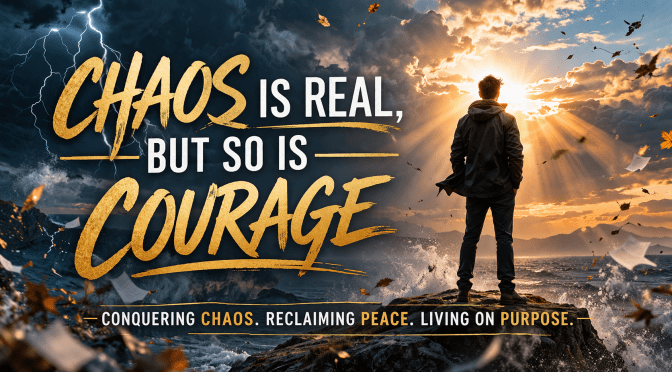
There are moments when I look at the world and feel the weight of just how chaotic it has become. The noise is constant. The pressure is relentless. Everywhere I turn, there seems to be another reason for people to feel anxious, divided, angry, exhausted, or uncertain about what comes next. Chaos shows up in our culture, in our homes, in our schedules, in our thinking, and sometimes in the private places of our hearts that no one else can see.
What I have come to realize is that chaos is not only dangerous because of what it does around us. It is dangerous because of what it tries to do within us. It wants to pull us out of alignment. It wants to steal our peace, cloud our judgment, weaken our discipline, and convince us that disorder is simply the new normal. Left unchecked, chaos does not just surround a person. It slowly starts shaping a person.
That is why I believe this conversation matters so much. We cannot afford to be passive in a chaotic world. We cannot afford to drift through life hoping peace will somehow appear on its own. If we want stability, we have to become intentional. If we want clarity, we have to pursue it. If we want to conquer chaos, we have to stop treating it like an unavoidable master and start confronting it like an enemy that can be resisted.
And that is the good news I keep coming back to: chaos is real, but so is courage. Chaos is powerful, but it is not absolute. It may test us, but it does not have to define us. We can face it. We can push back against it. We can build lives that are not ruled by fear, confusion, or constant emotional turmoil. We can become the kind of people who stand steady in a world that often feels unstable.
The Danger of Chaos in the World
One of the greatest dangers of chaos is how subtle it can be at first. It does not always begin with some obvious collapse. Sometimes it begins with disorder in our thinking. Sometimes it enters through distraction, hurry, emotional overload, or the endless stream of messages competing for our attention. Sometimes it looks like losing our focus little by little until one day we realize we are living reactively instead of intentionally.
That is what makes chaos so deceptive. It often starts small, but it rarely stays small.
When chaos takes hold in the world, people begin to lose their bearings. Truth becomes harder to hold onto. Emotions become easier to manipulate. Conviction gets replaced by impulse. Thoughtfulness gets replaced by outrage. Instead of responding wisely, people react emotionally. Instead of building what is good, they spend their energy surviving what is urgent. Chaos thrives when people no longer know where to stand, what to believe, or how to remain grounded under pressure.
I think that is why chaos feels so exhausting. It is not just about disorder in the external sense. It is about the breakdown of inner steadiness. It creates environments where confusion becomes common, peace becomes rare, and people begin to feel like they are always one step away from being overwhelmed.
And when that happens long enough, chaos starts telling a lie: that instability is just the way life is, and there is nothing we can do about it.
I do not accept that lie.
Yes, the world can be chaotic. Yes, life can be unpredictable. Yes, there are seasons when things feel messy, heavy, and difficult to manage. But I refuse to believe that chaos gets to dictate the terms of how I live. I refuse to believe that because disorder exists around me, I must surrender to disorder within me.
What Chaos Does to the Human Heart
Chaos has a way of working from the outside in. It begins with pressure around us, but if we are not careful, it starts producing pressure within us. That is when it becomes especially dangerous.
I have seen how chaos can distort perspective. It can make small problems feel enormous and important things feel impossible. It can make a person feel trapped in survival mode, where every day becomes about getting through instead of growing through. When that happens, hope begins to shrink. Patience gets thinner. Relationships become harder to nurture. Focus becomes harder to hold. Joy becomes harder to access.
Chaos also attacks identity. It whispers things like, “You are too late. You are too overwhelmed. You are too far behind. You are not strong enough for this.” It tries to turn hard circumstances into personal conclusions. Instead of seeing chaos as something I am experiencing, I begin to feel like chaos is who I am.
That is one of the most destructive things it does.
When people internalize chaos, they stop fighting it. They start organizing their lives around instability. They lose confidence in their ability to change, lead, heal, rebuild, or move forward. They begin to expect confusion, so they stop pursuing clarity. They begin to expect stress, so they stop protecting peace. They begin to expect failure, so they stop acting with courage.
That is why this battle matters. Chaos is never just about what is happening around me. It is also about what I am allowing to settle within me.
Why Chaos Grows When We Stop Leading Ourselves
I have learned that chaos tends to grow wherever self-leadership is absent. If I do not lead my thoughts, my thoughts will lead me. If I do not lead my time, distractions will consume it. If I do not lead my habits, comfort will shape them. If I do not lead my responses, emotion will do it for me.
That is not freedom. That is drift.
And drift is dangerous because it often feels harmless while it is happening. A little more procrastination. A little less reflection. A little more compromise. A little less discipline. A little more mental clutter. A little less intentional living. None of it seems significant in the moment, but over time it creates an environment where chaos can multiply.
I do not believe peace is maintained accidentally. I think peace requires stewardship. It requires awareness. It requires me to notice when my inner world is becoming disordered and to respond before that disorder becomes my new pattern.
For me, that means asking honest questions. What have I been tolerating that I should be confronting? What habits are feeding confusion instead of clarity? Where have I become passive? What am I giving too much power over my mind and emotions? What am I consuming that is making me weaker, more reactive, or more cynical?
Those questions matter because they expose where chaos is gaining unnecessary ground.
There comes a point when I have to stop blaming the noise around me for everything happening within me. Not because external pressures are not real, but because I still have responsibility for how I respond. I may not control every storm, but I do have influence over how I prepare, how I think, how I act, and what I build in the middle of it.
What I Can Do to Stave Off Chaos in Life
One of the most practical things I have learned is that chaos is best resisted with intentional order. Not perfection. Not rigid control. Order.
For me, that begins with grounding. In a chaotic world, I need stable foundations. I need convictions that do not change with every headline, every opinion, or every emotional swing. I need to know what matters most. I need to remember who I am, what I value, and what kind of person I want to be when life gets hard.
Without that grounding, everything starts to feel equally urgent. And when everything feels urgent, clarity disappears.
I also need structure. Simple structure has saved me more times than dramatic breakthroughs ever have. A healthy routine. A clear priority list. Time set aside for reflection. Time protected for rest. A plan for the day. Limits on what gets my attention. These things may seem small, but they create space for peace to live.
Chaos loves clutter, both mental and practical. That is why I have found it so important to simplify. I do not need to respond to everything. I do not need to carry what is not mine to carry. I do not need to say yes to every request, opportunity, or expectation. One of the strongest ways I stave off chaos is by refusing to overcrowd my life.
Another way I resist chaos is by guarding my mind. What I repeatedly consume will eventually shape the way I think. If I fill my mind with fear, outrage, comparison, and negativity, I should not be surprised when my internal world feels unstable. But when I feed my mind with truth, wisdom, discipline, encouragement, and perspective, I strengthen my ability to stay calm under pressure.
I also believe boundaries are essential. Not every voice deserves influence. Not every conflict deserves access. Not every demand deserves a response. Boundaries are not a sign of weakness. They are often a sign of maturity. They help preserve the peace, focus, and strength required to live on purpose.
How to Conquer Chaos Instead of Just Managing It
There is a difference between managing chaos and conquering it. Managing chaos often means learning how to function while staying internally overwhelmed. Conquering chaos means refusing to let it dominate the condition of my soul.
The first step is to pause.
Chaos wants immediate reaction. It wants panic, impulse, and emotional overcorrection. But I have found that some of the most powerful moments in life begin with a pause. A pause helps me breathe. A pause helps me think. A pause creates room for perspective before emotion takes over.
The second step is to identify what is real. I ask myself: What is actually happening here? What am I assuming? What is fact, and what is fear? What is within my control, and what is outside of it? These questions matter because chaos becomes larger when everything feels tangled together. Clarity begins when I separate what is true from what is merely loud.
The third step is to take the next right action. Not every answer comes at once. Not every problem gets solved overnight. But progress often begins the moment I stop staring at the entire mountain and take one faithful step forward. Chaos wants to overwhelm me with the size of everything. Courage reminds me that I only need to obey the next clear step.
The fourth step is consistency. This is where real victory is built. Not in one emotional breakthrough, but in repeated acts of disciplined living. Waking up and choosing peace again. Choosing focus again. Choosing truth again. Choosing responsibility again. Choosing faith over fear again. That is how inner strength is formed.
The fifth step is perspective. I have to remember that a chaotic moment is not the same as a chaotic identity. A hard season is not the same as a hopeless future. Just because things feel unstable today does not mean they will remain that way forever. Perspective helps me stop giving temporary storms permanent authority.
What Strength Really Looks Like in Chaotic Times
I think many people imagine strength as intensity, force, or emotional hardness. But the older I get, the more I believe true strength often looks quieter than that.
Strength is remaining calm when panic would be easier.
Strength is telling the truth when it would be more convenient to avoid it.
Strength is staying disciplined when nobody else sees the effort.
Strength is protecting peace when the world rewards outrage.
Strength is refusing to let fear become the loudest voice in the room.
Strength is showing compassion without losing conviction.
Strength is holding onto hope without denying reality.
In chaotic times, I do not want to become a louder version of the disorder around me. I want to become a steadier presence in the middle of it. I want to be someone who carries clarity into confusion, courage into fear, and peace into environments that feel unstable.
That kind of strength does not happen by accident. It is cultivated. It is practiced. It is tested. And in many cases, it is forged precisely in the fires we would rather avoid.
Turning Chaos Into a Catalyst for Growth
As difficult as chaos can be, I also believe it can reveal things that comfort never will. It can expose weak foundations. It can show me where I have been distracted. It can uncover unhealthy attachments, misplaced priorities, and habits that have been weakening me. It can force me to ask whether I am truly living with intention or simply reacting to whatever comes next.
That kind of exposure can be uncomfortable, but it can also be deeply valuable.
Some of the most important growth in life begins when I stop asking only, “How do I escape this?” and start asking, “What can this teach me?” That question changes everything. It shifts me from victimhood to responsibility. It moves me from panic to reflection. It helps me see that while I may not have chosen every challenge I face, I can still choose how I will be shaped by it.
Chaos can make me bitter, or it can make me wiser.
It can harden me, or it can deepen me.
It can scatter me, or it can teach me to become more anchored.
That does not mean I glorify hardship. It means I refuse to waste it.
Chaos Is Real, but So Is Courage
At the end of the day, I do not believe the answer to chaos is pretending it does not exist. The answer is to face it honestly without giving it the final word.
Yes, chaos is real.
But so is courage.
So is peace.
So is clarity.
So is discipline.
So is purpose.
So is hope.
And when I build my life around those things, chaos loses some of its power. It may still knock at the door, but it does not have to move in. It may still test me, but it does not have to own me. It may still challenge my peace, but it does not have to conquer my spirit.
That is the posture I want to live with. Not denial. Not passivity. Not fear. Courage.
Courage to slow down when the world says hurry.
Courage to think clearly when emotions run high.
Courage to protect peace when conflict feels contagious.
Courage to lead myself when passivity would be easier.
Courage to keep building order, truth, and purpose in a world that often celebrates confusion.
Chaos may be part of life, but it does not have to become the ruler of my life. I can meet it with steadiness. I can answer it with discipline. I can confront it with faith, wisdom, and action. I can refuse to let disorder define who I am.
Because chaos is real, but so is courage.
And courage, when practiced daily, has a way of changing everything.
 3 Pillars Podcast