
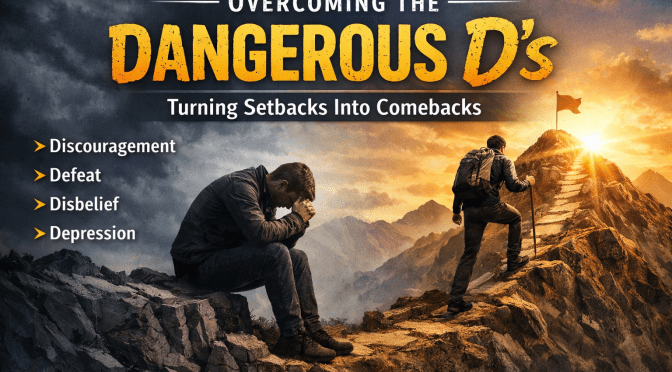
We all hit walls.
Not metaphorical ones — actual emotional, mental, or spiritual walls. Those moments when life seems to push back harder than we push forward. Every one of us knows what it’s like to feel stuck, derailed, or defeated. In Season 5, Episode 6 of my podcast, “Back on the Path,” I opened up about hitting one of those walls and what it took to get back up. What I didn’t expect was just how many of us are battling the same struggles — not just in the external world, but internally, with the fears and doubts that arise when we fall short of our goals.
In my own journey, one framework has helped me interpret setbacks in a fresh, grounded, and ultimately empowering way: the Dangerous D’s. These are the internal barriers — the self‑sabotaging mindsets that threaten to impede our progress and derail our momentum. Though I first encountered them in motivational teaching literature, they have since become a lens through which I understand my own reactions to adversity.
What Are the Dangerous D’s?
In life’s journey toward growth, success, or fulfillment, certain pitfalls lure us away from forward motion. Often, the danger isn’t the external setback itself — it’s the inner response we default to in the wake of that challenge. These internal struggles are what I call the Dangerous D’s:
- Discouragement
- Deception
- Defeat
- Disbelief
- Diversion
- Delay
- Depression
These aren’t just abstract concepts — they show up in our thoughts, our conversations, and our habits. Understanding them is the first step in learning how to recover from setbacks and continue pressing on.
1. Discouragement — The First Sting After a Setback
Discouragement hits us first. It’s that voice that says, “This setback means you’re not meant for this.” I’ve felt it — like the rug being pulled out from under my confidence. After one episode of defeat, I caught myself thinking that maybe I wasn’t cut out for the path I had chosen. The dream deferred became a threat to my identity.
But here’s what I’ve learned:
Discouragement is a feeling, not a verdict.
Feelings are honest — but they aren’t always true. Just because something feels hopeless doesn’t mean it is. When discouragement tries to take the wheel, I now pause, breathe, and re‑frame it as information, not instruction. It’s simply your heart reacting to pain. It doesn’t define your capacity for growth.
How to overcome discouragement:
- Name the feeling — identify it. (“This is discouragement, not failure.”)
- Separate emotion from identity.
- Remind yourself of past recoveries and lessons learned.
Discouragement loses its power when you see it for what it is — a temporary emotional response.
2. Deception — The Trap of Misreading Reality
Deception shows up when discouragement turns deceptive. It whispers things like:
- “You’re not as capable as you thought.”
- “This barrier means you’re finished.”
- “Everyone else is doing better than you.”
This is where your inner critic becomes your worst enemy. Deception isn’t truth; it’s your doubt wearing a mask.
I battled this the hard way. After a major goal collapsed, I started telling myself stories that weren’t true — stories that were built on fear and insecurity, not facts. That’s when I realized: my mind was lying to me. It was filling the gaps of uncertainty with fear‑generated fiction.
How to overcome deception:
- Do a reality check — What’s actual fact?
- Ask, “Is this thought true, useful, kind, or empowering?”
- Replace distorted thoughts with grounded truths.
Truth liberates you from fear’s imagination.
3. Defeat — The Wall That Feels Final
Of all the Dangerous D’s, defeat feels the most permanent. It arrives after we’ve tried, stumbled, and struggled. It sounds like, “You’ve failed. There’s no coming back from this.”
I once went weeks believing that one professional setback meant my career was over — not because it was, but because defeat had whispered that lie so convincingly.
But here’s the reality:
A set‑back is not a stop sign — it’s a learning moment.
Defeat only wins when you stop trying. It loses when you pivot, adjust, and take another step — no matter how small.
How to overcome defeat:
- Acknowledge the setback without surrendering to it.
- Break your path into smaller, manageable steps.
- Celebrate every tiny forward movement.
Momentum doesn’t come from perfection — it comes from persistence.
4. Disbelief — When You Stop Believing in Yourself
Disbelief creeps in when discouragement and defeat stick around too long. It’s when you begin to question:
- “Am I capable?”
- “Do I have what it takes?”
- “Is this worth it anymore?”
I remember sitting in my office, staring at a blank page for what felt like hours, whispering to myself, “Maybe I’m not a writer.” That disbelief was a shadow — not reality.
Disbelief doesn’t mean you lack ability — it means your confidence is wounded. But here’s the thing:
Belief is not built in a moment — it’s rebuilt through action.
One completed task — even a small one — rebuilds a piece of belief. It’s incremental. It’s patient. And it’s powerful.
How to overcome disbelief:
- Start with one action — even a small one.
- Track progress publicly or with accountability.
- Recognize momentum as belief’s fuel.
Belief thrives when it is witnessed — by you and others.
5. Diversion — The Sneaky Distraction of Disappointment
Diversion is subtle. It doesn’t look like defeat or disbelief. It looks like anything else that draws your focus away from your goal:
- Social media scrolling instead of action.
- Busywork instead of productive work.
- Emotional numbing instead of processing.
When hope feels fragile, diversion feels comforting. It’s easier to binge videos than rebuild a dream.
I’ve fallen into this trap more times than I’d care to admit. But what I learned is this:
Diversion only feels like relief — but it delays growth.
Setbacks demand attention, not avoidance.
How to overcome diversion:
- Schedule intentional time for rest and reflection — not distraction.
- Define your highest‑priority actions for the day.
- Protect your focus like a sacred resource.
Distraction dims your potential. Focus awakens it.
6. Delay — The False Promise of “Later”
Delay sounds responsible. It says things like:
- “I’ll start again tomorrow.”
- “I need more time.”
- “Once I feel ready…”
But in reality, it’s just another form of self‑procrastination. Delay is different from rest. Rest is intentional; delay is avoidance dressed in productivity clothes.
There were seasons of my life where I planned more than I acted — and that loop of planning became a prison of delay.
Here’s what I finally grasped:
The best time to restart is now — imperfectly, without permission.
Delay is the enemy of momentum.
How to overcome delay:
- Set a start date — and stick to it.
- Commit publicly — so accountability replaces avoidance.
- Act before you feel ready.
Action cures fear — not preparation.
7. Depression — The Deepest D and the Realest Struggle
Depression isn’t just a mindset — it’s an emotional experience that can be clinical, overwhelming, and heavy. It’s not something you simply “snap out of.” I don’t gloss over this because for many, it’s the most real and painful of all.
The dangerous part is when depression tells you:
- “Nothing matters.”
- “You can’t do this.”
- “You should give up.”
If you’re reading this and depression feels like a daily burden, please know this:
Recovery is not linear — and you don’t walk it alone.
Professional help, supportive communities, and daily care routines are not weaknesses — they are strength tools. Recovery from depression requires compassion, patience, and support.
How to navigate depression in setbacks:
- Seek professional support when needed.
- Create structure in your day.
- Celebrate small wins — progress is not always big steps.
Healing isn’t a race — it’s a series of small, intentional steps forward.
Recovering from Setbacks: A Path Forward
The Dangerous D’s don’t have to be traps — they can be teachers. Each one reveals something about your heart, your habits, and your capacity to grow.
When I think about my own setbacks — the moments I felt lost, discouraged, or disbelieving — I now see them not as evidence of failure, but as calls to deepen resilience.
Here are the core lessons I’ve taken from walking through these D’s:
1. Setbacks Are Not Stop Signs
Even when life throws you to your knees, the journey doesn’t end — it redirects. Every setback carries within it a seed of insight.
2. Your Response Matters More Than the Setback
You can’t always control what happens to you — but you can control how you respond. That response shapes your trajectory more than the event itself.
3. Growth Is Incremental, Not Immediate
Rebuilding belief, momentum, and clarity happens one step at a time. Celebrate progress — no matter how small.
4. You Don’t Have to Do It Alone
Community, mentorship, prayer, therapy, and accountability are not optional luxuries — they are essential supports along the path.
Final Thoughts: Press On — With Courage and Clarity
If you’ve ever been tempted to walk away from a dream, if discouragement has whispered in your ear, if defeat has felt permanent — you’re not alone. These Dangerous D’s are universal, not personal.
But here’s the hope:
You can rise from every setback more sure of yourself than before.
You can learn from each dangerous D, not be stopped by it. You can recover, rebuild, and renew your purpose.
Pressing on doesn’t mean ignoring pain. It means acknowledging it, learning from it, and using it to fuel forward motion. Every stumble becomes an ingredient in your strength. Every delay, a lesson in timing. Every doubt, an opportunity to reaffirm faith in yourself.
So today, if you’re facing discouragement, deception, or disbelief … remember:
You can keep walking forward. One step. One choice. One day at a time.
You don’t need perfection — you just need persistence. And that is where true recovery begins.
 3 Pillars Podcast