
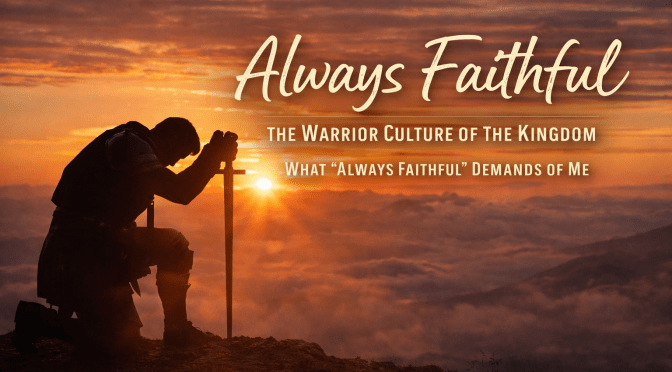
There are phrases that sound inspiring on a shirt, but carry weight when you try to live them on an ordinary Tuesday.
“Always Faithful” is one of those phrases for me.
It’s simple. It’s direct. It doesn’t leave much room for loopholes. And that’s exactly why it confronts me in the best way. Because if I’m honest, my default setting is not “always.” My default is “mostly.” Or “when I’m in the mood.” Or “when it’s convenient.” Or “when I feel strong.”
But “Always Faithful” calls me higher than convenience. It calls me into a kind of warrior culture that isn’t built on aggression or swagger, but on steadfast loyalty—especially when nobody is watching, when the pressure is real, and when the cost is personal.
When I talk about warrior culture, I’m not talking about a personality type. I’m talking about a posture. A way of standing in the world. A way of carrying responsibility without collapsing under it. A way of living as if good and evil are not just abstract concepts, but forces that press against the heart every day.
And in that sense, the battlefield is not only “out there.” The battlefield is also within.
This is where Jamie Walden’s “Omega Dynamics” has been useful for me as a frame—because it doesn’t treat life like a neutral stroll through history. It calls believers to wake up, to recognize the reality of spiritual conflict, and to become what he describes as a “warrior class” of Christians: grounded, disciplined, and ready for the days ahead. Not paranoid. Not theatrical. Not violent. Ready.
Ready to stay faithful.
What Warrior Culture Is—and What It Isn’t
Before I go further, I need to define what I mean, because “warrior culture” can get twisted fast.
True warrior culture is not a love affair with violence. It’s not a fetish for conflict. It’s not posturing, bullying, or trying to dominate people. That’s not strength. That’s insecurity dressed up as toughness.
Real warrior culture is ordered courage.
It is strength under authority.
It is the willingness to carry responsibility when it would be easier to walk away.
It is discipline that shows up even when the feelings don’t.
It is loyalty to mission and to people—especially when there’s no applause.
And in the Kingdom of God, warrior culture must be shaped by the character of Christ. That means humility has to sit inside strength. Love has to guide power. Truth has to outrank ego.
If my “warrior culture” makes me cruel, I’m not becoming a warrior—I’m becoming a threat.
If it makes me proud, I’m not being forged—I’m being inflated.
But if it makes me faithful—steady, sober, courageous, resilient, loving—then I’m moving in the right direction.
“Always Faithful” Is a Standard, Not a Mood
The reason “Always Faithful” hits me is because it doesn’t ask how I feel. It asks who I am.
And that’s the core of it: faithfulness is identity, not emotion.
A faithful person doesn’t wake up every day with perfect enthusiasm. A faithful person wakes up and does what is right anyway. Faithfulness is what you do when motivation is low, temptation is high, and the path is narrow.
In a spiritual sense, I think “Always Faithful” means this:
Faithful to God’s truth even when the culture calls it foolish.
Faithful to God’s ways even when shortcuts look easier.
Faithful in private before I try to be faithful in public.
Faithful when my prayers feel powerful, and faithful when my prayers feel like they bounce off the ceiling.
Faithful when my circumstances are calm, and faithful when my life is shaking.
That’s not perfection. That’s posture.
And I believe God honors posture.
Omega Dynamics and the Call to Stop Living Like a Spectator
One idea I’ve taken from “Omega Dynamics” is the insistence that believers should stop living like spectators.
There’s a difference between believing in God and being enlisted under His leadership.
There’s a difference between knowing Scripture and being formed by it.
There’s a difference between admiring courage and practicing it.
The “warrior class” concept, as I understand it, isn’t about elitism. It’s about maturity. It’s a call to become the kind of believer who doesn’t fold at the first sign of pressure. The kind of believer who can discern what’s happening in the world without becoming hysterical. The kind of believer who can stand firm, love well, and think clearly while other people panic.
That matters, because we live in an age where confusion is celebrated, distraction is constant, and compromise is marketed as compassion.
If I’m not intentional, I drift.
And drift is one of the enemy’s favorite strategies—not a dramatic fall, but a slow fade.
The Modern Battlefield Between Good and Evil
When I say “battlefield,” I’m not trying to sound dramatic. I’m describing what it feels like to live in a world where the pressure to compromise is constant.
The modern battlefield between good and evil is fought in places that don’t always look “spiritual” at first glance:
In the mind—what I allow to shape my beliefs.
In my attention—what gets my focus, my time, my imagination.
In my desires—what I chase when I’m stressed, lonely, or bored.
In my identity—who I believe I am and what I believe I’m for.
In my speech—whether my words heal or poison.
In my relationships—whether I love people with truth or use people for comfort.
In my home—whether I lead with presence or surrender the atmosphere to chaos.
Evil rarely announces itself as evil. It often shows up as a “reasonable” trade:
Trade conviction for comfort.
Trade prayer for distraction.
Trade truth for approval.
Trade courage for safety.
Trade holiness for “just this once.”
And the problem with trades is this: you rarely notice the cost until you’ve been doing it for a while.
Drift Is Not Neutral—It’s a Direction
One of the most thought-provoking realities for me is this: nobody accidentally becomes faithful. But a lot of people accidentally become compromised.
Drift doesn’t require effort. Drift requires neglect.
If I neglect prayer, I don’t become neutral—I become vulnerable.
If I neglect Scripture, I don’t become “free”—I become shaped by whatever is loudest.
If I neglect community, I don’t become independent—I become isolated, and isolation is where temptation speaks the clearest.
If I neglect repentance, I don’t become “confident”—I become hardened.
This is why “Always Faithful” feels like a battle cry. Not because I’m trying to win arguments, but because I’m trying to keep my soul alive.
Faithfulness is how I resist drift.
Applying Warrior Culture to the Real War: Staying Sane, Staying Soft, Staying Strong
If the modern battlefield is spiritual, then the weapons aren’t primarily physical. The weapons are disciplines, virtues, and decisions—repeated until they become instinct.
Here’s what applying these concepts looks like in my life.
1) I Start the Day Like I’m On Watch
Warrior culture includes an understanding of watchfulness. Someone is always on post. Someone is always guarding the gate. That mindset translates spiritually.
I cannot afford to start my day with chaos and call it “normal.”
So I treat prayer like a briefing. Not a performance—alignment.
Sometimes it’s simple: “Lord, keep me faithful today. Guard my mouth. Guard my eyes. Guard my mind. Make me courageous. Make me clean. Make me useful.”
That’s not fancy, but it’s real.
And reality is where battles are won.
2) I Treat Scripture Like a Map, Not a Decoration
If I’m not anchored in truth, I will be tossed by trends. That’s not a theory—it’s predictable.
The point of Scripture is not to make me sound smart. The point is to make me steady.
On the modern battlefield, deception is common. Half-truths are everywhere. Emotional manipulation is normal. Outrage is profitable. If I don’t know what God says, I’ll start repeating what the crowd says—and I’ll call it wisdom because it has likes.
A warrior can’t afford that.
So I return to the Word, not as a ritual, but as reinforcement. Truth has to be installed in me, not just visited.
3) I Build Rules of Engagement for My Life
Warriors don’t walk into conflict without rules of engagement. In the spiritual realm, I need boundaries, because my heart is not indestructible.
Rules of engagement sound like this:
I don’t entertain what I would hate to become.
I don’t flirt with what I pray against.
I don’t call weakness “self-care” if it’s actually self-indulgence.
I don’t excuse sin because the culture renamed it.
I don’t keep secrets that thrive in darkness.
I don’t feed anger and call it righteousness.
I don’t weaponize truth to hurt people.
I tell the truth, but I tell it with a clean heart.
If my methods contradict Christ, my mission is already compromised.
4) I Refuse the Counterfeit Warrior Spirit
There is a counterfeit warrior spirit that is loud, reactive, and addicted to conflict. It always needs an enemy. It always needs a fight. It confuses aggression for authority and sarcasm for discernment.
I’ve had to check myself here.
Because there’s a kind of “strength” that is really just unresolved anger.
There’s a kind of “boldness” that is really just pride.
There’s a kind of “discernment” that is really just suspicion.
But the warrior culture of the Kingdom is different.
It is steady.
It is patient.
It is courageous without being cruel.
It is strong enough to stay gentle.
It is bold enough to stay humble.
It can confront evil without becoming evil.
That’s not weakness. That’s mastery.
5) I Fight for Faithfulness in the Small Things
One of the most practical shifts for me has been realizing that the biggest battles are often won or lost in small decisions:
Will I tell the truth when a lie would be easier?
Will I apologize without defending myself?
Will I shut down temptation at the first knock, or invite it in for conversation?
Will I be present with my family, or disappear into screens?
Will I serve when I feel unnoticed?
Will I keep my word when it costs me?
Will I choose integrity when I could get away with compromise?
Warrior culture is forged in repetition. Faithfulness is built the same way.
Small obediences become spiritual strength.
The “Always” Part: Faithful When It’s Hard, Not Just When It’s Holy
“Always Faithful” sounds inspiring until you realize it includes days you didn’t plan for:
Days when you’re tired and irritable.
Days when temptation is loud.
Days when your prayers feel dry.
Days when people misunderstand you.
Days when doing the right thing costs you socially, financially, or emotionally.
This is where the phrase becomes more than a motto. It becomes a decision.
I cannot control everything that happens to me. But I can control whether I stay faithful in it.
Faithful doesn’t mean I never struggle. It means I don’t surrender.
Faithful doesn’t mean I never doubt. It means I bring my doubts to God instead of running from Him.
Faithful doesn’t mean I never get wounded. It means I refuse to let wounds become excuses for sin.
And this is where the modern battlefield reveals itself: the enemy loves to use fatigue as leverage. Burnout can become a doorway to compromise. Discouragement can become permission to quit.
So I have to fight for resilience—not the kind that pretends everything is fine, but the kind that keeps walking with God when life is not fine.
Every Warrior Needs a Unit
A lone-wolf mentality is not warrior culture. It’s vulnerability.
Even the strongest person becomes unstable without support.
So part of applying these concepts is building brotherhood and sisterhood—people who can speak truth, pray, challenge, encourage, and remind you who you are when your emotions get loud.
Accountability is not control. It’s protection.
And protection is love.
If I want to be “Always Faithful,” I need relationships where faithfulness is normal, not strange.
The Goal Is Not to Be Dangerous—It’s to Be Holy
This is a key point I want to keep clear.
Some people confuse “warrior” with “dangerous.” They want to feel intimidating. They want to feel feared. They want to feel like they can crush opposition.
But the goal in the Kingdom is not intimidation. The goal is transformation.
Holiness is not fragility. Holiness is power with purity.
A holy person is not controlled by impulse.
A holy person is not enslaved to addiction.
A holy person is not owned by pride.
A holy person is not manipulated by fear.
Holiness is the strength to obey God consistently.
That is warrior culture at its highest level.
A Thought-Provoking Question I Keep Asking Myself
If “Always Faithful” is the standard, I have to ask:
Where am I not faithful yet?
Not where someone else is failing. Where I am.
Where do I compromise quietly?
Where do I entertain what I should resist?
Where do I call convenience “wisdom” when it’s really avoidance?
Where do I let my emotions drive the wheel instead of letting truth drive the wheel?
Where am I more loyal to comfort than to calling?
These questions don’t exist to condemn me. They exist to calibrate me.
A warrior who refuses evaluation becomes a liability.
A believer who refuses repentance becomes brittle.
But a person who stays teachable stays dangerous in the right way: dangerous to darkness, because they won’t be owned by it.
Conclusion: “Always Faithful” Is How I Hold the Line With Hope
In the end, “Always Faithful” is not a call to become harsh. It’s a call to become steady.
It’s not a demand to become perfect. It’s a demand to stay committed.
It’s not about winning every moment. It’s about not abandoning the mission.
Warrior culture—rightly understood—forms people who can be trusted under pressure. People who don’t collapse when life gets heavy. People who don’t betray their convictions for temporary relief. People who love well, tell the truth, serve quietly, and stand firm when the wind shifts.
And that is exactly what I want to be in the modern battlefield between good and evil:
Not loud. Not performative. Not fueled by rage.
Faithful.
Always faithful.
 3 Pillars Podcast