
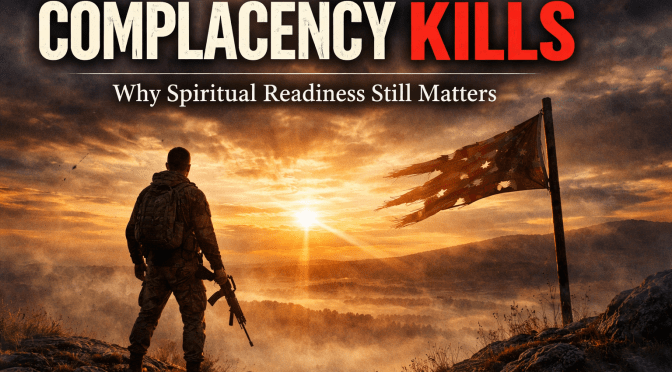
There are some phrases that hit harder than others because they carry the weight of lived reality. “Complacency kills” is one of them.
It is simple. Direct. Uncomfortable. And absolutely necessary.
As I continue this discussion on Warrior Culture, I keep coming back to the fact that this phrase is not just something that belongs in military language, tactical spaces, or high-risk environments. It belongs in everyday life. It belongs in the home, in the church, in leadership, in fatherhood, in marriage, in discipleship, and in the hidden places of the heart. It belongs anywhere there is something worth protecting and anywhere there is a battle worth fighting.
That is one of the reasons Jamie Walden’s Omega Dynamics resonates so deeply with me. It forces the reader to confront a truth that many people would rather avoid: we are not living in neutral territory. We are living in contested ground. There is a real conflict between good and evil, truth and deception, courage and cowardice, conviction and compromise. And in that kind of environment, complacency is never harmless.
It is deadly.
When I say “complacency kills,” I am not only talking about physical danger, although that absolutely matters. I am also talking about spiritual drift, moral laziness, emotional passivity, and the slow erosion of conviction. I am talking about what happens when a man, a woman, a family, or a community stops watching, stops praying, stops training, stops discerning, and starts assuming that because nothing has gone wrong yet, nothing ever will.
That assumption is where many defeats begin.
What Complacency Really Is
Complacency is not rest. It is not peace. It is not confidence.
Complacency is a false sense of security that convinces us vigilance is no longer necessary.
It whispers that the standards can relax. It says the threat is exaggerated. It tells us that one more compromise is no big deal, one more distraction is harmless, one more neglected responsibility can wait until tomorrow. It persuades us to lower our guard without realizing that our guard was the very thing preserving us.
That is why complacency is so dangerous. It rarely announces itself as collapse. It usually presents itself as comfort.
That is what makes it lethal.
In a physical battle, complacency gets people hurt because they stop paying attention to the terrain, the patterns, the weaknesses, the indicators, and the possibility of contact. In the spiritual and moral battle, it works the same way. People stop paying attention to what is forming them. They stop paying attention to what they are tolerating. They stop paying attention to the condition of their own soul. They stop paying attention to the forces trying to shape their mind, their family, their values, and their priorities.
And because the decline is gradual, it feels manageable right up until the consequences become undeniable.
Warrior Culture Is Not About Aggression
This matters to say clearly: Warrior Culture is not about becoming harsh, loud, reactive, or obsessed with conflict.
True warrior culture is not reckless. It is disciplined.
It is not insecure bravado. It is governed strength.
It is not domination. It is responsibility.
A warrior, in the highest sense, is someone who understands that strength exists for service, not vanity. It exists to protect, to endure, to stand firm, to bear weight, to confront evil when necessary, and to remain faithful under pressure. Warrior culture, at its best, forms people who are hard to deceive, hard to intimidate, hard to corrupt, and hard to move off truth.
That is why this conversation matters so much in our time. We live in an age that often confuses softness with virtue and passivity with peace. But peace is not the absence of conflict. Peace is the presence of order under righteous authority. And order does not sustain itself automatically. It must be guarded. It must be cultivated. It must be defended.
That takes people who are awake.
That takes people who are willing to carry responsibility rather than avoid it.
That takes people who understand that good does not advance merely because it is good. Good must be chosen, practiced, embodied, defended, and handed down.
The Modern Battlefield Between Good and Evil
When I talk about the modern battlefield, I am not reducing everything to politics or headlines. The battlefield is bigger than that.
The battlefield is the human heart.
It is the mind that is being discipled either by truth or by lies.
It is the family that is either being strengthened or slowly fractured.
It is the church that is either becoming bold and clear or vague and compromised.
It is the culture that is either honoring what is good, true, and beautiful or celebrating confusion in the name of progress.
It is the individual who must decide every day whether he will drift with the current or stand against it.
Good and evil are not abstract categories. They become visible in what we normalize, what we reward, what we excuse, what we ignore, and what we are willing to fight for.
That is why complacency is so dangerous on this battlefield. Evil rarely needs our active cooperation at first. It often only needs our silence. Our distraction. Our hesitation. Our desire to stay comfortable. Our willingness to say, “It’s probably fine,” when deep down we know it is not fine.
The modern battlefield is full of subtle invasions. Deception rarely begins as open rebellion. It begins as a slight shift. A little compromise. A little exhaustion. A little indifference. A little moral fog. A little less prayer. A little less conviction. A little less courage.
And then one day we look around and realize we have tolerated what we once would have confronted.
That is what complacency does.
How Complacency Shows Up in Real Life
Complacency is not always dramatic. In fact, it is usually mundane.
It shows up when I know I need to strengthen an area of my life but keep postponing it because today feels easier than discipline.
It shows up when I consume far more than I create, react more than I think, and drift more than I lead.
It shows up when comfort becomes my highest value and conviction becomes negotiable.
It shows up when I stop training my mind, stop guarding my habits, stop evaluating my influences, and stop taking responsibility for my role.
It shows up when I assume somebody else will carry the burden.
Somebody else will speak the truth.
Somebody else will protect the children.
Somebody else will preserve the standard.
Somebody else will confront the lie.
Somebody else will lead with courage.
That mindset is dangerous because the battlefield does not pause while we outsource responsibility.
I believe one of the clearest signs of complacency in our time is the normalization of passivity. We have gotten used to being spectators. We watch. We scroll. We comment. We analyze. But many people never step into responsibility. They never take ownership of their fitness, their home, their habits, their discipleship, their relationships, or their calling.
But Warrior Culture does not allow me to live like a spectator.
It reminds me that I have a post to keep.
How I Apply “Complacency Kills” on the Modern Battlefield
For me, applying this concept begins with remembering that vigilance is a lifestyle.
It means I do not wait for crisis to start becoming serious.
I want to be the kind of person who is already building strength before the pressure hits. That applies spiritually, mentally, emotionally, and physically.
Spiritually, it means staying rooted. Prayer cannot be an emergency-only discipline. Scripture cannot be an occasional reference point. Discernment cannot be outsourced. If I want to stand in a corrupt and confused age, then I have to remain anchored in truth before I am tested by error.
Mentally, it means guarding what shapes my thinking. Not every voice deserves influence. Not every trend deserves attention. Not every popular idea deserves a place in my worldview. Complacency in the mind leads to confusion in judgment. And confusion in judgment eventually produces compromise in action.
Physically, it means respecting the connection between stewardship and readiness. The body matters. Endurance matters. capacity matters. Discipline matters. I do not want to build a life where my spirit is willing but my habits are weak. Readiness requires training.
Relationally, it means leading and loving on purpose. Homes do not become strong accidentally. Marriages do not stay healthy on autopilot. Children are not formed by vague intentions. If complacency is allowed into the home, it will eventually affect everything. So I want to be deliberate with my words, my presence, my protection, and my example.
Morally, it means refusing to make peace with what I know is corrosive. The modern battlefield is full of seductive compromises disguised as normal life. But not everything common is harmless. Not everything convenient is wise. Not everything culturally approved is good.
“Complacency kills” reminds me to stay alert where it would be easiest to go numb.
Vigilance Is Not Fear
This is where I want to keep the discussion positive and grounded.
Vigilance is not paranoia.
Readiness is not anxiety.
Warrior culture, rightly understood, does not produce frantic people. It produces sober people. Clear people. Steady people. Faithful people.
There is a big difference between living in fear and living awake.
Fear reacts from panic.
Vigilance responds from clarity.
Fear imagines threats everywhere.
Vigilance recognizes that danger is real but refuses to be ruled by it.
Fear collapses inward.
Vigilance stands outward.
In my own life, I have found that disciplined readiness actually produces more peace, not less. When I know I am paying attention, strengthening weak areas, staying grounded in truth, and taking responsibility for what has been entrusted to me, there is a deep steadiness that comes with that. Not because I control everything, but because I am no longer pretending the battle is not there.
Denial is fragile.
Preparedness is stabilizing.
That is one of the greatest gifts of this mindset. “Complacency kills” does not have to leave us discouraged. It can wake us up. It can call us higher. It can move us out of passivity and into purposeful living.
What This Means for Good and Evil
If the battlefield between good and evil is real, then every day matters.
Small choices matter.
Private disciplines matter.
Quiet obedience matters.
Integrity matters.
Courage matters.
Attention matters.
Good is strengthened when ordinary people choose faithfulness over drift.
Evil gains ground when people decide that alertness is exhausting, conviction is inconvenient, and courage can be delayed until later.
But later is often where regret lives.
So I want to live now with intention. I want to confront the subtle things before they become strongholds. I want to identify the vulnerabilities before they become failures. I want to build the habits now that will sustain faithfulness later.
That is the challenge in front of all of us.
Stay awake.
Stay grounded.
Stay disciplined.
Stay watchful.
Stay humble enough to examine yourself.
Stay strong enough to act when action is needed.
Stay close enough to truth that lies become easier to recognize.
Final Thoughts
When I think about Warrior Culture through the lens of Omega Dynamics and the phrase “complacency kills,” I do not walk away feeling hopeless. I walk away feeling summoned.
Summoned to greater clarity.
Summoned to greater discipline.
Summoned to greater courage.
Summoned to greater responsibility.
This is not a call to live angry. It is a call to live awake.
It is a call to reject the slow death of passivity and to embrace the kind of life that is spiritually alert, morally anchored, and ready to stand. The modern battlefield between good and evil is not won by people who are casually drifting through life. It is faced by men and women who understand that vigilance is love in action, discipline is stewardship, and courage is still required.
Complacency kills.
So I do not want to coast.
I do not want to sleep through the hour.
I do not want to hand off my responsibility to someone else.
I do not want comfort to become my commander.
I want to be found faithful at my post.
And I believe that is the heart of Warrior Culture: not obsession with battle for its own sake, but readiness to stand for what is good, true, and worth defending when the battle comes.
 3 Pillars Podcast