
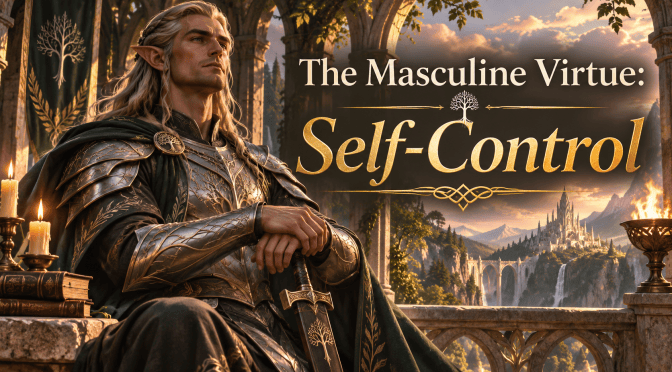
Mastering Our Desires Before Our Desires Master Us
There are many qualities I associate with strong masculinity.
Courage.
Wisdom.
Integrity.
Strength.
Responsibility.
Endurance.
But there is one virtue that determines whether many of those qualities will actually remain under control.
That virtue is self-control.
A strong man without self-control can become dangerous.
A courageous man without self-control can become reckless.
A passionate man without self-control can become enslaved to his desires.
An intelligent man without self-control can rationalize terrible decisions.
A successful man without self-control can destroy everything he spent years building in a matter of minutes.
That is why self-control matters.
While reading Jon Tyson’s The Intentional Father, I was struck by his emphasis on intentionally forming young men rather than simply hoping they somehow mature with age. Tyson identifies wisdom, self-control, courage, and justice as foundational virtues worth developing in our sons and, I would argue, continuing to develop within ourselves throughout adulthood.
That idea became the foundation of Episode 31 of Season 5 of the 3 Pillars Podcast, “The Masculine Virtue: SELF-CONTROL.”
What exactly is self-control?
Why does a man need it?
And perhaps the more uncomfortable question:
What happens when a man cannot control himself?
I believe the answer touches every part of life—our faith, marriages, families, careers, finances, health, leadership, sexuality, emotions, and relationships.
Self-control is not simply the ability to say no.
It is the ability to govern myself so that my appetites, emotions, and impulses do not become my master.
What Is Self-Control?
When I think about self-control, I think about disciplined authority over myself.
That distinction matters.
Self-control is not passivity.
It is not weakness.
It is not pretending that emotions, desires, or temptations do not exist.
Self-control means those things exist, but they do not automatically determine what I do next.
I may be angry, but anger does not get to control my mouth.
I may be afraid, but fear does not automatically determine my decision.
I may be attracted to something, but attraction does not give me permission to pursue it.
I may want to spend money, but desire does not eliminate financial responsibility.
I may want another drink, another plate of food, another hour online, or another round of entertainment, but appetite does not automatically earn obedience.
Self-control creates space between impulse and action.
Inside that space, character speaks.
Wisdom speaks.
Conviction speaks.
God’s Word speaks.
That is where mature decisions are made.
In many ways, self-control is the practical expression of internal leadership.
Before I can lead others effectively, I must learn to govern myself.
A City Without Walls
One of the clearest biblical pictures of self-control appears in Proverbs 25:28:
“He that hath no rule over his own spirit is like a city that is broken down, and without walls.”
That imagery is powerful.
In the ancient world, the walls surrounding a city represented security.
Without walls, the city was exposed.
Enemies could enter.
Resources could be stolen.
Citizens could be attacked.
There was no meaningful boundary between what belonged inside and whatever wanted to invade from outside.
Scripture says that a person without self-control is similar.
Every temptation gets access.
Every emotion receives authority.
Every desire demands satisfaction.
Every insult requires retaliation.
Every advertisement creates another purchase.
Every craving becomes a command.
Every attractive opportunity becomes something that must be pursued.
There are no walls.
That kind of life may initially feel like freedom.
In reality, it becomes slavery.
The man who says, “Nobody tells me what to do,” while being unable to control his anger, appetite, sexuality, spending, drinking, or phone is not truly free.
His appetites are telling him exactly what to do.
And he is obeying them.
Self-Control Is Freedom
Modern culture often defines freedom as the ability to do whatever I want.
I believe genuine freedom is something deeper.
Freedom is possessing the ability not to do everything I want.
That is a very different standard.
If I cannot say no to something, then I should seriously consider whether I actually control it.
Can I turn the phone off?
Can I stop drinking after one?
Can I walk away from an argument?
Can I control what I look at?
Can I delay a purchase?
Can I keep my commitments when motivation disappears?
Can I get out of bed when comfort tells me to stay there?
Can I remain faithful when temptation presents itself?
Can I control my tongue when someone insults me?
Those questions reveal far more about freedom than simply asking whether I have permission to do something.
Self-control allows me to choose what is best instead of simply choosing what feels best right now.
That is freedom.
Biblical Self-Control Is Spirit-Led
For Christians, self-control is not merely a motivational concept.
Galatians 5:22–23 identifies temperance, or self-control, as part of the fruit of the Spirit.
That reminds me that Christian self-control is not simply about gritting my teeth and attempting to overpower every weakness through raw willpower.
Discipline matters.
Habits matter.
Accountability matters.
But transformation ultimately requires God’s work within me.
There are desires I cannot simply negotiate with forever.
There are habits that require repentance.
There are temptations that require boundaries.
There are areas where I need prayer, accountability, mentorship, counseling, or professional assistance.
The Christian answer to weakness is not prideful independence.
It is disciplined dependence upon God.
That may sound paradoxical, but I believe it is central to Christian maturity.
The stronger I become spiritually, the more aware I become that I still need God’s grace.
I do not want merely to appear disciplined.
I want my desires increasingly reordered around what honors Him.
Life Without Self-Control
What does life look like without self-control?
Usually, it becomes increasingly reactive.
The person without self-control lives according to whatever feeling is strongest in the moment.
Anger becomes an explosion.
Sadness becomes withdrawal.
Stress becomes substance use.
Attraction becomes infidelity.
Boredom becomes endless scrolling.
Hunger becomes excess.
Success becomes arrogance.
Failure becomes despair.
The problem is not that emotions exist.
Emotions are part of being human.
The problem begins when emotions become commanders instead of messengers.
Anger can tell me something may be wrong.
Fear can alert me to danger.
Sadness can reveal loss.
Attraction can reveal desire.
But those emotions should provide information.
They should not automatically receive authority.
Life without self-control becomes a sequence of emotional reactions followed by consequences.
The tragedy is that those consequences rarely remain limited to the individual.
A father’s uncontrolled anger affects his children.
A husband’s uncontrolled lust affects his wife.
A leader’s uncontrolled ego affects an organization.
A person’s uncontrolled spending affects the entire household.
A man’s uncontrolled drinking can affect everyone who loves him.
The absence of self-control creates collateral damage.
Strength Under Control
One of the most common misunderstandings about masculinity is that strength means aggression.
I disagree.
Strength that cannot be controlled is not mature strength.
It is instability.
Imagine a powerful vehicle without brakes.
No matter how impressive the engine may be, nobody would call that vehicle safe.
The ability to generate power matters.
The ability to control power matters just as much.
Self-control is the braking system of masculine strength.
A strong man should be capable of aggression when legitimate circumstances require decisive action, but he should not be controlled by aggression.
He should be capable of speaking forcefully while knowing when restraint is more appropriate.
He should be physically capable while refusing to use strength to intimidate those weaker than himself.
He should possess ambition without allowing ambition to consume his family.
He should possess sexuality without allowing sexuality to control his conscience.
He should possess confidence without becoming arrogant.
That is strength under control.
And I believe that kind of strength is desperately needed.
Self-Control and Fatherhood
Jon Tyson’s larger argument in The Intentional Father is that fathers should actively participate in forming their sons rather than leaving that development to chance, peers, entertainment, social media, or the surrounding culture.
That challenges me as a father.
I cannot teach my children self-control only through lectures.
They must see it.
They need to see me remain calm when I am frustrated.
They need to see me put my phone away.
They need to see me exercise when I do not feel like exercising.
They need to see me manage money responsibly.
They need to see me apologize when I speak incorrectly.
They need to see me keep commitments.
They need to see me control what I consume physically, mentally, and spiritually.
Children notice contradictions.
If I tell them to control their screen time while constantly staring at my phone, they will notice.
If I tell them not to yell while yelling at them, they will notice.
If I teach discipline while living entirely according to comfort, they will notice.
More is caught than taught.
This does not mean they need a perfect father.
They will not get one.
It means they need a father willing to practice the same virtues he asks them to develop.
Self-Control and the Physical Pillar
Physical fitness is one of the clearest training grounds for self-control.
The body constantly communicates preferences.
Stay in bed.
Skip the workout.
Eat whatever tastes best.
Avoid discomfort.
Stop when something becomes difficult.
Physical discipline teaches me that discomfort is not automatically an emergency.
Sometimes discomfort is simply the price of adaptation.
I train even when motivation is low.
I finish the set.
I monitor nutrition.
I prioritize recovery.
I practice consistency.
Eventually, the lessons move beyond the gym.
I learn that motivation is useful, but discipline is more dependable.
I learn that progress usually comes from repeated small decisions rather than occasional bursts of intensity.
I learn to delay gratification.
I learn that I can experience discomfort without immediately escaping it.
Those lessons apply everywhere.
However, self-control also means knowing when not to push.
Overtraining, obsession, performance-enhancing drug abuse, or ignoring legitimate injury are not examples of superior discipline.
They can represent another form of uncontrolled appetite.
The goal is stewardship.
The body is a tool for service, not an idol.
Self-Control and the Mental Pillar
Mental self-control means learning to govern what receives my attention.
That may be increasingly important in the modern world.
We live in an economy built partially around capturing attention.
Notifications.
News cycles.
Social media.
Outrage.
Advertising.
Entertainment.
Pornography.
Endless information.
If I never intentionally govern my attention, someone else will gladly govern it for me.
Mental discipline requires asking what I allow into my mind and how long I permit it to remain there.
Philippians 4:8 instructs believers to think on things that are true, honest, just, pure, lovely, and of good report.
That requires intentionality.
I cannot consume garbage constantly and then wonder why my mind feels polluted.
Self-control might mean turning the television off.
Putting the phone down.
Unfollowing an account.
Walking away from an online argument.
Reading a book instead of scrolling.
Taking time to pray.
Sitting quietly.
Going outside.
Having an actual conversation.
The battle for self-control is often a battle for attention.
What repeatedly captures my attention will eventually influence my thinking.
And what shapes my thinking will eventually influence my behavior.
Self-Control and the Spiritual Pillar
Spiritually, self-control means submitting my desires to God.
Jesus demonstrated perfect strength under control.
He experienced hunger.
He experienced anger.
He experienced grief.
He experienced temptation.
Yet He did not allow those experiences to separate Him from obedience to the Father.
For me, that means Christian maturity cannot simply be measured by what I know about Scripture.
It must eventually become visible in how I live.
Do I control my tongue?
Do I forgive?
Do I remain faithful?
Do I resist temptation?
Do I confess when I fail?
Do I pray when I am frustrated?
Do I choose obedience when disobedience would be easier?
The spiritual life is not detached from ordinary behavior.
If my faith never influences my decisions, habits, relationships, and appetites, I should examine whether I am truly allowing Christ to transform me.
Anger: One of the Great Tests
For men, anger may be one of the clearest tests of self-control.
Anger itself is not automatically sinful.
There are situations where anger is appropriate.
Injustice should disturb us.
Abuse should disturb us.
Evil should disturb us.
Jesus Himself displayed righteous anger.
But righteous anger and uncontrolled rage are not the same thing.
James 1:19 tells us to be swift to hear, slow to speak, and slow to wrath.
That may be one of the most practical leadership principles in Scripture.
Slow down.
Listen.
Think.
Then respond.
When anger controls me, I say things I cannot retrieve.
I damage trust.
I intimidate people I am supposed to protect.
I turn disagreements into battles.
Self-control asks me to govern anger before anger governs me.
Sometimes the strongest thing I can do is lower my voice.
Sexual Self-Control
No discussion of masculine self-control would be complete without addressing sexuality.
Sexual desire is powerful.
It is also not inherently shameful.
God created sexuality.
But like every powerful human appetite, it requires boundaries.
Pornography, infidelity, objectification, and compulsive sexual behavior can distort relationships and reduce other human beings to instruments of gratification.
A man who refuses sexual discipline can destroy his marriage, damage his family, compromise professional responsibilities, and carry shame into every other area of his life.
Faithfulness requires self-control.
So does dating.
So does marriage.
So does singleness.
Christian sexual ethics are not based on the belief that sexuality is evil.
They recognize that sexuality is powerful enough to require responsible boundaries.
If I love my wife, my children, my God, and the man I am becoming, then certain desires must hear the word no.
Financial Self-Control
Money provides another test.
I live in a culture that constantly tells me I deserve more.
A bigger house.
A newer vehicle.
Another subscription.
Another trip.
Another purchase.
There is nothing inherently wrong with enjoying the fruits of hard work.
But financial maturity requires distinguishing between what I can buy and what I should buy.
Self-control creates margin.
It allows me to save.
Give.
Prepare.
Invest.
Help someone else.
Manage emergencies.
Money without self-control disappears quickly.
Income does not automatically create financial stability.
Character matters.
Again, the principle is the same:
What I refuse today may create freedom tomorrow.
Self-Control Is Built Through Small Decisions
I do not believe self-control suddenly appears when a major crisis arrives.
It is developed through ordinary decisions.
Getting up when the alarm rings.
Completing the workout.
Keeping a promise.
Turning off the screen.
Controlling a portion.
Saving money.
Reading Scripture.
Holding my tongue.
Walking away from temptation.
Apologizing.
Going to bed.
Showing up.
The small decisions are training.
When I repeatedly practice discipline in ordinary moments, I become better prepared for extraordinary ones.
That is why habits matter.
Character is often formed quietly.
Nobody applauds.
Nobody sees.
But eventually the results become visible.
Grace When Self-Control Fails
There is one final point I consider essential.
Every discussion of self-control must include grace.
I will fail.
Every man will.
There will be moments when anger wins.
When discipline breaks.
When temptation succeeds.
When I say what I should not have said.
When I consume what I should have resisted.
The Christian response is not to pretend the failure did not happen.
It is confession, repentance, accountability, and restoration.
Romans 5:8 reminds us:
“But God commendeth his love toward us, in that, while we were yet sinners, Christ died for us.”
Grace is not permission to remain undisciplined.
Grace gives me somewhere to go when discipline fails.
I confess.
I learn.
I rebuild.
I establish stronger boundaries.
I seek help when necessary.
And I continue forward.
Failure can become instruction if humility allows it.
Conclusion: Master Yourself
When I think about the masculine virtue of self-control, one principle rises above the rest:
A man who cannot govern himself will eventually be governed by something else.
His appetite.
His anger.
His lust.
His fear.
His money.
His phone.
His pride.
His addiction.
His need for approval.
Something will occupy the throne.
Self-control is the discipline of refusing to surrender that authority to every passing desire.
As a Christian, however, I ultimately recognize that even self-mastery is not the highest goal.
The goal is submission to Christ.
I want my strength governed by His truth.
My appetites governed by His wisdom.
My ambition governed by His purpose.
My emotions governed by mature judgment.
My body governed by stewardship.
My words governed by love.
That is what self-control looks like to me.
It is not becoming emotionless.
It is becoming dependable.
It is not becoming passionless.
It is directing passion toward what matters.
It is not rejecting pleasure.
It is refusing to exchange long-term purpose for short-term gratification.
It is strength under authority.
And if I want my children to become men and women of character, I cannot simply tell them that self-control matters.
I must show them.
So I leave myself with a question that I believe every man should occasionally ask:
What in my life currently has more control over me than it should?
My answer may reveal exactly where the next stage of growth needs to begin.
Because masculinity is not demonstrated simply by the ability to exert power over the world around me.
Sometimes the greatest demonstration of strength is the ability to exert discipline over the man in the mirror.
Semper Fi. God Bless.

