
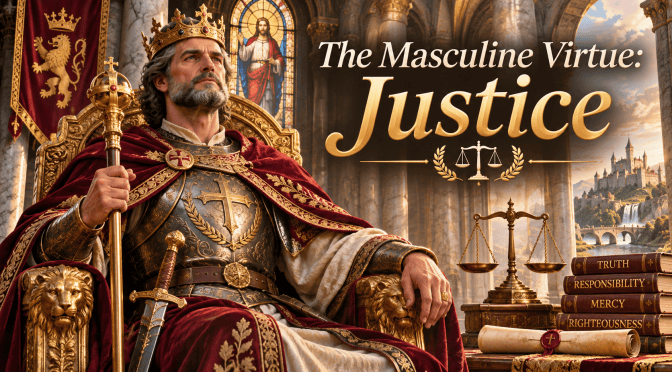
Becoming Men Who Know What Is Right—and Have the Character to Defend It
When we think about the qualities that define a strong man, certain virtues immediately come to mind.
Wisdom.
Self-control.
Courage.
Strength.
Integrity.
Responsibility.
But there is another virtue that gives moral direction to all of them.
That virtue is justice.
A wise man may understand what is happening around him, but justice helps him recognize what ought to happen.
A self-controlled man can govern his impulses, but justice helps determine what those impulses should be governed toward.
A courageous man can act despite fear, but justice determines whether the cause he is courageously defending is actually righteous.
Strength gives a man capacity.
Justice determines how that capacity should be used.
That is why I believe justice belongs at the heart of any serious discussion about masculine virtue.
While reading Jon Tyson’s The Intentional Father, I was challenged by his emphasis on forming young men intentionally rather than assuming maturity will simply emerge with age. Tyson highlights wisdom, self-control, courage, and justice as foundational virtues worth cultivating in young men. In other discussions of Christian masculinity, he has summarized the need simply: we need just men in a world where power can easily become tyranny.
That idea became the foundation for Episode 33 of Season 5 of the 3 Pillars Podcast, “The Masculine Virtue: JUSTICE.”
What is justice?
Why is it important?
What does life look like when justice disappears?
And perhaps an even more personal question:
Am I actually living justly within the responsibilities God has entrusted to me?
Those questions are not reserved for judges, police officers, politicians, pastors, or military leaders.
They apply to fathers.
Husbands.
Business leaders.
Coaches.
Teachers.
Friends.
Neighbors.
Every man possesses some degree of influence, and wherever influence exists, the question of justice eventually follows.
What Is Justice?
Justice is one of those words nearly everyone uses but people often define differently.
At its most basic level, justice means recognizing what is right and giving people what they are properly due.
It involves truth.
Fairness.
Responsibility.
Accountability.
Protection of the innocent.
Consequences for wrongdoing.
Respect for legitimate authority.
And recognition of the inherent dignity of other human beings.
Biblically, justice cannot be reduced merely to punishment.
Justice is also concerned with righteousness.
The Bible repeatedly connects justice with defending those who are vulnerable, refusing corruption, judging honestly, and ensuring that power is not used to exploit those who possess less of it.
Proverbs 31 is particularly interesting in this regard.
Most Christians immediately associate Proverbs 31 with the description of a virtuous woman at the end of the chapter. But the chapter begins with instruction to a king—a man entrusted with power.
He is told to speak for those who cannot speak for themselves, defend the cause of the poor and needy, and judge righteously.
That is masculine justice.
Power placed in service to what is right.
Authority exercised with restraint.
Strength used to protect rather than exploit.
Leadership directed toward truth rather than ego.
Jon Tyson points to this broader biblical framework when discussing the virtues he wants young men to develop. Justice is not an abstract philosophical concept. It is part of the formation of men who use their energy and influence for the good of others.
Justice Begins With Truth
Justice cannot exist without truth.
That statement seems obvious, but it has enormous implications.
If I care more about protecting my reputation than discovering what actually happened, I cannot act justly.
If I automatically believe whatever benefits my preferred side of an argument, I am not pursuing justice.
If I excuse wrongdoing because the person involved is my friend, family member, political ally, employee, or leader, I have allowed loyalty to replace truth.
Justice requires a willingness to see reality as it is.
That can be uncomfortable.
Sometimes the facts support my assumptions.
Sometimes they do not.
Sometimes the person I expected to be wrong is right.
Sometimes someone I respect behaves badly.
Sometimes I am the one who is wrong.
A just man must be willing to follow truth even when truth becomes inconvenient.
This is one reason humility is essential to justice.
I cannot judge rightly if I begin with the assumption that I am always right.
Justice Starts With Myself
It is easy to become passionate about injustice somewhere else.
It is much harder to examine injustice within my own sphere of influence.
Before I criticize corruption in national institutions, I should ask whether I behave honestly at work.
Before I complain about leaders refusing accountability, I should ask whether I accept responsibility when I make mistakes.
Before I demand fairness from others, I should examine whether I treat my wife, children, employees, coworkers, and neighbors fairly.
Justice begins locally.
It begins in my house.
It begins in my relationships.
It begins in my decisions.
If I expect my children to tell the truth but punish honesty so harshly that they become afraid to admit mistakes, I may unintentionally create an environment where deception feels safer than truth.
If I demand respect from my family while treating them disrespectfully, I am not practicing justice.
If I expect loyalty from employees while refusing to recognize their contributions, I am not leading justly.
Justice requires consistency.
The standards I apply to others must also apply to me.
Justice and Masculine Strength
Men often possess forms of strength that can significantly influence the people around them.
Physical strength.
Financial resources.
Authority.
Professional position.
Experience.
Knowledge.
Social influence.
Leadership.
None of those things is inherently good or evil.
The moral question is how they are used.
A physically strong man can protect someone weaker than himself.
He can also intimidate them.
A father can use authority to create stability within his home.
He can also use authority to dominate his family.
A business leader can use influence to develop employees.
He can also exploit them.
A government official can use authority to uphold the law.
He can also abuse power.
Strength becomes virtuous when justice governs it.
This is one reason I reject the idea that masculinity should simply be defined by dominance.
The strongest man in the room is not necessarily the man who can impose his will on everyone else.
Sometimes the strongest man is the one who possesses power but refuses to abuse it.
That is strength under moral authority.
Jesus and Perfect Justice
For Christians, the ultimate model of justice is Jesus Christ.
Jesus demonstrated an extraordinary combination of truth and grace.
He confronted hypocrisy.
He defended the vulnerable.
He refused to flatter powerful people.
He treated people with dignity regardless of social status.
He showed compassion toward sinners while never pretending sin was harmless.
That combination matters.
Justice without mercy can become cold.
Mercy without truth can become permissiveness.
Christ demonstrates both.
The cross itself shows us how seriously God takes justice.
Sin is not ignored.
It is dealt with.
At the same time, God’s mercy is extended to undeserving people through Christ.
Romans 5:8—the verse included in the published description of this episode—captures the heart of that grace: God demonstrated His love toward us while we were still sinners.
Christian justice therefore cannot be driven primarily by vengeance.
I am not called to enjoy another person’s destruction.
I can desire accountability while still desiring repentance.
I can recognize wrongdoing while still remembering that I am also someone who depends upon grace.
That humility changes the way justice is pursued.
Life Without Justice
What does life look like without justice?
Eventually, it becomes a contest of power.
If there is no meaningful standard of right and wrong, the strongest individual or group gets to decide what everyone else must accept.
Truth becomes negotiable.
Rules become selective.
Accountability becomes political.
Favoritism replaces fairness.
People stop trusting institutions because they believe consequences depend upon who you are rather than what you did.
Families experience the same dynamic.
Imagine a household where rules change depending on a parent’s mood.
One child is disciplined for behavior another child is allowed to ignore.
Promises are made but never honored.
Authority exists without accountability.
Eventually resentment develops.
Workplaces experience it too.
A leader who rewards favorites while ignoring competent employees destroys morale.
A company that publicly promotes one set of values while privately tolerating unethical behavior loses trust.
Justice is foundational because people need to believe that standards mean something.
Without justice, cynicism grows.
Justice Is Not Revenge
One distinction I consider essential is the difference between justice and revenge.
Revenge says:
“You hurt me, so I want you to hurt.”
Justice says:
“Something wrong happened, and it must be addressed appropriately.”
Those motivations are very different.
Revenge is personal.
Justice attempts to be principled.
Revenge is often emotional and disproportionate.
Justice seeks an appropriate response.
Revenge wants satisfaction.
Justice seeks restoration of proper order.
This is why self-control is essential to justice.
The previous masculine virtue in this series matters here.
A man governed entirely by anger cannot reliably administer justice.
Neither can a man controlled by fear.
Justice requires enough emotional discipline to separate the offense from the appropriate response.
This is especially important in fatherhood.
Discipline should never simply be an angry father’s revenge against a child for frustrating him.
The purpose of discipline should be correction, formation, boundaries, and restoration.
If punishment becomes an outlet for my own uncontrolled emotions, I have missed the point.
Justice and Fatherhood
Fatherhood may be one of the first environments where children learn what justice feels like.
They learn whether rules matter.
They learn whether truth is valued.
They learn whether authority is trustworthy.
They learn whether mistakes can be acknowledged.
They learn whether consequences are consistent.
They learn whether weaker members of the household are protected.
That places enormous responsibility on me as a father.
I will not always get it right.
Sometimes I will misunderstand what happened.
Sometimes I will respond too quickly.
Sometimes I will be inconsistent.
Justice does not require me to pretend otherwise.
Justice requires me to correct myself.
If I discipline a child unfairly and later realize I was wrong, I should apologize.
That does not undermine my authority.
It demonstrates that my authority exists beneath a greater standard.
I am accountable too.
That may be one of the most important lessons a father can teach.
The rules do not exist simply because Dad is bigger.
Truth matters even when Dad is wrong.
Teaching Children to Recognize Justice
If I want my children to become just adults, I need to help them develop moral reasoning.
I cannot simply teach:
“Follow the rules because I said so.”
Eventually, they will enter situations where the rules are unclear.
They will encounter peer pressure.
Workplace conflicts.
Moral dilemmas.
Competing loyalties.
People who manipulate truth.
They need more than compliance.
They need principles.
Why do we tell the truth?
Why do we defend someone being mistreated?
Why should we keep promises?
Why should consequences be proportional?
Why should we listen to both sides before making judgments?
Why does human dignity matter?
Intentional fatherhood is not merely about producing well-behaved children.
It is about preparing future adults to exercise judgment.
That is where justice becomes formation.
Justice and the Spiritual Pillar
Spiritually, justice begins with recognizing God’s character.
God is righteous.
God is truthful.
God does not show partiality in the corrupt human sense of favoritism.
If I claim to follow God, then justice must influence how I treat others.
Micah 6:8 provides one of Scripture’s clearest summaries:
“He hath shewed thee, O man, what is good; and what doth the LORD require of thee, but to do justly, and to love mercy, and to walk humbly with thy God?”
I love the balance in that verse.
Do justice.
Love mercy.
Walk humbly.
Those ideas belong together.
Justice without humility becomes self-righteousness.
Mercy without justice becomes permissiveness.
Humility keeps both in proper relationship.
Justice and the Mental Pillar
Mental strength is essential to justice because justice requires disciplined thinking.
I must resist emotional manipulation.
I must evaluate evidence.
I must listen.
I must distinguish what I know from what I assume.
I must be willing to delay judgment until I understand the situation.
This is increasingly difficult in an age of instant reaction.
A video clip appears online.
Within minutes, millions of people decide who is guilty.
A headline appears.
People react before reading the article.
An accusation is made.
Tribes form immediately.
Justice requires patience.
There is wisdom in saying:
“I do not know enough yet.”
That is not cowardice.
It is intellectual discipline.
Justice and the Physical Pillar
Physical strength also carries responsibilities of justice.
If I have greater physical capability than someone else, that strength should create a greater obligation toward restraint.
I should protect rather than intimidate.
Assist rather than exploit.
Physical fitness can increase confidence and capability, but character determines how those abilities are used.
The strongest person should not automatically dominate the weakest.
Sometimes the strongest person’s responsibility is to create safety for them.
That is justice expressed physically.
Justice in Leadership
Leadership reveals a person’s relationship with justice quickly.
Do I give credit?
Do I accept blame?
Do I apply standards consistently?
Do I listen before judging?
Do I protect people who tell me uncomfortable truths?
Do I reward competence?
Do I tolerate misconduct because the person involved produces good numbers?
These questions matter.
As a leader, I will eventually be forced to make decisions that disappoint someone.
Justice does not mean everyone receives the outcome they want.
It means decisions should be based upon legitimate principles rather than favoritism, ego, or personal convenience.
Good leaders establish standards before emotions become involved.
They communicate expectations.
They investigate problems.
They hold people accountable.
And they remain accountable themselves.
The Courage to Defend What Is Right
Justice also requires courage.
Recognizing injustice is not enough.
Eventually someone has to act.
Sometimes that means speaking.
Sometimes it means reporting misconduct.
Sometimes it means defending a person who is being mistreated.
Sometimes it means disciplining someone I personally like.
Sometimes it means refusing to participate in something unethical even when participation would benefit me.
This is why these masculine virtues work together.
Wisdom identifies what is right.
Self-control keeps emotion and appetite from distorting the decision.
Courage gives me the willingness to act.
Justice provides the moral objective.
They reinforce one another.
Justice Must Begin With Mercy and Humility
There is a danger in becoming passionate about justice.
I can begin seeing myself exclusively as the righteous judge of everyone around me.
That is where humility becomes essential.
I am capable of wrongdoing too.
I misunderstand things.
I carry biases.
I have blind spots.
I need forgiveness.
Remembering that does not make justice weaker.
It makes justice more humane.
I can hold someone accountable without hating them.
I can establish boundaries without dehumanizing them.
I can condemn an action without believing I am morally incapable of failure myself.
Christian justice always exists beneath the shadow of the cross.
I stand for truth while remembering how desperately I need grace.
Becoming a Just Man
Justice is not developed through slogans.
It is developed through daily decisions.
Tell the truth.
Keep your word.
Listen before judging.
Protect someone weaker.
Pay what you owe.
Give credit where it belongs.
Accept responsibility.
Treat people fairly.
Refuse corruption.
Do not exploit authority.
Apologize when wrong.
Defend what is right.
Show mercy when mercy is appropriate.
These decisions may never receive public recognition.
But character rarely develops under spotlights.
It develops quietly.
Conclusion: Do Justly
The masculine virtue of justice asks something demanding of me.
It asks me to become a man whose strength can be trusted.
A man who values truth more than convenience.
A man who protects rather than exploits.
A man who refuses favoritism.
A man willing to accept accountability himself before demanding it from everyone else.
A man capable of mercy without abandoning truth.
A man courageous enough to defend what is right.
That kind of man is needed in families.
Churches.
Businesses.
Communities.
Government.
The military.
Everywhere human beings exercise influence over one another.
Jon Tyson’s framework in The Intentional Father reminds me that these virtues should not be left to chance.
If I want my children to grow into adults who understand justice, they need to see justice modeled.
They need to see me tell the truth when lying would be easier.
They need to see me treat people consistently.
They need to see me defend what is right.
They need to see me apologize.
They need to see strength governed by morality.
Most importantly, they need to see that justice is not merely about demanding what others owe me.
Justice asks what I owe them.
Respect.
Truth.
Fairness.
Protection.
Accountability.
Compassion.
Leadership.
The question I leave myself with is therefore simple:
Can the people who depend upon me trust my strength?
Can my wife trust it?
Can my children trust it?
Can my employees and coworkers trust it?
Can the people with less power than me trust that I will not use my position against them?
That may be one of the clearest tests of masculine justice.
Because true justice is not merely possessing the strength to impose consequences.
It is possessing the character to use strength rightly.
Wisdom tells me what is right.
Self-control governs my impulses.
Courage enables me to act.
Justice ensures that my actions are directed toward what is good.
And all of those virtues find their highest expression when they are submitted to Jesus Christ.
So I want to pursue justice.
Not vengeance.
Not self-righteousness.
Not ideological tribalism.
Justice grounded in truth.
Justice tempered by mercy.
Justice practiced with humility.
Justice strong enough to defend the vulnerable and disciplined enough to remain fair even when emotions run high.
In the words of Micah:
Do justly. Love mercy. Walk humbly with God.
That is the kind of man I want to become.
That is the kind of father I want my children to remember.
And that is the masculine virtue of justice.
Semper Fi. God Bless.

