
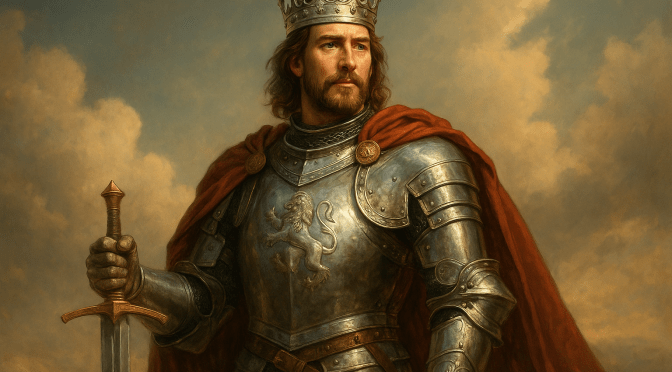
Introduction: Myth, Legend, and the Real King
I remember first being captivated by the legend of King Arthur—Camelot, Excalibur, the Round Table, the quest for the Holy Grail. Something about the story resonated deeply: the call to justice, the reign of a king who loved his people, the hope of renewal. In writing Episode 123—“The Allegory of Arthur”—I realised that while King Arthur may be mythic, his story echoes themes that point to something far greater: the life, work, and reign of Jesus Christ.
This isn’t to say Arthur is Jesus, or that his story is a direct one-to-one mapping. Legends stretch, evolve, diverge. But the parallels are striking: the king who comes, the land healed, the betrayal, the return. These motifs invite us to see not only the legend, but the Legendary King—Jesus Christ—the King of kings, whose reign is real, whose kingdom is eternal.
In this post I want to wander through major motifs of the Arthurian legend—kingship, sacrifice, betrayal, restoration—and show how they reflect Christ’s narrative. I’ll also explore how these reflections matter for our faith, our living, our hope. Because if the legend points us boldly toward the Gospel, then perhaps our own hearts are renewed by more than a story—they’re awakened by truth.
1. Kingship and Identity: The True Heir
King Arthur is portrayed as the rightful heir of Uther Pendragon, pulled from obscurity (the sword in the stone), raised with mystery, then revealed as king. The motif of hidden royalty echoes the concept of the Messiah—Jesus, heir to David’s throne, hidden in human form then revealed in glory.
In Arthur’s story, the king embodies virtue, leadership, protectiveness, and the hope of his people. Likewise, Jesus is described in Scripture as the Son of Man, the King of kings and Lord of lords, who came not to be served but to serve (Mark 10:45). His kingship is not just authority—but sacrificial, redemptive.
For me, reflecting on Arthur’s identity helps me see my identity in Christ: hidden, revealed, heir of the Kingdom. When I feel unworthy, I remind myself: He has claimed the throne for me. Arthur’s story whispers: every king has a kingdom; every believer has a King.
2. The Sword and the Cross: Authority, Power & Servanthood
One of Arthur’s iconic symbols is Excalibur—the sword given, or pulled, to signify his right and power. It is a symbol of authority, justice, the king’s charge to protect the realm. The sword is not merely for war, but for peace enforced.
In the Christian narrative, the cross and resurrection of Jesus symbolize the ultimate authority—not by terror, but by love. Colossians 2:15 speaks of Jesus disarming powers and authorities. His “sword” is not a literal blade, but the Word, the Spirit, the sacrifice. He wields power by surrender.
When I think of Arthur raising Excalibur, I think of Jesus lifting the cross—and raising us with Him. The king who wields the sword is the king who serves with it. For Arthur fans, the sword is a symbol of righteous leadership. For believers, the cross is symbol of sacred leadership. So when I hold my “spiritual Excalibur”—my gifts, my calling, my service—they are meaningful only because I serve under the King.
3. The Fall of the Realm: Betrayal, Weakness, and Hope
In Arthur’s legend, after years of peace, betrayal comes—Lancelot and Guinevere, Mordred’s rebellion, the realm fractures. Camelot falls not simply through external invasion, but internal compromise. The ideal fails, the king weeps, the land suffers.
In the Gospel, Jesus foretold that betrayal would come from within. Judas, Peter’s denial, and the collapse of the twelve echo the fragility of human virtue. The world Jesus came to heal is broken not only by sin but by our own betrayals and weaknesses. Yet Jesus meets the betrayal, the cross, the grave—and restores the realm.
I’ve walked through seasons of my own “Camelot” collapsing—relationships failing, my heart giving in, hope dimming. But the Christ narrative shows me that when the King comes to the cross, when the realm falls, redemption begins. Arthur’s tale reminds me: even when the kingdom falls, the King promises return.
4. The Quest for the Grail: Seeking the Divine, Finding the King
Another powerful motif: Arthur’s knights quest for the Holy Grail—a symbol of divine presence, transcendence, healing. The Grail quest is partly an external journey, partly an internal one—knights purified, tempted, transformed.
In Christian faith, the “quest” is not for mystery objects but for Christ Himself. We seek God, we yearn for communion, we respond to the call: “Follow me.” The Grail metaphor echoes our spiritual longing—yet the object of the quest is not the cup but the King who gives it.
I’ve felt that longing—searching for meaning, navigating faith, chasing signs. Arthur’s quest gives shape to the longing; Jesus gives fulfilment to it. He is the Grail I didn’t know I needed. Arthur’s story challenges me: not just to chase the symbol, but to surrender to the King.
5. The Wounded King and the Returning Hope
One of the most poignant elements of the Arthur legend is that the king is wounded (the Fisher or Wounded King myth). The land suffers with the king; when he is wounded the realm is barren. But there is also promise: the Once and Future King will return. The hope remains.
Jesus is wounded—on the cross, forsaken, yet triumphant. And He promises: I go to prepare a place… I will come again. His return brings full restoration. The realm (creation) will be made new (Revelation 21). Our waiting has purpose.
For me, the idea of the returning King changes how I live today. Arthur’s legend gives a mirror: though Camelot fell, hope remains. In Christ I hold a stronger hope: though the world groans, our King is coming. I live now in light of His return, not just nostalgia for a lost legend, but anticipation of a coming Kingdom.
6. Living the Allegory: What This Means for Us
A. Kingdom Mindset
When Arthur reigned, his kingdom was just, servant-hearted, unified. So we too are called to live under the King—seeking justice, mercy, faithfulness. It’s not just waiting—it’s living kingdom.
B. Servanthood & Sacrifice
Arthur’s best moments are not his coronation but his service. Jesus’ best moment is the cross. Christian discipleship is not seat of power but foot of service.
C. Community & Fellowship
Camelot is built around the Round Table—a symbol of equality, unity, shared mission. In Christ’s church we mirror that: every member, every gift, every servant. The King invites us into the table.
D. Hope Amid Brokenness
When kingdoms fall, streams dry, people weep, the returning promise sustains. For us: when our lives fracture, our faith wobbles, our world tugs—Christ is King, He reigns, He returns. The legend gives metaphor; the Gospel gives fulfilment.
7. Guarding the Parallel: A Caveat
While the comparisons are rich, two caveats matter:
- Arthur is mythic; Jesus is historical. Arthur’s story is legendary, built over centuries. Jesus’ life, death, and resurrection are claimed as historical facts by the Christian faith.
- Arthur is a reflection; Jesus is the Original. The legend points; the Gospel fulfils. Arthur helps our imagination; Christ changes our lives.
So we don’t worship the legend. We let the legend sharpen our vision of the Truth.
8. My Story: From Legend Lover to Kingdom Citizen
Reflecting on my own journey:
- I once loved the myth of Arthur for escapism—knights, quests, epic battles.
- I gradually saw how the legend mirrors longing.
- I realised I am not merely a spectator of the myth—I am a citizen of the Kingdom of Christ.
- The King I follow is more real, more good, more victorious.
- My service, my quest, my waiting—all find a deeper shape under His reign.
The legend of Arthur stirred my imagination. The Gospel transformed my life. Today I live not in Camelot’s shadow, but in the light of the true King.
Conclusion: The King Lives, the Kingdom Grows
King Arthur’s tale still speaks because it points beyond itself. It points to a Kingdom that lasts, a King who loves, a hope that rises. Jesus is that King. His story is not a legend—it is living.
If you wander the legends of Arthur, may you see more than myth—may you glimpse the King who came, reigns, and will return. May you live today in his Kingdom—serving, loving, hoping. And may you rest in this truth: THE KING LIVES. The Kingdom advances. And your life matters in his story.

 3 Pillars Podcast