Tag Archives: Jesus Is King

Thoughts Have Power — A Biblical Call to Renew Your Mind

Introduction

If there’s one battle I fight daily—and I know I’m not alone—it’s the battle of the mind. The world we live in today is saturated with messages, images, voices, and influences all competing for space in our heads. And the truth is, the thoughts we entertain don’t just stay in our heads—they shape our attitudes, our emotions, our decisions, and ultimately our lives.

I’ve come to learn through experience, reflection, and Scripture that our thoughts have real power. They are not abstract. They are formative. The way we think has the potential to either align us with God’s truth or drift us further away from it. And that’s why Episode 108 of the podcast felt so important to me. It was personal. It was necessary. And it was deeply inspired by the words of Paul to the Christians in Philippi.

The question I want to explore here is simple but profound: What does God want us to do with our thoughts? Because how we answer that determines the kind of life we live.


The Battlefield of the Mind

The mind is where the real war is fought. Before a mistake is made, a thought has usually been entertained. Before a habit forms, a mental pathway has been repeated. And before peace can take root, the soil of the mind has to be cultivated for it.

Proverbs 23:7 says, “As a man thinketh in his heart, so is he.” That verse hit me hard the first time I really understood it. It’s not just about our actions—it’s about our identity. Who we are is shaped by what we consistently think about. The mind isn’t just a place of thinking—it’s a battlefield of becoming.

Every day, we’re either sowing seeds of faith or seeds of fear. Seeds of purpose or seeds of insecurity. And those seeds take root based on whether we allow God to transform our thinking—or whether we allow the world to shape it.


Paul’s Message to the Philippians

Paul knew this. When he wrote to the church in Philippi, he wasn’t writing from a place of comfort. He was writing from prison. And yet, his message wasn’t one of defeat or despair—it was one of joy, peace, and power.

In Philippians 4:8, Paul gives us one of the clearest and most practical instructions in all of Scripture regarding our thought life:

“Finally, brothers and sisters, whatever is true, whatever is noble, whatever is right, whatever is pure, whatever is lovely, whatever is admirable—if anything is excellent or praiseworthy—think about such things.”

Think about such things. Not once. Not occasionally. But as a regular, disciplined practice.

Paul understood that the battle for peace was won not in our circumstances, but in our focus. That’s why earlier in verse 7, he speaks of a “peace of God, which surpasses all understanding,” guarding our hearts and minds.

It’s not that we ignore hardship. It’s that we learn to dwell on truth.

Philippians 4:8 — A Breakdown

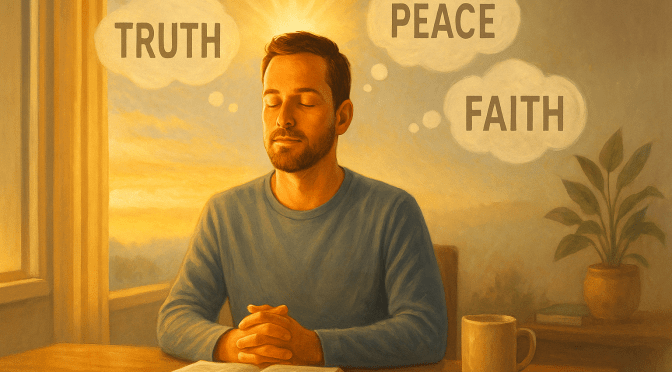
Let’s take a closer look at what Paul tells us to dwell on. These aren’t random words—they’re intentional filters. They form a mental checklist for spiritual clarity:

  • Whatever is true — In a world full of half-truths, exaggerations, and flat-out lies, Paul tells us to focus on what is true. That starts with God’s Word. His promises are true. His identity for you is true. Not every thought that enters your mind is worth believing.
  • Whatever is noble — Noble thoughts elevate your perspective. They pull you out of pettiness and negativity and point you toward integrity and honor. When I fix my thoughts on the noble, I begin to think like someone called to lead, not just survive.
  • Whatever is right — Righteousness isn’t just about behavior—it’s about thinking rightly. Are my thoughts aligned with God’s justice, holiness, and truth? Am I seeing things the way He sees them?
  • Whatever is pure — Purity isn’t popular, but it’s powerful. Pure thoughts protect your heart. They cleanse your motives. They free you from shame and renew your desire to please God—not people.
  • Whatever is lovely and admirable — This is about looking for beauty in the broken. Gratitude in the grind. It’s about seeing God’s goodness even in ordinary things. The more I meditate on what is admirable, the more peace I carry through the day.
  • Whatever is excellent or praiseworthy — Your mind becomes magnetic to what you feed it. Excellence in thinking trains you to expect God to show up. To look for His glory. To refuse to settle for lazy, negative, or destructive thought loops.

Paul is telling us: these are the things to rehearse. Not just acknowledge—but dwell on. Meditate on. Speak over yourself. Let them shape how you process everything.

The Link Between Thoughts and Peace

Have you ever had those days where everything around you was still chaos—but inside, you felt calm? That’s not random. That’s the fruit of disciplined thinking.

Paul connects this list in Philippians 4:8 with a promise of peace in verse 7. And it’s not just any peace—it’s peace that surpasses understanding.

That’s what happens when you start aligning your thoughts with God’s truth. Your situation might not change right away, but your state of mind does. Anxiety loses its grip. Doubt fades. Fear gets drowned out by faith.

This kind of peace isn’t passive—it’s protective. Paul says it will guard your heart and mind. That word “guard” is a military term. It implies a defense, a shield, a force that stands between you and mental chaos.

I’ve learned the hard way that peace doesn’t come by accident. It comes by focus. And focus is always a result of discipline.

My Personal Battle with Thought Life

Let me be real with you—this hasn’t always been easy for me.

There was a season where my thoughts were dominated by fear. Fear of failure. Fear of not being enough. Fear of being misunderstood. I would wake up with anxiety and go to sleep mentally exhausted—not because my life was chaotic, but because my thoughts were.

What changed? Not my circumstances—but my thinking.

I started writing down lies I believed and holding them up to the truth of God’s Word. I started memorizing verses, journaling what God said about me, and speaking life out loud—even when I didn’t feel it yet.

And slowly, the strongholds started to break.

That’s the power of renewing your mind. It’s not instant. But it’s transformative.

The Danger of Negative Thinking

Negative thinking doesn’t just ruin your mood—it reshapes your entire reality. One anxious thought becomes a narrative. One hurtful word loops over and over until you start to believe it. One lie, if left unchecked, can become a belief system.

That’s why Romans 12:2 has become a foundational verse for my life:

“Do not conform to the pattern of this world, but be transformed by the renewing of your mind.”

It doesn’t say you’ll be transformed by trying harder or by changing your circumstances. It says transformation comes from the renewing of your mind.

The problem is that the world is constantly trying to conform us—through media, culture, comparison, and fear. The enemy doesn’t need to destroy your life if he can distort your thinking. A distorted mindset will sabotage you before you even get started.

That’s why unchecked thoughts are dangerous. They don’t stay idle—they grow. They reinforce habits, attitudes, and behaviors. And they have the power to either align you with God’s truth or push you further from it.

Taking Every Thought Captive

So how do we fight back?

Paul gives us the answer in 2 Corinthians 10:5:

“We demolish arguments and every pretension that sets itself up against the knowledge of God, and we take captive every thought to make it obedient to Christ.”

I love the imagery here. We don’t entertain every thought—we take it captive. We interrogate it. We ask, “Does this align with the truth of Christ?” If not, it doesn’t get to stay.

It’s like being the gatekeeper of your mind. Not everything gets a free pass. Not every thought deserves your attention, your energy, or your belief.

Here’s what that looks like in practice:

  • A thought says, “You’re a failure.”
    You respond: “No, I am more than a conqueror through Christ.”
  • A thought says, “You’ll never be enough.”
    You say: “I am fearfully and wonderfully made.”
  • A thought says, “God has forgotten you.”
    You declare: “He will never leave me nor forsake me.”

This is spiritual warfare—and it starts in your mind.

Daily Habits That Shape Thinking

If you want to change your thought life, you have to change your daily input.

I had to start paying close attention to what I was feeding my mind. Because just like the body responds to what you eat, your mind responds to what you consume. Garbage in, garbage out. Truth in, transformation out.

Here are a few daily habits that have shaped my mental renewal:

  1. Scripture First — I try to make the first voice I hear each day God’s. Even if it’s just one verse, it sets the tone for the rest of my thinking.
  2. Positive Declarations — I speak life out loud. Even if I don’t feel bold, I say it anyway. Words have power, and they help rewire the brain.
  3. Journaling — Writing down my thoughts, questions, and prayers helps me sort what’s real from what’s emotional.
  4. Protecting Input — I limit toxic media, avoid gossip, and choose environments that fuel faith instead of fear.

These habits didn’t change me overnight. But they’ve rewired me over time. And that’s the goal—consistent, Spirit-led transformation from the inside out.

The Power of Spoken Thought

One of the most overlooked spiritual principles is this: your thoughts shape your words, and your words shape your world.

Proverbs 18:21 says:

“The tongue has the power of life and death, and those who love it will eat its fruit.”

What you speak reveals what you believe. And what you repeatedly say—whether out loud or internally—begins to frame the life you live.

This isn’t self-help. This is spiritual alignment. When you consistently speak truth, faith, and identity over your life, you’re not “manifesting”—you’re agreeing with God.

When I began speaking differently, I started thinking differently. And that shift started changing how I showed up—at work, in relationships, in my own private battles.

What are you saying to yourself every day? Are you reinforcing fear? Or are you reinforcing faith?

Mental Renewal Is a Lifelong Discipline

I want to be honest here: renewing your mind is not a one-time event. It’s not a sermon, a book, or a podcast episode. It’s a lifelong spiritual discipline.

You don’t just win the battle once and coast. You suit up daily. You stay alert. You remain in God’s Word. And you create rhythms that keep your mind anchored when life tries to pull you in every direction.

The good news is that God walks with us through every step of that discipline. You’re not renewing your mind alone. The Holy Spirit is your guide, your teacher, your comforter.

You’re not expected to be perfect. But you are called to be intentional.

The Mind of Christ

One of the most powerful verses about our thought life is tucked away in 1 Corinthians 2:16:

“But we have the mind of Christ.”

Pause and let that sink in. We don’t just have access to good advice—we have access to divine perspective.

Having the mind of Christ means we no longer need to interpret our world through fear, scarcity, insecurity, or comparison. We interpret life through the Spirit—just like Jesus did.

What would happen if, before every reaction, every decision, and every temptation, we paused and asked: “How would Christ think about this?”

That question alone could change everything.

Encouragement for the Struggling Mind

If you’re reading this and your thought life feels like a mess right now—I want to encourage you: you are not your thoughts.

God is not surprised by your struggles. He is patient, gracious, and deeply committed to transforming you from the inside out. You don’t have to pretend everything is fine. But you also don’t have to stay stuck.

Invite God into your mind. Ask Him to help you see clearly. Ask Him to silence the noise. Ask Him to remind you of who you are—not who the world says you are.

Your mental struggle is not your identity. It’s the battleground where your identity is being restored.

Aligning Thoughts with Identity

Here’s what I’ve discovered: the most powerful thoughts are the ones that align with who God says I am.

When my thoughts agree with shame, fear, or condemnation, I live beneath my calling. But when my thoughts agree with truth, I live boldly, freely, and purposefully.

Psalm 139:14 says:

“I praise you because I am fearfully and wonderfully made.”

That’s not just a verse for wall art—it’s a declaration for your inner world. God’s Word must become the loudest voice in your mind.

Write down truth. Speak it out loud. Let your thoughts match your identity in Christ.

Conclusion: Change Your Thoughts, Change Your Life

Your thoughts are not random. They are powerful. And when surrendered to God, they become tools of transformation.

The mind is a battlefield—but it’s one you can win with God’s help. Through Scripture, prayer, discipline, and the Holy Spirit, you can begin to think the way Jesus thinks. You can build a thought life that produces peace, confidence, purpose, and joy.

So let me leave you with this: Don’t believe every thought that comes into your head. Believe the ones God has spoken over you.

Change your thoughts. Renew your mind. Transform your life.


Call to Action

  • Reflect: What dominant thought patterns have shaped your life recently?
  • Journal: Write down three lies you’ve believed—and three truths from Scripture to replace them.
  • Practice: This week, pick one area of your life to intentionally renew your thinking. Use Philippians 4:8 as your filter.


The Transcendent Power of Jesus Christ: His Victory over Death and Our Eternal Salvation

As we approach the Easter season, we are reminded of the true power of Jesus Christ. His life, death, and resurrection provide a beacon of hope and a path to eternal salvation. In this blog post, we will explore the transcendent power of Jesus Christ, His victory over death, and how this relates to our eternal salvation.

Jesus Christ, the Son of God, has an unparalleled power that transcends the limits of human understanding. He is the divine Word made flesh, the embodiment of God’s love and grace. Through His life, teachings, and miracles, Jesus demonstrated a power that defied the natural order and offered a glimpse of the divine.

This power is made evident in Jesus’ ability to heal the sick, cast out demons, and even raise the dead. In the Gospel of Luke, we read the story of Jesus healing a paralyzed man (Luke 5:17-26). Despite the opposition of the Pharisees and teachers of the law, Jesus healed the man and forgave his sins, demonstrating His power to heal both body and soul.

Furthermore, Jesus’ teachings on love, forgiveness, and compassion have had a tremendous impact on countless lives throughout history. His Sermon on the Mount (Matthew 5-7) is a powerful testament to the transcendent power of His teachings, offering a blueprint for living a life of love, mercy, and justice.

Perhaps the most significant manifestation of Jesus’ transcendent power is His victory over death. Throughout His ministry, Jesus foretold of His impending death and resurrection, promising that His sacrifice would pave the way for eternal salvation.

In the Gospel of John, Jesus said, “I am the resurrection and the life. The one who believes in me will live, even though they die; and whoever lives by believing in me will never die” (John 11:25-26). This promise was fulfilled when Jesus was crucified, died, and rose again on the third day, conquering death and providing the hope of eternal life to all who believe.

This victory over death is the central element to the Easter season, as we celebrate the resurrection of Jesus Christ. Through His resurrection, Jesus demonstrated His power over the grave and offered a path to eternal salvation for all who believe in Him.

The victory of Jesus Christ over death and His sacrifice on the cross provide the foundation for our eternal salvation. As Jesus said in John 3:16, “For God so loved the world that he gave his one and only Son, that whoever believes in him shall not perish but have eternal life.”

This gift of eternal life is available to all who believe in Jesus Christ and accept Him as their Lord and Savior. Through faith, we can be reconciled with God, forgiven of our sins, and granted eternal life in His presence.

The Easter season serves as a powerful reminder of this promise of salvation. As we reflect on the life, death, and resurrection of Jesus Christ, we are called to renew our faith and recommit ourselves to following His teachings.

The transcendent power of Jesus Christ, His victory over death, and our eternal salvation are central themes of the Easter season. Through His life, teachings, and sacrifice, Jesus offers a path to eternal life and the hope of reconciliation with God. As we celebrate the resurrection of Jesus Christ, let us be reminded of the transformative power of faith and the promise of salvation that is available to all who believe.

In conclusion, may the Easter season inspire us to deepen our faith, strengthen our commitment to following Jesus Christ, and share the good news of His love and salvation with others. Let us rejoice in the transcendent power of our Savior and the eternal hope that He offers to all who believe.

Giving Weakness to God: A Journey to Inner Strength

In our lives, we all face personal weaknesses that can often hold us back. It’s easy to become bogged down by our shortcomings and feel overwhelmed by the challenges they present. However, by surrendering our weaknesses to God, we can transform them into sources of strength and empowerment. In this blog post, we will explore the concept of giving weakness to God and provide strategies that will help you develop inner strength. By embarking on this journey, you will discover the power of faith and find the motivation to make lasting changes in your life.

  1. Understanding the Concept of Giving Weakness to God

Giving weakness to God is the act of acknowledging our limitations and surrendering them to a higher power. This doesn’t mean we are giving up or becoming passive, but rather recognizing that we cannot control everything in our lives. By surrendering our weaknesses to God, we invite Him to work in our lives and help us overcome our challenges. This act of faith can lead to inner strength and a deeper sense of purpose.

  1. The Benefits of Giving Weakness to God

There are numerous benefits to giving weakness to God, such as increased faith, improved self-awareness, and a greater sense of inner peace. By surrendering our limitations to a higher power, we can experience spiritual growth and develop a more intimate relationship with God. Additionally, giving weakness to God can lead to a renewed sense of purpose and a stronger desire to live a life that honors Him.

  1. Strategies to Develop Inner Strength by Surrendering Weaknesses to God

a. Prayer: Prayer is a powerful tool that can help you connect with God and surrender your weaknesses. Spend time in prayer, asking God to help you overcome your challenges and develop inner strength. Be open to His guidance and listen for His voice as He leads you through the journey of transformation.

b. Meditation: Meditation is another effective strategy for surrendering your weaknesses to God. Set aside time each day to meditate on His word and seek His guidance. Allow your mind to be at peace as you connect with Him, and trust that He will lead you to a place of inner strength.

c. Community: Surrounding yourself with a supportive community can be instrumental in developing inner strength. Find a group of like-minded individuals who share your faith and values, and lean on them for support and encouragement. Together, you can help each other overcome your weaknesses and grow in your relationship with God.

d. Gratitude: Practicing gratitude can help shift your focus from your weaknesses to the blessings in your life. Take time each day to reflect on the things you are thankful for, and express your gratitude to God for His provision and guidance. By focusing on the positive, you will be better equipped to face your challenges with inner strength and resilience.

e. Service: Serving others is a powerful way to develop inner strength and overcome personal weaknesses. Look for opportunities to help those in need, and use your gifts and talents to make a positive impact in the world. By focusing on the needs of others, you will find that your own challenges become less daunting, and your inner strength will grow as you serve God and His people.

Conclusion

Giving weakness to God is a powerful way to develop inner strength and overcome the challenges we face in our lives. By surrendering our limitations to a higher power, we invite Him to work in our lives and help us grow in our faith. Through prayer, meditation, community, gratitude, and service, we can transform our weaknesses into sources of strength and empowerment. As you embark on this journey, trust in God’s plan for your life and be open to the incredible power of faith.

May your journey to inner strength be filled with blessings, and may you find the motivation to make lasting changes in your life. Remember, you are never alone – God is with you every step of the way.

“Giving Weakness to God” – Episode 39

Breaking Free: Letting Go of Guilt on the Path to Healing

Guilt, stemming from addiction and regret, can weigh heavily on our hearts, hindering our progress and impeding our ability to find peace and healing. Have you ever experienced the suffocating grip of guilt that accompanies addiction? In this transformative blog post, we delve into the depths of guilt, offering effective strategies to release its burdens and foster healing in our lives. By embracing forgiveness, practicing self-compassion, and seeking support, we can let go of guilt, break free from the shackles of regret, and embark on a path of transformation and healing.

  1. Understanding the Depths of Guilt:

Guilt often permeates the lives of individuals struggling with addiction, intensifying their pain and inhibiting their growth. Here’s a deeper look:

a. Recognize the Source: Understand the actions or behaviors that have led to guilt and the impact they have had on yourself and others.

b. Consequences of Guilt: Guilt perpetuates a cycle of shame, self-blame, and remorse, hindering personal growth and well-being.

c. A Catalyst for Change: Use guilt as a catalyst for transformation. Let it motivate you to make positive changes in your life and seek healing.

  1. Embracing Forgiveness:

Forgiveness is a powerful tool for releasing guilt and finding inner peace. Consider the following steps towards embracing forgiveness:

a. Self-Forgiveness: Begin by forgiving yourself for past mistakes and acknowledging that everyone makes errors. Treat yourself with kindness and compassion.

b. Seeking Forgiveness: When appropriate, reach out to those affected by your actions and sincerely apologize. Understand that forgiveness from others is a process that may take time.

c. Letting Go: Release the need to dwell on past actions and their associated guilt. Embrace the present moment and focus on becoming a better version of yourself.

  1. Cultivating Self-Compassion:

Self-compassion is vital in the process of letting go of guilt. Here’s how to cultivate self-compassion:

a. Practice Mindfulness: Be present with your emotions and thoughts, acknowledging them without judgment. Treat yourself with kindness and understanding.

b. Challenge Negative Self-Talk: Replace self-criticism with self-affirming statements. Remind yourself that you are worthy of love, forgiveness, and healing.

c. Engage in Self-Care: Prioritize self-care activities that nurture your physical, emotional, and spiritual well-being. Engaging in activities you enjoy can help shift your focus towards self-compassion.

  1. Seeking Support and Healing:

Healing from guilt often requires the support of others who understand and empathize with our struggles. Consider the following avenues for support:

a. Therapy or Counseling: Seek professional help to address the underlying causes of addiction, process guilt, and develop healthy coping strategies.

b. Support Groups: Join support groups where you can share your experiences, gain insights from others, and receive encouragement and guidance.

c. Cultivate Healthy Relationships: Surround yourself with a supportive network of family and friends who uplift and encourage your journey towards healing.

Conclusion:

Letting go of guilt is a transformative process that paves the way for healing, growth, and self-discovery. By embracing forgiveness, cultivating self-compassion, and seeking support, we can release the burdens of guilt and regret that accompany addiction. Remember, the journey towards healing is unique for each individual. Embrace the wisdom and strategies shared here, and embark on a path of self-forgiveness and healing. Break free from the chains of guilt, reclaim your worth, and step into a future filled with hope and transformation.

Hedges of Protection

What keeps you and your family safe? Your house? Your guns? Your fitness or fighting ability? How about your faith?

When we are instructed by Paul in Ephesians 6 to “Put on the Full Armor of God”, this is not a task to be taken lightly. This act is not just something you do occasionally or once in a while, but EVERY SINGLE DAY as the enemy is constantly seeking for a weakness in your armor. A gap in your battle line. Your Achilles’ heel. The Armor of God protects us individually and like the Spartan Phalanx, we can interlock shields with our brothers and sisters in the faith to form an impenetrable wall of FAITH that the Devil and his cohorts cannot break through. Always remember that the Armor of God must always be maintained, and for it to work properly it MUST BE PUT ON. This is our individual hedge of protection.

As a corporate entity, the Children of God, the Body of Christ, are spread across all nations. Israel and Judah during the Divided Monarchy found themselves in quite tumultuous times. Having a King who did good in the eyes of the Lord placed a hedge of protection around the people. My Sunday School teacher (rest her soul) always used the metaphor of a dome or a bowl being placed over the Kingdom while a good king was head of state. This dome represented God’s hedge of protection from the evils of the world. When a bad king came in and led the people astray, the dome or bowl would be lifted and invaders or trouble would come rushing in. The prophets would be lifted up and would give warnings to the Kings and to the people to turn back to the Lord, but ultimately we know what happened to the 12 Tribes of Israel. The 10 Northern Tribes (The Kingdom of Israel) would be lost and scattered by the Assyrian Captivity, and the Kingdom of Judah (Southern two tribes) would ultimately be led into exile by the Babylonians (see chart below).

While it was a time of great apostasy and turmoil, it is highly resonable to consider that there were some people in the land who were righteous and true to the Lord, but still suffered through this strife. Their indiviual armor and small hedges of protection for their families would keep them afloat and keep them focused on the LORD. Their FAITH would earn them a seat with the Father in Heaven even though their mortal bodies be battered, beaten, and broken.

What’s the point of having arms and armament if it’s not to be put to use? No weapon formed against you shall prosper, but that does not mean they won’t be formed or used against you. Trust in the Lord, Our God. Trust in the Armor that He has provided you. Lock shields with your family, your brothers and sisters in Christ, and with Jesus, Himself, and together, we will emerge through the tumult as VICTORS!