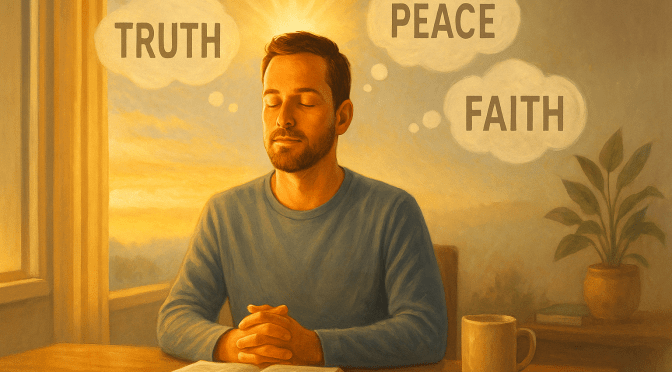
Anxiety has been my constant companion—sometimes a whisper, other times a tidal wave. In Episode 113—“Dealing With Anxiety”—I realized that anxiety isn’t something to defeat through sheer willpower but through cultivating trust in Christ and transforming my mind. That journey brought me back to Paul’s letter to the Philippians—one of Scripture’s most profound resources on mental and emotional well-being.
Paul didn’t write this letter from a place of peace—it was penned from prison, under duress, with every reason to feel anxious. Yet in it, he models a peace so deep it surprised me. Through Philippians, I discovered not just management techniques, but a lifeline: how to align my anxious thoughts with Jesus’ steadfast presence.
This post explores how Philippians guides us through anxiety—from prayer to renewal of mind and preventative practices—empowered always by the most important reality: trusting in our Lord Jesus.
1. Turning Worry into Prayer: Philippians 4:6–7
Paul’s words in Philippians 4:6–7 are some of the most quoted verses in Scripture for anxious hearts:
“Do not be anxious about anything, but in every situation, by prayer and petition, with thanksgiving, present your requests to God. And the peace of God, which transcends all understanding, will guard your hearts and your minds in Christ Jesus.”
This isn’t a call to suppress anxiety, but an invitation to transform it. Prayer becomes the act of turning a burden into a dialogue—with transparency, vulnerability, and gratitude.
One reflection explains that obeying this isn’t about self-effort; it’s about entrusting our hearts to the Lord, who responds with a peace so profound it exceeds our understanding—and that peace will guard us.
My Practice in Prayer:
I consciously say out loud what’s weighing on me—work worries, relational tension, health fears.
Then I shift to thanksgiving, even something small: a friend’s message, a moment of clarity, a favorite song.
Often, I sense a tangibly calm presence—not because circumstances changed, but because my focus shifted to His character.
2. Renewing the Mind with Philippians 4:8
Paul knew anxiety starts in our thoughts. So he redirects us:
“Finally, brothers and sisters, whatever is true, whatever is noble, whatever is right, whatever is pure, whatever is lovely, whatever is admirable—if anything is excellent or praiseworthy—think about such things.”
This isn’t passive reflection—it’s an act of discipline. Choose what your mind dwells on. Truth, purity, loveliness—such focus changes inner atmosphere.
My Thought-Shift Routine:
When worry creeps in, I pause and name one “true” thought: “God is with me.”
Then I look for something “lovely”—a scripture, a memory, a quiet moment.
I repeat with one more “praiseworthy” focus before returning to tasks—anchored now, not anxious.
3. Understanding Context: Why Paul Could Say “Don’t Be Anxious”
Paul didn’t say these things lightly. He wrote Philippians from prison—under threat, uncertainty, and separation from the people he loved.
A commentary reminds us: this isn’t blatant denial of anxiety. Instead, it’s grounded in deep reliance on the Spirit—a grace-enabled calm amid real trials.
How This Changes My Perspective:
I stop comparing my anxiety to others’.
I acknowledge it’s real but not final.
I ask—not for denial of difficulty—but spiritual strength to face it.
4. Strategies for Managing Anxiety
A. Immediate Strategies for Overwhelmed Moments:
Pray transparently—bring specifics, not just generic fears.
Thank God for something specific—even small grace matters.
Take a physical pause—walk outside, breathe, let your body reset.
Refocus thoughts with Philippians 4:8 themes—actively redirect your mind.
B. Preventative Habits to Build Resilience:
Daily habit of journaling—notes of gratitude and truth.
Memorize Philippians 4:6–7—setting it as a mental anchor.
Create ritual—a morning or evening rhythm of prayer + Philippians reading.
Community connection—share honest prayers with a trusted friend or small group.
5. Trusting Jesus: The Foundation of Peace
Underlying all of Paul’s instruction is this: Jesus is near, He cares, and He sustains.
One reflection emphasizes our relationship with God—not self-help or surface platitudes—is the antidote to worry. Prayer plus thanksgiving reveals our dependence is not weakness but trust.
Walking in Trust Daily:
Remind myself, Jesus is real and present, not distant.
When anxiety nags, I whisper, Jesus, I trust You.
Use the landscape of Philippians as both mirror and map—truth to see my need, hope to lead me forward.
6. Stories from Scripture: Paul’s Peace in Prison
In prison, Paul wrote about rejoicing, contentment, and serving Christ joyfully—despite threat and uncertainty.
His lived experience pulled me from conceptualizing anxiety into spiritual formation. If Paul could rejoice amid chains, I could walk forward in relative discomfort—with peace.
7. Reflecting on Anxiety, Not Avoiding It
If you rush past anxiety by refusing to acknowledge it, you miss God’s invitation.
Philippians doesn’t say “don’t feel anxious”; it guides us to not be shaped by anxiety. It invites us to notice it, navigate through it, and redirect toward Jesus.
Personal Takeaway:
I started labeling anxious thoughts as “not from the Spirit.”
Then I pause—pray Psalm 46:10, or whisper Philippians 4:7.
Then I journal or walk away—not running from anxiety, but redirecting from it.
8. Preventative Spiritual Fitness
Think of spiritual habits like emotional vitamins.
Regular prayers with thanksgiving create immunity.
Meditating on verses like Philippians 4:6–9 sets a guard around your heart.
*Community, worship, and confessing your anxiety—don’t walk that path alone.
Conclusion: Trust Jesus, Take Every Thought Captive
Here’s the truest freedom I’ve found:
Anxiety is real—don’t deny it.
But God offers a different reality: prayer that reshapes, thoughts that reflect truth, peace that protects—and a Savior who walks with us.
In Episode 113, I confessed that habitual anxiety isn’t defeated, it’s navigated—with Jesus as the guiding compass. Philippians isn’t just a chapter—it’s an invitation to live anchored, not anxious.
Take the next step:
Memorize 4:6–7.
Journal one thanksgiving every day.
Share your journey with someone who cares.
This isn’t about elimination—it’s about transformation. Trusting Jesus doesn’t stop storms—but it strengthens you to walk through them in peace.
When I sat down to record “Where to Begin”, Episode 112 of my podcast, I realized something powerful: most of us hesitate to open the Bible because we feel unsure, intimidated, or distant. Whether you’re brand new to faith or simply wanting to renew your spiritual journey, the most important first step is simple: start.
Declaring “I’m going to begin reading the Bible,” radical as it sounds in a busy world, is stepping into a relationship with our Savior. This post is an invitation—to help you take that first step, build sustainable rhythms, and embrace the grace that sees every new start.
1. Why It’s More Important to Begin Than to Know the Whole Plan
Too many feel pressure to have a perfect plan before opening God’s Word—when actually, God desires presence and humility more than perfection.
Starting—even in small doses—creates momentum. Reading one passage with prayer opens space for revelation. Consistency matters more than speed. As one guide encouragingly said, starting with 10–15 minutes a day builds spiritual stamina and helps you engage relationally, not just informationally Open the Biblekeithferrin.com.
2. Choose a Starting Point That Anchors You in Jesus
Begin with the Gospels
If you’re new, start with the Gospels—John, Matthew, Mark, Luke—in that order or sequence you prefer. They intimately introduce Jesus—His life, teachings, character, and love for humanity Reddit.
Why John first?
John presents Jesus as Savior and Son of God with rich, relational language. Then dive into the others for historical depth and narrative breadth.
Consider Acts Next
After a Gospel or two, turn to Acts, which picks up after Jesus, revealing how the early church responded to Jesus’ mission and moves forward with Spirit-led life Open the Bible+2keithferrin.com+2Reddit+2.
3. Practical Habits for Beginners and Those Restarting
🕰️ Set a Daily Time and Place
Pick a consistent window—early morning or evening—that you can honor. Keep it simple: a comfortable chair, Bible, journal, pen, maybe a cup of coffee. Even 10 minutes is powerful when repeated daily shiningeverbrighter.com+6Ascension Press Media+6keithferrin.com+6.
🙏 Start with Prayer and an Open Heart
Invite the Holy Spirit: “Father, speak to me. Open my eyes.” Don’t skip this step—God’s Word meets you where you are spiritually, but the Spirit makes it alive and applicable Reddit+2Open the Bible+2Ascension Press Media+2.
📖 Read Relationally, Not Rigorously
Avoid making every reading feel like homework. Track themes, not just every lesson. Let the story draw you in. As one guide explained: reading relationally helps you feast with God, not just study Him keithferrin.com.
📓 Journal Thoughts, Themes, or Questions
Write down what surprised you, what comforted you, or what challenged you. This helps you internalize and reflect later.
👥 Invite a Companion or Community
If possible, partner with one or two people reading the same passage—or join a small group. It fosters accountability and shared discovery keithferrin.comFaithGateway.
4. Tackling Overwhelm—Strategies to Sustain Momentum
✅ Use a Reading Rhythm
Begin with 10–15 minutes per day or select a portion (a chapter, narrative section). If that feels light, extend to 20–30 minutes. The aim is consistency, not intensity Open the Biblekeithferrin.com.
🧭 The “New Disciple Challenge” Approach
Spend two weeks in each Gospel and Acts; repeat Acts between each Gospel. In 10‑week cycles, you revisit foundational themes and grow familiarity across the life of Jesus and early church keithferrin.com.
🔄 Mix Genres for Engagement
If the Gospels feel too straightforward after a while, add in Psalms for prayer-rich engagement or Proverbs for bite‑size wisdom. This keeps the journey fresh and multidimensional FaithGatewayshiningeverbrighter.com.
5. Cultivating Relationship Over Religion
🤝 See Jesus in Every Page
Beyond theology, see Jesus in the people He healed, taught, and loved. From Mark or Luke, visualize His compassion. From John, sense His intimate presence. Let His humanity and divinity draw you deeper.
💡 Reflect and Respond in Prayer
Close your reading time by asking: “How did You speak today? What are You leading me toward?” A relational rhythm helps you respond rather than just observe.
🎯 Small Goals Grow Big Faith
A chapter a day lays over time into completion. Two months in, you’ll know the Gospels intimately. Six months in, you’ll have a foundation you can build on.
6. Addressing Common Concerns
“I feel lost—too much to understand.” Be patient. The Bible is not meant to be mastered at once. Read trustingly—God’s Spirit will teach you over time. Don’t compare yourself to others’ pace or style.
“I’m restarting—is it too late or too hard?” Starting over is brave. Approach with fresh expectancy. The same discipline you develop will feel familiar after a few weeks, renewing your relationship with God.
“I don’t know what Bible version to use.” Pick a readable translation (e.g., NIV, ESV, NLT). The best Bible is the one you’ll actually open and hold. If one version feels dry, try another until something clicks Ascension Press MediaSara Laughed.
7. The Transformative Power of Simply Beginning
The greatest spiritual growth often comes from the smallest steps forward. When I began consistently reading Scripture—even when I felt dry, tired, or distracted—I started noticing God’s voice in new ways. My faith got anchored in narrative, not novelty.
I discovered hope in Jesus’ teachings, conviction in His commands, peace in the Psalms, and direction in Acts. I found joy not in finishing books—but in meeting Him there each day.
To someone new: your first verse may feel insignificant. But it’s not just ink—it’s life. When you open your heart to Him, He meets you. Over time, casual reading becomes spiritual formation.
8. Invitation: Begin Today
Here’s your personal invitation:
Pick where to start: John or Matthew, then Acts.
Choose your time and spot: 10–15 minutes today.
Pray first: Ask God to open and meet you.
Journal a reflection: One insight or question.
Connect weekly: With someone or a group, if you can.
Don’t worry if it’s imperfect. Just begin. Each morning you open your Bible can become an invitation into deeper relationship—with Jesus, more understanding, and greater spiritual momentum.
Conclusion: A First Step Toward Lifelong Relationship
The Bible is not only God’s Word—it’s His invitation. It speaks beauty, truth, hope, and redemption. The most important thing isn’t how fast you read or how well you understand—it’s the posture of your heart. Begin. Continue. Trust. Believe that Jesus walks with you.
Just start. And watch how He meets you in each chapter, verse, or line. Over time, those small steps become a journey of faith that transforms your heart—because God is faithful to reveal Himself to those who seek intentionally.
When I recorded Episode 111—“Benefits of Coffee”—I realized coffee wasn’t just a beverage for me. It had become a daily ally—energizing early mornings, sharpening focus during writing sessions, and offering ritualistic solace. But more than comfort, I discovered it came with tangible benefits. As I explored scientific research, I learned how coffee could support health, longevity, mood, metabolic wellness—and all without sugary overload.
In this post, I’ll share how incorporating coffee into my routine—with simplicity and moderation—supported my well‑being, sharpened my mind, and deepened my daily rhythms. And I’ll explain why going light on additives is critical so you don’t lose coffee’s intrinsic benefits.
1. The Physical Benefits: Health Backed by Science
🎯 Longevity and Cardiovascular Health
Multiple large studies reveal that moderate coffee drinkers (about two to four cups daily) have significantly lower risk of premature death from heart disease and other causes—often in the range of 16–19% reduced mortality compared to non-drinkers Wikipedia+3rush.edu+3U.S. News+3. One UK Biobank analysis affirms that consuming coffee before noon is linked to lower overall and cardiovascular mortality—suggesting timing matters too NHLBI, NIH.
👩⚕️ Lower Risk of Type 2 Diabetes & Metabolic Support
Meta-analyses show each daily cup of coffee (caffeinated or decaf) is associated with a 6–9% reduced risk of developing type 2 diabetes NHLBI, NIH+15Healthline+15Wikipedia+15. Coffee’s polyphenols and other compounds improve insulin sensitivity and reduce inflammation—making it a metabolic ally Daily Telegraph+1New York Post+1.
🧠 Brain Health: Parkinson’s, Dementia, and Mood
Long-term coffee consumption correlates with lower rates of Parkinson’s disease and some neuroprotective effects. Preliminary data suggest reduced risk of depression and possible cognitive benefits later in life Wikipedia+1The Times+1.
🍃 Liver and Cancer Benefits
Research links moderate coffee intake with reduced odds of liver disease, gallstones, and certain forms of cancer such as liver and colorectal cancers Mayo Clinic Press.
2. Energy, Focus & Performance: My Personal Experience
From my own life: one to two cups in the morning often giving clarity, alertness, and sustained energy. The caffeine in coffee blocks adenosine, enhancing concentration and physical performance—especially during creative or writing sessions Reddit. It’s also used by athletes for improved performance, endurance, and reduced perceived effort Rock Creek Coffee Roasters+1The Times+1.
My writing flow and post-recording recovery improved noticeably once I began exercising with coffee beforehand—it lifted fatigue and sharpened focus. And genuinely: weight management became easier. Coffee’s metabolism-boosting effects and mild appetite suppression supported my efforts Rock Creek Coffee RoastersHopkins Medicine.
3. Why Moderation Matters—And Why Less Is More
🚫 Stick Within Safe Limits
Experts recommend no more than 400 mg of caffeine per day, roughly two to four cups of brewed coffee—sometimes up to five—depending on individual sensitivity Wikipedia+1Real Simple+1. Excess can lead to anxiety, sleep disruption, elevated heart rate, and gastrointestinal discomfort Real Simple.
🕝 Timing Is Key
Drinking coffee before noon seems to maximize its longevity and cardiovascular benefits while reducing negative impact on sleep or cortisol levels during evenings NHLBI, NIHThe Times.
🧁 Avoid Sugar & Excess Add‑Ins
Research shows that adding sugar, syrups, or high‑fat creams significantly weakens coffee’s health advantages. Black coffee—or coffee with minimal sugar (< ½ tsp) and low‑fat creamer—is associated with a ~14% lower risk of death compared to heavily sweetened drinks or no coffee Tufts Now+1The Times of India+1. Calories and sugar can negate coffee’s antioxidant and anti-inflammatory benefits.
😌 Sensitivity and Mindful Listening
Some individuals—like those with anxiety disorders, heart sensitivities, or sleep issues—may need less caffeine or even decaf. Coffee can spike blood sugar temporarily, especially when consumed on an empty stomach or with added sugar—but long-term associations still favor reduced diabetes risk when enjoyed mindfully Verywell HealthPMC.
4. How I Built Coffee into My Routine—With Purpose
🌅 Morning Ritual, Not Rush Hour Fuel
I intentionally sip coffee first thing in the morning, paired with a protein-rich breakfast or nuts—optimizing energy without cortisol crash or sugar spikes. I avoid drinking coffee past early afternoon to safeguard sleep quality NHLBI, NIHThe Times.
🚫 Keep It Simple
Most days, it’s just black coffee or black with light milk—and a dash of cinnamon when I’m craving flavor. Cinnamon introduces antioxidants and helps stabilize blood sugar without excessive sweetness New York Post.
🔁 Cup Limit
I aim for two to three cups daily—enough for benefits without bingeing. I noticed that beyond three cups, the health advantage plateaus—and risks like restlessness rise Verywell Health+9U.S. News+9New York Post+9.
🏃♂️ Pre-Workout Fuel
About 30–60 minutes before physical activity, I drink a cup. It helps me train harder, recover faster, and avoid post-exercise fatigue—especially helpful before writing marathons or long coaching days Rock Creek Coffee Roasters.
5. The Positive Impacts: Real Benefits Fused Into Daily Life
📈 More Clarity, Less Fog
Coffee’s mild stimulation often jumpstarts creativity and decision-making. On days I skip it, I’m missing not just caffeine—but a mental edge and ritual that primes my mind.
❤️ Emotional Balance
I’ve felt clearer during stress—not anxious, but alert and grounded. In my experience, the antioxidants and mood-lifting compounds contribute to emotional resilience HealthlineMayo Clinic Press.
🧘 Weight & Wellness Synergy
With smarter nutrition and consistent workouts, coffee became a tool—not a crutch—to support metabolism and focus. It didn’t replace meals but supplemented disciplined habits.
🔄 Rhythm and Intentionality
Coffee helped shape routines—morning reflection, planning, sessions of podcast recording, focused writing, or times of guided rest. It became a symbol, not a necessity: a simple anchor for purpose.
6. Caveats to Consider—and Practicing Awareness
⚠️ Anxiety & Sleep
If you suffer from anxiety, insomnia, or hypertension, consider reducing intake or switching to decaffeinated beans. Over 300 mg can worsen symptoms in sensitive individuals Wikipedia.
🍬 Not a License for Sugar Overload
Even if you love flavored lattes, treat them as occasional treats—not daily staples. The health benefits fade with sugar and high-fat additives The Times of India.
🚫 Avoid Too Late
A cup after 2 or 3 pm may interfere with sleep quality—undermining the long-term benefits of coffee. Timing matters as much as quantity NHLBI, NIHThe Times.
7. A Positive Conclusion: Designing Your Own Coffee-Driven Wellness
Here’s what I believe: Coffee, when embraced with mindfulness, becomes more than a beverage—it becomes a healthy ritual. It fuels discipline, clarity, and intentional living.
It enhances mood and cognition, offering creativity, mental sharpness, and sustained focus WikipediaHopkins Medicine.
It becomes part of a balanced lifestyle, not a shortcut—especially when kept simple and free from excess sugar or creamers.
My encouragement? Try two to three mindful cups a day. Make it black or lightly sweetened. Have it before noon. Pair it with food. Be attuned to your body’s response. And don’t use coffee as a mask for fatigue—it’s best paired with healthy sleep, movement, and nutrition.
Final Thoughts & Call to Action
Coffee—done well—is a friend. It’s the warm invitation at dawn, the mental boost in midday, the ritual that connects your body and mind to intention.
If you joined me for Episode 111, you heard my testimony. But science supports what I’ve experienced: coffee, in moderation and simplicity, can promote health, vitality, focus, and longevity.
So consider this a personal invitation: become a conscious coffee drinker. Drink with purpose and presence. Enjoy the richness—not just in flavor, but in life. Let it help you show up more focused, more joyful, more energized—without extra sugar or unnecessary extras diluting your well-being.
Here’s a thought question to ponder: What simple ritual could coffee anchor in your day—that promotes focus, wellness, and joy? I’d love to read your experiences, ideas, or recipes. Let’s brew with intention—together.
On Episode 110 of my podcast—“How to Pray”—I realized something profound: many of us approach prayer like ordering off a menu—“God, bless this,” “God, fix that.” But prayer is so much more than that. It’s a conversation—and like any meaningful exchange, structure matters.
Structured prayer doesn’t mean formulaic. Instead, it creates space for deeper intimacy, honest reflection, and spiritual growth. In this post, I’ll share why the A.C.T.S. method—Adoration, Confession, Thanksgiving, Supplication—can revolutionize your prayers. Not by making God more predictable, but by inviting Him into deeper parts of your heart.
By the end, you’ll see why this framework can elevate your prayer life and strengthen your bond with God.
What Is the A.C.T.S. Method? A Brief Overview
A.C.T.S. is a time-tested acronym guiding believers through four spiritual rhythms in prayer:
Thanksgiving – Gratitude for His blessings and presence.
Supplication – Lifting our needs and praying for others.
This approach helps avoid disconnected or “wish list” prayer times. Instead, each part anchors your heart, aligning your focus with God’s, and builds toward a deeper, more balanced conversation.
Why Structure Enhances Prayer
Some might say structured prayer is soulless or rigid. But structure can be a pathway, not a prison.
It keeps your mind engaged, avoiding emotional wandering.
It ensures you don’t neglect any spiritual posture—worship, repentance, gratitude, petition.
It prepares your heart to receive from God, not just talk to Him.
As one resource noted, ACTS “helps us exchange our concerns for God’s perspective, balancing personal needs with worship and thanksgiving”
Personally, I find structure liberating. Instead of wandering aimlessly, my prayers begin with worship, move through repentance, overflow in thanks, and then land in honest requests. That framework invites clarity and peace—every single time.
A – Adoration: Start with His Majesty
Prayer posture begins with worship.
When we adore God, we shift the focus from us to Him. It’s about who He is—His character, power, faithfulness. Adoration realigns our hearts, humbles our attitudes, and opens spiritual eyes.
One guide explained:
“When we pray with adoration … we are declaring the glory of God’s majesty and beauty of who He is.”
During Episode 110, I described pausing after “Our Father who art in heaven” and saying to myself: You are good. You are just. You are my provider, my protector. That moment of simple adoration often sets the tone for everything that follows.
C – Confession: Honest Repentance Opens Hearts
Once our hearts are lifted toward His greatness, we’re prepared to face our shortcomings.
Confession isn’t about guilt—it’s about honesty, freedom, and restoration. James 5:16 reminds us: “The prayer of a righteous person is powerful and effective…” when it’s humble and transparent.
One guide said:
“When you confess, … ask God to search your heart and reveal any hidden sin.”
During confession, be specific. I’ve often begun prayers simply with, “Search me, Lord.” But when I name my struggles—impatience, pride, anxiety—that specificity brings clarity, healing, and God’s mercy.
T – Thanksgiving: Cultivating a Heart of Gratitude
Humans often forget. We complain easily, even amid blessings.
That’s why thanksgiving is vital. Psalm 100:4 teaches us to “enter His gates with thanksgiving.” And after confession, gratitude is healing balm.
Structured thanksgiving helps us remember:
What is going well?
What lessons have I learned?
What gifts—big or small—has God given?
A source highlighted that thanksgiving:
“forces me to consider what I am grateful for on the days I feel less than grateful.”
For me, listing even mundane blessings—the cool air, a friend’s message, a moment of clarity—shifts perspective and brings joy to prayer.
S – Supplication: Pouring Out Our Needs and Others’
Finally, after focusing on God, we bring our heart’s burdens and intercessions to Him.
Supplication is not about demanding—it’s about trust. Scripture tells us to “present your requests to God” with thanksgiving (Philippians 4:6). We ask boldly and humbly.
As described:
“Supplication … making requests of God … ‘Come show me the path forward on a major decision…’”
This step acknowledges that we need Him—for ourselves, others, our world. And it reminds us of our dependence on divine grace.
How A.C.T.S. Builds a Stronger Relationship with God
1. Makes Prayer Relational, Not Ritual
Continuously hitting repeat on the same prayer formula can become rote. But ACTS, when used sincerely, reconnects you to a living God—one you know, love, confess to, and depend upon.
2. Creates Balanced Spiritual Posture
Adoration keeps us humble. Confession keeps us honest. Thanksgiving keeps us grateful. Supplication keeps us reliant. A.C.T.S. ensures prayers aren’t unbalanced, self-centered, or superficial.
3. Transforms Your Inner Condition
Adoration fills with worship; confession clears shame; thanksgiving cultivates contentment; supplication fosters hope. That personal shift strengthens our intimacy with God.
One resource explained:
“As you spend time … adoring God, confessing … and thanking … a transformation takes place in your relationship with Him. You become expectant and confident …”
4. Anchors You in God’s Perspective
When anxiety hits, ACTS reorients you—not to your problems, but to God’s character and faithfulness, your own need for cleansing, reasons to be thankful, and the freedom to ask for help.
How I Use ACTS in My Life: A Personal Narrative
Here’s how it really unfolds for me:
A by Morning Light: I start my quiet time with worship songs or silent adoration, speaking aloud truths about God.
C amid Transparency: Then I pause, confessing lies I’ve believed or wrong ways I’ve reacted—usually things still fresh in my mind.
T through reflection: I list blessings: family, Scripture, answered prayers, fresh starts.
S with bold faith: Finally, I ask for wisdom, peace, or breakthrough. Then I intercede for my community, our church, and world.
Every time, I feel anchored. I’ve seen anxiety dissipate, relationships deepen, clarity emerge. It’s not because the formula is magic—it’s because I now pray as a whole person, not a fragmented one.
Practical Tips to Adopt A.C.T.S. Prayer
If you’re ready to adopt ACTS, here are some practical tips:
Tip
Description
Use a Journal or App
Write or type each section—keep it simple or detailed based on your time.
Start with worship lyrics, confess with Psalm 51, or request via Philippians 4:6.
Pray with Others
ACTS works well in group prayer—worship together, confess, thank, and lift needs.
Be Flexible
Adapt the style—use ACTS as a guideline, not a rule—especially when the Holy Spirit leads.
Potential Objections and Clarifications
Objection 1: “This feels formulaic.” Good! Human minds need structure. ACTS simply gives order—but the content, emotion, and sincerity are all yours.
Objection 2: “I don’t have time.” Even a 5-minute ACTS prayer can be powerful. Worshipers linger longer, but it works at any pace.
Objection 3: “I prefer spontaneous prayer.” Structure doesn’t exclude spontaneity. Use ACTS as a pattern, and when the Holy Spirit moves you beyond one section, flow with Him.
The Ripple Effect—Why It Matters
When we pray with balance, we:
Grow spiritually—our faith becomes centered, not cyclical.
Build emotional resilience—confession and thanksgiving soothe the soul.
Experience relational depth—honest prayer fosters trust with God and others.
Become contagious spiritually—your example invites others to deeper prayer.
A.C.T.S. prayer isn’t private; it impacts families, communities, churches, and nations.
Challenge: Try A.C.T.S. for 21 Days
Here’s your invitation:
Write out or use an app for each section daily.
Reflect: How is your heart different on day 7? Day 14? Day 21?
Share your experience—comment on the blog, your church, your group.
Let’s do this together.
Conclusion: A.C.T.S.—A Ladder to Divine Connection
Structure isn’t the enemy of intimacy—it can pave the way for it. The A.C.T.S. method provides a scaffold: worship that uplifts, confession that cleanses, thanksgiving that warms, and supplication that releases dependence.
I’ve experienced deeper clarity, greater peace, and more meaningful encounters with God through ACTS. Jesus taught us to pray intimately—giving us the Lord’s Prayer as an example. ACTS simply builds on that, giving us a way to say what He taught us to pray.
So if you’re longing for a more balanced, heartfelt prayer life, give A.C.T.S. a try. Let structure guide—not restrict—you. And prepare for your relationship with God to grow deeper than ever.
There’s a moment during Episode 109 of my podcast—“Humble Yourselves”—when I paused, my voice steady but my heart thundering. I said it plainly, maybe even boldly: “God is not looking for your greatness—He’s asking for your submission.” That truth hit me harder than I expected. It wasn’t just something I said—it was something I was living.
If I’ve learned anything on this journey, it’s this: humility is not weakness. It’s strength. It’s discipline. It’s the gateway to everything God wants to do through you. I’ve seen firsthand how pride can delay destiny, how ego can cloud divine assignments, and how trying to do life on our terms leads to spiritual burnout. But I’ve also seen what happens when we choose to bow low—how God lifts us up.
This blog isn’t a lecture. It’s a testimony. A personal reflection. An invitation to join me on a deeper walk of surrender. Because in humbling yourself, you don’t lose identity—you gain authority. You don’t give up power—you receive divine alignment. And most of all, you open yourself to let God do what only He can.
What True Humility Looks Like
Let’s clear something up right now: humility isn’t self-hatred or pretending you’re less than who God made you to be. It’s not shrinking back. It’s not living under shame or minimizing your purpose. That’s false humility—and it’s just another form of pride dressed in insecurity.
True humility, as I’ve come to understand, is powerful. It’s an accurate view of yourself in light of who God is. It’s acknowledging that every gift you have—every opportunity, every success—isn’t a result of your doing alone. It’s being willing to say, “God, I don’t want to go anywhere or do anything if You’re not in it.”
C.S. Lewis once said, “Humility is not thinking less of yourself, but thinking of yourself less.” That landed hard with me. Because I realized that so much of what we do—even “good” things—can be rooted in our need to be seen or validated. Humility takes the spotlight off us and puts it back on Him.
It means living with open hands and an open heart. It means being teachable. Being correctable. And yes—it means admitting when you’re wrong. But more than anything, it means yielding your will to God’s.
Humility Is Our Greatest Strength
You want to know the real flex? Surrender. Because humility unlocks strength you didn’t know you had.
When I operate out of humility, I have access to wisdom beyond my experience. I stop reacting out of emotion and start moving with intention. I don’t need to prove myself—I just need to obey. And in that obedience, power flows. Peace flows. Purpose gets clearer. And doors that I couldn’t open in my own strength? They swing wide, all because I got out of the way.
Humility doesn’t make you invisible. It makes you available.
And trust me—God does His best work through those who are available. That’s why the humble rise. That’s why they’re elevated. That’s why Jesus said, “Whoever humbles himself like this child is the greatest in the kingdom of heaven” (Matthew 18:4).
Humility strengthens our relationships. It silences our need to always be right. It fuels unity and dissolves conflict. In ministry, in business, in family—where humility leads, grace follows.
Christ: The Blueprint of Humility
Nowhere is humility more vividly displayed than in Jesus Himself.
Philippians 2:5–8 tells us that Christ, though He was God, “did not count equality with God a thing to be grasped.” Instead, He emptied Himself. Took on the form of a servant. Became obedient to the point of death—even death on a cross.
That’s divine humility. The Son of God stooped down, washed dirty feet, and let Himself be crucified by the very people He came to save.
Jesus didn’t have to prove who He was. He knew who He was. That’s why He could kneel and serve. That’s why He could keep silent in front of His accusers. His power came from surrender.
If the One who holds the universe in His hands could choose humility—what excuse do we have?
Why Full Submission to God Changes Everything
Here’s where it gets personal.
Humbling myself wasn’t easy. It meant letting go of control. It meant silencing my plans and listening—really listening—for His voice. It meant repentance. It meant forgiveness. It meant trusting that God’s timing was better than mine.
But it changed everything.
Full submission isn’t passive. It’s fierce. It’s active. It’s saying: “Lord, take my ideas, my goals, my fears, my pride. I trust You more than I trust myself.”
And when you submit like that, you make room for the Holy Spirit to flow. You stop striving. You start hearing. You begin to operate in divine rhythm.
In my life, submission has brought clarity where there was confusion, peace where there was chaos, and purpose where there was wandering. And it’s not because I figured it out. It’s because I finally got low enough for God to lift me.
How to Walk in Humility Daily
Humility isn’t a one-time decision. It’s a daily discipline. Here’s what I’ve learned:
Start your day surrendered. Before you scroll, before you speak—ask God: “Lead me today. Keep me humble. Correct me quickly.” That posture sets the tone.
Ask for feedback. It takes humility to let people speak truth into your life. But those conversations? They’re gold. Don’t run from correction—run to it.
Serve when it’s inconvenient. Humility doesn’t wait for applause. It serves in silence. In secret. And that’s where growth happens.
Own your mistakes. Pride deflects. Humility owns. Say “I was wrong.” Say “I’m sorry.” Watch healing follow.
Celebrate others. A humble heart is secure enough to cheer others on. No comparison. Just joy.
Humility Impacts Everything
When you choose humility, you shift atmospheres.
Your relationships change. Your leadership changes. Your inner world transforms. Pride builds walls—but humility builds bridges. And in those bridges, God moves.
People aren’t drawn to perfection. They’re drawn to authenticity. To gentleness. To leaders and friends who walk low and lift others up.
And the best part? God honors it. He promises in James 4:10, “Humble yourselves before the Lord, and He will lift you up.”
I’ve seen it. I’m living it.
Conclusion: A Call to Bow Low So God Can Lift High
Let me leave you with this: Don’t be afraid to humble yourself.
It’s not the end of your influence—it’s the beginning of your impact. It’s not about thinking less of yourself—it’s about thinking more of God.
If Episode 109 taught me anything, it’s that God is still looking for vessels—not performers. He’s looking for people who will say, “Not my will, but Yours.” People who will go low so that He can go high. People who will carry His heart and not just His name.
So here’s my challenge to you this week: Pick one area where pride is hiding. Surrender it. Serve in secret. Apologize first. Let go of the need to be right. And ask the Holy Spirit to help you live humbled, not humiliated—surrendered, not silenced.
If there’s one battle I fight daily—and I know I’m not alone—it’s the battle of the mind. The world we live in today is saturated with messages, images, voices, and influences all competing for space in our heads. And the truth is, the thoughts we entertain don’t just stay in our heads—they shape our attitudes, our emotions, our decisions, and ultimately our lives.
I’ve come to learn through experience, reflection, and Scripture that our thoughts have real power. They are not abstract. They are formative. The way we think has the potential to either align us with God’s truth or drift us further away from it. And that’s why Episode 108 of the podcast felt so important to me. It was personal. It was necessary. And it was deeply inspired by the words of Paul to the Christians in Philippi.
The question I want to explore here is simple but profound: What does God want us to do with our thoughts? Because how we answer that determines the kind of life we live.
The Battlefield of the Mind
The mind is where the real war is fought. Before a mistake is made, a thought has usually been entertained. Before a habit forms, a mental pathway has been repeated. And before peace can take root, the soil of the mind has to be cultivated for it.
Proverbs 23:7 says, “As a man thinketh in his heart, so is he.” That verse hit me hard the first time I really understood it. It’s not just about our actions—it’s about our identity. Who we are is shaped by what we consistently think about. The mind isn’t just a place of thinking—it’s a battlefield of becoming.
Every day, we’re either sowing seeds of faith or seeds of fear. Seeds of purpose or seeds of insecurity. And those seeds take root based on whether we allow God to transform our thinking—or whether we allow the world to shape it.
Paul’s Message to the Philippians
Paul knew this. When he wrote to the church in Philippi, he wasn’t writing from a place of comfort. He was writing from prison. And yet, his message wasn’t one of defeat or despair—it was one of joy, peace, and power.
In Philippians 4:8, Paul gives us one of the clearest and most practical instructions in all of Scripture regarding our thought life:
“Finally, brothers and sisters, whatever is true, whatever is noble, whatever is right, whatever is pure, whatever is lovely, whatever is admirable—if anything is excellent or praiseworthy—think about such things.”
Think about such things. Not once. Not occasionally. But as a regular, disciplined practice.
Paul understood that the battle for peace was won not in our circumstances, but in our focus. That’s why earlier in verse 7, he speaks of a “peace of God, which surpasses all understanding,” guarding our hearts and minds.
It’s not that we ignore hardship. It’s that we learn to dwell on truth.
Philippians 4:8 — A Breakdown
Let’s take a closer look at what Paul tells us to dwell on. These aren’t random words—they’re intentional filters. They form a mental checklist for spiritual clarity:
Whatever is true — In a world full of half-truths, exaggerations, and flat-out lies, Paul tells us to focus on what is true. That starts with God’s Word. His promises are true. His identity for you is true. Not every thought that enters your mind is worth believing.
Whatever is noble — Noble thoughts elevate your perspective. They pull you out of pettiness and negativity and point you toward integrity and honor. When I fix my thoughts on the noble, I begin to think like someone called to lead, not just survive.
Whatever is right — Righteousness isn’t just about behavior—it’s about thinking rightly. Are my thoughts aligned with God’s justice, holiness, and truth? Am I seeing things the way He sees them?
Whatever is pure — Purity isn’t popular, but it’s powerful. Pure thoughts protect your heart. They cleanse your motives. They free you from shame and renew your desire to please God—not people.
Whatever is lovely and admirable — This is about looking for beauty in the broken. Gratitude in the grind. It’s about seeing God’s goodness even in ordinary things. The more I meditate on what is admirable, the more peace I carry through the day.
Whatever is excellent or praiseworthy — Your mind becomes magnetic to what you feed it. Excellence in thinking trains you to expect God to show up. To look for His glory. To refuse to settle for lazy, negative, or destructive thought loops.
Paul is telling us: these are the things to rehearse. Not just acknowledge—but dwell on. Meditate on. Speak over yourself. Let them shape how you process everything.
The Link Between Thoughts and Peace
Have you ever had those days where everything around you was still chaos—but inside, you felt calm? That’s not random. That’s the fruit of disciplined thinking.
Paul connects this list in Philippians 4:8 with a promise of peace in verse 7. And it’s not just any peace—it’s peace that surpasses understanding.
That’s what happens when you start aligning your thoughts with God’s truth. Your situation might not change right away, but your state of mind does. Anxiety loses its grip. Doubt fades. Fear gets drowned out by faith.
This kind of peace isn’t passive—it’s protective. Paul says it will guard your heart and mind. That word “guard” is a military term. It implies a defense, a shield, a force that stands between you and mental chaos.
I’ve learned the hard way that peace doesn’t come by accident. It comes by focus. And focus is always a result of discipline.
My Personal Battle with Thought Life
Let me be real with you—this hasn’t always been easy for me.
There was a season where my thoughts were dominated by fear. Fear of failure. Fear of not being enough. Fear of being misunderstood. I would wake up with anxiety and go to sleep mentally exhausted—not because my life was chaotic, but because my thoughts were.
What changed? Not my circumstances—but my thinking.
I started writing down lies I believed and holding them up to the truth of God’s Word. I started memorizing verses, journaling what God said about me, and speaking life out loud—even when I didn’t feel it yet.
And slowly, the strongholds started to break.
That’s the power of renewing your mind. It’s not instant. But it’s transformative.
The Danger of Negative Thinking
Negative thinking doesn’t just ruin your mood—it reshapes your entire reality. One anxious thought becomes a narrative. One hurtful word loops over and over until you start to believe it. One lie, if left unchecked, can become a belief system.
That’s why Romans 12:2 has become a foundational verse for my life:
“Do not conform to the pattern of this world, but be transformed by the renewing of your mind.”
It doesn’t say you’ll be transformed by trying harder or by changing your circumstances. It says transformation comes from the renewing of your mind.
The problem is that the world is constantly trying to conform us—through media, culture, comparison, and fear. The enemy doesn’t need to destroy your life if he can distort your thinking. A distorted mindset will sabotage you before you even get started.
That’s why unchecked thoughts are dangerous. They don’t stay idle—they grow. They reinforce habits, attitudes, and behaviors. And they have the power to either align you with God’s truth or push you further from it.
Taking Every Thought Captive
So how do we fight back?
Paul gives us the answer in 2 Corinthians 10:5:
“We demolish arguments and every pretension that sets itself up against the knowledge of God, and we take captive every thought to make it obedient to Christ.”
I love the imagery here. We don’t entertain every thought—we take it captive. We interrogate it. We ask, “Does this align with the truth of Christ?” If not, it doesn’t get to stay.
It’s like being the gatekeeper of your mind. Not everything gets a free pass. Not every thought deserves your attention, your energy, or your belief.
Here’s what that looks like in practice:
A thought says, “You’re a failure.” You respond: “No, I am more than a conqueror through Christ.”
A thought says, “You’ll never be enough.” You say: “I am fearfully and wonderfully made.”
A thought says, “God has forgotten you.” You declare: “He will never leave me nor forsake me.”
This is spiritual warfare—and it starts in your mind.
Daily Habits That Shape Thinking
If you want to change your thought life, you have to change your daily input.
I had to start paying close attention to what I was feeding my mind. Because just like the body responds to what you eat, your mind responds to what you consume. Garbage in, garbage out. Truth in, transformation out.
Here are a few daily habits that have shaped my mental renewal:
Scripture First — I try to make the first voice I hear each day God’s. Even if it’s just one verse, it sets the tone for the rest of my thinking.
Positive Declarations — I speak life out loud. Even if I don’t feel bold, I say it anyway. Words have power, and they help rewire the brain.
Journaling — Writing down my thoughts, questions, and prayers helps me sort what’s real from what’s emotional.
Protecting Input — I limit toxic media, avoid gossip, and choose environments that fuel faith instead of fear.
These habits didn’t change me overnight. But they’ve rewired me over time. And that’s the goal—consistent, Spirit-led transformation from the inside out.
The Power of Spoken Thought
One of the most overlooked spiritual principles is this: your thoughts shape your words, and your words shape your world.
Proverbs 18:21 says:
“The tongue has the power of life and death, and those who love it will eat its fruit.”
What you speak reveals what you believe. And what you repeatedly say—whether out loud or internally—begins to frame the life you live.
This isn’t self-help. This is spiritual alignment. When you consistently speak truth, faith, and identity over your life, you’re not “manifesting”—you’re agreeing with God.
When I began speaking differently, I started thinking differently. And that shift started changing how I showed up—at work, in relationships, in my own private battles.
What are you saying to yourself every day? Are you reinforcing fear? Or are you reinforcing faith?
Mental Renewal Is a Lifelong Discipline
I want to be honest here: renewing your mind is not a one-time event. It’s not a sermon, a book, or a podcast episode. It’s a lifelong spiritual discipline.
You don’t just win the battle once and coast. You suit up daily. You stay alert. You remain in God’s Word. And you create rhythms that keep your mind anchored when life tries to pull you in every direction.
The good news is that God walks with us through every step of that discipline. You’re not renewing your mind alone. The Holy Spirit is your guide, your teacher, your comforter.
You’re not expected to be perfect. But you are called to be intentional.
The Mind of Christ
One of the most powerful verses about our thought life is tucked away in 1 Corinthians 2:16:
“But we have the mind of Christ.”
Pause and let that sink in. We don’t just have access to good advice—we have access to divine perspective.
Having the mind of Christ means we no longer need to interpret our world through fear, scarcity, insecurity, or comparison. We interpret life through the Spirit—just like Jesus did.
What would happen if, before every reaction, every decision, and every temptation, we paused and asked: “How would Christ think about this?”
That question alone could change everything.
Encouragement for the Struggling Mind
If you’re reading this and your thought life feels like a mess right now—I want to encourage you: you are not your thoughts.
God is not surprised by your struggles. He is patient, gracious, and deeply committed to transforming you from the inside out. You don’t have to pretend everything is fine. But you also don’t have to stay stuck.
Invite God into your mind. Ask Him to help you see clearly. Ask Him to silence the noise. Ask Him to remind you of who you are—not who the world says you are.
Your mental struggle is not your identity. It’s the battleground where your identity is being restored.
Aligning Thoughts with Identity
Here’s what I’ve discovered: the most powerful thoughts are the ones that align with who God says I am.
When my thoughts agree with shame, fear, or condemnation, I live beneath my calling. But when my thoughts agree with truth, I live boldly, freely, and purposefully.
Psalm 139:14 says:
“I praise you because I am fearfully and wonderfully made.”
That’s not just a verse for wall art—it’s a declaration for your inner world. God’s Word must become the loudest voice in your mind.
Write down truth. Speak it out loud. Let your thoughts match your identity in Christ.
Conclusion: Change Your Thoughts, Change Your Life
Your thoughts are not random. They are powerful. And when surrendered to God, they become tools of transformation.
The mind is a battlefield—but it’s one you can win with God’s help. Through Scripture, prayer, discipline, and the Holy Spirit, you can begin to think the way Jesus thinks. You can build a thought life that produces peace, confidence, purpose, and joy.
So let me leave you with this: Don’t believe every thought that comes into your head. Believe the ones God has spoken over you.
Change your thoughts. Renew your mind. Transform your life.
Call to Action
Reflect: What dominant thought patterns have shaped your life recently?
Journal: Write down three lies you’ve believed—and three truths from Scripture to replace them.
Practice: This week, pick one area of your life to intentionally renew your thinking. Use Philippians 4:8 as your filter.
In a world as loud, fast, and emotionally charged as the one we’re living in today, knowing the difference between what feels right and what actually is right has never been more critical. If you’ve ever found yourself saying, “I wish I had more clarity,” you’re not alone. I’ve been there—too many times to count.
Over the years, I’ve come to realize that what I was really asking for wasn’t more information… it was discernment. The ability to see beneath the surface. To separate noise from truth. To know the voice of God in a world that’s constantly shouting.
In Episode 107 of my podcast, I shared some thoughts on this spiritual gift and why it’s essential—not just for preachers or leaders, but for every single one of us trying to live intentionally and righteously in a confusing world. This blog post is an extension of that message—deeper, more personal, and absolutely necessary.
What Is Discernment?
Discernment isn’t about being judgmental. It’s not about labeling things as “bad” or “good” just to feel in control. At its core, discernment is a spiritual sensitivity—a God-given gift that allows us to perceive what’s really going on beneath the surface.
It’s the wisdom to sense the true nature of people, situations, or decisions when they aren’t obvious. It’s knowing when to speak and when to stay silent. It’s recognizing divine opportunities—and demonic distractions.
Discernment goes beyond common sense and intelligence. You can be educated and still deceived. You can be successful and still walk blindly into the wrong room. But with discernment, you begin to walk in step with the Spirit. You don’t just move—you move with purpose, on divine timing.
It’s the difference between surviving life and navigating life spiritually and strategically.
King Solomon’s Request: A Discerning Heart
Let’s go back to one of the most profound stories in Scripture—1 Kings 3. Solomon, newly crowned as king, is given a divine invitation: “Ask for whatever you want me to give you.”
If there was ever a blank check moment in the Bible, this was it. He could’ve asked for wealth. He could’ve asked for military power, long life, or the destruction of his enemies. But instead, Solomon asked God for one thing:
“So give your servant a discerning heart to govern your people and to distinguish between right and wrong.” (1 Kings 3:9, NIV)
A discerning heart. That was it.
And God was pleased.
Because Solomon’s request wasn’t self-serving—it was spiritual. He wanted to lead well. To make decisions not based on instinct, popularity, or ego—but based on righteousness and justice. And God responded by not only granting that request but adding wealth, honor, and peace as a bonus.
Why? Because when we ask for what’s close to God’s heart, He entrusts us with more than we imagined.
Why Solomon’s Example Still Speaks Today
What Solomon asked for thousands of years ago is exactly what we need today—perhaps more than ever.
We’re living in a time of blurred lines. Right and wrong are often redefined by trends, feelings, or groupthink. Leadership is often based on charisma rather than character. And personal decisions—about relationships, careers, money, or even faith—can easily be made through the lens of pressure instead of purpose.
That’s why Solomon’s example is more than just a wise king’s prayer—it’s a blueprint for how to thrive in today’s chaos.
When you ask God for discernment, you’re not just asking to make good choices. You’re asking to live with clarity in a world of confusion. To respond, not react. To evaluate, not just absorb. To live from your spirit, not just your senses.
That’s powerful. And that’s rare.
The World Is Loud — Discernment Helps You Hear God
Let’s be real: we’re bombarded with messages every second. Social media, news, entertainment, opinions from people we admire and people we don’t even know. Everything is urgent. Everything is loud.
But not everything is truth.
The enemy doesn’t always come in the form of open rebellion. Sometimes, he disguises deception in what sounds “positive,” “affirming,” or “wise in your own eyes.” That’s why spiritual discernment is a must. Without it, we confuse convenience for calling, or emotion for anointing.
Discernment helps you filter what’s from God, what’s from your flesh, and what’s a distraction in disguise.
In my life, I’ve noticed that when I neglect discernment, I end up busy but ineffective. I start running fast—but in the wrong direction. But when I take time to pause, pray, and discern, I move slower—but with so much more power and peace.
It’s not about hearing more voices—it’s about hearing His.
Discernment in Daily Life
You don’t need to be a pastor or prophet to need discernment. You need it in everyday life.
When you’re making a decision about a relationship—God, give me discernment. When you’re offered a job that looks good on paper but doesn’t sit right in your spirit—God, give me discernment. When you’re raising your children and trying to protect their innocence while guiding them in truth—God, give me discernment.
Discernment shows up in the small moments: a hesitation before saying “yes.” A pause before firing back a text. A peace that floods you even when the circumstances say “panic.”
It’s a muscle. The more you use it, the more sensitive it becomes. And with every small act of obedience, you sharpen your ability to sense God’s leading.
Discernment vs. Judgment
Let’s clear something up: discernment is not the same as judgmentalism.
A lot of people get uncomfortable with the word discernment because they associate it with being harsh, critical, or self-righteous. But that’s not what true, Spirit-led discernment looks like.
Discernment is about seeing clearly—not condemning. It’s about understanding the deeper truth behind a person, a situation, or an opportunity—not assigning worth or shame to it.
Jesus made this distinction in John 7:24:
“Stop judging by mere appearances, but instead judge correctly.”
He wasn’t saying don’t judge at all—He was saying judge righteously. Use discernment. Don’t take things at face value. Don’t be fooled by polish or appearances.
The Pharisees judged by religion. Jesus discerned by the Spirit.
And we’re called to do the same. Not to tear others down, but to protect what’s holy. To guard our hearts. To live wisely. And to navigate a world that constantly wants us to confuse good with godly.
How to Cultivate Discernment
The beautiful thing about discernment is that it’s not reserved for a select few. It’s a gift, but also a skill—and we can all grow in it.
Here’s how I’ve learned to cultivate it:
Prayer – Start here. Ask God for it, just like Solomon did. James 1:5 tells us that if we lack wisdom, we can ask—and God will give generously.
Scripture – The Word is the ultimate filter. The more you know God’s truth, the easier it is to detect lies. Discernment without the Word is just intuition.
Quiet Time – You can’t hear God clearly if your mind is always filled with noise. Create space. Be still. Let the Spirit speak.
Wise Counsel – Surround yourself with people who live wisely. Who don’t just tell you what you want to hear but will tell you what you need to hear.
Obedience – The more you obey God’s promptings, the more sensitive you become to His voice. Disobedience dulls discernment. Faithfulness sharpens it.
Cultivating discernment is a lifelong process, but every step you take toward clarity is a step away from confusion.
The Fruit of Discernment
When discernment becomes part of your life, you start to notice the fruit.
Clarity in the midst of chaos
Peace in decisions that once felt overwhelming
Protection from traps that used to trip you up
Purpose where there used to be indecision
Confidence because you know you’re walking in alignment with God’s will
I can’t tell you how many times discernment has saved me—from relationships I should’ve avoided, opportunities that weren’t what they seemed, and paths that would’ve taken me far from my calling.
It’s not about being perfect. It’s about being positioned—in step with the Spirit, guided by truth, and anchored in God’s wisdom.
Biblical Examples Beyond Solomon
Solomon may be the most well-known example, but he wasn’t the only person in Scripture who operated with discernment. In fact, the Bible is full of people who leaned into this gift and saw God move powerfully as a result.
Take Joseph, for instance. In Genesis 41, Pharaoh has a dream no one can interpret. But Joseph, empowered by divine discernment, not only interprets it—but offers a strategy to save Egypt from famine. His discernment didn’t just change his life—it saved a nation.
Or consider Paul, who had to discern between true believers and false teachers. He constantly warned the early church not to be deceived by fine-sounding arguments, but to stay grounded in truth (Colossians 2:4–8). Paul’s discernment helped keep the gospel pure.
And of course, there’s Jesus, who discerned not just actions, but the intentions and thoughts of people’s hearts. Over and over again, Scripture says, “Knowing their thoughts…” Jesus responded in truth and grace—not reacting to the surface, but engaging with what was really going on underneath.
These weren’t random spiritual moments—they were rooted in deep relationship with God. And they show us that discernment isn’t just useful—it’s transformational.
My Personal Journey with Discernment
I’ll never forget a specific moment when discernment changed the entire trajectory of my life.
There was an opportunity presented to me—on paper, it looked perfect. The right pay. The right connections. The right timing. Everyone around me said, “This is a no-brainer.”
But something in my spirit wasn’t at peace. I prayed, and instead of excitement, I felt a quiet resistance. That’s the best way I can describe it—a pause in my soul.
So I said no.
Not long after, the full picture came to light. That opportunity would have pulled me away from my purpose. It was a good thing—but not a God thing. And that decision—rooted not in fear, but in discernment—saved me from months, maybe years, of distraction.
That experience taught me that discernment doesn’t always make sense to others. But when you trust the Holy Spirit more than human validation, you find peace even in the “no’s.”
Discerning the Spiritual Climate
We can’t talk about discernment today without talking about the spiritual climate we live in.
Culture is moving fast—and not always in the direction of truth. What was once considered biblical is now called bigotry. What was once sacred is now mocked. And what once convicted us now gets explained away.
This is not a time to be spiritually numb. This is a time for discernment.
We need believers who don’t just go with the flow, but stand firm in the faith. We need parents who can discern what’s being taught to their kids. Leaders who can discern between ambition and assignment. Churches that can discern between emotional hype and genuine Holy Spirit power.
Discernment doesn’t just protect you—it protects your family, your community, and your calling.
The Danger of Living Without Discernment
When we ignore discernment, we leave ourselves vulnerable to deception.
I’ve learned this the hard way. Without discernment, we end up:
Making decisions based on emotion instead of truth
Falling for flattery instead of integrity
Trusting appearances instead of character
Running after opportunities God never intended us to chase
And the results? Regret. Wasted time. Broken relationships. Burnout. Disillusionment with people—and sometimes even with God.
But it wasn’t God who led us there. It was our decision to move without pausing to pray.
That’s the danger of living without discernment. It’s not always obvious in the moment—but eventually, it always costs us something. And in some cases, it costs us everything.
That’s why we need to treat discernment not as a bonus—but as a non-negotiable in our spiritual walk.
The Role of Discernment in Leadership
If you’re in any form of leadership—ministry, business, parenting, coaching—discernment is your greatest asset.
You’re not just managing tasks. You’re stewarding people, culture, and vision. And with that comes the need to:
Discern people’s motives—not just their words
Discern timing—when to act, when to wait
Discern seasons—what God is doing now, not just what worked yesterday
Leadership isn’t just about making decisions. It’s about making the right decisions, at the right time, for the right reasons. And that requires spiritual sensitivity.
I’ve learned that leadership discernment is more caught than taught. It’s developed through experience, refined through mistakes, and deepened through prayer. But once you have it—it’s like having a spiritual compass. Even when the map isn’t clear, you can still head in the right direction.
Encouragement for Those Still Growing in Discernment
If you’re reading this and thinking, “I’m not there yet,” I want to encourage you: you don’t have to be perfect to grow in discernment.
God is not hiding wisdom from you. In fact, James 1:5 says:
“If any of you lacks wisdom, let him ask God, who gives generously to all without reproach, and it will be given to him.”
That’s a promise.
Start asking. Start listening. Start journaling what you sense. Start paying attention to peace—or the lack of it. Every time you obey the nudge of the Holy Spirit, you sharpen your discernment just a little more.
It’s not about hearing an audible voice. It’s about knowing His voice—that still, small whisper that always points to peace, truth, and righteousness.
And when you miss it (because we all do)? Learn from it. Don’t condemn yourself. God is committed to growing you. He’s not looking for perfect decision-makers—He’s looking for sensitive and surrendered hearts.
Conclusion: A Heart That Hears
Discernment is more than a spiritual accessory. It’s a spiritual necessity.
Solomon didn’t ask for riches, strength, or fame. He asked for a discerning heart—because he knew that everything else flowed from the ability to know and do what is right.
And if there was ever a time when we needed more believers with discerning hearts, it’s right now.
You don’t have to live confused. You don’t have to stay stuck. You don’t have to be swayed by every opinion, trend, or emotion. You can live with clarity, conviction, and confidence.
But it starts by asking.
So today, my challenge to you is simple:
Ask God for what Solomon asked for. A heart that hears. A spirit that sees. A life that discerns.
Call to Action
Reflect: Where in your life are you relying on logic or emotion more than discernment?
Pray: Ask God, right now, for a heart like Solomon’s—a heart that discerns what is right and pleasing to Him.
Journal: Look back on moments in your life where discernment saved you—or where lack of it cost you. What patterns do you see?
I’ll be honest—comfort used to be my goal. I thought if I could just find enough stability, success, and ease, I’d finally arrive at peace. But I’ve come to realize something radical: comfort doesn’t create peace—it creates complacency. And complacency is the enemy of purpose.
In Episode 106 of the 3 Pillars Podcast, I unpacked this truth: the life you were created for will demand discomfort. Growth doesn’t happen in the safe zone. It happens in the stretch zone. And if you want to live with meaning, faith, and fire, you have to embrace the process of being uncomfortable—again and again.
This post is about that process. About how I’ve learned (and continue learning) to lean into what stretches me instead of running from it. About how discomfort, rather than being something to avoid, is actually a gift from God—a tool He uses to shape, strengthen, and launch us.
If you’ve been stuck in a rut, coasting through life, or quietly avoiding the hard things—you’re not alone. But you don’t have to stay there. Let’s talk about how to break out of the comfort zone and start truly living.
The Comfort Zone: A Trap in Disguise
We love the comfort zone because it’s familiar. It’s predictable. We know the rules. We feel safe. And that’s the problem.
The comfort zone isn’t a sanctuary—it’s a trap. It keeps us small while convincing us we’re safe. It whispers, “Don’t try. Don’t risk. Don’t stretch. Just stay right here.” But staying still too long becomes its own kind of danger. That “safe space” becomes a cage.
When we live too long in the comfort zone, we stop challenging ourselves. We stop growing. We get spiritually sluggish, mentally dull, and emotionally numb. And slowly, without even realizing it, we start settling for survival instead of pushing toward significance.
Here’s what I’ve learned: growth and comfort cannot coexist. One will always cost the other.
The Science of Growth and Discomfort
This isn’t just spiritual talk—it’s biological fact. Your brain is designed to grow through challenge. It’s called neuroplasticity—the ability of your brain to rewire itself through effort, struggle, and learning.
When you lift weights, your muscles don’t grow because of comfort—they grow because of resistance. When you study something new, you feel mentally stretched—but that’s your brain expanding its capacity. Discomfort signals that adaptation is happening.
The same goes for your emotional and spiritual life. Facing fears, navigating conflict, tackling a new challenge—these experiences stretch you. And while they’re uncomfortable in the moment, they create resilience, confidence, and capacity you didn’t have before.
That’s why you can’t wait to “feel ready” before stepping out. You become ready by stepping out. Discomfort is the curriculum for growth—and we all have to enroll.
Faith and Discomfort: A Biblical Perspective
Let’s talk about faith for a minute. Because if you read the Bible—really read it—you’ll notice a pattern: God’s people are always being called out of their comfort zones.
Abraham was told to leave his home and everything familiar. Moses was called to confront Pharaoh and lead a nation through the wilderness. Esther had to risk her life to save her people. And Jesus? He left the glory of heaven to walk among us, suffer, and die for our redemption.
There’s no version of living by faith that doesn’t involve discomfort.
James 1:2–4 reminds us, “Consider it pure joy, my brothers and sisters, whenever you face trials of many kinds, because you know that the testing of your faith produces perseverance. Let perseverance finish its work so that you may be mature and complete, not lacking anything.”
God doesn’t call us to comfort. He calls us to maturity. And maturity happens through stretching.
If your faith has felt stale, dry, or uninspired lately, ask yourself: When was the last time I did something uncomfortable for God? If you’re not willing to step out in obedience when it’s hard, you’ll miss out on the growth and glory He’s trying to birth in your life.
My Personal Journey Into Discomfort
Let me tell you a story—one that changed me.
Years ago, I felt called to take a bold step in a direction that terrified me. It was completely outside my comfort zone—new people, new skills, new expectations. I didn’t feel ready. I didn’t feel qualified. But I felt convicted.
I wrestled. I delayed. I made excuses. But deep down, I knew: this wasn’t about my feelings. It was about my faith.
So I said yes. And stepping into that space felt like jumping into deep water without knowing how to swim. I was awkward. I was scared. I messed up. But I learned. I grew. I discovered strength I didn’t know I had—and more importantly, I discovered a deeper dependence on God.
Now, looking back, that moment became a pivot point. The fear didn’t disappear, but it no longer controlled me. Discomfort became familiar—not because it got easier, but because I got stronger.
Discomfort Builds Resilience
Here’s what no one tells you: the more you choose discomfort, the more resilient you become.
Think of it like emotional callusing. Just like your hands toughen after lifting weights, your heart and mind grow stronger every time you face what’s hard instead of running from it.
I’ve learned that discomfort doesn’t just toughen you up—it clarifies what matters. When you walk through something difficult, you stop sweating the small stuff. You stop procrastinating. You start acting with urgency and intentionality. Because you’ve been through something—and it changed you.
Resilience isn’t about pretending things don’t hurt. It’s about knowing you’re not defined by the pain. It’s about showing up even when it’s hard. And every time you do, you prove to yourself that you are not fragile—you are forged.
Breaking the Cycle of Complacency
Complacency doesn’t always look like laziness. Sometimes it shows up as routine. As busyness. As productivity that lacks purpose. I know—I’ve been there.
You wake up, go through the motions, stay in your lane, check the boxes… but deep down, you’re unfulfilled. Why? Because your soul was never designed to be satisfied by easy. It was built for mission. For momentum. For meaning.
The truth is, we can get really good at surviving our lives—and still miss the point of living them.
If you feel stuck, uninspired, or emotionally flat, it might not be because something is wrong. It might be because nothing is challenging you.
Breaking out of that cycle starts with awareness. Ask yourself:
When was the last time I did something new? When was the last time I failed at something because I tried something hard? What goals have I buried because they scare me?
Then, do something small—but bold. Shake up your routine. Choose the thing you usually avoid. Because that’s where the growth lives.
Daily Habits to Embrace Discomfort
You don’t need a dramatic leap to start stretching yourself. In fact, the real power lies in small, daily acts of discomfort. Here are a few I practice regularly:
Cold showers: It’s simple, but it teaches your body and mind to lean into discomfort on purpose. Difficult conversations: Don’t wait. Address what’s awkward. Say what needs to be said with humility and courage. Waking up early: Start your day by doing something hard—it shifts your whole mindset. Intentional silence: Sit without distractions. Listen to your thoughts. It’s uncomfortable, but deeply revealing.
These aren’t random challenges. They are disciplines. And discipline, as Scripture says, produces righteousness and peace (Hebrews 12:11). The more I practice discomfort daily, the more prepared I am to handle the bigger challenges when they come.
Discomfort in Relationships and Leadership
Let’s talk about people. Relationships can be some of the most uncomfortable areas in life—but also the most rewarding. Whether it’s friendships, marriage, parenting, or leadership, growth happens when we’re willing to be honest, humble, and vulnerable.
Leadership especially demands discomfort. You’ll have to make decisions people don’t like. You’ll have to say things that might offend. You’ll have to admit when you’re wrong. But here’s the thing—true leadership requires courage, not comfort.
And in close relationships, choosing discomfort means telling the truth, setting boundaries, and sometimes having painful conversations in the name of love and respect. That’s not easy. But the alternative—resentment, dishonesty, disconnection—is far more painful in the long run.
I’ve found that every time I lean into relational discomfort, I gain something: clarity, trust, connection, or freedom. And the relationships that matter most are the ones that survive those refining fires.
The Mindset Shift: Challenge = Opportunity
One of the most important shifts I’ve made in life is learning to see challenges not as threats, but as invitations. When something feels hard, scary, or uncertain, I try to pause and ask, “What is this trying to teach me?”
You see, fear is often a sign you’re standing on the edge of something meaningful. It’s a signal—not to run, but to pay attention. To lean in.
We have a saying in the leadership world: “Run toward the roar.” The idea comes from how lions hunt. The oldest lion—the one with the loudest roar but no teeth—stands on one side of the field and roars while the other lions wait on the other side. The prey, hearing the roar, runs away—right into the trap.
The safest direction? Toward the roar.
That story changed how I see discomfort. When something feels intimidating or uncertain, it might be God’s way of saying, “This is where I’m growing you.” The discomfort isn’t there to destroy you. It’s there to develop you.
Lessons from Episode 106
In Episode 106 of the 3 Pillars Podcast, I talked about how discomfort has been a powerful force in my own life—and how embracing it has led to everything I value: growth, faith, discipline, and purpose.
I shared how so many of us stay stuck because we confuse comfort with peace. But real peace—the kind that surpasses understanding—often comes after the obedience, not before.
Some of my favorite moments from the episode included:
Discomfort as divine preparation. How pain, when properly framed, produces perseverance. Why faith without risk is really just religion.
We weren’t created to live lukewarm lives. We were made to live with fire in our bones. And that fire is often lit in the furnace of discomfort.
Thriving Through Discomfort
This isn’t about gritting your teeth and surviving. It’s about learning to thrive in spaces where your old self would have quit.
When I look back on the most defining seasons of my life, they were all marked by some level of discomfort—moving to a new city, starting a business, confronting my own weaknesses, walking through uncertainty with nothing but faith.
And yet, those seasons didn’t destroy me. They rebuilt me.
I became more focused, more resilient, more prayerful. I found purpose in places I never would’ve gone if I had stayed comfortable. And I’ve seen that pattern repeated in the lives of people I respect most. The high performers. The deeply faithful. The purpose-driven. They all have this in common: they stopped chasing easy.
They leaned into challenge. And they came out stronger.
Encouragement for the Reluctant
If this message makes you a little uncomfortable—good. That’s the beginning.
Discomfort has a way of exposing what we’ve been avoiding. Maybe it’s a difficult decision. Maybe it’s a dream you’ve delayed. Maybe it’s a conversation you’ve been dreading or a risk you’ve been talking yourself out of for years.
If that’s you, let me encourage you with this: God doesn’t wait for you to be fearless—He invites you to be faithful.
Fear isn’t your enemy. Avoidance is.
You don’t need to be superhuman to break out of your comfort zone. You just need to be willing. Willing to show up afraid. Willing to be stretched. Willing to trust that who you’ll become is worth the discomfort it takes to get there.
You’re more capable than you think. And more than that—you’re called. Called to grow. To lead. To step into the version of yourself that you were created to become. But you won’t get there by staying comfortable.
Conclusion: The Gift of Discomfort
I used to pray for comfort. Now I thank God for discomfort.
Why? Because every great thing in my life was born through it. Growth. Faith. Purpose. Discipline. Leadership. None of it came from playing it safe. All of it came from leaning into the stretch.
Discomfort is not the enemy—it’s a gift. A guide. A tool in the hands of a loving God who sees more in you than you see in yourself.
So if you’re reading this today, I want to leave you with a challenge:
Stop asking for the path of least resistance. Start asking for the path of deepest growth.
That’s where your power is.
That’s where your calling is.
That’s where your future is waiting.
And it starts not someday, but today—with one brave, uncomfortable step.
Call to Action
Here are three things you can do today to start breaking out of your comfort zone:
Reflect and Journal: What areas of your life feel stagnant? What dream or decision have you been avoiding because it feels uncomfortable? Do One Hard Thing: Choose one thing that makes you stretch—big or small—and do it today. Don’t wait for motivation. Move with discipline. Share Your Journey: Tell someone what you’re working on. Invite accountability. Discomfort is easier to face when you don’t face it alone.
There was a time when I thought counseling was only for people who had hit rock bottom—those battling clinical depression, addiction, or trauma. I figured that as long as I could function, smile, and carry out my responsibilities, I didn’t need help. But deep inside, I knew there were parts of me that needed healing—emotions I hadn’t fully processed, beliefs I hadn’t questioned, and patterns I kept repeating. It wasn’t until I finally sat down with a professional and began to open up that I realized something powerful: counseling isn’t just for survival. It’s for growth.
In Episode 104 of the 3 Pillars Podcast, I shared my honest take on why mental health counseling is one of the most courageous and transformative choices you can make—not just when you’re struggling, but when you’re striving to become your best self. Today, I want to take that message deeper.
This post is for the strong person who carries a lot but rarely puts it down. It’s for the high achiever who feels like counseling is for “other people.” It’s for the faithful servant who prays often but still feels emotionally stuck. If you’ve ever wondered whether counseling could help you, I want you to know—it absolutely can.
Counseling Is Not Just for Crisis
Let’s get this out of the way first: you don’t need to be in crisis to go to counseling.
Yes, therapy can be a lifeline during trauma, loss, or emotional breakdowns. But that’s not all it’s for. Counseling is also a place for reflection, intentionality, and growth. It’s a space to ask questions like:
Who am I, really?
What emotional patterns do I keep repeating?
How can I communicate better in my relationships?
What beliefs are holding me back from living fully?
You don’t wait until your car breaks down to change the oil. You don’t wait for a heart attack to start exercising. So why should mental health be any different?
Counseling isn’t just triage. It’s training. It’s coaching. It’s emotional and spiritual hygiene. And just like going to the gym, the more you engage, the stronger you become—not just in your mind, but in your soul.
The Mental Health Parallel to Physical Wellness
Imagine if we treated physical health the way we treat mental health. “Oh, you’re going to the doctor? What’s wrong with you?” Or: “You don’t need a gym—you should be able to fix that yourself.” Sounds ridiculous, right? Yet we often bring that mindset into our emotional and psychological world.
Mental fitness is just as real as physical fitness. You don’t train your mind only when it’s weak—you train it so it can endure, expand, and thrive. Counseling is a place where you exercise your emotional muscles, challenge limiting beliefs, and gain tools to navigate life with clarity and peace.
I’ve had sessions where I didn’t cry, vent, or unravel. Instead, I explored. I learned. I discovered new ways to think, love, and lead. And I left those sessions stronger, clearer, and more grounded than ever.
Counseling as a Catalyst for Personal Growth
One of the most beautiful surprises I found in counseling is how much it helped me grow—not just emotionally, but mentally, relationally, and spiritually. Counseling didn’t just help me manage stress or sadness; it helped me see myself more clearly.
When I sat across from a counselor, I began to notice patterns in how I think, speak, and react. I saw how unresolved disappointments from the past still influenced my present. I discovered narratives I had picked up somewhere along the way—stories that said I had to be strong, silent, or self-sufficient at all times. Some of those stories weren’t true. Some of them were keeping me stuck.
Counseling offered me a mirror. Not a distorted mirror of shame or judgment, but one that gently revealed what needed healing. And the more I leaned into that honesty, the more I grew. I found new ways to manage my energy, regulate my emotions, and align my daily actions with my deeper values.
This wasn’t about fixing something that was broken—it was about strengthening something I wanted to keep building: my character.
Overcoming the Fear of Vulnerability
Let me be real—opening up is not easy. The first time I sat down for a counseling session, I kept thinking, “What am I even going to say?” I was worried I’d be judged. I was afraid of getting emotional. I wasn’t even sure if I’d be taken seriously since I wasn’t in a “crisis.”
But here’s the truth: vulnerability is the gateway to freedom.
We spend so much of our lives performing—smiling, showing up, doing what’s expected. But behind all that, there’s a deeper story waiting to be acknowledged. When you enter a safe, non-judgmental counseling space, you get to take off the armor. You get to speak freely, think aloud, and explore emotions you didn’t even know were there.
And something powerful happens in that space. You realize you’re not weak for feeling. You realize you’re not crazy for caring. You realize you’re not alone.
I’ve come to believe that being vulnerable is not the opposite of strength—it’s the evidence of it. And the more we embrace that truth, the more we can grow.
Integrating Faith and Therapy
One of the questions I often get is, “Can Christians go to therapy?” My answer is simple: Absolutely—and I believe we should.
There’s a dangerous misconception out there that faith and therapy are mutually exclusive. That if you really trusted God, you wouldn’t need counseling. But that’s like saying if you really trusted God, you wouldn’t need a doctor.
God created us with minds, hearts, and bodies that are wonderfully complex. And just as we seek physical healing through medicine, we can seek emotional and psychological healing through counseling.
For me, faith and therapy have worked hand in hand. Counseling has helped me explore how my faith is lived out in real time—not just in theology, but in how I forgive, how I process fear, how I trust, and how I love others. It’s helped me see where my spiritual life and emotional life need alignment. And it’s reminded me that asking for help is not a betrayal of God—it’s often His provision.
Whether you pursue biblical counseling or clinical therapy rooted in values you trust, the important thing is this: You’re not choosing between Jesus and a therapist. You’re inviting both into your healing journey.
How Counseling Enhances Relationships
One of the greatest byproducts of healthy counseling is its ripple effect on our relationships. I didn’t go into therapy to “fix” my relationships—but I began noticing shifts almost immediately.
Why? Because when we heal, we relate differently.
Counseling helped me become more self-aware. I began to see how my tone, assumptions, and emotional triggers impacted the people around me. I learned that listening wasn’t just about being quiet—it was about being present. I realized that my tendency to avoid confrontation was actually a barrier to intimacy. And I learned how to set boundaries—not to push people away, but to protect the space where healthy love can thrive.
These were not just psychological tools—they were relational game-changers. I stopped reacting from woundedness and started responding from wisdom. I grew in empathy. I learned to validate others without needing to fix them. I learned to apologize from a place of humility, not defensiveness.
And I didn’t just love others better—I felt more loved myself. Because when you’re emotionally grounded and mentally clear, you can show up authentically. And authenticity is what real connection is built on.
Busting the Myths Around Counseling
Let’s talk about the elephant in the room: the myths we’ve believed about counseling. Some are cultural. Some are generational. Some are spiritual. But all of them are damaging. So let’s bring them into the light.
Myth #1: “Only weak people need counseling.” Truth: The strongest people I know are the ones who know when to ask for help.
Myth #2: “I should be able to handle this on my own.” Truth: God designed us for community. Healing often happens in relationship.
Myth #3: “I just need to pray more.” Truth: Prayer is powerful, but it doesn’t replace wise counsel—it partners with it. Proverbs 15:22 says, “Plans fail for lack of counsel, but with many advisers they succeed.”
Myth #4: “Therapy is only for trauma or mental illness.” Truth: Therapy is also for growth, clarity, peace, prevention, and potential.
I’ve had to confront these lies in myself. And once I let go of them, I experienced something beautiful: freedom. The freedom to be human, to need help, to grow, and to get better—not because I was failing, but because I was finally facing the parts of me I wanted to evolve.
What to Expect in a Counseling Session
If you’ve never been to counseling before, you might wonder, “What actually happens in a session?” Let me demystify it a little for you.
Most sessions are around 45 to 60 minutes. They’re confidential, judgment-free, and entirely focused on helping you explore, understand, and grow. It’s not about fixing you—it’s about empowering you.
Some sessions feel deep and emotional. Others feel practical and strategic. Sometimes you’ll talk through past experiences. Other times, you’ll focus on present challenges or future goals. Your counselor won’t give you all the answers—but they will ask you the questions that lead to the truth.
The most important part is the relationship. The trust. The rapport. The feeling that you can bring your full self into the room and not be shamed for it.
Finding the right counselor is like finding the right mentor or coach. It might take a session or two to feel comfortable—but once you do, you’ll wonder why you didn’t start sooner.
The Role of Accountability and Objectivity
One of the most valuable aspects of counseling is having someone outside your personal circle offer objective perspective and accountability. Unlike friends or family—who often carry their own biases, emotions, or history—your counselor is trained to hold up a mirror without judgment or agenda.
When I began counseling, I was amazed at how freeing it was to talk to someone who wasn’t there to fix me, agree with me, or protect my ego. They simply reflected the truth. Gently, yes—but firmly, when needed.
Accountability isn’t just about behavior; it’s about mindset. A good counselor can help you spot self-sabotage, blind spots, and emotional habits you didn’t even realize were operating in the background of your life. That insight? It’s priceless.
And because counseling is consistent, it builds momentum. You start connecting dots between past wounds and present reactions. You become more aware of your triggers. And over time, you start making better decisions—not just reactive ones.
This objective support keeps you grounded in truth, not just emotion. And that makes all the difference.
Mental Clarity = Greater Focus and Purpose
We live in a world of noise. Information overload. Emotional clutter. Inner monologues on repeat. And if we’re not intentional, all of that static can drown out the voice of purpose.
Counseling helped me clear the fog.
With each session, I began to sort out what was urgent versus what was important. I gained clarity on the goals that actually aligned with my values. I discovered where I was people-pleasing, procrastinating, or acting from fear—and I started realigning my actions with intentionality.
Mental clarity isn’t just about “feeling better”—it’s about functioning better. When your mind is clear, your work improves. Your relationships deepen. Your time becomes more fruitful. You’re no longer spinning your wheels in survival mode—you’re steering toward purpose.
I truly believe that when we’re mentally well, we’re more available for God’s calling on our lives. We stop being driven by wounds and start being led by wisdom.
Counseling as Preventative Care
We don’t wait until we’re physically collapsing to prioritize our health—we take vitamins, we eat well, we stretch. Why should emotional wellness be different?
Counseling is one of the most powerful forms of preventative care for your mind, your relationships, and your soul. It teaches you how to recognize the signs of burnout before you hit the wall. It equips you to navigate stress, grief, or life transitions with grace instead of chaos.
You don’t have to wait until something “goes wrong” to benefit from therapy. In fact, some of my most transformative breakthroughs came when things were going well. That’s the power of preventative insight—it strengthens the foundation so storms don’t shake you.
Just like we tune up our cars and recharge our batteries, counseling helps us sustain mental and spiritual energy. And that sustainability is what gives us long-term health—not just bursts of healing.
A Testimony of Transformation
I can say with full confidence that counseling changed me—but not in the way I expected. It didn’t just “fix” something. It transformed me.
I became more aware of how I show up in conversations. I started listening—not to respond, but to understand. I gained the courage to confront emotions I’d buried for years. I began making decisions not from fear or approval-seeking, but from wisdom and alignment with my values.
My faith also deepened. I realized that God wasn’t asking me to pretend I had it all together. He was inviting me to bring everything—mess and all—into the light. Through counseling, I began to experience what real grace looks like: truth spoken in love, growth without shame, and healing that doesn’t come from trying harder, but surrendering deeper.
It hasn’t been easy. Some sessions brought tears. Others brought frustration. But every time, I walked away more whole than I walked in. And that wholeness? It overflows into every area of my life—from my work to my relationships to my spiritual walk.
Counseling didn’t make me less of who I was. It helped me become more of who I was always meant to be.
Encouragement for the Reluctant
If you’ve read this far and you’re still unsure—maybe even a little nervous—I get it. Starting counseling can feel intimidating. Vulnerability takes courage. But let me encourage you with this:
You don’t have to have all the answers. You just have to take the first step.
You’re not weak for needing help. You’re wise for recognizing it.
God can—and often does—work through people. Through professionals. Through processes. Don’t let pride or fear rob you of the breakthrough that’s waiting on the other side of one brave conversation.
Start small. Reach out. Explore your options. You don’t have to commit forever. Just begin. Because the journey of healing and growth doesn’t start with having it all together—it starts with telling the truth.
You’re not alone. You’re not broken. And you’re absolutely not beyond help.
Conclusion: Give Yourself Permission to Grow
We invest in what we value—our homes, our careers, our bodies. But the most valuable investment you can make is in your inner world—your heart, your mind, your soul.
Healthy mental counseling is not a luxury or a last resort. It’s a tool for the emotionally intelligent, the spiritually hungry, and the personally driven. It’s for people who want to be free. Who want to be whole. Who want to live with intention.
So today, I invite you to give yourself permission to grow. Not because you’re failing—but because you’re finally ready to flourish.
You deserve that. And more importantly—your future deserves that version of you.
Call to Action
If this message spoke to you, here are three steps you can take today:
Reflect: Where in your life are you feeling stuck, unclear, or emotionally heavy? Journal it. Name it.
Explore: Research local or virtual counselors. Look for someone whose approach aligns with your values—whether clinical, faith-based, or integrative.
Talk: Reach out to a trusted friend, pastor, or mentor. Share your desire to grow and ask for prayer or guidance as you take the next step.
You were never meant to carry everything alone. Healing is available. Growth is possible. And the time to start is now.
There’s one sin I’ve wrestled with more than any other—not because it’s always obvious, but because it’s always lurking beneath the surface. It disguises itself as strength, confidence, and even righteousness. It’s the sin that turns victories into vanity, faith into arrogance, and leadership into domination.
I’m talking about pride.
In Episode 102 of the 3 Pillars Podcast, I unpacked what C.S. Lewis called “The Great Sin.” And let me tell you—it was one of the most personal and challenging topics I’ve ever covered. Not just because pride is dangerous, but because I’ve seen how deeply it infects even the best intentions. In this post, I want to dive deeper—sharing my own reflections, calling out the blind spots, and walking with you toward something better: humility.
Why Pride Is Called “The Great Sin”
C.S. Lewis didn’t call pride “The Great Sin” lightly. In Mere Christianity, he writes:
“The essential vice, the utmost evil, is Pride. Unchastity, anger, greed, drunkenness, and all that, are mere flea bites in comparison.”
Why? Because pride is the root of all other sin. It puts the self at the center, crowding out God, truth, and others. It’s the spiritual cancer that turns love into control, service into performance, and faith into superiority.
Pride whispers, “You deserve more,” “You know better,” and “You don’t need help.” It’s not just bad behavior—it’s rebellion at the deepest level.
The Invisible Poison
The dangerous thing about pride is that it’s invisible—at least to ourselves. We can spot it in others from a mile away, but in the mirror? Not so much.
I’ve had moments where I thought I was pursuing excellence, but I was really chasing applause. Times I believed I was leading out of conviction, when in reality, I just didn’t want to be questioned. That’s how pride works. It wears the costume of virtue—success, strength, intelligence—but it poisons everything from the inside.
There’s a fine line between confidence and arrogance. One lifts others up. The other keeps others down so you can stand taller.
Pride as Opposition to God
James 4:6 says, “God opposes the proud but gives grace to the humble.” Let that sink in: God actively resists the proud.
Pride puts us in direct opposition to God because it dethrones Him. It says, “I’ve got this. I don’t need help. I don’t need grace.” It kills prayer, because why pray if you think you’re in control? It kills worship, because you’re too focused on yourself. It kills surrender, because surrender requires trust—and pride only trusts itself.
The more I tried to control outcomes, micromanage my life, and perform for God, the more exhausted and empty I became. Pride builds towers. God builds altars. And He only meets us at one of those.
Pride in Comparison
Lewis also said, “Pride gets no pleasure out of having something, only out of having more of it than the next man.” That hit me hard. Because pride feeds off comparison.
It’s not enough to be successful—you have to be more successful than someone else. Not just wise—wiser. Not just holy—holier. It’s a zero-sum game where someone always has to lose so you can win.
But that mindset is a prison. It steals joy, kills gratitude, and fosters envy. I’ve caught myself measuring my worth by likes, influence, or income. And every time, it left me more anxious, more insecure, and more disconnected.
Pride and Isolation
The loneliest people I’ve ever met are the proudest. Because pride isolates.
When you believe you’re always right, no one can correct you. When you’re always performing, no one really knows you. When you’re addicted to being admired, you stop letting yourself be loved.
I’ve had to learn the hard way that the cost of pride isn’t just personal—it’s relational. Real intimacy—whether with God, friends, or a spouse—requires humility. It requires saying, “I don’t know,” “I need help,” and “I’m sorry.”
Humility as the Antidote
So what’s the antidote? Humility.
Not weakness. Not insecurity. True humility. Which isn’t thinking less of yourself—it’s thinking of yourself less.
Jesus modeled this perfectly. Philippians 2:5–8 says He “made Himself nothing… and humbled Himself by becoming obedient to death—even death on a cross.” The King of Kings washed feet, embraced lepers, and died for enemies. That’s humility. And that’s strength.
The more I choose humility, the more peace I find. No need to prove anything. No need to be the best. Just walking in grace.
Recognizing Pride in Yourself
How do you know if pride is running your life?
Here are some red flags I’ve had to wrestle with:
Getting defensive when corrected Always needing to have the last word Feeling threatened by others’ success Struggling to celebrate others Wanting recognition for every good deed Thinking “I deserve more”
A good gut-check is to ask: “Who gets the credit when I succeed?” If the answer isn’t God, you might be exalting the wrong person.
Practical Strategies to Overcome Pride
Overcoming pride isn’t about a one-time decision. It’s daily warfare. But here are some tools that have helped me:
Gratitude: Thank God and others daily. It shifts focus from entitlement to appreciation. Service: Do things no one sees. Clean the bathroom. Serve a stranger. It purifies your motives. Accountability: Invite people to speak into your blind spots. Pride hates correction—but humility welcomes it. Prayer: Ask God to humble you before He has to. A teachable spirit invites His grace.
Pride in the Church and Faith Community
Pride doesn’t just live in the world—it lives in the church. It hides in theological debates, ministry competition, and spiritual elitism.
Romans 12:3 reminds us, “Do not think of yourself more highly than you ought.” Yet how often do we measure faith by knowledge, gifting, or visibility?
The goal of our faith isn’t to be right—it’s to be righteous. And righteousness isn’t earned—it’s received.
We need to trade prideful performance for Spirit-led presence. To seek unity over ego. To remember we’re all beggars pointing to the same Bread.
Pride and Performance
For years, I lived on the treadmill of performance—especially in my spiritual life. I thought if I prayed more, achieved more, or looked holier, I’d be closer to God.
But that mindset only fed my pride and deepened my exhaustion. Pride says, “Earn your worth.” Grace says, “You already have it.”
Now, I live for an audience of One. And when I mess up, I repent—not perform. When I succeed, I give credit—not take it.
Pride in Relationships
Pride kills relationships. It refuses to apologize, refuses to forgive, and refuses to listen. It clings to being right, even when it costs everything.
I’ve seen this play out in my own life—marriages strained, friendships broken, all because someone (often me) couldn’t say, “I was wrong.”
Humility opens the door to healing. It says, “I value the relationship more than being right.” And in that space, love can grow.
What Freedom from Pride Feels Like
Let me tell you: there’s nothing like walking free from pride.
When I started letting pride die, I found peace. I found clarity. I found God again—not as a concept I mastered, but a Savior I desperately needed.
I stopped needing applause. I stopped fearing failure. I started walking in grace.
It’s not perfect—I still battle pride every day. But now I’m aware. Now I fight. Now I choose the lower seat and let God lift me up.
A Daily Choice: Humble Yourself
Luke 14:11 says, “All those who exalt themselves will be humbled, and those who humble themselves will be exalted.” The choice is ours.
Pride doesn’t die once. It dies daily.
Each day, I have to crucify my ego. Each day, I have to surrender the throne. And each day, God meets me in that place with grace and peace.
Conclusion: Choose the Lower Seat
Pride leads to destruction. Humility leads to freedom. It’s that simple—and that difficult.
But the good news? You don’t have to do it alone. God gives grace to the humble. And He’s ready to meet you in your surrender.
So today, I challenge you: Choose the lower seat. Let go of ego. Embrace humility. And walk in the joy and freedom of grace.
Call to Action
Journal: Where does pride show up in your thoughts, words, or relationships? Pray: “Lord, expose the pride in me and replace it with humility.” Practice: Do one act this week that no one sees and that benefits someone else.
Let’s walk this path together—lower, freer, and full of grace.